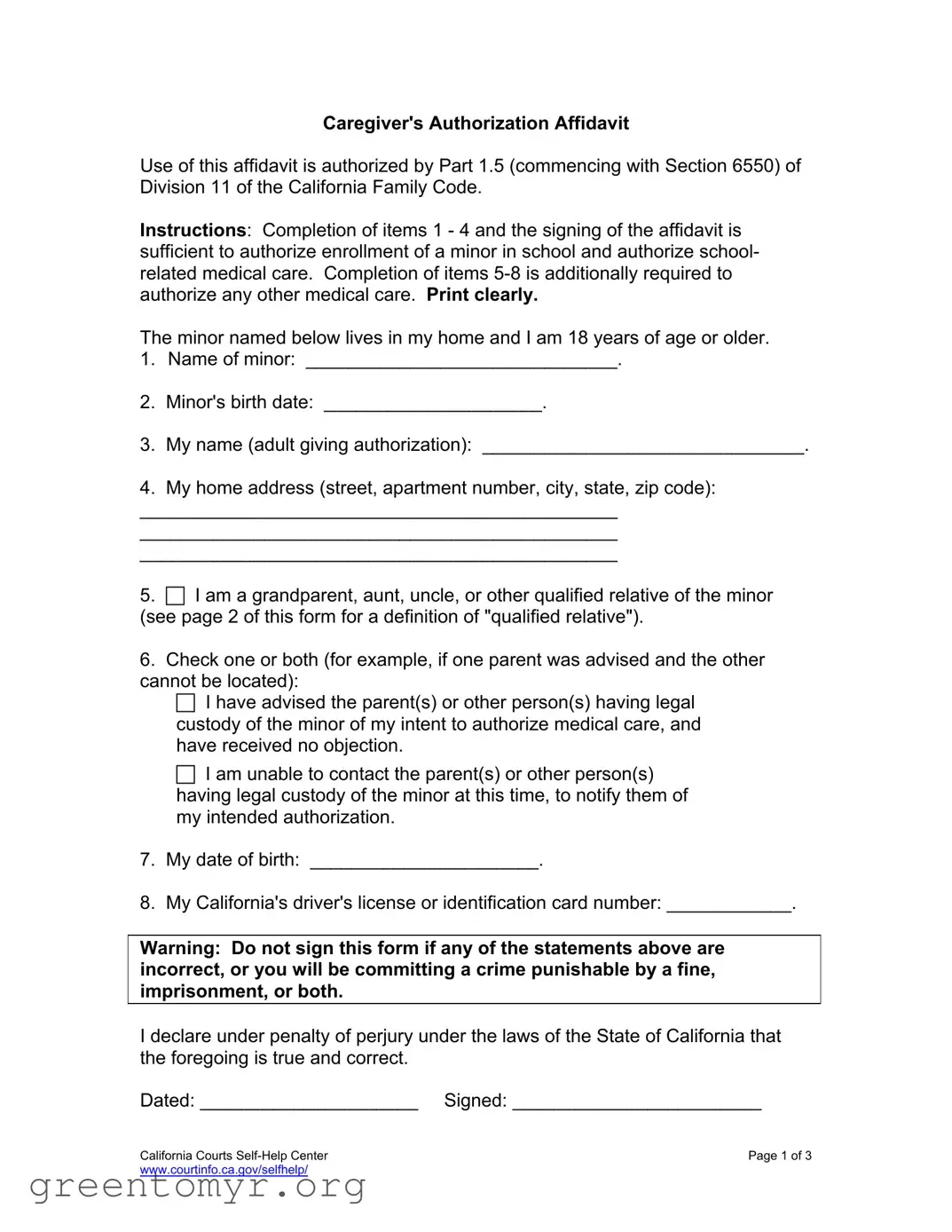
The Caregivers Authorization Affidavit form serves as a vital tool for caregivers in California, allowing them to enroll minors in school and authorize necessary medical care. This form is particularly useful for individuals who are not the legal guardians of the minor but are closely related, such as grandparents, aunts, or uncles. To complete the affidavit, caregivers must provide specific information, including the minor's name and birth date, as well as their own details, such as age and address. The form requires caregivers to confirm that they have informed the minor's parents or legal guardians of their intent to authorize medical care, or to state that they are unable to contact them. Notably, this affidavit does not grant legal custody to the caregiver and remains valid for only one year. It is essential for caregivers to understand their responsibilities and limitations under this affidavit, as well as the implications for schools and healthcare providers relying on its contents.

Caregiver's Authorization Affidavit
Use of this affidavit is authorized by Part 1.5 (commencing with Section 6550) of Division 11 of the California Family Code.
Instructions: Completion of items 1 - 4 and the signing of the affidavit is sufficient to authorize enrollment of a minor in school and authorize school- related medical care. Completion of items
The minor named below lives in my home and I am 18 years of age or older.
1.Name of minor: ______________________________.
2.Minor's birth date: _____________________.
3.My name (adult giving authorization): _______________________________.
4.My home address (street, apartment number, city, state, zip code):
______________________________________________
______________________________________________
______________________________________________
5.I am a grandparent, aunt, uncle, or other qualified relative of the minor (see page 2 of this form for a definition of "qualified relative").
6.Check one or both (for example, if one parent was advised and the other cannot be located):
I have advised the parent(s) or other person(s) having legal custody of the minor of my intent to authorize medical care, and have received no objection.
I am unable to contact the parent(s) or other person(s) having legal custody of the minor at this time, to notify them of my intended authorization.
7.My date of birth: ______________________.
8.My California's driver's license or identification card number: ____________.
Warning: Do not sign this form if any of the statements above are incorrect, or you will be committing a crime punishable by a fine, imprisonment, or both.
I declare under penalty of perjury under the laws of the State of California that the foregoing is true and correct.
Dated: _____________________ Signed: ________________________
California Courts |
Page 1 of 3 |
www.courtinfo.ca.gov/selfhelp/ |
|
Notices:
1.This declaration does not affect the rights of the minor's parents or legal guardian regarding the care, custody, and control of the minor, and does not mean that the caregiver has legal custody of the minor.
2.A person who relies on this affidavit has no obligation to make any further inquiry or investigation.
3.This affidavit is not valid for more than one year after the date on which it is executed.
Additional Information:
TO CAREGIVERS:
1."Qualified relative," for purposes of item 5, means a spouse, parent, stepparent, brother, sister, stepbrother, stepsister,
2.The law may require you, if you are not a relative or a currently licensed foster parent, to obtain a foster home license in order to care for a minor. If you have any questions, please contact your local department of social services.
3.If the minor stops living with you, you are required to notify any school, health care provider, or health care service plan to which you have given this affidavit.
4.If you do not have the information requested in item 8 (California driver's license or I.D.), provide another form of identification such as your social security number or
TO SCHOOL OFFICIALS:
1.Section 48204 of the Education Code provides that this affidavit constitutes a sufficient basis for a determination of residency of the minor, without the requirement of a guardianship or other custody order, unless the school district determines from actual facts that the minor is not living with the caregiver.
2.The school district may require additional reasonable evidence that the caregiver lives at the address provided in item 4.
California Courts |
Page 2 of 3 |
www.courtinfo.ca.gov/selfhelp/ |
|
TO HEALTH CARE PROVIDERS AND HEALTH CARE SERVICE PLANS:
1.No person who acts in good faith reliance upon a caregiver's authorization affidavit to provide medical or dental care, without actual knowledge of facts contrary to those stated on the affidavit, is subject to criminal liability or to civil liability to any person, or is subject to professional disciplinary action, for such reliance if the applicable portions of the form are completed.
2.This affidavit does not confer dependency for health care coverage purposes.
California Courts |
Page 3 of 3 |
www.courtinfo.ca.gov/selfhelp/ |
|
| Fact Name | Details |
|---|---|
| Governing Law | The Caregiver's Authorization Affidavit is authorized by Part 1.5 (commencing with Section 6550) of Division 11 of the California Family Code. |
| Purpose | This affidavit allows caregivers to enroll a minor in school and authorize school-related medical care. |
| Medical Care Authorization | Items 1-4 must be completed to authorize school enrollment, while items 5-8 are needed for other medical care authorizations. |
| Validity Period | The affidavit is valid for no more than one year from the date it is executed. |
| Notification Requirement | Caregivers must notify schools and healthcare providers if the minor no longer resides with them. |
| Qualified Relative Definition | A "qualified relative" includes various family members such as grandparents, aunts, uncles, and siblings. |
| Legal Implications | Signing the affidavit with incorrect information may lead to criminal penalties, including fines or imprisonment. |
Filling out the Caregivers Authorization Affidavit form is a straightforward process. After completing the form, it will allow you to authorize the enrollment of a minor in school and provide consent for school-related medical care. If you wish to authorize additional medical care, further information is needed. Follow these steps to complete the form accurately.
The Caregivers Authorization Affidavit form allows a caregiver to authorize the enrollment of a minor in school and to approve school-related medical care. It is designed for situations where a minor lives with someone other than their parents or legal guardians. By completing this form, caregivers can ensure that the minor receives necessary care and education without needing to go through a lengthy legal process.
To complete the form, the caregiver must be at least 18 years old and must be a "qualified relative" of the minor. Qualified relatives include grandparents, aunts, uncles, and other family members as defined by California law. If the caregiver is not a relative or a licensed foster parent, they may need to obtain a foster home license to care for the minor legally.
If the minor no longer resides with the caregiver, the caregiver is responsible for notifying any schools, healthcare providers, or health care service plans to which they have submitted the affidavit. This ensures that all parties involved are aware of the change in living arrangements and can update their records accordingly.
The affidavit is valid for one year from the date it is signed. After one year, the caregiver must complete a new affidavit if they wish to continue authorizing medical care or school enrollment for the minor. This time limit helps ensure that the information remains current and accurate.
Filling out the Caregiver's Authorization Affidavit form correctly is essential for ensuring that a minor can receive necessary medical care and enroll in school. However, many people make mistakes that can lead to delays or complications. One common error is failing to complete all required fields. Items 1 through 4 must be filled out to authorize enrollment in school and medical care. Omitting even one detail can invalidate the affidavit.
Another frequent mistake is not providing clear and legible information. The instructions specify that the form should be printed clearly. Illegible handwriting can lead to misunderstandings about the minor's identity or the caregiver's information, which can create issues when the affidavit is presented to schools or healthcare providers.
Many caregivers also overlook the importance of notifying the minor's parents or legal guardians. Item 6 requires caregivers to check one or both boxes indicating whether they have advised the parents or if they are unable to contact them. Failing to do so can raise questions about the caregiver's authority and intentions.
In addition, caregivers often forget to include their date of birth in item 7. This information is crucial for verifying the caregiver's identity and age, which must be 18 years or older. Without this detail, the affidavit may be considered incomplete.
Another mistake involves the identification number in item 8. Caregivers must provide their California driver's license or identification card number. If they do not have one, they should include an alternative form of identification, such as a social security number. Neglecting this requirement can lead to complications when the affidavit is used.
Some individuals mistakenly assume that the affidavit grants them legal custody of the minor. It is important to understand that this document does not alter the rights of the minor's parents or legal guardians. Misinterpretation of this aspect can lead to legal issues down the line.
Additionally, caregivers may forget that the affidavit is only valid for one year from the date it is signed. If the minor continues to live with the caregiver beyond this period, a new affidavit must be completed. This oversight can hinder access to necessary services for the minor.
Caregivers should also be cautious about the definition of a "qualified relative." Misidentifying their relationship to the minor can invalidate the affidavit. Understanding who qualifies under this definition is crucial for compliance with the law.
Finally, caregivers often neglect to inform schools, healthcare providers, or health care service plans if the minor stops living with them. This notification is essential to ensure that the minor's records are up to date and that the appropriate care is provided.
The Caregivers Authorization Affidavit is an important document that allows a caregiver to make decisions regarding a minor's education and medical care. However, it often works in conjunction with several other forms and documents to ensure that the caregiver's authority is recognized and that the minor's needs are met. Below are some commonly used documents that may accompany the Caregivers Authorization Affidavit.
By understanding these accompanying documents, caregivers can better navigate the responsibilities and rights associated with their role. Each form plays a crucial part in ensuring that the minor's best interests are prioritized and that the caregiver's authority is clearly established.
The Caregivers Authorization Affidavit form serves a specific purpose in allowing caregivers to authorize medical care and school enrollment for minors. Several other documents share similarities with this affidavit, particularly in their function of granting authority or permissions regarding minors. Here are six such documents:
When filling out the Caregiver's Authorization Affidavit form, it's important to follow certain guidelines to ensure everything goes smoothly. Here’s a list of things you should and shouldn’t do:
Understanding the Caregiver's Authorization Affidavit is crucial for those who may need to act on behalf of a minor. Here are ten common misconceptions about this form, along with clarifications to help you navigate the process effectively.
Understanding these misconceptions can help caregivers make informed decisions and ensure that they are acting within the legal framework established by California law. Always consider seeking guidance if there are uncertainties regarding the use of the Caregiver's Authorization Affidavit.
When filling out and using the Caregivers Authorization Affidavit form, consider the following key takeaways:
Always ensure the information provided is accurate to avoid potential legal consequences.