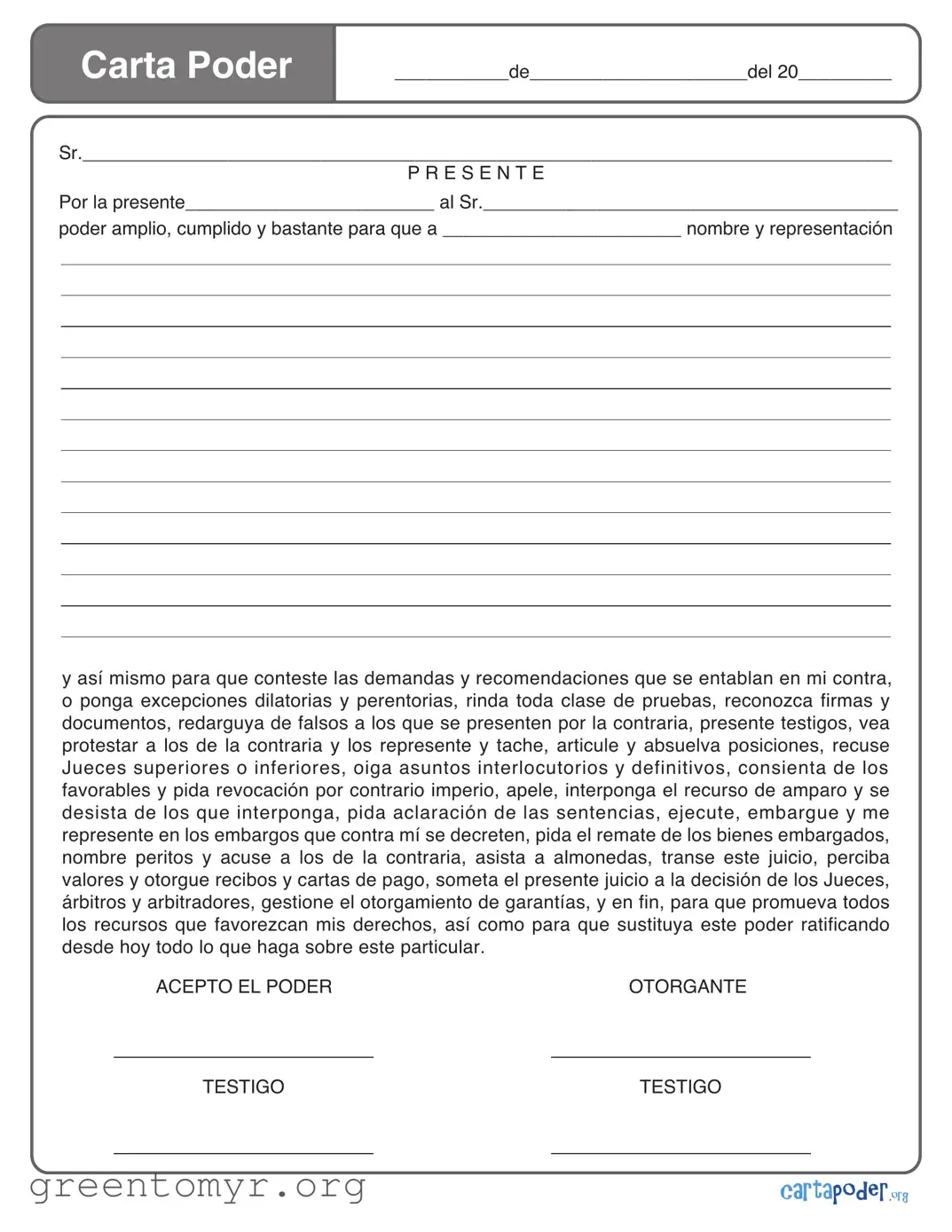
The Carta Poder form serves as a crucial legal document in various personal and business contexts. It allows one individual, the grantor, to authorize another, the attorney-in-fact, to act on their behalf in a wide array of legal matters. This form is particularly significant in situations where the grantor is unable to attend court proceedings or engage in legal transactions personally. The powers conferred through the Carta Poder can encompass a broad spectrum of actions, including the ability to respond to legal demands, present evidence, and represent the grantor in various legal settings. Furthermore, it enables the attorney-in-fact to manage financial matters, such as executing judgments, handling property sales, and engaging in negotiations. The document also allows for the appointment of witnesses and the ability to contest opposing claims. Importantly, the Carta Poder is not limited to a single transaction; it grants extensive authority that can be exercised in multiple legal scenarios, making it a versatile tool for individuals seeking representation. This form is typically signed in the presence of witnesses, ensuring its legitimacy and compliance with legal standards.
Carta Poder
___________de_____________________del 20_________
Sr.______________________________________________________________________________
P R E S E N T E
Por la presente________________________ al Sr.________________________________________
poder amplio, cumplido y bastante para que a _______________________ nombre y representación
y así mismo para que conteste las demandas y recomendaciones que se entablan en mi contra, o ponga excepciones dilatorias y perentorias, rinda toda clase de pruebas, reconozca firmas y documentos, redarguya de falsos a los que se presenten por la contraria, presente testigos, vea protestar a los de la contraria y los represente y tache, articule y absuelva posiciones, recuse Jueces superiores o inferiores, oiga asuntos interlocutorios y definitivos, consienta de los favorables y pida revocación por contrario imperio, apele, interponga el recurso de amparo y se desista de los que interponga, pida aclaración de las sentencias, ejecute, embargue y me represente en los embargos que contra mí se decreten, pida el remate de los bienes embargados, nombre peritos y acuse a los de la contraria, asista a almonedas, transe este juicio, perciba valores y otorgue recibos y cartas de pago, someta el presente juicio a la decisión de los Jueces, árbitros y arbitradores, gestione el otorgamiento de garantías, y en fin, para que promueva todos los recursos que favorezcan mis derechos, así como para que sustituya este poder ratificando desde hoy todo lo que haga sobre este particular.
ACEPTO EL PODER |
OTORGANTE |
TESTIGO |
|
TESTIGO |
|
|
|
| Fact Name | Description |
|---|---|
| Purpose | The Carta Poder form grants authority to an individual to act on behalf of another person in legal matters, including representation in court and managing legal documents. |
| Governing Law | In the United States, the Carta Poder form is governed by state-specific laws regarding powers of attorney, which may vary by state. |
| Requirements | Typically, the form must be signed by the person granting the power and may require notarization or witnesses, depending on state regulations. |
| Revocation | The authority granted by a Carta Poder can generally be revoked at any time by the person who issued it, provided they follow the proper legal procedures. |
After completing the Carta Poder form, you will be able to grant someone the authority to act on your behalf in various legal matters. Ensure that all information is accurate and clearly written to avoid any issues.
A Carta Poder is a legal document that grants someone the authority to act on behalf of another person. This form is often used in legal matters, allowing the designated person, known as the attorney-in-fact, to make decisions, represent the individual in court, and handle various transactions. It is crucial for ensuring that someone you trust can manage your affairs when you are unable to do so.
Any competent adult can be designated as an attorney-in-fact in a Carta Poder. This means that the person must be at least 18 years old and capable of understanding the responsibilities involved. You should choose someone you trust implicitly, as they will have significant authority over your legal matters.
A Carta Poder can grant a wide range of powers, including:
Essentially, the document allows the attorney-in-fact to act in your best interest in various situations.
Yes, it is generally advisable to have witnesses sign the Carta Poder. Depending on the jurisdiction, notarization may also be required to validate the document. This adds an extra layer of authenticity and helps prevent any disputes about the legitimacy of the powers granted.
Yes, you can revoke a Carta Poder at any time as long as you are mentally competent. To do this, you should provide written notice to the attorney-in-fact and any relevant parties. It’s also a good idea to formally document the revocation to avoid any confusion in the future.
While a Carta Poder is recognized in many states, the specific requirements and powers granted can vary. It is essential to check the laws in your state to ensure that the document meets all legal standards. Consulting with a legal professional can help clarify any state-specific nuances.
Filling out the Carta Poder form can seem straightforward, but several common mistakes can lead to complications. One frequent error is not providing complete names. It’s essential to include the full legal names of all parties involved, including the person granting the power and the representative. Omitting any part of a name can create confusion or even invalidate the document.
Another mistake involves the lack of specific details regarding the powers being granted. The form should clearly outline the extent of authority given to the representative. If the powers are vague or overly broad, it may lead to misunderstandings or disputes later on. Clearly stating the specific actions the representative is authorized to undertake is crucial.
People often forget to include the date on the form. The date serves as a critical reference point for when the power of attorney takes effect. Without it, the validity of the document may be questioned. Always ensure that the date is filled out correctly to avoid any legal ambiguities.
In addition, failing to sign the document properly is a common pitfall. Both the person granting the power and any witnesses must sign the form. Neglecting this step can render the document ineffective. It’s important to ensure that all required signatures are present before considering the form complete.
Lastly, individuals sometimes overlook the need for witnesses. Depending on the jurisdiction, the Carta Poder may require one or more witnesses to validate the document. Not adhering to this requirement can lead to challenges regarding the legitimacy of the power granted. Always check local laws to ensure compliance with witness requirements.
The Carta Poder form is a significant document used in legal matters, granting authority to another individual to act on one's behalf. In addition to this form, several other documents are often utilized to ensure that legal processes run smoothly. Below is a list of these commonly used forms and documents, each accompanied by a brief description.
Understanding these documents can help individuals navigate legal situations more effectively. Each form serves a distinct purpose and can be critical in ensuring that rights and preferences are respected during legal proceedings.
The Carta Poder form grants authority to an individual to act on behalf of another in legal matters. Several other documents serve similar purposes in delegating authority or representation. Below are four documents that share similarities with the Carta Poder form:
When filling out the Carta Poder form, it is essential to ensure accuracy and clarity. Here are ten important dos and don’ts to consider:
The Carta Poder form is a legal document used to grant someone the authority to act on your behalf in various matters. However, there are several misconceptions surrounding its use and implications. Here’s a breakdown of ten common misunderstandings:
Understanding these misconceptions can help individuals make informed decisions when considering the use of a Carta Poder. Always consult with a knowledgeable professional to ensure that your specific needs are met.
When filling out and using the Carta Poder form, there are several important aspects to consider. Here are key takeaways to keep in mind: