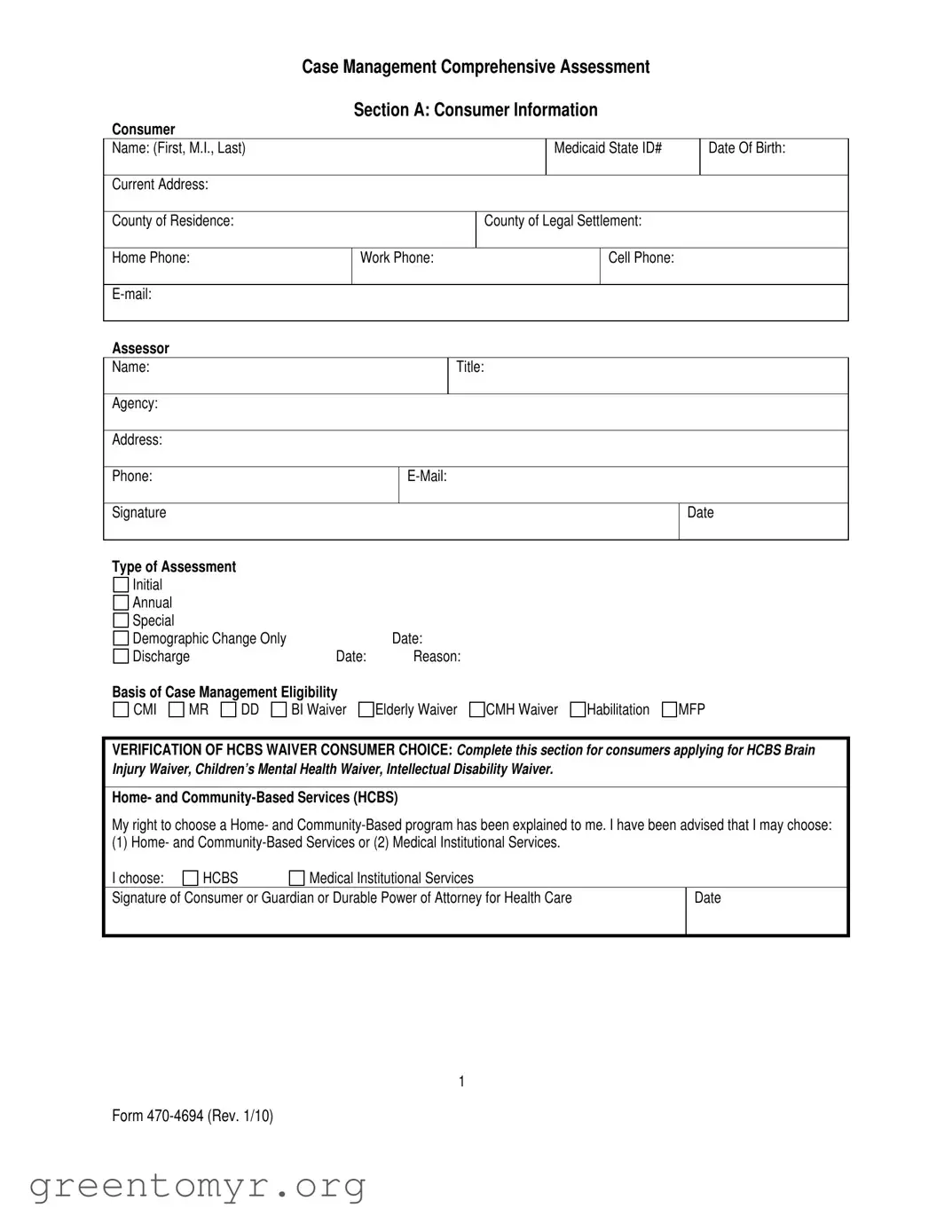
The Case Management Assessment form serves as a vital tool for gathering essential information about individuals seeking support through various Home- and Community-Based Services (HCBS) programs. This comprehensive document is designed to capture a wide range of consumer details, starting with basic identification information such as name, address, and contact numbers. It also includes demographic data, income sources, and any relevant court involvement, which helps in assessing the individual’s needs and eligibility for services. Importantly, the form addresses consumer choice, allowing individuals to indicate their preference between HCBS and medical institutional services. Additionally, it requires input from interdisciplinary team members and includes sections for medical and mental health diagnoses, ensuring a holistic view of the consumer’s situation. Emergency contacts and legal decision-makers are also documented, providing a complete picture of the support network available to the consumer. By collecting this information, the form not only aids in the eligibility determination process but also lays the groundwork for tailored case management services that align with the individual’s unique circumstances.
Case Management Comprehensive Assessment
Section A: Consumer Information
Consumer
Name: (First, M.I., Last)
Current Address:
Medicaid State ID#
Date Of Birth:
County of Residence:
Home Phone:
|
County of Legal Settlement: |
|
|
|
|
Work Phone: |
|
Cell Phone: |
|
|
|
Assessor
Name:
Agency:
Address:
Phone:
Signature
Title:
Date
Type of Assessment |
|
|
|
|
Initial |
|
|
|
|
Annual |
|
|
|
|
Special |
|
|
|
|
Demographic Change Only |
|
Date: |
||
Discharge |
|
Date: |
Reason: |
|
Basis of Case Management Eligibility |
|
|||
CMI |
MR |
DD |
BI Waiver |
Elderly Waiver |
CMH Waiver
Habilitation
MFP
VERIFICATION OF HCBS WAIVER CONSUMER CHOICE: Complete this section for consumers applying for HCBS Brain Injury Waiver, Children’s Mental Health Waiver, Intellectual Disability Waiver.
Home- and
My right to choose a Home- and
(1) Home- and
|
I choose: |
HCBS |
Medical Institutional Services |
|
|
Signature of Consumer or Guardian or Durable Power of Attorney for Health Care |
Date |
||
|
|
|
|
|
1
Form

Case Management Comprehensive Assessment
Consumer Name:
Interdisciplinary team members consulted (including consumer):
Name
Title (if applicable)
Relationship to Consumer
Additional records reviewed:
Consumer Demographics
Gender: |
Female |
Male |
Language:
Speaks English
Understands English
Needs interpreter services
Comments:
Yes
No
Monthly Income: (Please check all that apply) |
|
Source |
Amount |
SSI |
$ |
SSDI |
$ |
Employment |
$ |
Other (specify): |
$ |
Comments: |
|
Court Involvement: |
|
Involuntary Commitment |
|
Probation or Parole |
|
Child in Need of Assistance (CINA) |
|
Child Protection |
|
Delinquency |
|
Foster Care |
|
Other (Identify) |
|
None |
|
Comments: |
|
2
Form

Case Management Comprehensive Assessment
Consumer Name:
Legal decision maker: (Please check all that apply)
None Guardian
Other (Specify):
Address:
Home Phone:
Work Phone:
Cell Phone:
Guardian
Other (Specify):
Address:
Home Phone:
Work Phone:
Cell Phone:
Financial Decision Maker: (e.g. Conservator or |
No |
Name: (First, M.I., Last) |
|
Yes
(complete below)
Address: |
|
|
|
|
|
|
|
|
|
Home Phone: |
|
|
Work Phone: |
Cell Phone: |
|
|
|
|
|
|
|
|
|
|
|
|
|
|
|
Payee: |
No |
Yes (complete below) |
|
|
Name: (First, M.I., Last) |
|
|
|
|
|
|
|
|
|
Address: |
|
|
|
|
|
|
|
|
|
Home Phone: |
|
|
Work Phone: |
Cell Phone: |
|
|
|
|
|
|
|
|
|
|
|
|
|
|
|
Emergency Contacts: |
|
|
|
|
Primary Contact |
|
|
|
|
Name: (First, M.I., Last) |
|
|
Relationship: |
|
|
|
|
|
|
Address: |
|
|
|
|
|
|
|
|
|
Home Phone: |
|
|
Work Phone: |
Cell Phone: |
|
|
|
|
|
|
|
|
|
|
|
|
|
|
|
3
Form
Case Management Comprehensive Assessment
Consumer Name:
Secondary Contact (if applicable):
Name: (First, M.I., Last) |
|
Relationship: |
|
|
|
Address: |
|
|
|
|
|
Home Phone: |
Work Phone: |
Cell Phone: |
|
|
|
|
|
|
|
|
|
|
|
|
Complete This Section For Adults (Age 18 and Over)
Veteran:
Yes
No
Marital Status: |
|
Never Married |
|
Married |
Spouse’s Name: |
Divorced |
|
Legally Separated
Widowed
Unknown or Other – Specify
Comments:
Complete This Section For Children (Age 17 and Under)
With whom does the child live?
(If the child currently lives in a institutional setting, please make note in the comments section below.)
What are the child’s parent’s names?
Parents marital status: |
Married |
Divorced |
Never married |
If the parent’s are not living together, what is the
Street:
City, State, Zip:
Parent’s contact information (if different from the child’s):
Home Phone:
Work Phone:
Cell Phone:
Are there siblings in the home? |
Yes |
No |
|
Are any siblings receiving waiver services? |
Yes |
No |
|
Are there any individuals who are not supposed to have contact with the child? If yes, specify:
Other Comments:
Yes
No
4
Form
Case Management Comprehensive Assessment
Consumer Name:
Medical Information
Diagnoses:
Medical:
Diagnosis
Name and credential of professional making diagnosis:
Date of diagnosis:
Comments:
Mental Health
Axis 1:
Axis 2:
Axis 3:
Axis 4:
Axis 5:
Name and credential of professional making diagnosis: |
Date of diagnosis: |
|
|
Comments: |
|
Complete this section for consumers applying for or receiving HCBS Intellectual Disability Waiver.
List the most current IQ score, or if the IQ isn’t listed, give the consumer’s level of functioning within the range of mental retardation (mild, moderate, severe, profound):
IQ: |
Range: |
Date of Evaluation: |
Complete this section for consumers applying for or receiving HCBS Brain Injury Waiver.
Diagnosis: |
Date Injury Occurred: |
Health Care Provider Information:
Who is your regular doctor? |
None |
|
Name |
|
Address |
|
|
|
Phone
Date of last visit (if known):
Reason:
Who is your regular dentist?
Name
None
Address
Phone
Date of last visit (if known):
Reason:
Are you seeing any other doctors, such as a psychiatrist, or specialists of any kind?
Yes (list below) |
No |
Don’t know |
Name
Specialty
Address
Phone
5
Form

Case Management Comprehensive Assessment
Section B: Medical and Physical Health
Health Conditions
B1. Overall, how would you rate your physical health? |
|
|
|
||
Excellent |
Good |
|
Fair |
Poor |
No Response |
Comments: |
|
|
|
|
|
B2. Do you have any health problems that require assistance to manage?
Cardiac
Skin Related
G.I. Disorders
Urinary Tract
Weight problems
Evidence of communicable disease
Other – Specify
None
How do they affect you and how long have you had them?
Comments:
B3. Any respiratory problems that require assistance to manage?
Ventilator
Oxygen
Suctioning
Tracheotomy
Cardiorespiratory monitor
Chest physiotherapy
Nebulizer treatment
Other – Specify
None
How do they affect you and how long have you had them?
Comments:
B4. Do you regularly receive any of the following medical treatments?
Days per week |
Hours per day |
Nursing |
no |
yes |
Physical Therapy |
no |
yes |
Occupational Therapy |
no |
yes |
Speech Therapy |
no |
yes |
Supervision for Safety |
no |
yes |
Diabetes Education |
no |
yes |
Dialysis |
no |
yes |
Respiratory Treatment |
no |
yes |
Catheter Care |
no |
yes |
Colostomy Care |
no |
yes |
Nasogastric Tube Care |
no |
yes |
Other |
no |
yes |
6
Form

Case Management Comprehensive Assessment
Consumer Name:
B5. Hearing
No hearing impairment.
Hearing impairment, but managed through assistive devices
Hearing difficulty at level of conversation.
Hears only very loud sounds.
No useful hearing.
Not determined.
Comments:
B6. Vision
Has no impairment of vision.
Vision impairment, but managed through assistive devices
Has difficulty seeing at level of print
Has difficulty seeing obstacles in environment
Has no useful vision.
Not determined.
Comments:
B7. Speech/Communication
Communicates independently or impairment has been compensated to function independently.
Communicates with difficulty but can be understood.
Communicates with sign language, symbol board, written messages, gestures or an interpreter.
Communicates inappropriate content, makes garbled sounds, or displays echolalia.
Does not communicate.
Comments:
B8. Sensory Perception (e.g. – taste, smell, tactile, spatial)
No impairment
Impaired – Specify
Comments:
B9. Cognitive Status
Alert and fully oriented
Alert and oriented with significant alteration on
Generally oriented through use of assistive techniques
Cognitive deficits (e.g. orientation, attention/concentration, perception, memory, reasoning)
Exhibits mental status changes consistent with psychiatric disorder
Comatose, but responsive
Comatose, but unresponsive
Other – Specify
Comments:
B10. Musculoskelatal/Fine or Gross Motor Skills
No Impairment of Musculoskelatal/Fine or Gross Motor Skills |
|
|||
Impaired muscle tone |
|
|
|
|
Contractures |
|
|
|
|
Scoliosis |
|
|
|
|
Paralysis: |
Hemiplegia |
Paraplegia |
Quadriplegia |
Other (Specify) |
Comments:
7
Form

Case Management Comprehensive Assessment
Consumer Name:
Complete This Section For Adults (Age 18 and Over)
|
B11. Do you have someone who could stay with you for a while if you were sick or needed help? |
|
|
|
|
||
|
|
Yes (Complete below) |
No |
|
|
|
|
|
|
Name: |
Relationship: |
|
|
|
|
|
|
Address: |
|
|
|
|
|
|
|
City, State, Zip code: |
|
|
|
|
|
|
|
Phone: |
|
|
|
|
|
|
B12. Is there anybody you would not want to be involved with your care if you were sick or needed help? |
|
|
|
|
||
|
|
Yes (Complete below) |
No |
|
|
|
|
|
|
Name: |
Relationship: |
|
|
|
|
|
|
|
|
|
|
|
|
|
|
|
|
|
|
|
|
|
|
|
HEALTH CONDITIONS RISK FACTORS |
|
|
YES |
NO |
|
|
|
|
|
|
|
|
|
R1. |
Has the consumer had a seizure in the past year? |
|
|
|
|
|
|
R2. |
Does the consumer have a diagnosis of any other serious medical conditions or other serious health |
|
|
|
|
|
|
|
concerns (i.e., diabetes, cerebral palsy, heart condition, etc.)? |
|
|
|
|
|
|
|
If yes, list all conditions/concerns: |
|
|
|
|
|
|
R3. |
Does the consumer have any life threatening allergies (such as peanuts, bee stings, or shellfish)? |
|
|
|
|
|
|
R4. Is the consumer in need of a primary health care provider (or the provider’s contact information is |
|
|
|
|
||
|
|
|
|
|
|||
|
|
unknown)? |
|
|
|
|
|
|
|
|
|
|
|
|
|
|
R5. |
Is the consumer in need of a dentist (or dentist’s contact information is unknown)? |
|
|
|
|
|
|
R6. Is the consumer in need of a specialist (or the specialist’s contact information is unknown)? |
|
|
|
|
||
|
R7. |
Has the consumer had difficulty making, keeping, or following through with appointments in the last year? |
|
|
|
|
|
|
|
|
|
|
|
|
|
|
R8. |
In the past year, has the consumer gone to a hospital emergency room? |
|
|
|
|
|
|
|
|
|
|
|||
|
|
If yes, how many times? |
Why? |
|
|
|
|
|
|
|
|
|
|
||
|
|
|
|
|
|
|
|
|
R9. |
In the past year, has the consumer stayed overnight or longer in a hospital? |
|
|
|
|
|
|
|
If yes, how many times? |
Why? |
|
|
|
|
|
R10. Is the consumer in need of someone to help if he or she was sick or injured? |
|
|
|
|
||
Comment on any risk factors marked as “Yes” and address the issue in the Crisis Intervention Plan. |
|
|
No. of risks: |
||||
Comments: |
|
|
|
|
|
||
8
Form

Case Management Comprehensive Assessment
Consumer Name: |
|
|
|
|
|
Medication Use |
|
|
|
|
|
B13. Are you currently taking any prescription medication? |
Yes (complete below) |
No |
|||
Medication Name |
Dosage |
|
Frequency |
|
Purpose |
|
|
|
|
|
|
|
|
|
|
|
|
|
|
|
|
|
|
|
|
|
|
|
|
|
|
|
|
|
|
|
|
|
|
|
|
|
|
|
|
|
|
|
|
|
|
|
|
|
|
|
|
|
|
|
|
|
|
|
|
|
|
|
|
|
|
|
|
|
|
|
|
|
|
|
|
|
|
|
|
|
|
|
|
|
|
|
|
|
|
|
|
|
|
|
|
Comments:
B14. Are you currently taking any
Yes (complete below) No
Medication Name
Dosage
Frequency
Purpose
Comments:
9
Form

Case Management Comprehensive Assessment
Consumer Name:
Complete this section only if the consumer is taking medications.
B15. Are any of your medications kept in a special place, like a locked container or the refrigerator?
Yes No Comments:
B16. |
What pharmacy do you use? |
|
|
B17. |
How do you remember to take your medications? (Check all that apply.) |
|
|
|
By following directions |
Calendar |
|
|
Caregiver gives them |
Bubble wrap/Blister Pack |
|
|
Medpass Machine |
Egg Carton, envelopes |
Other: |
Comments:
B18. How well do you
With no help or supervision
With some help or occasional supervision
With a lot of help or constant supervision
Unable to administer own medications/caregiver gives them
Comments:
RN
|
|
MEDICATION ERROR RISK FACTORS |
|
|
|
YES |
|
NO |
|
||||
|
|
|
|
|
|
|
|||||||
|
3 = Frequently 2 = Sometimes 1 = Rarely 0 = Never |
|
|
3 |
|
|
2 |
1 |
|
|
0 |
|
|
|
|
|
|
|
|
|
|
|
|
|
|
||
|
R11. |
Has the consumer had problems with not taking or not receiving medications on time? |
|
|
|
|
|
|
|
|
|
|
|
|
|
|
|
|
|
|
|
|
|
|
|
|
|
|
R12. |
Has the consumer had problems with taking or being given the incorrect number of |
|
|
|
|
|
|
|
|
|
|
|
|
|
|
|
|
|
|
|
|
|
|
|
||
|
|
medications? |
|
|
|
|
|
|
|
|
|
|
|
|
|
|
|
|
|
|
|
|
|
|
|
|
|
|
|
|
|
|
|
|
|
|
|
|
|
|
|
|
|
|
|
|
|
|
|
|
|
|
|
|
|
|
R13. Has the consumer had problems with medications not being refilled on time? |
|
|
|
|
|
|
|
|
|
|
|
|
|
|
|
|
|
|
|
|
|
|
|
|
|
|
|
R14. Have there been issues with medications not being |
|
|
|
|
|
|
|
|
|
|
|
|
|
|
|
|
|
|
|
|
|
|
|
|
|
|
|
R15. |
Has the consumer had significant side effects from medications? |
|
|
|
|
|
|
|
|
|
|
|
|
|
|
|
|
|
|
|
|
|
|
|
|
|
|
R16. |
Has the consumer had significant medication changes in the past year? |
|
|
|
|
|
|
|
|
|
|
|
|
|
|
|
|
|
|
|
|
|
|
|
|
|
|
R17. |
Has the consumer refused or spit out medications? |
|
|
|
|
|
|
|
|
|
|
|
|
|
|
|
|
|
|
|
|
|
|
|
|
|
|
R18. |
Have there been problems with drug interactions? |
|
|
|
|
|
|
|
|
|
|
|
|
|
|
|
|
|
|
|
|
|
|
|
||
|
|
|
|
|
|
|
|
|
|
|
|
|
|
|
R19. Has the consumer experienced health problems because of missing/refusing |
|
|
|
|
|
|
|
|
|
|
|
|
|
|
medications? |
|
|
|
|
|
|
|
|
|
|
|
|
|
|
|
|
|
|
|
|
|
|
|
|
|
|
R20. |
Has the consumer misused prescription or |
|
|
|
|
|
|
|
|
|
|
|
|
|
|
|
|
|
|
|
|
|
|
|
||
|
|
many at once)? |
|
|
|
|
|
|
|
|
|
|
|
|
|
|
|
|
|
|
|
|
|
|
|
|
|
|
|
|
|
|
|
|
|
|
|
|
|
|
|
|
|
|
|
|
|
|
|
|
|
|
|
|
|
|
R21. |
Has the consumer taken another person’s prescription medications? |
|
|
|
|
|
|
|
|
|
|
|
|
|
|
|
|
|
|
|
|
|
|
|
|
|
|
R22. |
Has the consumer used |
|
|
|
|
|
|
|
|
|
|
|
|
R23. Has the consumer used multiple pharmacies or multiple physicians in the past year? |
|
|
|
|
|
|
|
|
|
|
|
|
|
|
|
|
|
|
|
|
|
|
||||
|
Comment on any risk factors marked as “Yes” and address the issue in the Crisis |
|
|
No. of risks: |
|
|
|
|
|
||||
|
Intervention Plan. |
|
|
|
|
|
|
|
|
|
|
|
|
|
Comments: |
|
|
|
|
|
|
|
|
|
|
|
|
10
Form
| Fact Name | Description |
|---|---|
| Consumer Information | The form collects essential consumer details, including name, address, and contact information to ensure accurate case management. |
| Assessment Types | It allows for various assessment types: Initial, Annual, Special, and Demographic Change Only, catering to different consumer needs. |
| HCBS Waiver Verification | The form includes a section for consumers applying for Home- and Community-Based Services (HCBS) waivers, ensuring informed choice. |
| Interdisciplinary Team Input | Consultation with interdisciplinary team members is documented, promoting a collaborative approach to case management. |
| Legal Decision Maker | Information on legal decision makers, such as guardians or attorneys-in-fact, is collected to clarify decision-making authority. |
| Emergency Contacts | Emergency contact information is gathered to ensure support is available in critical situations, enhancing consumer safety. |
| Medical Information | The form captures comprehensive medical and mental health information, aiding in appropriate service planning and delivery. |
Completing the Case Management Assessment form is an important step in the process of receiving the necessary support and services. After you fill out the form, it will be reviewed by the appropriate professionals to determine eligibility and develop a plan tailored to your needs.
The Case Management Assessment form is designed to gather comprehensive information about individuals seeking case management services. It helps assess their needs, eligibility for various programs, and preferences regarding care options. This information is crucial for developing personalized care plans that address each consumer's unique situation.
The form should be completed by the consumer or their legal representative, such as a guardian or power of attorney. It is important that the information provided is accurate and thorough to ensure appropriate services are offered. In some cases, an interdisciplinary team may assist in gathering the necessary details.
The form requires various types of information, including:
Providing complete and accurate information is essential for effective case management.
Home- and Community-Based Services (HCBS) are designed to support individuals in living independently within their communities rather than in institutional settings. These services can include personal care, respite care, and support for daily living activities. Consumers have the right to choose between HCBS and medical institutional services, which is outlined in the assessment form.
Eligibility for case management services is determined based on several factors, including the consumer's diagnosis, income, and specific needs. The assessment form includes sections that help identify these factors, allowing case managers to evaluate whether the consumer qualifies for various waivers and services.
If the consumer has a legal decision-maker, such as a guardian or attorney-in-fact, their contact information should be included on the form. This ensures that the decision-maker can be involved in the case management process and that they receive relevant information regarding the consumer's care and services.
Once the assessment form is submitted, a case manager will review the information provided. They may contact the consumer or their representatives for additional details if necessary. Following this review, the case manager will develop a personalized care plan that outlines the services and supports available to the consumer.
Yes, the assessment form can be updated as needed. Changes in the consumer's situation, such as a new diagnosis, changes in income, or updates to contact information, should be reported to the case manager. Keeping the information current ensures that the consumer receives the most appropriate services.
If you have questions about the Case Management Assessment form or the process, you should reach out to the agency or case manager listed on the form. They will be able to provide guidance and address any concerns you may have regarding the assessment and subsequent services.
Completing the Case Management Assessment form accurately is crucial for ensuring that consumers receive the appropriate services. However, several common mistakes can lead to delays or complications in the process. Awareness of these pitfalls can help streamline the assessment and improve outcomes for consumers.
One frequent error is incomplete consumer information. Failing to provide all required details, such as the consumer's full name, current address, or Medicaid State ID number, can hinder the assessment process. Each piece of information is essential for verification and eligibility determination. It’s vital to double-check that all fields are filled out correctly before submission.
Another common mistake involves neglecting to specify the type of assessment being conducted. The form requires the assessor to indicate whether it is an initial, annual, or special assessment. Omitting this detail can lead to confusion about the consumer’s needs and the services they may qualify for. Ensure that the correct type is clearly marked to avoid unnecessary delays.
Many individuals also overlook the verification of HCBS waiver consumer choice. This section is critical for consumers applying for specific waivers. Not signing or failing to indicate a choice between Home- and Community-Based Services or Medical Institutional Services can result in processing issues. It is imperative to read this section carefully and make an informed choice.
Inaccurate or missing information regarding financial details is another significant mistake. Consumers must provide accurate monthly income sources and amounts. Incomplete financial information can complicate eligibility for services. Review this section thoroughly to ensure all income sources are accounted for and correctly documented.
Additionally, the section regarding court involvement is often filled out incorrectly or left blank. This information can be vital for understanding the consumer's situation and needs. If there are any court-related issues, they should be clearly stated to provide a complete picture to the assessment team.
Another mistake involves not providing emergency contact information. This section is essential for ensuring that someone can be reached in case of an emergency. Failing to list primary and secondary contacts can lead to complications during critical situations. Ensure that all contact details are accurate and up to date.
Finally, neglecting to consult interdisciplinary team members can be detrimental. The assessment form requires input from various professionals involved in the consumer's care. Not documenting these consultations can lead to a lack of comprehensive understanding of the consumer’s needs. Make it a priority to gather insights from all relevant team members and include their names and titles in the assessment.
By being aware of these common mistakes, individuals can improve the accuracy and effectiveness of the Case Management Assessment form. Thoroughly reviewing each section and ensuring all necessary information is included will contribute to a smoother assessment process and better outcomes for consumers.
The Case Management Assessment form is a crucial document in the case management process. It collects essential information about the consumer, their needs, and their legal and medical background. Alongside this form, several other documents play important roles in ensuring comprehensive case management. Below is a list of these documents, each serving a specific purpose.
These documents collectively support the case management process, ensuring that the consumer receives appropriate care tailored to their needs. Proper completion and management of these forms are essential for effective service delivery and compliance with regulations.
Individualized Service Plan (ISP): Similar to the Case Management Assessment form, the ISP outlines specific services and supports tailored to the individual's needs. It includes information about the consumer's preferences and goals, ensuring a personalized approach to care.
Intake Form: This document gathers essential information about a new consumer, including demographic details and initial needs. Like the Case Management Assessment, it establishes a foundation for further evaluation and service planning.
Client History Report: This report provides a comprehensive overview of the consumer's past interactions with services. It shares similarities with the Case Management Assessment by documenting previous assessments and outcomes that inform current case management decisions.
Eligibility Determination Form: This form assesses whether a consumer qualifies for specific services or programs. It parallels the Case Management Assessment by evaluating the consumer's circumstances and needs to determine eligibility.
Risk Assessment Form: This document evaluates potential risks to the consumer's health and safety. Both forms aim to identify areas of concern and develop strategies to mitigate risks, ensuring the consumer's well-being.
Service Authorization Request: This request is used to obtain approval for specific services. It shares the goal of the Case Management Assessment by ensuring that the services align with the consumer's identified needs and preferences.
Care Plan: A care plan outlines the strategies and actions to be taken to meet the consumer's needs. Like the Case Management Assessment, it is a critical tool for guiding the delivery of services and monitoring progress.
Progress Notes: These notes document the ongoing status and changes in the consumer's situation. They complement the Case Management Assessment by providing updates that inform future assessments and service adjustments.
Discharge Summary: This document summarizes the consumer's progress and reasons for discharge from services. It parallels the Case Management Assessment by reviewing the consumer's journey and outcomes, which can inform future care planning.
Consumer Rights and Responsibilities Form: This form outlines the rights of the consumer and their responsibilities within the service system. It is similar to the Case Management Assessment in that it emphasizes informed choice and participation in care.
When filling out the Case Management Assessment form, it’s essential to approach the task with care. Here are some helpful do's and don'ts to keep in mind:
Following these guidelines will help ensure that the assessment process goes smoothly and that the information provided is both accurate and useful.
Misconceptions about the Case Management Assessment form can lead to confusion and misunderstanding among consumers and their families. Here are seven common misconceptions clarified:
Understanding these misconceptions can help consumers and their families navigate the assessment process more effectively, ensuring that they receive the support they need.
Filling out and using the Case Management Assessment form is a critical step in ensuring that consumers receive the appropriate services. Here are key takeaways to consider: