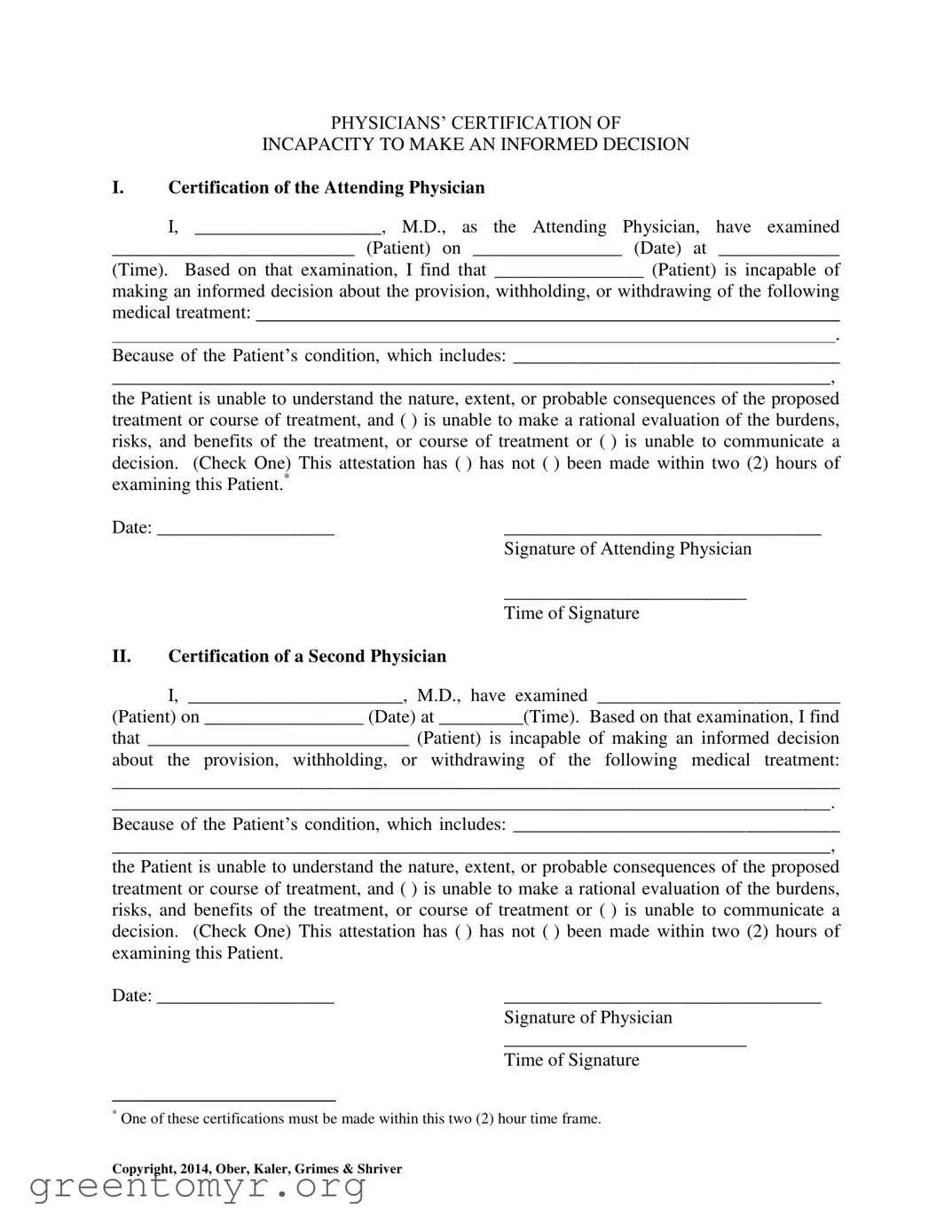
The Certification of Incapacity form plays a crucial role in medical decision-making, particularly for patients who are unable to make informed choices about their treatment. This form requires the signatures of at least two physicians who have examined the patient. Each physician must provide their assessment regarding the patient’s ability to understand their medical situation and the implications of proposed treatments. The form includes specific sections where physicians detail the patient's condition, indicating whether the patient can evaluate the risks and benefits of treatment or communicate their decisions. Timeliness is also essential; one of the certifications must be completed within two hours of the patient’s examination to ensure that the assessments reflect the patient's current state. This structured approach helps safeguard the rights and well-being of patients who may be incapacitated, ensuring that their medical care is handled with the utmost consideration and respect.

PHYSICIANS’ CERTIFICATION OF
INCAPACITY TO MAKE AN INFORMED DECISION
I.Certification of the Attending Physician
I, ____________________, M.D., as the Attending Physician, have examined
__________________________ (Patient) on ________________ (Date) at _____________
(Time). Based on that examination, I find that ________________ (Patient) is incapable of
making an informed decision about the provision, withholding, or withdrawing of the following medical treatment:
.
Because of the Patient’s condition, which includes: ___________________________________
_____________________________________________________________________________,
the Patient is unable to understand the nature, extent, or probable consequences of the proposed treatment or course of treatment, and ( ) is unable to make a rational evaluation of the burdens, risks, and benefits of the treatment, or course of treatment or ( ) is unable to communicate a decision. (Check One) This attestation has ( ) has not ( ) been made within two (2) hours of examining this Patient.*
Date: ___________________ |
__________________________________ |
|
Signature of Attending Physician |
|
__________________________ |
|
Time of Signature |
II.Certification of a Second Physician
I, _______________________, M.D., have examined __________________________
(Patient) on _________________ (Date) at _________(Time). Based on that examination, I find
that ____________________________ (Patient) is incapable of making an informed decision
about the provision, withholding, or withdrawing of the following medical treatment:
______________________________________________________________________________
_____________________________________________________________________________.
Because of the Patient’s condition, which includes: ___________________________________
_____________________________________________________________________________,
the Patient is unable to understand the nature, extent, or probable consequences of the proposed treatment or course of treatment, and ( ) is unable to make a rational evaluation of the burdens, risks, and benefits of the treatment, or course of treatment or ( ) is unable to communicate a decision. (Check One) This attestation has ( ) has not ( ) been made within two (2) hours of examining this Patient.
Date: ___________________ |
__________________________________ |
|
Signature of Physician |
|
__________________________ |
|
Time of Signature |
*One of these certifications must be made within this two (2) hour time frame.
Copyright, 2014, Ober, Kaler, Grimes & Shriver
| Fact Name | Description |
|---|---|
| Purpose | The Certification of Incapacity form is used to determine whether a patient can make informed medical decisions. |
| Physician Requirement | Two physicians must certify the patient's incapacity; one must be the attending physician. |
| Examination | The form requires that the patient be examined by the physicians before making the certification. |
| Time Frame | One of the certifications must occur within two hours of the patient's examination. |
| Patient's Condition | The form requires a detailed description of the patient's condition affecting decision-making ability. |
| Decision-Making Capacity | The form assesses the patient's ability to understand treatment options and their consequences. |
| Communication Ability | It evaluates whether the patient can communicate a decision regarding their treatment. |
| Legal Framework | The form is governed by state-specific laws, which vary by jurisdiction. |
| Signature Requirement | Both physicians must sign the form, indicating their certification of the patient's incapacity. |
| Confidentiality | All information on the form is subject to patient confidentiality laws, protecting the patient's privacy. |
Completing the Certification of Incapacity form is a straightforward process. It requires specific information about the patient and the physicians involved. Follow these steps to ensure the form is filled out correctly.
Once both sections are completed and signed, the form is ready for submission. Ensure all information is accurate to avoid any delays in processing.
The Certification of Incapacity form serves a critical role in healthcare decision-making. It allows physicians to formally document that a patient is unable to make informed decisions regarding their medical treatment. This form is particularly important in situations where patients may be incapacitated due to medical conditions such as severe mental illness, neurological disorders, or significant physical ailments. By completing this form, physicians provide a clear record that can guide healthcare providers and family members in making decisions that align with the patient’s best interests.
The form must be completed by licensed physicians who have examined the patient. Typically, two physicians are required to certify the patient’s incapacity. The first physician is the attending physician who conducts the initial examination. The second physician must also examine the patient and provide their assessment. This dual certification process ensures that there is a consensus regarding the patient's condition and incapacity, thus safeguarding the patient's rights and ensuring that decisions are made with appropriate medical oversight.
Several key pieces of information are necessary to complete the Certification of Incapacity form:
This information helps establish a clear understanding of the patient's situation and the basis for their incapacity, which is essential for making informed medical decisions.
The two-hour time frame is a critical aspect of the Certification of Incapacity form. One of the physicians must complete their certification within two hours of examining the patient. This requirement is in place to ensure that the assessment of the patient's capacity is timely and reflects their current medical condition. If the certification is not completed within this window, it may raise questions about the validity of the decision-making process. Therefore, both physicians must be diligent in their evaluations and prompt in completing the necessary documentation.
Filling out the Certification of Incapacity form requires attention to detail. One common mistake occurs when physicians fail to provide complete patient information. Omitting the patient's name, date, or time of examination can lead to significant delays in treatment and confusion regarding the patient's status.
Another frequent error is neglecting to specify the medical treatment in question. The form requires a clear description of the treatment being considered. Without this detail, the certification lacks clarity, which can hinder the decision-making process for caregivers and family members.
Physicians sometimes overlook the importance of clearly stating the patient's condition. The section that outlines the patient's condition must be thorough and specific. Vague descriptions can lead to misunderstandings about the patient's capacity to make informed decisions.
Additionally, failing to check the appropriate boxes regarding the patient's ability to evaluate risks or communicate decisions is a mistake that can have serious implications. This section is critical in determining the patient's capacity, and inaccuracies can lead to inappropriate treatment decisions.
Time constraints are also a factor. Physicians must ensure that the attestation is made within the specified two-hour window. Failing to adhere to this requirement can render the certification invalid, complicating the treatment process.
Furthermore, signatures must be clear and legible. Illegible signatures can create confusion about who certified the form. This issue can lead to complications in the legal and medical processes that follow.
Finally, many practitioners forget to date their signatures. The date is essential for establishing the timeline of the patient's incapacity. Without it, the certification may lack the necessary context for subsequent medical decisions.
The Certification of Incapacity form serves a crucial role in healthcare decision-making when a patient is unable to make informed choices about their treatment. Alongside this form, several other documents may be utilized to ensure that the patient's rights and needs are fully addressed. Below is a list of related forms that often accompany the Certification of Incapacity.
These documents work in conjunction with the Certification of Incapacity form to provide a robust approach to patient care, ensuring that individuals' rights and preferences are prioritized even when they cannot advocate for themselves.
When filling out the Certification of Incapacity form, it is essential to follow certain guidelines to ensure accuracy and compliance. Below are four key actions to take and avoid:
Understanding the Certification of Incapacity form is essential for patients and their families, but several misconceptions can lead to confusion. Here are five common misunderstandings:
By clarifying these misconceptions, individuals can better navigate the complexities of medical decision-making and ensure that their rights and wishes are respected.
When filling out and using the Certification of Incapacity form, consider the following key takeaways: