The CF-1R Alt HVAC form plays a crucial role in ensuring compliance with California's stringent building energy efficiency standards, specifically for residential HVAC alterations. Designed for use in Climate Zones 10 to 15, this form is essential for contractors and homeowners alike, outlining the necessary requirements for heating, ventilation, and air conditioning systems. It serves as a declaration of compliance with the 2008 Building Energy Efficiency Standards, mandating that all HVAC installations meet specific efficiency ratings, such as a minimum of 78% Annual Fuel Utilization Efficiency (AFUE) for heating equipment and a minimum of 13 Seasonal Energy Efficiency Ratio (SEER) for central air conditioning units. Moreover, the form stipulates that any significant changes, including new installations or extensive ductwork modifications, necessitate a permit from the local enforcement agency. It also emphasizes the importance of proper sealing and insulation for duct systems, alongside the need for Home Energy Rating System (HERS) verification, which confirms that the installation adheres to established energy efficiency standards. This verification process involves a series of tests to ensure that the HVAC system operates efficiently and effectively, safeguarding both the environment and the homeowner’s investment. By providing a clear framework for compliance, the CF-1R Alt HVAC form helps facilitate a smoother inspection process while promoting energy conservation in residential settings.

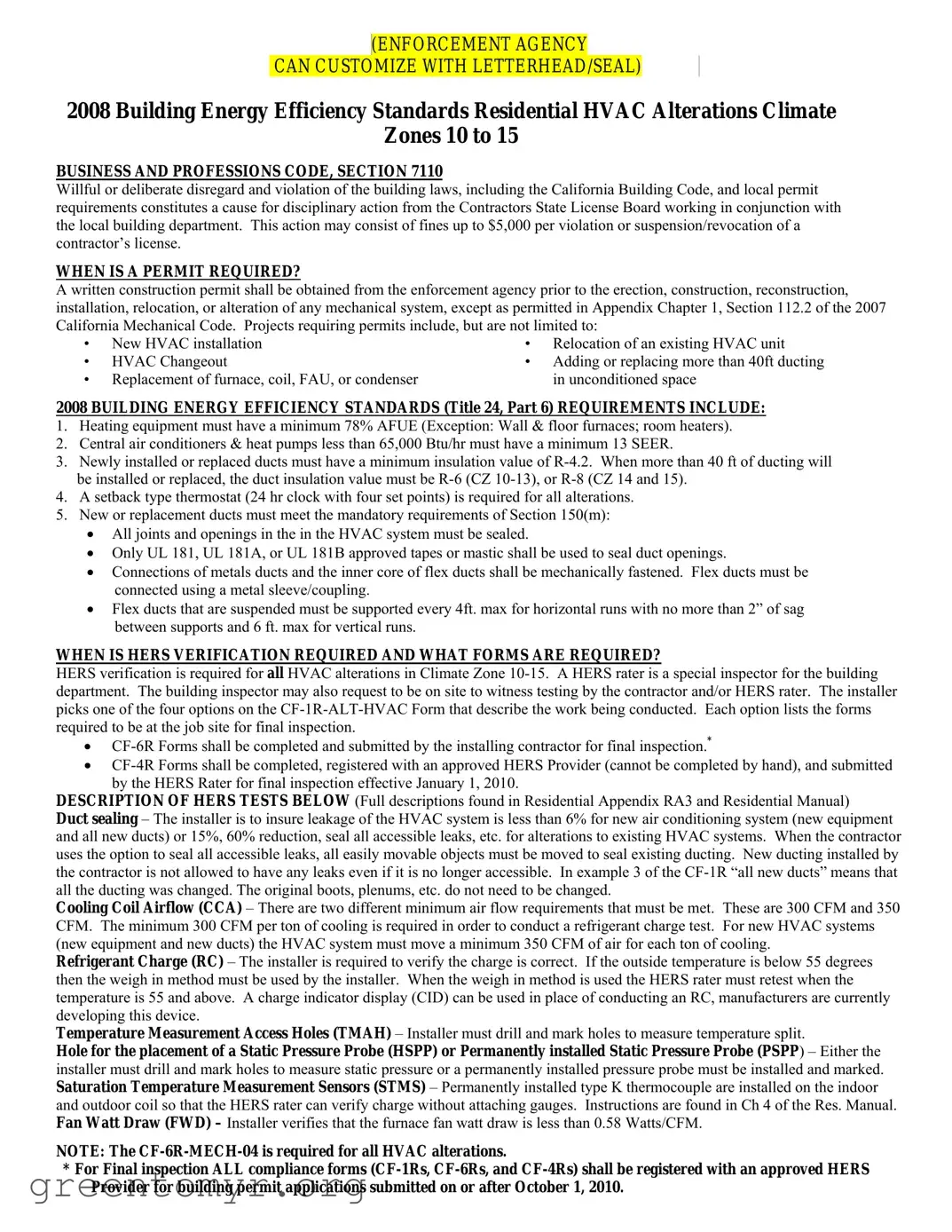
(ENFORCEMENT AGENCY CAN CUSTOMIZE WITH LETTERHEAD/SEAL)
2008 Building Energy Efficiency Standards Residential HVAC Alterations Climate
Zones 10 to 15
BUSINESS AND PROFESSIONS CODE, SECTION 7110
Willful or deliberate disregard and violation of the building laws, including the California Building Code, and local permit requirements constitutes a cause for disciplinary action from the Contractors State License Board working in conjunction with the local building department. This action may consist of fines up to $5,000 per violation or suspension/revocation of a contractor’s license.
WHEN IS A PERMIT REQUIRED?
A written construction permit shall be obtained from the enforcement agency prior to the erection, construction, reconstruction, installation, relocation, or alteration of any mechanical system, except as permitted in Appendix Chapter 1, Section 112.2 of the 2007 California Mechanical Code. Projects requiring permits include, but are not limited to:
• |
New HVAC installation |
• |
Relocation of an existing HVAC unit |
• |
HVAC Changeout |
• |
Adding or replacing more than 40ft ducting |
• Replacement of furnace, coil, FAU, or condenser |
|
in unconditioned space |
|
2008 BUILDING ENERGY EFFICIENCY STANDARDS (Title 24, Part 6) REQUIREMENTS INCLUDE:
1.Heating equipment must have a minimum 78% AFUE (Exception: Wall & floor furnaces; room heaters).
2.Central air conditioners & heat pumps less than 65,000 Btu/hr must have a minimum 13 SEER.
3.Newly installed or replaced ducts must have a minimum insulation value of
4.A setback type thermostat (24 hr clock with four set points) is required for all alterations.
5.New or replacement ducts must meet the mandatory requirements of Section 150(m):
•All joints and openings in the in the HVAC system must be sealed.
•Only UL 181, UL 181A, or UL 181B approved tapes or mastic shall be used to seal duct openings.
•Connections of metals ducts and the inner core of flex ducts shall be mechanically fastened. Flex ducts must be connected using a metal sleeve/coupling.
•Flex ducts that are suspended must be supported every 4ft. max for horizontal runs with no more than 2” of sag between supports and 6 ft. max for vertical runs.
WHEN IS HERS VERIFICATION REQUIRED AND WHAT FORMS ARE REQUIRED?
HERS verification is required for all HVAC alterations in Climate Zone
•
•
DESCRIPTION OF HERS TESTS BELOW (Full descriptions found in Residential Appendix RA3 and Residential Manual)
Duct sealing – The installer is to insure leakage of the HVAC system is less than 6% for new air conditioning system (new equipment and all new ducts) or 15%, 60% reduction, seal all accessible leaks, etc. for alterations to existing HVAC systems. When the contractor uses the option to seal all accessible leaks, all easily movable objects must be moved to seal existing ducting. New ducting installed by the contractor is not allowed to have any leaks even if it is no longer accessible. In example 3 of the
Cooling Coil Airflow (CCA) – There are two different minimum air flow requirements that must be met. These are 300 CFM and 350 CFM. The minimum 300 CFM per ton of cooling is required in order to conduct a refrigerant charge test. For new HVAC systems (new equipment and new ducts) the HVAC system must move a minimum 350 CFM of air for each ton of cooling.
Refrigerant Charge (RC) – The installer is required to verify the charge is correct. If the outside temperature is below 55 degrees then the weigh in method must be used by the installer. When the weigh in method is used the HERS rater must retest when the temperature is 55 and above. A charge indicator display (CID) can be used in place of conducting an RC, manufacturers are currently developing this device.
Temperature Measurement Access Holes (TMAH) – Installer must drill and mark holes to measure temperature split.
Hole for the placement of a Static Pressure Probe (HSPP) or Permanently installed Static Pressure Probe (PSPP) – Either the installer must drill and mark holes to measure static pressure or a permanently installed pressure probe must be installed and marked. Saturation Temperature Measurement Sensors (STMS) – Permanently installed type K thermocouple are installed on the indoor and outdoor coil so that the HERS rater can verify charge without attaching gauges. Instructions are found in Ch 4 of the Res. Manual. Fan Watt Draw (FWD) – Installer verifies that the furnace fan watt draw is less than 0.58 Watts/CFM.
NOTE: The
*For Final inspection ALL compliance forms
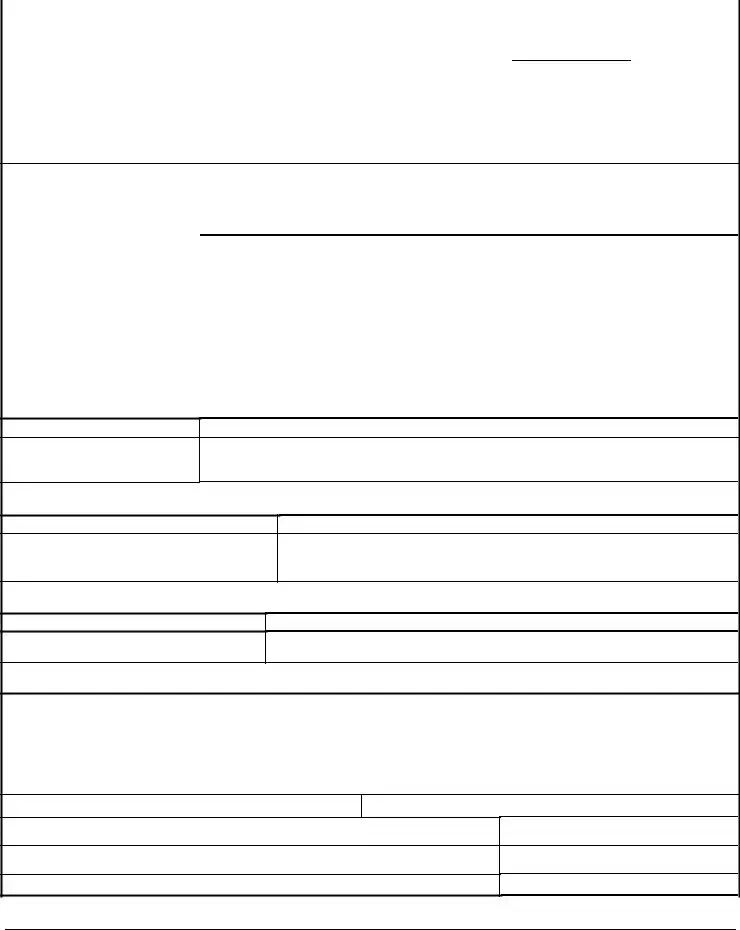
Simplified Prescriptive Certificate of Compliance: 2008 Residential HVAC Alterations |
||||||
Climate Zones 10 to 15 |
|
|
|
|
|
|
|
|
|
|
|
|
|
Site Address: |
|
|
Enforcement Agency: |
Date: |
|
Permit #: |
|
|
|
|
|
|
|
Equipment Type1 |
List Minimum Efficiency2 |
|
Conditioned Floor |
|
||
Duct insulation requirement |
Area |
|
Thermostat |
|||
Packaged Unit |
|
|
Over 40 ft of ducts added or |
|
|
Setback |
Furnace |
AFUE____ |
COP______ |
|
|
||
replaced in unconditioned space |
Served by system |
|
(If not already |
|||
Indoor Coil |
SEER_____ |
HSPF ____ |
|
|||
R 6 (CZ |
________ sf |
|
present, must be |
|||
Condensing Unit |
EER _____ |
Resistance |
|
|||
R 8 (CZ |
|
|
installed) |
|||
Other ________ |
|
|
|
|
||
|
|
|
|
|
|
|
1.Equipment Type: Choose the equipment being installed; if more than one system, use another
2.Minimum Equipment Efficiencies: 13 SEER, 78% AFUE, 7.7HSPF for typical residential systems.
HERS VERIFICATION SUMMARY Listed below are four HVAC alteration Options. The installer decides what work is being done and picks one of the appropriate Options. Each Option lists the HERS measures that must be conducted. A copy of the forms shall be left on site for final inspection and a copy given to the homeowner. At final, the inspector verifies that the work listed on this form was in fact the work completed by the installer. The inspector also verifies that each appropriate
1. HVAC Changeout |
Required Forms: |
|
• All HVAC Equipment replaced |
||
|
||
• Condenser Coil and /or |
||
• Indoor Coil and /or |
||
• Furnace |
||
|
For Split Systems: Duct leakage < 15 percent; RC, CCA ≥ 300 CFM/ton(Minimum Air Flow Requirement), TMAH
For Packaged Units: Duct leakage < 15 percent
Exempted from duct leakage testing if:
1. Duct system was documented to have been previously sealed and confirmed through HERS verification, or
2. Duct systems with less than 40 linear feet in unconditioned space, or
3. Existing duct systems are constructed, insulated or sealed with asbestos
2. New HVAC System
•Cut in or Changeout with new ducts: (all new ducting and all new equipment)
Required Forms:
For Split Systems: Duct leakage < 6 percent; RC, CCA ≥ 350 CFM/ton, FWD, TMAH, STMS, and either HSPP or PSPP.
For Packaged Units: Duct leakage < 6 percent
3. New Ducts with/or without Replacement
•Includes replacing or installing all new ducting and/or outdoor condensing unit and/or indoor coil and/or furnace. No or some equipment changed.
Required Forms:
For Split Systems: Duct leakage < 6 percent, RC, CCA ≥ 300 CFM/ton, TMAH
For Packaged Units: Duct leakage < 6 percent
4. New Ducting over 40 feet
• Includes adding or replacing more than 40
For split system or packaged units: Duct leakage < 15 percent
EXCEPTION: Existing duct systems constructed, insulated or sealed with asbestos.
Contractor (Documentation Author's /Responsible Designer's Declaration Statement)
•I certify that this Certificate of Compliance documentation is accurate and complete.
•I am eligible under Division 3 of the California Business and Professions Code to accept responsibility for the design identified on this Certificate of Compliance.
•I certify that the energy features and performance specifications for the design identified on this Certificate of Compliance conform to the requirements of Title 24, Parts 1 and 6 of the California Code of Regulations.
•The design features identified on this Certificate of Compliance are consistent with the information documented on other applicable compliance forms, worksheets, calculations, plans and specifications submitted to the enforcement agency for approval with the permit application.
Name:
Company:
Address:
City/State/Zip:
Signature:
Date:
License:
Phone:
2008 Residential Compliance Forms |
March 2010 |
| Fact Name | Details |
|---|---|
| Purpose | The CF-1R Alt HVAC form is used for documenting HVAC alterations in compliance with California's Building Energy Efficiency Standards. |
| Governing Law | This form is governed by the California Business and Professions Code, Section 7110, which outlines the requirements for permits and compliance in HVAC work. |
| Permit Requirement | A written construction permit must be obtained prior to any HVAC alterations, including installations and changes to mechanical systems. |
| Climate Zones | The CF-1R Alt HVAC form is specifically designed for use in Climate Zones 10 to 15 in California. |
| HERS Verification | HERS verification is mandatory for all HVAC alterations in the specified climate zones, ensuring compliance with energy efficiency standards. |
| Required Forms | For final inspection, the CF-6R and CF-4R forms must be completed and submitted by the contractor and HERS rater, respectively. |
Filling out the CF-1R Alt HVAC form is an important step in ensuring compliance with California's building energy efficiency standards. This process requires careful attention to detail to ensure that all necessary information is accurately recorded. After completing the form, it will be submitted to the appropriate enforcement agency for review. Following the submission, further inspections and verifications will take place to ensure that the work aligns with the documented plans.
The CF-1R Alt HVAC form is a compliance document used for residential HVAC alterations in California, specifically for Climate Zones 10 to 15. It ensures that HVAC installations meet the 2008 Building Energy Efficiency Standards. This form must be completed before obtaining a construction permit and is crucial for final inspections.
A permit is required for various HVAC projects, including:
Always check with your local enforcement agency to confirm specific requirements.
According to the 2008 Building Energy Efficiency Standards, HVAC systems must meet certain efficiency ratings:
HERS (Home Energy Rating System) verification is required for all HVAC alterations in Climate Zones 10-15. A certified HERS rater must conduct specific tests to ensure compliance with energy efficiency standards. The installer must select one of the four options on the CF-1R-ALT-HVAC form, which indicates the required HERS measures for the project.
For final inspection, the following forms must be submitted:
All forms must be registered with the HERS Provider for building permit applications submitted on or after October 1, 2010.
Failure to comply with building laws, including the California Building Code and local permit requirements, can lead to disciplinary action from the Contractors State License Board. This may include fines of up to $5,000 per violation or suspension/revocation of a contractor's license.
Specific testing is required based on the type of HVAC alteration being performed. For example:
To ensure compliance, follow these steps:
Consult with professionals who are familiar with local regulations and energy efficiency standards to avoid potential issues.
Filling out the CF-1R Alt HVAC form can be straightforward, but many people make common mistakes that can lead to delays or issues with their projects. One frequent error is neglecting to select the appropriate option that describes the work being conducted. Each option corresponds to specific requirements and forms needed for final inspection. If the installer chooses the wrong option, it can create confusion and lead to non-compliance with local building codes.
Another common mistake is failing to provide accurate efficiency ratings for the HVAC equipment being installed. The form requires specific minimum efficiency ratings, such as a 78% AFUE for heating equipment and a minimum of 13 SEER for central air conditioners. If these ratings are incorrectly entered or omitted, it may result in additional scrutiny from inspectors and potential fines.
Many individuals also overlook the importance of ensuring that all required forms are completed and submitted correctly. For instance, the CF-6R and CF-4R forms must be filled out and registered with an approved HERS provider. Handwritten CF-4R forms are not acceptable. Missing or improperly filled forms can lead to delays in obtaining necessary permits and approvals.
Lastly, a significant mistake involves not leaving copies of the completed forms on-site for final inspection. The inspector must verify that the work done matches what is documented on the CF-1R form. If the required documentation is not available during the inspection, it can result in a failed inspection and further complications in the permitting process. Being diligent about these details can save time and ensure compliance with local regulations.
When undertaking HVAC alterations, various forms and documents work in tandem with the CF-1R Alt HVAC form to ensure compliance with building codes and standards. Each of these documents serves a unique purpose, streamlining the process of obtaining permits and ensuring that installations meet regulatory requirements. Below is a list of common forms that may accompany the CF-1R Alt HVAC form.
Each of these documents plays a vital role in ensuring that HVAC alterations are performed safely and in accordance with established regulations. Understanding the purpose of each form can help streamline the permitting process and promote energy-efficient practices in residential HVAC installations.
The CF-1R Alt HVAC form is essential for HVAC alterations in California. It shares similarities with several other documents in the compliance process. Here’s a list of those documents and how they relate:
When filling out the CF-1R Alt HVAC form, there are several important guidelines to follow. Here are four things you should do, as well as four things you should avoid:
Misconceptions about the CF-1R Alt HVAC form can lead to confusion and potential compliance issues. Here are five common misconceptions and clarifications for each:
Permits are essential: Before starting any HVAC alteration, it's crucial to obtain a written construction permit from the enforcement agency. This applies to new installations, relocations, and significant changes to existing systems.
Know the efficiency standards: Familiarize yourself with the 2008 Building Energy Efficiency Standards. For example, heating equipment must achieve a minimum of 78% Annual Fuel Utilization Efficiency (AFUE), while central air conditioners need at least a 13 Seasonal Energy Efficiency Ratio (SEER).
HERS verification is mandatory: In Climate Zones 10 to 15, a Home Energy Rating System (HERS) verification is required for all HVAC alterations. This involves inspections by a certified HERS rater to ensure compliance with energy efficiency standards.
Complete the right forms: Depending on the type of work being done, specific forms must be completed. For instance, the CF-6R forms must be submitted by the installing contractor, while the CF-4R forms must be registered with an approved HERS provider.
Seal all ductwork: When altering or installing ducting, ensure that all joints and openings are properly sealed. Use only approved materials for sealing, and ensure that flex ducts are adequately supported to avoid sagging.
Final inspections are critical: For final inspections, it’s important to have all compliance forms on site. Inspectors will verify that the work completed matches what is documented on the CF-1R form and that all required forms are filled out correctly.