The CG 20 10 07 04 Liability Endorsement form plays a crucial role in commercial general liability insurance by extending coverage to additional insured parties, such as owners, lessees, or contractors. This form modifies the existing insurance policy to include specific individuals or organizations listed in a schedule, ensuring they are protected against certain liabilities. The endorsement primarily addresses liability for bodily injury, property damage, or personal and advertising injury that arises from the actions of the insured or those acting on their behalf during ongoing operations. However, it’s essential to note that the coverage is limited and only applies to the extent permitted by law. If a contract stipulates the need for such coverage, the insurance provided will not exceed what is required by that contract. Furthermore, the endorsement outlines exclusions, particularly concerning injuries or damages that occur after the completion of work or when the work has been put to its intended use by someone other than a contractor or subcontractor involved in the project. Additionally, it sets limits on the amount payable to the additional insured, ensuring it aligns with contractual obligations or the policy's existing limits, whichever is lower. Understanding these aspects is vital for anyone involved in contractual agreements where liability coverage is a concern.
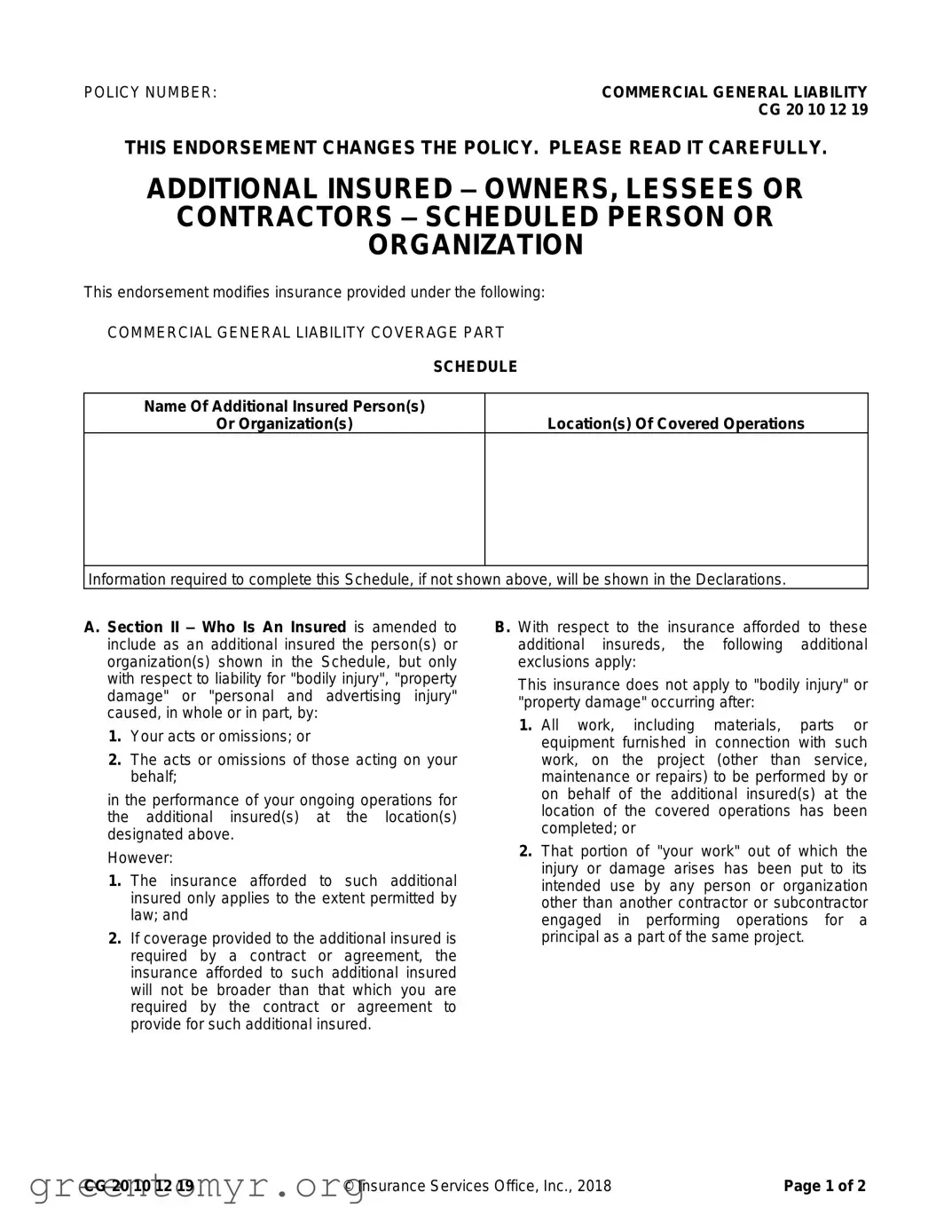
POLICY NUMBER: |
COMMERCIAL GENERAL LIABILITY |
|
CG 20 10 12 19 |
THIS ENDORSEMENT CHANGES THE POLICY. PLEASE READ IT CAREFULLY.
ADDITIONAL INSURED – OWNERS, LESSEES OR
CONTRACTORS – SCHEDULED PERSON OR
ORGANIZATION
This endorsement modifies insurance provided under the following:
COMMERCIAL GENERAL LIABILITY COVERAGE PART
SCHEDULE
Name Of Additional Insured Person(s)
Or Organization(s)
Location(s) Of Covered Operations
Information required to complete this Schedule, if not shown above, will be shown in the Declarations.
A. Section II – Who Is An Insured is amended to include as an additional insured the person(s) or organization(s) shown in the Schedule, but only with respect to liability for "bodily injury", "property damage" or "personal and advertising injury" caused, in whole or in part, by:
1.Your acts or omissions; or
2.The acts or omissions of those acting on your behalf;
in the performance of your ongoing operations for the additional insured(s) at the location(s) designated above.
However:
1.The insurance afforded to such additional insured only applies to the extent permitted by law; and
2.If coverage provided to the additional insured is required by a contract or agreement, the insurance afforded to such additional insured will not be broader than that which you are required by the contract or agreement to provide for such additional insured.
B. With respect to the insurance afforded to these additional insureds, the following additional exclusions apply:
This insurance does not apply to "bodily injury" or "property damage" occurring after:
1.All work, including materials, parts or equipment furnished in connection with such work, on the project (other than service, maintenance or repairs) to be performed by or on behalf of the additional insured(s) at the location of the covered operations has been completed; or
2.That portion of "your work" out of which the injury or damage arises has been put to its intended use by any person or organization other than another contractor or subcontractor engaged in performing operations for a principal as a part of the same project.
CG 20 10 12 19 |
© Insurance Services Office, Inc., 2018 |
Page 1 of 2 |
C. With respect to the insurance afforded to these additional insureds, the following is added to
Section III – Limits Of Insurance:
If coverage provided to the additional insured is required by a contract or agreement, the most we will pay on behalf of the additional insured is the amount of insurance:
1.Required by the contract or agreement; or
2.Available under the applicable limits of insurance;
whichever is less.
This endorsement shall not increase the applicable limits of insurance.
Page 2 of 2 |
© Insurance Services Office, Inc., 2018 |
CG 20 10 12 19 |
| Fact Name | Fact Description |
|---|---|
| Policy Number | CG 20 10 12 19 is the designated policy number for this endorsement. |
| Purpose | This endorsement adds additional insured coverage for owners, lessees, or contractors. |
| Coverage Type | It modifies the Commercial General Liability Coverage Part. |
| Insured Parties | Additional insureds are specified in a schedule and include persons or organizations. |
| Liability Scope | Coverage applies to liability for bodily injury, property damage, or personal and advertising injury. |
| Exclusions | Exclusions apply after work has been completed or the project has been put to intended use. |
| Limits of Insurance | The endorsement does not increase the applicable limits of insurance. |
| Contractual Requirement | If coverage is required by contract, it cannot exceed the limits specified in that contract. |
| Governing Law | State-specific forms may be subject to local laws, which vary by jurisdiction. |
Filling out the CG 20 10 07 04 Liability Endorsement form is a straightforward process. It is essential to ensure that all required information is accurate and complete to avoid any issues with coverage. Below are the steps to guide you through the completion of the form.
The CG 20 10 07 04 Liability Endorsement form is an addition to a Commercial General Liability (CGL) policy. It allows for certain individuals or organizations to be included as additional insureds under the policy. This means that they are protected against certain liabilities that may arise from your operations.
The endorsement specifically lists the names of the additional insured persons or organizations in a schedule. These individuals or entities are covered for liabilities related to bodily injury, property damage, or personal and advertising injury that arise from your actions or those acting on your behalf during your ongoing operations.
This endorsement covers:
However, coverage is limited to incidents caused by your acts or omissions or those of your representatives while performing work for the additional insured at specified locations.
Yes, there are important limitations to be aware of:
If all work on the project is finished, including any materials or equipment, the coverage for the additional insured will no longer apply. This means that if an incident occurs after completion, the additional insured may not be covered under this endorsement.
The endorsement does not increase the overall limits of insurance. If coverage for the additional insured is required by a contract, the maximum amount payable will be the lesser of the amount specified in the contract or the available limits of insurance under your policy.
If you need to add an additional insured, contact your insurance agent or provider. They will help you complete the necessary forms and ensure that the endorsement is properly applied to your policy.
There may be a fee associated with adding an additional insured to your policy. This varies by insurer, so it’s best to check with your insurance provider for specific details regarding costs.
For more detailed information, refer to your insurance policy documents or consult with your insurance agent. They can provide clarity on how the endorsement works and any specific implications for your coverage.
When filling out the CG 20 10 07 04 Liability Endorsement form, many people make common mistakes that can lead to issues later on. One frequent error is failing to accurately fill in the policy number. This number is crucial for identifying your specific coverage. Without it, the insurance provider may struggle to process your endorsement correctly.
Another mistake is neglecting to list all additional insured persons or organizations. It is essential to include everyone who needs coverage under this endorsement. Omitting someone can leave them without protection in case of a claim, which could lead to significant financial repercussions.
People often overlook the location of covered operations. This information is vital because it specifies where the coverage applies. If the location is not clearly stated, it could result in confusion or denial of a claim.
Additionally, some individuals fail to understand the limitations of coverage. The endorsement only applies to liability for "bodily injury," "property damage," or "personal and advertising injury" caused by your actions or those acting on your behalf. Misinterpreting this can lead to unrealistic expectations about the protection offered.
Another common error is misunderstanding the exclusions listed in the endorsement. For example, coverage does not apply if the work has been completed or if the work has been put to its intended use. Being unaware of these exclusions can result in unexpected denial of claims.
People sometimes skip reading the contract or agreement requirements related to the additional insured. The coverage provided cannot exceed what is stipulated in these documents. Ignoring this can lead to underinsurance or coverage that does not meet contractual obligations.
Furthermore, failing to review the limits of insurance can be problematic. The endorsement states that the most the insurer will pay is the lesser of the amount required by the contract or the available limits. Not understanding this can create misunderstandings about the extent of coverage.
Lastly, many individuals do not keep a copy of the completed form for their records. Retaining a copy is essential for future reference and can help clarify any disputes that may arise regarding coverage. Without it, proving what was submitted can become challenging.
The CG 20 10 07 04 Liability Endorsement form is an important document that modifies a commercial general liability insurance policy. It specifically addresses the inclusion of additional insured parties, outlining the coverage provided for their liability in certain circumstances. Alongside this form, there are several other documents commonly used in conjunction with it to ensure comprehensive coverage and compliance with contractual obligations.
These documents work together to provide clarity and protection for all parties involved in a contractual relationship. Ensuring that they are properly completed and understood is essential for effective risk management and compliance with legal obligations.
When filling out the CG 20 10 07 04 Liability Endorsement form, it is important to follow specific guidelines to ensure accuracy and compliance. Below is a list of things you should and shouldn't do:
By adhering to these guidelines, you can help ensure that the endorsement form is completed correctly and that the necessary coverage is in place.
Misconception 1: The CG 20 10 07 04 Liability Endorsement automatically provides full coverage for all claims.
This is not true. The endorsement only extends coverage to additional insureds for specific liabilities related to your operations. It does not cover all potential claims, and the coverage is limited to what is outlined in the endorsement itself.
Misconception 2: Once an additional insured is added, they are covered for any incident.
This is misleading. The coverage is only applicable if the claim arises from your acts or omissions or those of your representatives. If the incident is unrelated to your operations, the additional insured may not be covered.
Misconception 3: The endorsement increases the overall limits of my insurance policy.
This is incorrect. The CG 20 10 07 04 does not increase your policy limits. The coverage for additional insureds is subject to the existing limits of your policy or the limits required by a contract, whichever is lower.
Misconception 4: The endorsement covers all types of damages, including those after project completion.
This is a common misunderstanding. The endorsement specifically excludes coverage for bodily injury or property damage that occurs after your work has been completed, except for certain ongoing operations. It’s important to understand these limitations to avoid surprises later.
When filling out and using the Cg 20 10 07 04 Liability Endorsement form, consider the following key takeaways: