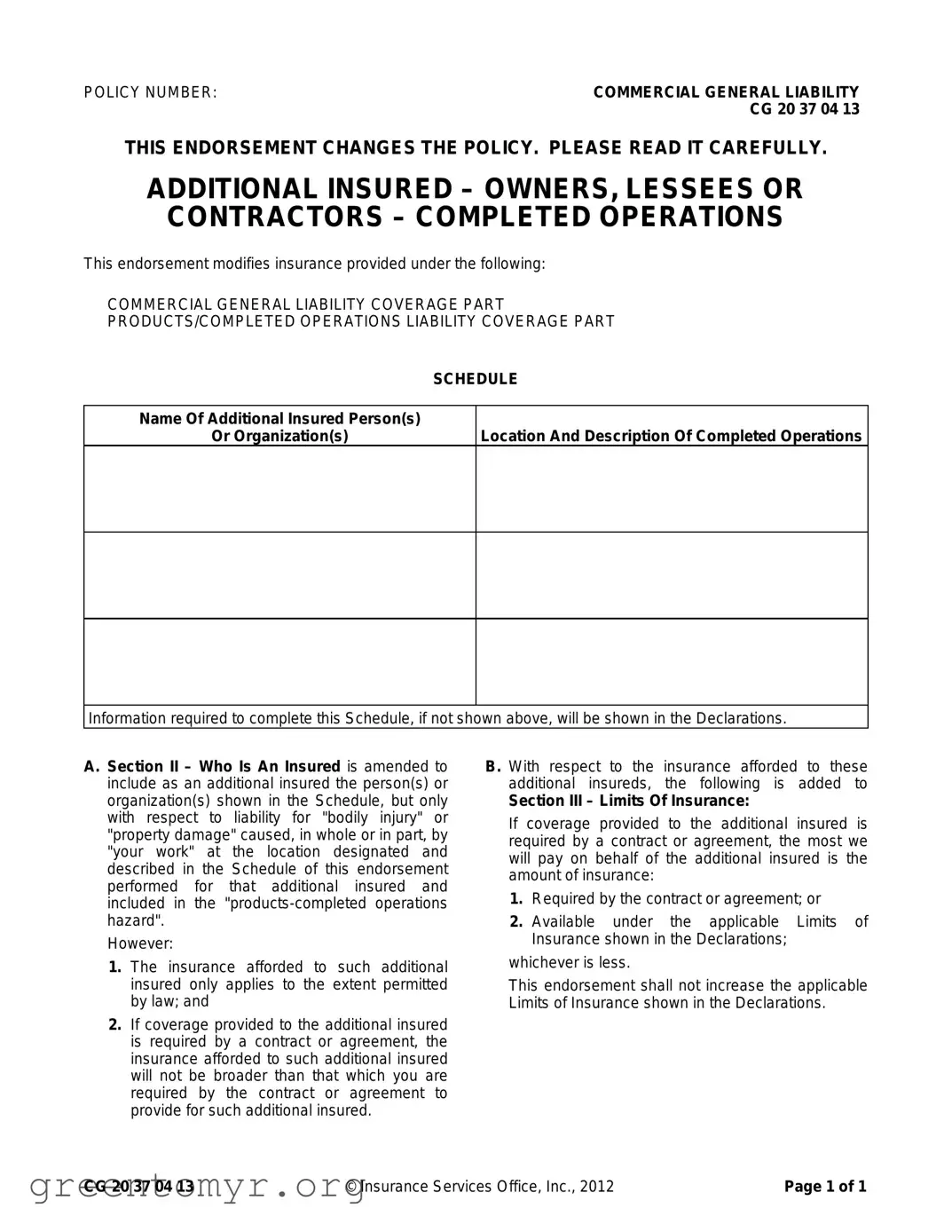
The CG 2037 form is a crucial endorsement in the realm of commercial general liability insurance, specifically addressing the needs of owners, lessees, or contractors involved in completed operations. It modifies the existing coverage by adding additional insured parties, allowing them to benefit from liability protections related to bodily injury or property damage linked to the insured's work. This endorsement outlines the specific conditions under which these additional insureds are covered, emphasizing that the protection is limited to the operations performed at designated locations as specified in the endorsement schedule. Notably, the coverage provided is contingent upon the terms of any existing contracts or agreements, ensuring that the insurance does not extend beyond what is contractually required. The form also clarifies the limits of insurance, stating that the maximum payout for additional insureds will either be dictated by the contract or the limits outlined in the policy declarations, whichever is less. Understanding these key aspects is vital for businesses to ensure they are adequately protected and compliant with contractual obligations.

POLICY NUMBER: |
COMMERCIAL GENERAL LIABILITY |
|
CG 20 37 04 13 |
THIS ENDORSEMENT CHANGES THE POLICY. PLEASE READ IT CAREFULLY.
ADDITIONAL INSURED – OWNERS, LESSEES OR CONTRACTORS – COMPLETED OPERATIONS
This endorsement modifies insurance provided under the following:
COMMERCIAL GENERAL LIABILITY COVERAGE PART
PRODUCTS/COMPLETED OPERATIONS LIABILITY COVERAGE PART
SCHEDULE
Name Of Additional Insured Person(s)
Or Organization(s)
Location And Description Of Completed Operations
Information required to complete this Schedule, if not shown above, will be shown in the Declarations.
A.Section II – Who Is An Insured is amended to include as an additional insured the person(s) or organization(s) shown in the Schedule, but only with respect to liability for "bodily injury" or "property damage" caused, in whole or in part, by "your work" at the location designated and described in the Schedule of this endorsement performed for that additional insured and included in the
However:
1.The insurance afforded to such additional insured only applies to the extent permitted by law; and
2.If coverage provided to the additional insured is required by a contract or agreement, the insurance afforded to such additional insured will not be broader than that which you are required by the contract or agreement to provide for such additional insured.
B. With respect to the insurance afforded to these additional insureds, the following is added to
Section III – Limits Of Insurance:
If coverage provided to the additional insured is required by a contract or agreement, the most we will pay on behalf of the additional insured is the amount of insurance:
1.Required by the contract or agreement; or
2.Available under the applicable Limits of Insurance shown in the Declarations;
whichever is less.
This endorsement shall not increase the applicable Limits of Insurance shown in the Declarations.
CG 20 37 04 13 |
© Insurance Services Office, Inc., 2012 |
Page 1 of 1 |
| Fact Name | Fact Description |
|---|---|
| Policy Number | CG 20 37 04 13 is the policy number for this endorsement. |
| Endorsement Purpose | This endorsement adds additional insured coverage for owners, lessees, or contractors related to completed operations. |
| Insurance Coverage | The endorsement modifies insurance provided under the Commercial General Liability Coverage Part. |
| Additional Insureds | It includes persons or organizations listed in the Schedule as additional insureds. |
| Liability Scope | Coverage applies only for liability related to "bodily injury" or "property damage" caused by "your work." |
| Legal Limits | The coverage for additional insureds is limited to what is permitted by law. |
| Contractual Obligations | If required by a contract, the coverage cannot exceed what is specified in that contract. |
| Limits of Insurance | The maximum amount payable is the lesser of the contract requirement or the limits shown in the Declarations. |
| Non-Increase Clause | This endorsement does not increase the Limits of Insurance stated in the Declarations. |
After obtaining the CG 2037 form, the next step involves accurately filling it out to ensure all necessary details are included. This form is essential for adding additional insured parties to a commercial general liability policy. Completing it correctly will help avoid any potential issues with coverage in the future.
The CG 2037 form, also known as the Additional Insured – Owners, Lessees or Contractors – Completed Operations endorsement, is designed to extend liability coverage to additional parties. This is crucial for businesses involved in construction or contracting work, as it protects owners or contractors from liability related to completed operations performed by another party. Essentially, it ensures that if an issue arises from work completed on their behalf, they have coverage under the primary contractor's insurance policy.
Individuals or organizations specified in the endorsement's Schedule can be considered additional insureds. This typically includes property owners, lessees, or contractors who have a vested interest in the completed operations. The endorsement ensures that these additional insureds are protected against liability for bodily injury or property damage that may occur as a result of the work performed for them.
While the CG 2037 form provides valuable coverage, it comes with specific limitations. First, the insurance for additional insureds only applies to the extent permitted by law. Second, if the coverage is required by a contract, it cannot exceed what the primary contractor is obligated to provide. This means that the coverage will not be broader than what is stipulated in the contract or agreement between the parties involved.
The endorsement does not increase the overall limits of insurance stated in the policy. If coverage for the additional insured is mandated by a contract, the maximum amount payable will be the lesser of either the amount required by that contract or the limits of insurance outlined in the policy. This is an important consideration for both primary contractors and additional insureds when assessing potential risks and coverage needs.
"Your work" refers to the operations or services performed by the primary insured (the contractor) at the location designated in the endorsement. This includes any completed operations that may lead to liability claims. The coverage extends to bodily injury or property damage that arises from these completed operations, ensuring that the additional insured is protected against claims stemming from the contractor's work.
The Schedule requires specific details about the additional insureds, including their names and the location and description of the completed operations. If this information is not included in the endorsement, it will be provided in the Declarations of the policy. Accurate completion of this Schedule is essential to ensure that the intended parties are covered under the endorsement.
Reading the CG 2037 form carefully is crucial for understanding the specific coverage it provides and any limitations that may apply. This endorsement modifies the original insurance policy, and being aware of its terms can help prevent misunderstandings or gaps in coverage. Businesses should ensure they fully grasp the implications of the endorsement, especially in the context of contractual obligations and potential liability risks.
Filling out the CG 2037 form can be straightforward, but many people make common mistakes that can lead to issues later on. One frequent error is not providing the correct policy number. Ensure that the policy number matches the one on your insurance documents. An incorrect number can delay processing or result in denial of coverage.
Another common mistake is failing to list all additional insured parties accurately. If there are multiple parties involved, make sure to include each one. Omitting an additional insured can leave them unprotected and may cause problems if a claim arises.
People often overlook the location and description of completed operations. This section is crucial for defining where and what work was done. Without clear information, it can be difficult to establish liability if a claim is filed.
Some individuals forget to check if the information in the Declarations is complete. If the necessary details are not included, it could lead to confusion or disputes about coverage. Always double-check to ensure that all required information is present.
Another mistake is misunderstanding the limits of insurance provided to additional insureds. The coverage may not exceed what is specified in the contract. Make sure you understand the limits to avoid unexpected gaps in coverage.
People also sometimes fail to read the endorsement carefully. This form modifies existing insurance policies, and missing important details can lead to misunderstandings about what is covered. Take the time to read through the entire document.
Not keeping a copy of the completed form is another error. It’s important to maintain records of what was submitted for your own reference. This can be helpful in case of future questions or disputes.
Another common mistake is submitting the form without signatures or dates. Ensure that all required signatures are in place, as an unsigned form can be considered invalid. Also, include the date to confirm when the form was completed.
Lastly, people sometimes rush through the process. Take your time to ensure that all information is accurate and complete. Rushing can lead to careless mistakes that may affect coverage later on.
The CG 2037 form is an important document in the realm of commercial general liability insurance, specifically designed to add additional insured parties for completed operations. However, it often works in conjunction with several other forms and documents that provide a comprehensive overview of coverage and responsibilities. Here’s a look at six other documents frequently used alongside the CG 2037 form.
Understanding these documents can help ensure that all parties involved in a project are adequately protected and aware of their coverage. Properly utilizing these forms alongside the CG 2037 can lead to smoother operations and reduced liability risks for everyone involved.
The Cg 2037 form, which pertains to additional insured status for completed operations, shares similarities with several other insurance documents. Below is a list of eight documents that are comparable in purpose or function:
When filling out the CG 2037 form, it is essential to follow certain guidelines to ensure accuracy and compliance. Here is a list of things you should and shouldn't do:
Understanding the CG 2037 form can be challenging. Here are eight common misconceptions about this endorsement:
Clarifying these misconceptions can help businesses navigate their insurance needs more effectively.
When filling out and using the CG 2037 form, consider the following key takeaways: