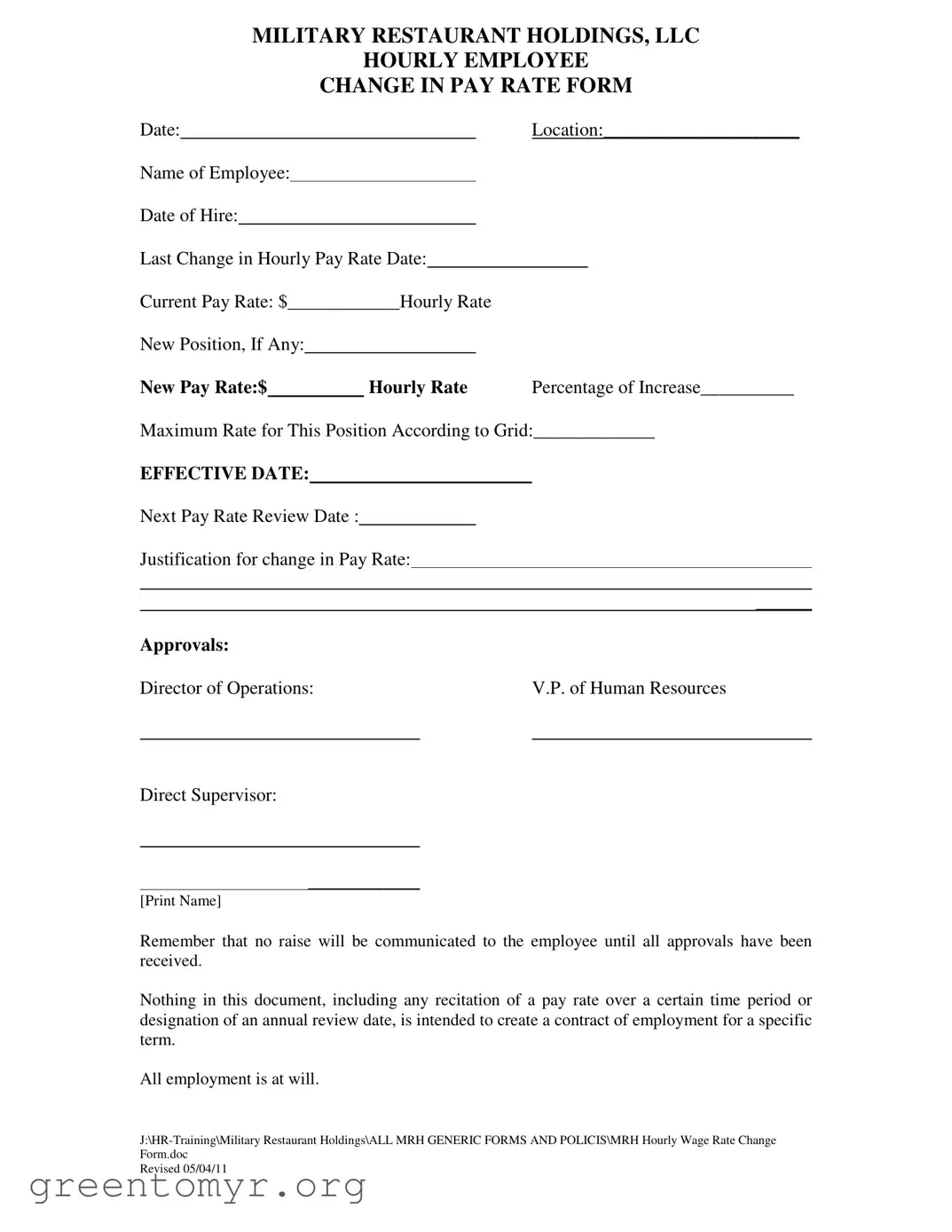
The Change Pay Rate form is an essential document for managing hourly employee compensation within Military Restaurant Holdings, LLC. This form captures critical information such as the employee's name, date of hire, and current pay rate, providing a comprehensive overview of the pay adjustment process. It outlines the new pay rate and the percentage increase, ensuring transparency and clarity for both the employee and management. Additionally, it requires justification for the pay change, which helps maintain accountability and consistency in compensation practices. The form also includes sections for necessary approvals from the Director of Operations, the V.P. of Human Resources, and the employee's direct supervisor, emphasizing the importance of a structured review process. It's crucial to note that no pay raise will be communicated to the employee until all approvals are secured, reinforcing the need for careful consideration before any changes are finalized. Lastly, the form clarifies that nothing within it constitutes a contract of employment for a specific term, as all employment remains at will, protecting both the employee and the organization.

|
|
MILITARY RESTAURANT HOLDINGS, LLC |
|||||||||
|
|
|
|
|
HOURLY EMPLOYEE |
||||||
|
|
|
|
|
CHANGE IN PAY RATE FORM |
||||||
Date: |
|
|
|
|
|
|
Location:_____________________ |
||||
Name of Employee: |
|
|
|
|
|
|
|
|
|||
Date of Hire: |
|
|
|
|
|
|
|
|
|||
Last Change in Hourly Pay Rate Date: |
|
|
|
||||||||
Current Pay Rate: $____________Hourly Rate |
|
|
|||||||||
New Position, If Any: |
|
|
|
|
|
|
|
||||
New Pay Rate:$ |
|
|
Hourly Rate |
Percentage of Increase__________ |
|||||||
Maximum Rate for This Position According to Grid:_____________
EFFECTIVE DATE:
Next Pay Rate Review Date :
Justification for change in Pay Rate:
______
Approvals:
Director of Operations: |
|
V.P. of Human Resources |
|
|
|
Direct Supervisor:
____________
[Print Name]
Remember that no raise will be communicated to the employee until all approvals have been received.
Nothing in this document, including any recitation of a pay rate over a certain time period or designation of an annual review date, is intended to create a contract of employment for a specific term.
All employment is at will.
Form.doc
Revised 05/04/11
| Fact Name | Details |
|---|---|
| Purpose | This form is used to document changes in the hourly pay rate for employees at Military Restaurant Holdings, LLC. |
| Required Approvals | Changes must be approved by the Director of Operations, V.P. of Human Resources, and the employee's direct supervisor. |
| Effective Date | The new pay rate takes effect on the date specified in the form, following all necessary approvals. |
| Employee Notification | No raise will be communicated to the employee until all approvals have been received. |
| At-Will Employment | The form clarifies that nothing in it creates a contract of employment for a specific term; all employment is at will. |
| Governing Law | This form is subject to applicable state labor laws, which may vary by location. |
After completing the Change Pay Rate form, it will be necessary to submit it for the required approvals. Ensure that all sections are filled out accurately to facilitate a smooth review process.
The Change Pay Rate form is utilized to document any changes in the hourly pay rate of employees at Military Restaurant Holdings, LLC. This includes adjustments due to promotions, performance reviews, or other factors that warrant a pay rate change.
The form requires several key pieces of information, including:
Approval is required from three key individuals: the Director of Operations, the Vice President of Human Resources, and the employee's direct supervisor. No raise will be communicated to the employee until all necessary approvals have been obtained.
The effective date of the new pay rate is specified on the form. It is important to ensure that all approvals are secured before this date to avoid any discrepancies in pay.
No, employees will not be notified of any pay increase until all approvals are finalized. This ensures that the change is officially documented and authorized.
No, the Change Pay Rate form does not create a contract of employment for a specific term. All employment remains at will, meaning either the employee or employer can terminate the employment relationship at any time.
If the form is incomplete, it may be returned for additional information. This could delay the approval process and the implementation of the new pay rate. Ensuring that all required fields are filled out accurately is essential.
The justification should clearly explain the reason for the pay rate change. This could include factors such as increased responsibilities, performance improvements, or market adjustments. A well-documented justification helps facilitate the approval process.
The Change Pay Rate form can be found in the HR training section of Military Restaurant Holdings' shared drive, specifically under the folder titled "ALL MRH GENERIC FORMS AND POLICIES." It is advisable to ensure you are using the most recent version of the form.
When filling out the Change Pay Rate form, individuals often overlook several important details that can lead to delays or complications in processing the request. One common mistake is failing to include the effective date of the pay change. This date is crucial, as it determines when the new pay rate will take effect. Without it, the approval process may stall, causing confusion and frustration for both the employee and management.
Another frequent error involves the justification for the pay rate change. This section is essential for providing context to the request. Insufficient or vague explanations can lead to misunderstandings and may result in the denial of the change. Clear and specific justifications help decision-makers understand the rationale behind the request.
Many people also neglect to update the current pay rate before submitting the form. This oversight can lead to discrepancies in pay calculations and may affect the employee’s overall compensation. It is vital to ensure that the current pay rate reflects the most recent information to avoid any potential errors.
Another mistake is not specifying the new position, if applicable. If an employee is being promoted or changing roles, this should be clearly indicated on the form. Failing to do so can create confusion about the employee's responsibilities and the associated pay rate.
Individuals sometimes forget to include the percentage of increase in pay. This figure is important for both transparency and budgeting purposes. Without it, the approving authorities may struggle to evaluate the fairness and appropriateness of the pay change.
In addition, some individuals may not seek the necessary approvals before submitting the form. Each level of management plays a critical role in the approval process, and skipping this step can delay the implementation of the pay change. It is essential to ensure that all required signatures are obtained to facilitate a smooth transition.
Another common oversight is not double-checking the location and date fields. These details are often overlooked, yet they are vital for record-keeping and tracking purposes. Inaccuracies can lead to administrative errors that complicate the process further.
Moreover, individuals sometimes fail to communicate with the employee about the change until all approvals are finalized. This can create anxiety and uncertainty for the employee. Keeping the lines of communication open throughout the process helps maintain trust and clarity.
Lastly, many people mistakenly believe that the form itself serves as a contract of employment. It is important to remember that this document is simply a record of the pay change and does not establish any binding agreement regarding employment terms. Understanding this distinction can help manage expectations for both employees and management.
The Change Pay Rate form is an essential document in the employment process, particularly when adjustments to an employee's compensation are necessary. Several other forms and documents complement this form to ensure a comprehensive and compliant approach to changes in pay rates. Below are some commonly used documents associated with the Change Pay Rate form.
Using these documents in conjunction with the Change Pay Rate form helps ensure a transparent and fair process for both employees and employers. Each form plays a critical role in maintaining accurate records and facilitating effective communication regarding changes in pay rates.
The Change Pay Rate form is an essential document used by employers to officially record and communicate changes in an employee's pay rate. Several other documents share similar purposes or functions. Here are five such documents:
When filling out the Change Pay Rate form, it's essential to ensure accuracy and clarity. Here are some important dos and don'ts to keep in mind:
Understanding the Change Pay Rate form is essential for both employees and management. However, several misconceptions can lead to confusion. Here’s a list of common misunderstandings:
Clearing up these misconceptions can help ensure a smoother process for everyone involved. Always refer to your company's guidelines and consult with HR if you have questions about the Change Pay Rate form.
When filling out and using the Change Pay Rate form, keep the following key takeaways in mind: