Content Navigation

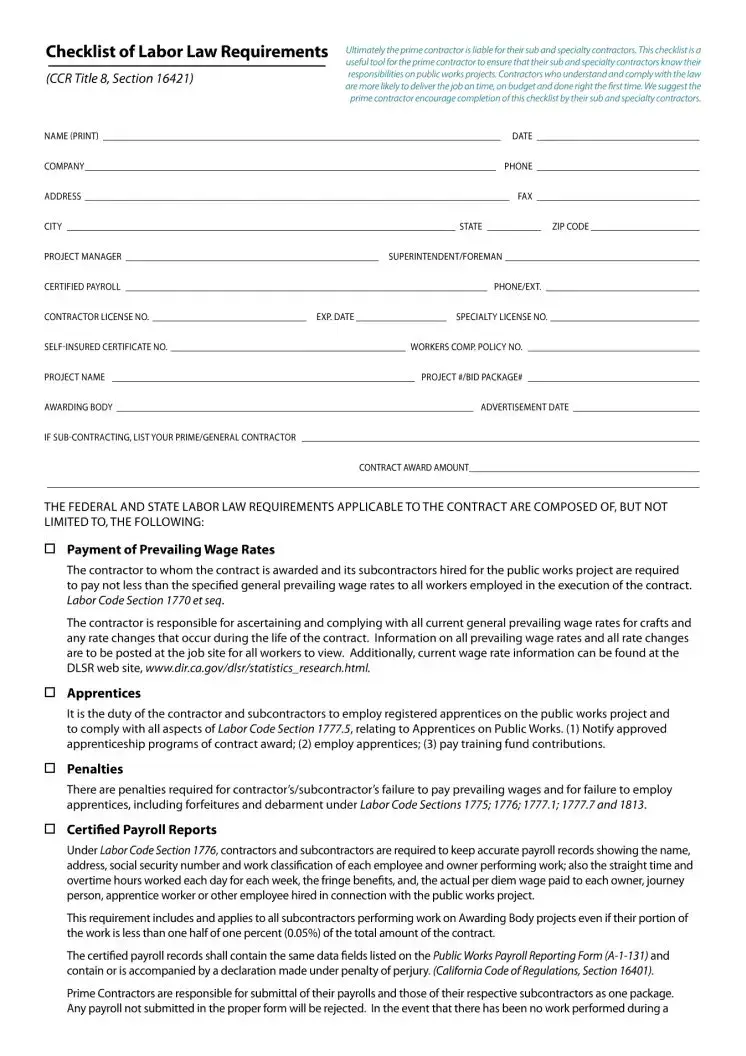
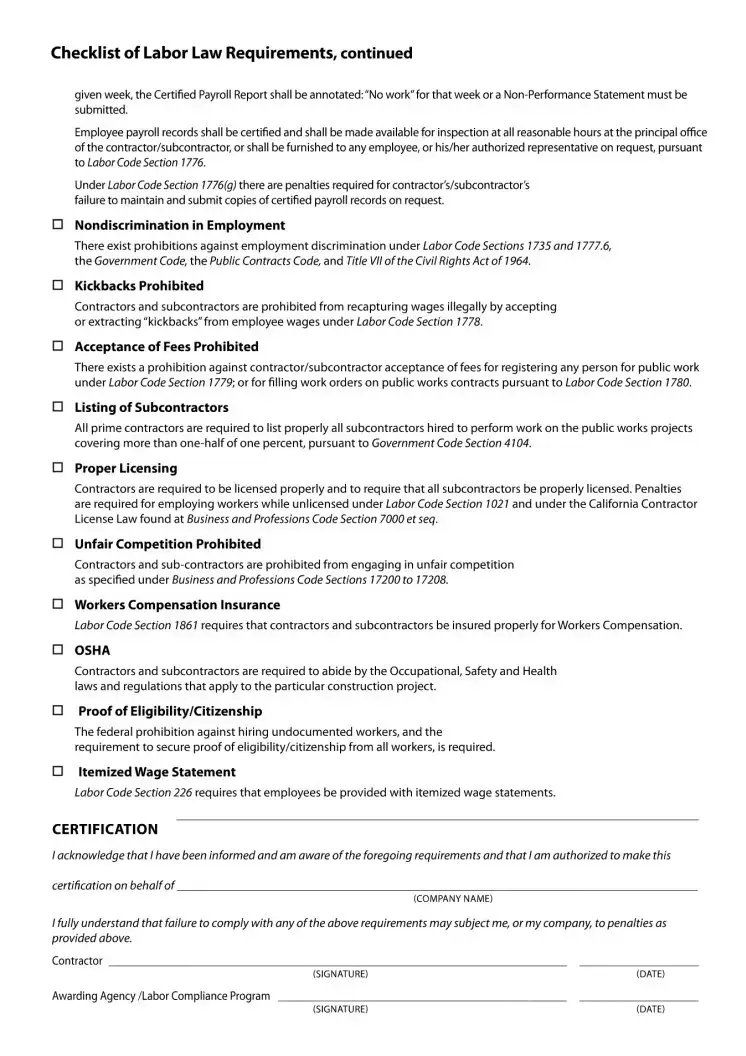
The Checklist Labor Law form serves as an essential tool for contractors engaged in public works projects, ensuring compliance with a variety of labor law requirements. This form collects vital information, including the contractor's name, company address, project details, and relevant licensing numbers. It emphasizes the importance of paying prevailing wage rates, a critical aspect of labor law that mandates contractors and their subcontractors to compensate workers fairly. In addition to wage compliance, the form outlines the necessity of employing registered apprentices and maintaining accurate certified payroll records, which must be submitted regularly. The checklist also highlights the legal obligations surrounding nondiscrimination in employment practices, the prohibition of kickbacks, and the need for proper licensing and workers' compensation insurance. By encouraging prime contractors to utilize this checklist, subcontractors can better understand their responsibilities, thereby fostering a more efficient and compliant work environment. Ultimately, this proactive approach helps ensure that projects are completed on time, within budget, and to the highest standards of quality.
Checklist Labor Law Example

File Breakdown

Fact Name Description
Governing Law The Checklist of Labor Law Requirements is governed by California Code of Regulations Title 8, Section 16421.
Purpose This checklist serves as a tool for prime contractors to ensure compliance with labor laws on public works projects.
Prevailing Wage Contractors must pay prevailing wage rates as specified in Labor Code Section 1770 et seq.
Apprenticeship Requirements Contractors are required to employ registered apprentices and notify approved programs, as per Labor Code Section 1777.5.
Payroll Records Accurate payroll records must be maintained and submitted under Labor Code Section 1776.
Nondiscrimination Employment discrimination is prohibited under Labor Code Sections 1735 and 1777.6, among others.
Kickbacks Contractors cannot accept or extract kickbacks from employee wages, as stated in Labor Code Section 1778.
Subcontractor Listing Prime contractors must list all subcontractors performing work exceeding 0.5% of the project, per Government Code Section 4104.
Workers Compensation Contractors must be insured for Workers Compensation under Labor Code Section 1861.
Certification Requirement Contractors must certify their awareness of these requirements and their authority to act on behalf of their company.

Guide to Using Checklist Labor Law

Completing the Checklist Labor Law form is a crucial step for contractors involved in public works projects. This form helps ensure compliance with various labor law requirements. It is essential to fill out the form accurately to avoid potential penalties and to keep the project on track. Below are the steps to guide you through the process of filling out the form.

  1. Print your name in the designated NAME field at the top of the form.
  2. Enter your company information in the COMPANY ADDRESS, CITY, STATE, and ZIP CODE fields.
  3. Provide the project manager's name in the PROJECT MANAGER field.
  4. Fill in your contractor license number in the CONTRACTOR LICENSE NO. field.
  5. List your self-insured certificate number in the SELF-INSURED CERTIFICATE NO. field.
  6. Write the project name in the PROJECT NAME field.
  7. Indicate the awarding body in the AWARDING BODY field.
  8. If subcontracting, list your prime/general contractor in the appropriate field.
  9. Provide the date in the DATE field.
  10. Enter your phone number in the PHONE field and your fax number in the FAX field.
  11. Fill in the expiration date of your license in the EXP. DATE field.
  12. Provide the superintendent/foreman's name in the SUPERINTENDENT/FOREMAN field.
  13. Enter the superintendent/foreman's phone number in the PHONE/EXT. field.
  14. Fill in the specialty license number in the SPECIALTY LICENSE NO. field.
  15. Provide your workers' compensation policy number in the WORKERS COMP. POLICY NO. field.
  16. Enter the project number or bid package number in the PROJECT #/BID PACKAGE# field.
  17. Indicate the advertisement date in the ADVERTISEMENT DATE field.
  18. Fill in the contract award amount in the CONTRACT AWARD AMOUNT field.
  19. Sign the certification acknowledging awareness of labor law requirements.
  20. Date your signature in the DATE field next to your signature.
  21. Have the awarding agency or labor compliance program sign and date the form.

Get Answers on Checklist Labor Law

What is the Checklist Labor Law form?

The Checklist Labor Law form is a document designed to help contractors ensure compliance with federal and state labor laws on public works projects. It outlines the responsibilities of contractors and subcontractors, including wage rates, apprenticeship requirements, and payroll reporting.

Who needs to complete the Checklist Labor Law form?

The prime contractor is responsible for completing the form. Additionally, subcontractors should also be encouraged to fill it out to understand their obligations under the law. This helps ensure that everyone involved in the project is aware of their responsibilities.

What are prevailing wage rates?

Prevailing wage rates are the minimum wages that must be paid to workers on public works projects. Contractors and subcontractors must pay these rates as specified in the contract. It's essential to stay updated on any changes to these rates during the project.

What are the penalties for not complying with labor laws?

Penalties can include forfeitures and debarment from future contracts. Contractors and subcontractors may face fines for failing to pay prevailing wages or employ registered apprentices as required by law.

What is required for certified payroll reports?

Certified payroll reports must include detailed records of each employee's name, address, social security number, work classification, hours worked, and wages paid. These reports must be submitted accurately and on time. If no work was performed in a given week, the report should state "No work" for that week.

What is the role of apprentices in public works projects?

Contractors are required to employ registered apprentices on public works projects. They must notify approved apprenticeship programs of the contract award, employ apprentices, and make necessary training fund contributions.

Are there regulations against employment discrimination?

Yes, there are strict prohibitions against employment discrimination under various laws, including Labor Code Sections and Title VII of the Civil Rights Act. Contractors must ensure equal opportunity in hiring and employment practices.

What is the significance of itemized wage statements?

Itemized wage statements are required by law to be provided to employees. These statements help workers understand their earnings, deductions, and any other relevant payroll information. It's an important transparency measure in labor practices.

What happens if a contractor employs unlicensed workers?

Employing unlicensed workers can lead to penalties under the California Contractor License Law. Contractors must ensure that both they and their subcontractors are properly licensed to avoid legal issues and fines.

What is the importance of workers' compensation insurance?

Workers' compensation insurance is crucial for protecting workers in case of injuries on the job. Contractors and subcontractors must have proper coverage to comply with Labor Code requirements and ensure the safety and rights of their employees.

Common mistakes

Filling out the Checklist Labor Law form can be straightforward, but mistakes are common. One frequent error is failing to provide complete and accurate information. For example, if the company name or contractor license number is missing or incorrect, it can lead to significant delays in processing. It is essential to double-check all entries for accuracy to avoid complications.

Another mistake often made is neglecting to include the necessary supporting documents. The form requires specific certifications and records, such as the certified payroll reports. If these documents are not attached, it can result in the rejection of the entire submission. Contractors should ensure that they gather all required paperwork before submitting the form.

Some individuals also overlook the importance of understanding prevailing wage rates. Failing to pay the correct wages can lead to penalties. Contractors must stay informed about the current wage rates and ensure that they are reflected accurately in the payroll records. This diligence is crucial for compliance with Labor Code requirements.

Lastly, many contractors forget to sign and date the certification section of the form. This step is not merely a formality; it signifies that the contractor acknowledges and agrees to comply with all labor law requirements. Without a signature, the submission is incomplete and may not be considered valid. Therefore, it is critical to remember this final step before sending the form.

Documents used along the form

When navigating the complexities of labor law compliance, several essential documents accompany the Checklist Labor Law form. Each of these documents serves a specific purpose, helping contractors and subcontractors adhere to legal requirements while ensuring fair treatment of all workers involved in public works projects. Understanding these forms can empower you to maintain compliance and foster a positive work environment.

  • Certified Payroll Reports: These reports detail the wages paid to employees, including their classifications and hours worked. They must be accurate and submitted regularly to ensure compliance with prevailing wage laws.
  • Employee Payroll Records: This document includes comprehensive information about each employee, such as their name, address, and work classification. It must be maintained for inspection and should reflect the same details as the Certified Payroll Reports.
  • Apprentice Employment Records: Contractors must keep records that demonstrate compliance with apprenticeship requirements, including the employment of registered apprentices and contributions to training funds.
  • Subcontractor Listings: Prime contractors must provide a list of all subcontractors involved in the project, especially those whose work exceeds half a percent of the total contract amount. This ensures transparency and accountability.
  • Itemized Wage Statements: These statements must be provided to employees, detailing their earnings, deductions, and net pay. They are crucial for ensuring that workers are informed about their compensation.
  • Workers Compensation Insurance Documentation: Proof of adequate workers' compensation insurance coverage is essential. This protects both the contractor and the workers in case of workplace injuries.
  • OSHA Compliance Records: Contractors must maintain documentation demonstrating adherence to Occupational Safety and Health Administration (OSHA) regulations, ensuring a safe working environment for all employees.

Each of these documents plays a vital role in maintaining compliance with labor laws and protecting the rights of workers. By understanding and properly managing these forms, contractors can not only avoid penalties but also promote a culture of fairness and respect in the workplace.

Similar forms

  • Certified Payroll Report: Similar to the Checklist Labor Law form, this document requires contractors to maintain accurate payroll records. It includes details about each employee's work classification, hours worked, and wages paid. Both documents emphasize the importance of compliance with labor laws and accurate reporting.
  • Prevailing Wage Determination: This document outlines the wage rates that contractors must pay their workers. Like the Checklist Labor Law form, it ensures that contractors are aware of their obligations regarding wage payments, particularly for public works projects.
  • Apprenticeship Program Compliance Form: This form is used to verify that contractors are employing registered apprentices as required by law. Similar to the Checklist Labor Law form, it emphasizes the contractor's responsibility to notify apprenticeship programs and comply with related regulations.
  • Nondiscrimination Policy Statement: This document outlines the contractor's commitment to non-discrimination in employment. It parallels the Checklist Labor Law form by addressing legal obligations to prevent discrimination under various laws.
  • Subcontractor Listing Form: This form requires prime contractors to list all subcontractors on a project. It is similar to the Checklist Labor Law form in that both documents emphasize the importance of transparency and compliance in subcontracting practices.
  • Workers' Compensation Insurance Certification: This document certifies that a contractor has the required workers' compensation insurance. Like the Checklist Labor Law form, it highlights the contractor's responsibility to ensure proper insurance coverage for all workers.
  • OSHA Compliance Report: This report demonstrates a contractor's adherence to Occupational Safety and Health Administration regulations. It is similar to the Checklist Labor Law form in that both focus on ensuring a safe working environment for employees.
  • Itemized Wage Statement: This document provides employees with a detailed breakdown of their wages. It is akin to the Checklist Labor Law form, which also emphasizes the importance of clear communication regarding wages and benefits to workers.
  • Kickback Prohibition Acknowledgment: This acknowledgment confirms that contractors understand the prohibition against wage kickbacks. It parallels the Checklist Labor Law form by reinforcing the legal obligations regarding fair wage practices.
  • Proof of Eligibility/Citizenship Documentation: This document verifies that contractors have secured proof of eligibility or citizenship from their workers. Similar to the Checklist Labor Law form, it addresses the legal requirement to avoid hiring undocumented workers.

Dos and Don'ts

When filling out the Checklist Labor Law form, there are specific actions to take and avoid. Adhering to these guidelines will help ensure compliance and smooth processing.

  • Do print all information clearly to avoid any misunderstandings.
  • Do ensure that all required fields are completed accurately.
  • Do keep a copy of the completed form for your records.
  • Do submit the form by the deadline to avoid penalties.
  • Don't leave any sections blank unless explicitly stated as optional.
  • Don't provide false information, as this can lead to serious consequences.
  • Don't forget to sign and date the form; an unsigned form may be rejected.
  • Don't ignore instructions regarding additional documentation; include everything required.

Misconceptions

Understanding the Checklist Labor Law form is essential for contractors involved in public works projects. However, several misconceptions can lead to confusion. Here’s a look at some of the common misunderstandings:

  • It is optional to use the Checklist Labor Law form. Many believe this checklist is merely a suggestion. In reality, it is a critical tool to ensure compliance with labor laws on public works projects.
  • Only prime contractors need to complete the checklist. This is not true. While prime contractors are primarily responsible, subcontractors must also be aware of their obligations and should participate in completing the checklist.
  • Prevailing wage rates are fixed and do not change. Some assume that once the rates are set, they remain the same throughout the project. However, prevailing wage rates can change, and contractors must stay informed about any updates during the contract period.
  • Apprentices are not required on all projects. This misconception overlooks the fact that employing registered apprentices is a legal requirement on public works projects, ensuring that training opportunities are provided.
  • Certified payroll reports are only necessary for large contractors. In truth, all contractors and subcontractors, regardless of the size of their work, must maintain and submit certified payroll reports.
  • There are no penalties for failing to comply with labor laws. This is misleading. There are significant penalties, including forfeitures and debarment, for failing to adhere to labor law requirements.
  • Workers' compensation insurance is optional. Some contractors mistakenly believe that having workers' compensation insurance is a choice. In reality, it is a legal requirement for all contractors and subcontractors.
  • Discrimination laws do not apply to construction projects. This misconception is false. Employment discrimination laws are applicable in all sectors, including construction, ensuring fair treatment for all workers.

Clarifying these misconceptions can help contractors navigate the complexities of labor law compliance more effectively. Awareness and understanding of these requirements contribute to smoother project execution and help avoid legal pitfalls.

Key takeaways

When filling out and using the Checklist Labor Law form, several important points should be kept in mind. Understanding these key takeaways can help ensure compliance with labor laws and promote a fair working environment.

  • Accurate Information is Crucial: Ensure that all fields on the form are filled out accurately. This includes details such as the contractor's license number, project name, and the names of subcontractors. Inaccurate information can lead to delays or compliance issues.
  • Prevailing Wage Compliance: Contractors must pay the prevailing wage rates as specified. Familiarize yourself with current wage rates and ensure they are posted at the job site for all workers to see. This transparency fosters trust and compliance.
  • Apprentice Employment: It is essential to employ registered apprentices and notify approved apprenticeship programs. This not only meets legal requirements but also supports workforce development.
  • Certified Payroll Reports: Maintain accurate payroll records for all employees and subcontractors. These records must be submitted correctly and on time, as any discrepancies can lead to penalties.
  • Nondiscrimination Policies: Be aware of laws prohibiting employment discrimination. Ensuring fair treatment for all employees is not only a legal requirement but also a moral obligation.
  • Licensing Requirements: Verify that all contractors and subcontractors are properly licensed. Employing unlicensed workers can result in significant penalties, so diligence in this area is vital.

By keeping these takeaways in mind, contractors can navigate the complexities of labor law requirements more effectively, ultimately leading to successful project completion.