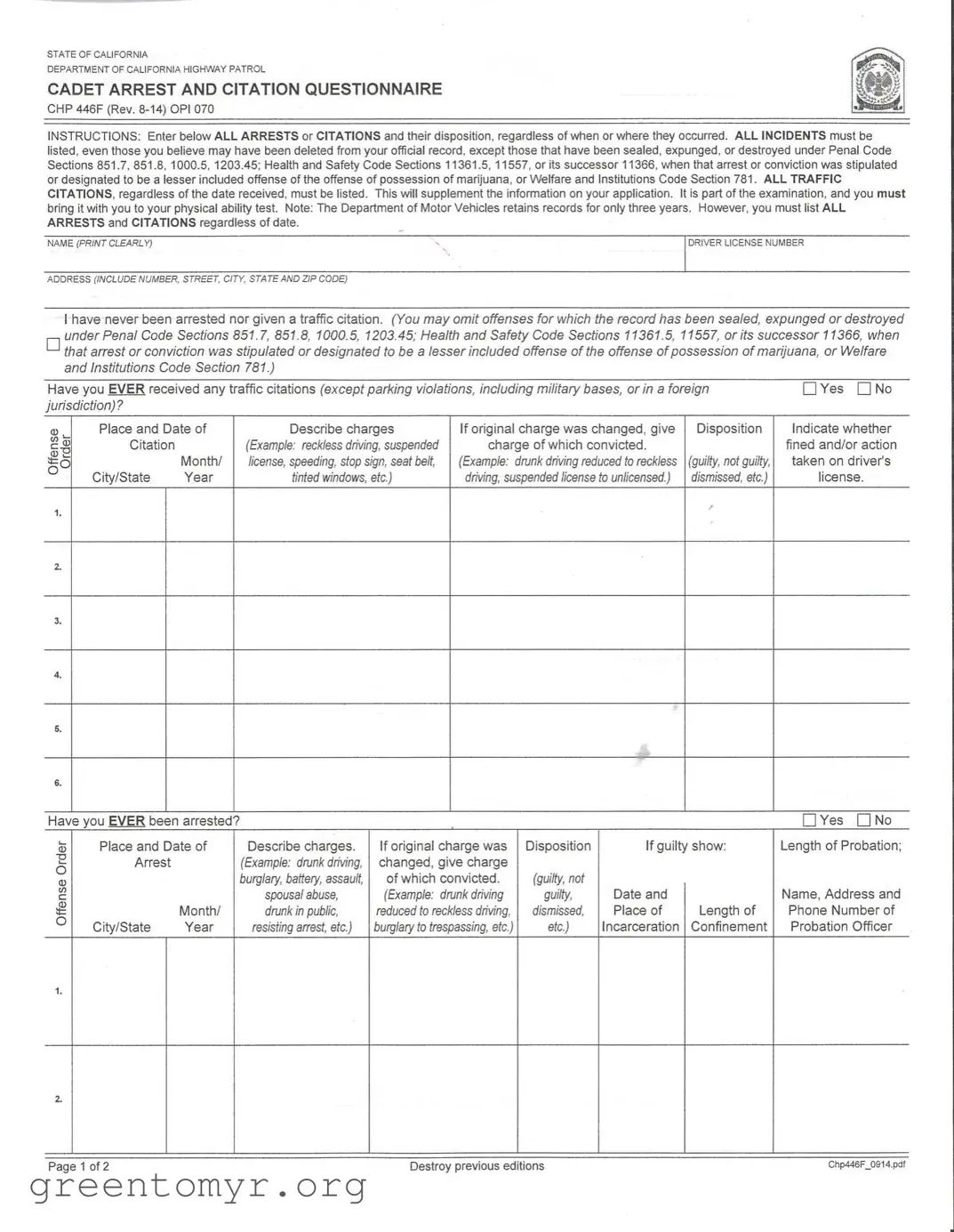
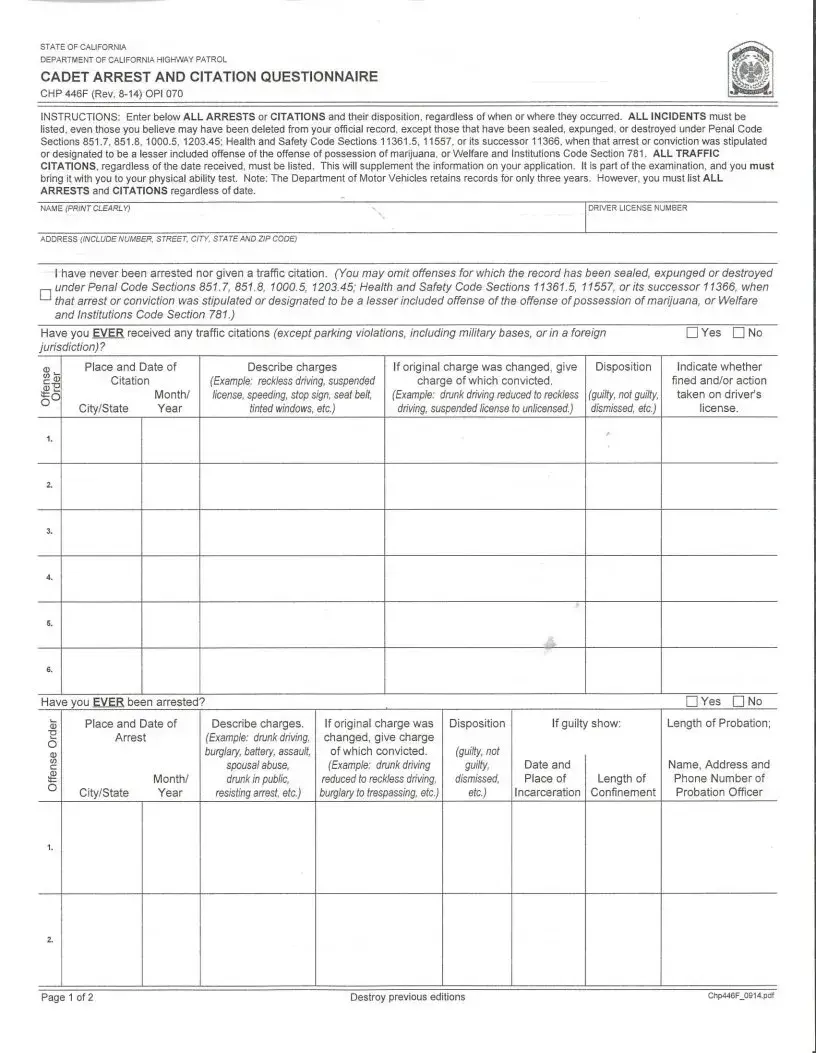
The CHP 446F form, officially known as the Cadet Arrest and Citation Questionnaire, plays a crucial role in the application process for those aspiring to join the California Highway Patrol. This form requires applicants to provide a comprehensive account of all arrests and citations they have received, regardless of when or where these incidents occurred. It emphasizes the importance of transparency, urging candidates to disclose even those incidents that may not appear on their official records, except for those that have been legally sealed or expunged. Traffic citations, in particular, must be listed without exception, as they contribute to the overall assessment of an applicant's background. The form serves as a supplement to the application and must be presented during the physical ability test, highlighting its significance in the evaluation process. By collecting this information, the California Highway Patrol ensures that they can conduct thorough background checks, which are essential for maintaining the integrity and safety of their law enforcement personnel. Understanding the requirements and implications of the CHP 446F form is vital for prospective cadets, as it not only impacts their application but also reflects their commitment to honesty and accountability in their pursuit of a career in law enforcement.
| Fact Name | Details |
|---|---|
| Form Purpose | The CHP 446F form is designed for applicants to disclose all arrests and citations as part of the California Highway Patrol's hiring process. |
| Governing Law | This form is governed by various California Penal Code sections, including 851.7, 851.8, and 1203.45, which outline the requirements for reporting arrests and convictions. |
| Traffic Citations | All traffic citations, regardless of when they occurred, must be reported on this form, ensuring a comprehensive background check. |
| Sealed Records | Arrests or convictions that have been sealed, expunged, or destroyed under specific California laws do not need to be reported. |
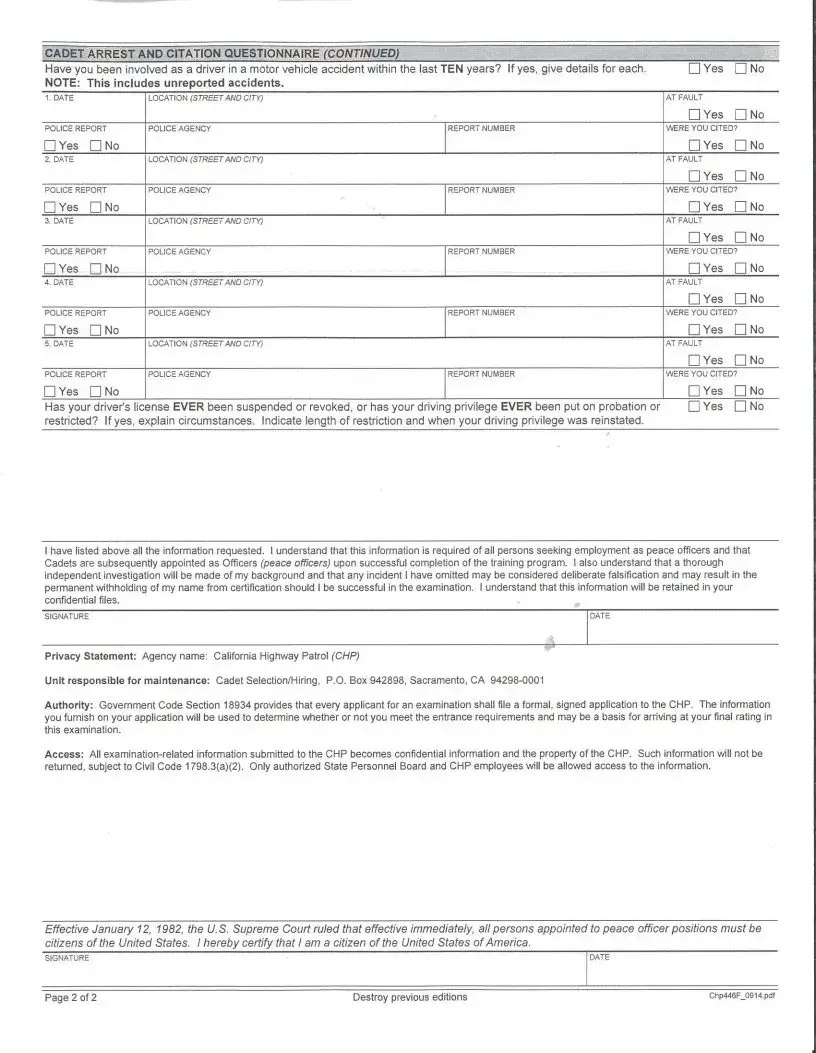
| Accident Reporting | Applicants must disclose any motor vehicle accidents they were involved in within the last ten years, including unreported incidents. |
| Driver's License Status | The form requires applicants to state if their driver's license has ever been suspended or revoked, along with the reasons for such actions. |
| Confidentiality | Information provided on the form is confidential and will be retained by the California Highway Patrol for hiring purposes. |
| Citizenship Requirement | As per U.S. Supreme Court rulings, all applicants for peace officer positions must be U.S. citizens. |
| Signature Requirement | Applicants must sign the form, certifying the accuracy of the information provided and acknowledging the potential consequences of omissions. |
Completing the CHP 446F form is an essential step in your application process. This form requires you to provide detailed information about any arrests or citations you have received. Make sure to gather all necessary information before starting, as accuracy is crucial.
After completing the form, review it carefully to ensure all information is correct. Bring the completed form with you to your physical ability test as it is a vital part of the examination process.
The CHP 446F form is a Cadet Arrest and Citation Questionnaire required by the California Highway Patrol (CHP). It collects detailed information about any arrests or traffic citations an applicant has received. This information is crucial for assessing the background of individuals seeking employment as peace officers.
All individuals applying for a position as a cadet with the California Highway Patrol must complete the CHP 446F form. This includes anyone who has ever been arrested or cited for traffic violations, regardless of when or where these incidents occurred.
Applicants must report all arrests and traffic citations, including those that may have been sealed, expunged, or destroyed, unless they fall under specific legal exemptions. This includes:
If you have never been arrested or received a traffic citation, you can indicate this on the form. However, it is essential to be truthful and thorough in your responses, as any omissions could be viewed as deliberate falsification.
If your driver's license has ever been suspended or revoked, or if your driving privileges have been restricted, you must provide an explanation on the form. Include details about the circumstances, the length of the restriction, and when your driving privileges were reinstated.
When reporting traffic citations, you should include the following details for each citation:
Omitting any information from the CHP 446F form can have serious consequences. The CHP conducts thorough background checks, and any discrepancies or omissions may be viewed as an attempt to mislead. This could result in disqualification from the hiring process or permanent removal from consideration for certification.
Yes, the information submitted on the CHP 446F form is treated as confidential. It becomes the property of the California Highway Patrol and will not be returned. Access to this information is limited to authorized personnel only.
If you have further questions about the CHP 446F form or the application process, it is advisable to contact the Cadet Selection/Hiring Unit of the California Highway Patrol. They can provide guidance and clarification on any concerns you may have.
Completing the CHP 446F form can seem straightforward, but many applicants make common mistakes that can lead to complications in their application process. Understanding these pitfalls can save time and ensure a smoother experience.
One frequent error is failing to list all arrests and citations. Even if an incident seems minor or has been removed from an official record, it must still be disclosed unless it has been sealed or expunged under specific legal codes. Omitting any details can raise red flags during the background check.
Another mistake is not including traffic citations. Many applicants mistakenly believe that only significant offenses need to be reported. However, the form explicitly requires all traffic citations, regardless of their severity or date. This includes anything from speeding tickets to minor infractions.
Completing the form with illegible handwriting is also a common issue. Clear, legible writing is essential. If the reviewing officer cannot read the information provided, it can lead to misunderstandings or delays in processing the application.
Some individuals also struggle with providing incomplete information. Each section of the form requires specific details, such as dates, locations, and outcomes of incidents. Leaving any part blank or providing vague responses can lead to confusion and may be perceived as an attempt to hide information.
Another oversight is misunderstanding the instructions regarding sealed records. While it is true that certain offenses can be omitted, applicants often misinterpret what qualifies. It is crucial to understand the legal definitions and ensure that any relevant incidents are disclosed appropriately.
Many applicants also forget to double-check their personal information. Errors in names, addresses, or driver's license numbers can create significant delays or issues. A simple typo can lead to complications in verifying identity or background checks.
Lastly, some individuals may neglect to sign and date the form. This may seem trivial, but without a signature, the form is not valid. Ensuring all sections are complete and that the form is signed is vital for it to be accepted.
By being aware of these common mistakes, applicants can approach the CHP 446F form with greater confidence and accuracy, ultimately enhancing their chances of a successful application process.
The CHP 446F form, known as the Cadet Arrest and Citation Questionnaire, is an essential document for individuals seeking employment with the California Highway Patrol. It requires applicants to disclose all arrests and citations they have received. Alongside this form, several other documents may also be necessary to complete the application process. Below is a list of commonly used forms and documents that complement the CHP 446F form.
Each of these documents plays a vital role in the application process for the California Highway Patrol. They help ensure that candidates are thoroughly vetted and meet the necessary qualifications for a career in law enforcement. Completing these forms accurately and honestly is crucial for a successful application.
The CHP 446F form, which is the Cadet Arrest and Citation Questionnaire, has similarities with several other documents used in legal and law enforcement contexts. Here are five documents that share common features with the CHP 446F form:
When filling out the CHP 446F form, there are important dos and don'ts to keep in mind. Following these guidelines can help ensure your application is complete and accurate.
Understanding the CHP 446F form is essential for applicants seeking employment with the California Highway Patrol. However, several misconceptions can lead to confusion. Below is a list of common misunderstandings about this form:
Being aware of these misconceptions can help ensure that applicants complete the CHP 446F form accurately and comprehensively, facilitating a smoother application process.
When filling out the CHP 446F form, keep the following key takeaways in mind: