Content Navigation

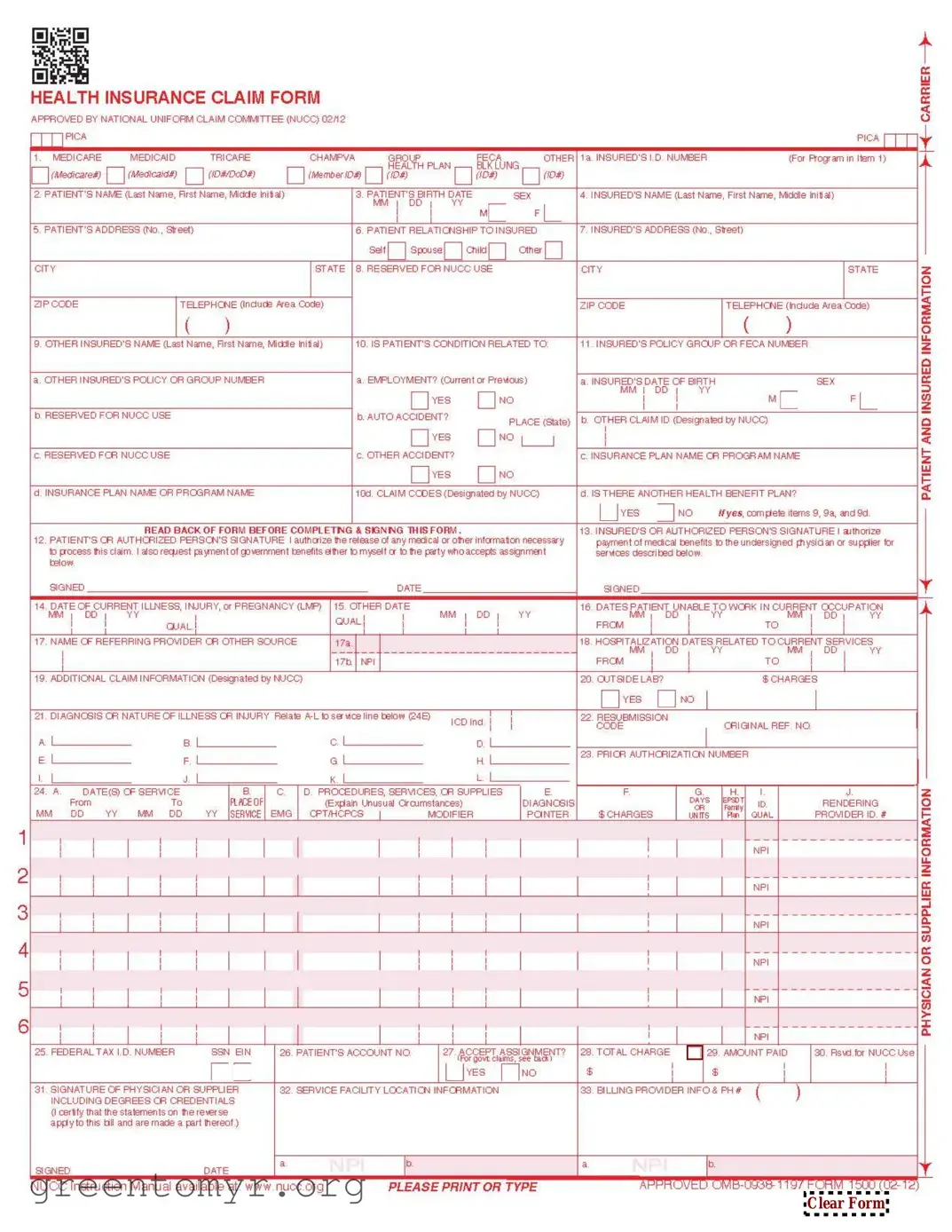
The CMS 1500 form serves as a vital tool in the healthcare billing process, facilitating the submission of claims for reimbursement from insurance providers. This standardized form is utilized primarily by healthcare professionals, including physicians and non-physician practitioners, to report services rendered to patients. Key sections of the CMS 1500 form include patient information, provider details, and a comprehensive list of services provided, complete with corresponding codes. Each field must be filled out accurately to ensure prompt payment and reduce the likelihood of claim denials. Additionally, the form captures essential data such as diagnosis codes, which help insurers understand the medical necessity of the services billed. Understanding the intricacies of the CMS 1500 form is crucial for healthcare providers, as it directly impacts their revenue cycle and the overall efficiency of healthcare delivery.
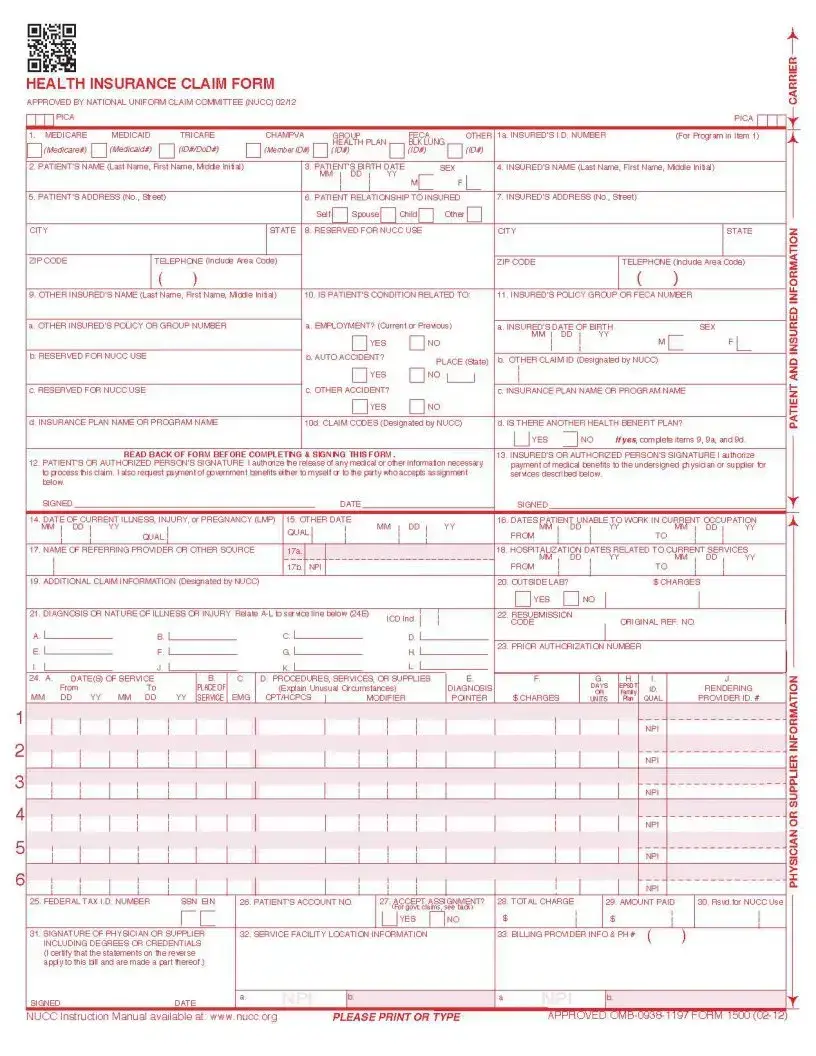
CMS 1500 Example

File Breakdown

Fact Name Description
Purpose The CMS 1500 form is primarily used for billing Medicare and Medicaid services, as well as private insurance claims.
Format This form is typically filled out in a paper format, but electronic submissions are also accepted in many cases.
Required Information Patients' demographic information, insurance details, and the services provided must be accurately recorded on the form.
State-Specific Forms Some states may have variations of the CMS 1500 form. For instance, California adheres to the California Code of Regulations Title 22.
Submission Process Providers must submit the completed form to the appropriate insurance company or government agency for reimbursement.
Updates The CMS 1500 form is periodically updated to reflect changes in healthcare regulations and billing practices.

Guide to Using CMS 1500

Once you have the CMS 1500 form in front of you, it's important to fill it out accurately to ensure proper processing. Follow these steps carefully to complete the form correctly.

  1. Begin by entering the patient's information in the designated fields. Include their name, address, and date of birth.
  2. Provide the insurance information. Fill in the policyholder's details, including their name, policy number, and group number.
  3. In the next section, enter the provider's information. This includes the name, address, and National Provider Identifier (NPI) number.
  4. Indicate the patient's relationship to the insured. Use the appropriate code to show whether they are the policyholder, spouse, child, or other.
  5. Complete the section for the diagnosis codes. Use the appropriate codes that correspond to the patient's condition.
  6. Fill out the procedure codes for the services provided. Make sure to use the correct codes for each service rendered.
  7. List the dates of service. Provide the exact dates when the services were performed.
  8. Include the total charges for each service in the designated field.
  9. Sign and date the form at the bottom to certify that the information is accurate.

After completing the form, review it for any errors or missing information. Once everything is confirmed, you can submit it to the appropriate insurance company or agency for processing.

Get Answers on CMS 1500

What is the CMS 1500 form?

The CMS 1500 form is a standardized document used by healthcare providers to bill Medicare and other insurance companies for medical services provided to patients. It captures essential information about the patient, the provider, and the services rendered, ensuring that claims are processed efficiently.

Who uses the CMS 1500 form?

This form is primarily used by non-institutional providers, such as physicians, therapists, and other healthcare professionals. It is essential for billing outpatient services and is widely accepted by various insurance carriers.

What information is required on the CMS 1500 form?

Key information includes:

  • Patient's demographic details (name, address, date of birth)
  • Insurance information (policy number, group number)
  • Provider's details (name, NPI number, address)
  • Diagnosis codes (ICD-10 codes)
  • Procedure codes (CPT or HCPCS codes)
  • Dates of service

How do I fill out the CMS 1500 form?

To complete the form, follow these steps:

  1. Gather all necessary patient and insurance information.
  2. Accurately fill in each section of the form, ensuring that all codes are correct.
  3. Double-check for any missing information or errors.
  4. Submit the form electronically or by mail, depending on the requirements of the insurance provider.

Where can I obtain a CMS 1500 form?

You can download the CMS 1500 form from the official CMS website or obtain printed copies from various medical supply companies. Many billing software programs also include the form as part of their services.

What are common mistakes to avoid when using the CMS 1500 form?

Common mistakes include:

  • Incorrect patient or provider information
  • Missing diagnosis or procedure codes
  • Inaccurate dates of service
  • Failure to sign the form if required

How long does it take to process a claim submitted on the CMS 1500 form?

Claim processing times can vary by insurer, but typically it takes anywhere from a few days to several weeks. Prompt submission and accurate information can help expedite the process.

What should I do if my claim is denied?

If a claim is denied, review the denial notice for specific reasons. Common reasons include coding errors, lack of medical necessity, or missing information. You can appeal the denial by providing the necessary documentation and correcting any mistakes in the original submission.

Is electronic submission of the CMS 1500 form allowed?

Yes, electronic submission is not only allowed but encouraged. Many insurers prefer electronic claims as they are processed faster. Ensure that you comply with the specific electronic submission guidelines set by the insurance carrier.

Common mistakes

Filling out the CMS 1500 form can be challenging, and mistakes can lead to delays in payment or claim denials. One common error is providing incorrect patient information. This includes misspelling names or entering the wrong date of birth. Such inaccuracies can cause confusion and may result in the claim being rejected. Always double-check the details before submitting.

Another frequent mistake involves the use of the wrong billing codes. The CMS 1500 form requires specific codes for diagnoses and procedures. If these codes do not match the services provided, the claim may be denied. Ensure that you are using the most current codes and that they accurately reflect the treatment given.

Many people also overlook the importance of completing all required fields. Leaving sections blank can lead to automatic denials. Each box on the form has a purpose, and filling out every necessary part is crucial for a smooth claims process. Take your time and ensure that nothing is missing.

Additionally, some individuals fail to sign the form. A signature is essential to validate the claim and confirm that the information provided is accurate. Without a signature, the form may not be processed. Always remember to sign and date the form before submission.

Lastly, not keeping copies of submitted forms is a mistake that can come back to haunt you. If a claim is denied or requires follow-up, having a copy of the original form can help clarify what was submitted. Always maintain a record of your submissions for future reference.

Documents used along the form

The CMS 1500 form is a crucial document used for billing and reimbursement in the healthcare industry. Along with this form, several other documents may be necessary to ensure a smooth claims process. Here are five commonly used forms and documents that often accompany the CMS 1500 form:

  • Superbill: This document serves as a detailed invoice for services rendered, including diagnosis codes, procedure codes, and patient information. It helps healthcare providers keep track of the services they provide.
  • Patient Registration Form: This form collects essential information from patients, such as personal details, insurance information, and medical history. It is vital for establishing a patient’s profile in the healthcare system.
  • Insurance Verification Form: This document is used to confirm a patient’s insurance coverage and benefits before services are rendered. It helps avoid billing issues later on.
  • Referral Form: When a patient needs to see a specialist, a referral form is often required. This document includes details about the patient's condition and the reason for the referral, ensuring the specialist has the necessary context.
  • Clinical Notes: These notes provide a record of the patient’s treatment and progress. They can support the claims process by justifying the medical necessity of the services billed on the CMS 1500 form.

Understanding these accompanying documents can streamline the billing process and improve communication between healthcare providers and insurance companies. Proper documentation ensures that claims are processed efficiently and accurately.

Similar forms

The CMS 1500 form is a key document used in the healthcare industry for billing purposes. Several other forms share similarities with it, primarily in their function and structure. Here are four documents that are comparable to the CMS 1500 form:

  • UB-04 Form: This form is used by hospitals and other healthcare facilities for billing services. Like the CMS 1500, it captures patient information, services provided, and billing details, but it is specifically designed for institutional claims rather than professional services.
  • HCFA 1500 Form: This is essentially the same as the CMS 1500 form, as HCFA was the former name of the Centers for Medicare & Medicaid Services. It serves the same purpose of submitting claims for medical services rendered by healthcare professionals.
  • CMS 1450 Form: Similar to the UB-04, the CMS 1450 is used for billing institutional services. It contains information about patient demographics, diagnosis codes, and services, making it a vital tool for healthcare facilities in submitting claims to insurers.
  • Superbill: A superbill is an itemized form used by healthcare providers to capture services rendered to patients. While it is not submitted directly to insurers, it serves as a basis for generating claims like the CMS 1500, ensuring that all necessary information is recorded for billing purposes.

Dos and Don'ts

When filling out the CMS 1500 form, it's important to follow certain guidelines to ensure accuracy and compliance. Below is a list of things you should and shouldn't do.

  • Do verify all patient information for accuracy.
  • Do use black ink and write clearly.
  • Do include the correct National Provider Identifier (NPI) number.
  • Do check for required signatures before submission.
  • Don't leave any required fields blank.
  • Don't use abbreviations that may cause confusion.

Following these guidelines can help streamline the claims process and reduce the chances of delays or rejections.

Misconceptions

The CMS 1500 form is a crucial document in the healthcare billing process, yet many people hold misconceptions about it. Here are seven common misunderstandings:

  • It's only for physicians. Many believe that only doctors can use the CMS 1500 form. In reality, a variety of healthcare providers, including therapists, chiropractors, and other non-physician practitioners, can submit claims using this form.
  • It’s only used for Medicare claims. While the CMS 1500 form is often associated with Medicare, it is actually used for a wide range of insurance claims, including Medicaid and private insurance.
  • Filling it out is the same for every provider. Different providers may have unique requirements when completing the form. Each insurance company may request specific information, so it’s essential to check their guidelines.
  • Only the patient can submit the form. Some think that only patients can submit the CMS 1500 form. However, healthcare providers can submit claims on behalf of their patients, making the process easier for everyone involved.
  • It doesn’t require supporting documentation. Many people assume that the CMS 1500 form is a standalone document. In many cases, insurers require supporting documents, such as medical records or notes, to process the claim.
  • Once submitted, it can't be changed. Some believe that once the form is submitted, it’s set in stone. In fact, if errors are discovered, providers can often submit corrected claims to rectify any mistakes.
  • All insurance companies accept the same version. Lastly, there’s a misconception that all insurers accept the same version of the CMS 1500 form. Different insurers may have their own specifications, so it’s important to ensure compliance with each one’s requirements.

Understanding these misconceptions can help streamline the billing process and improve communication between healthcare providers and insurers.

Key takeaways

The CMS 1500 form is essential for healthcare providers when submitting claims to insurance companies. Here are some key takeaways to keep in mind:

  • Accurate Information: Ensure that all patient and provider information is filled out accurately to avoid delays in payment.
  • Correct Coding: Use the appropriate CPT and ICD-10 codes for the services rendered. Incorrect codes can lead to claim denials.
  • Signature Requirement: The patient’s signature is necessary on the form to authorize payment and release of medical information.
  • Timely Submission: Submit the form within the required timeframe set by the insurance company to ensure prompt processing.
  • Use of Red Ink: Do not use red ink to fill out the form. Black ink is preferred to ensure clarity and readability.
  • Complete Sections: Fill out all required sections completely. Missing information can result in claim rejections.
  • Review Before Submission: Double-check all entries before sending the form. Mistakes can be costly and time-consuming to correct.
  • Keep Copies: Always keep copies of submitted forms for your records. This can help resolve any disputes or questions that arise later.
  • Follow Up: After submission, follow up with the insurance company to confirm receipt and check the status of your claim.