Starting a business in Colorado requires careful planning and the right paperwork. One of the most crucial documents in this process is the Articles of Incorporation form. This form lays the foundation for your corporation, detailing essential information such as the corporation's name, its purpose, and the address of its principal office. Additionally, it includes the names and addresses of the initial directors, as well as the registered agent responsible for receiving legal documents. By filing the Articles of Incorporation, you not only establish your business as a legal entity but also protect your personal assets from business liabilities. Understanding the requirements and implications of this form is vital for anyone looking to navigate the incorporation process smoothly. Whether you’re a seasoned entrepreneur or a first-time business owner, grasping the key elements of the Articles of Incorporation will help you set your business on the right path.
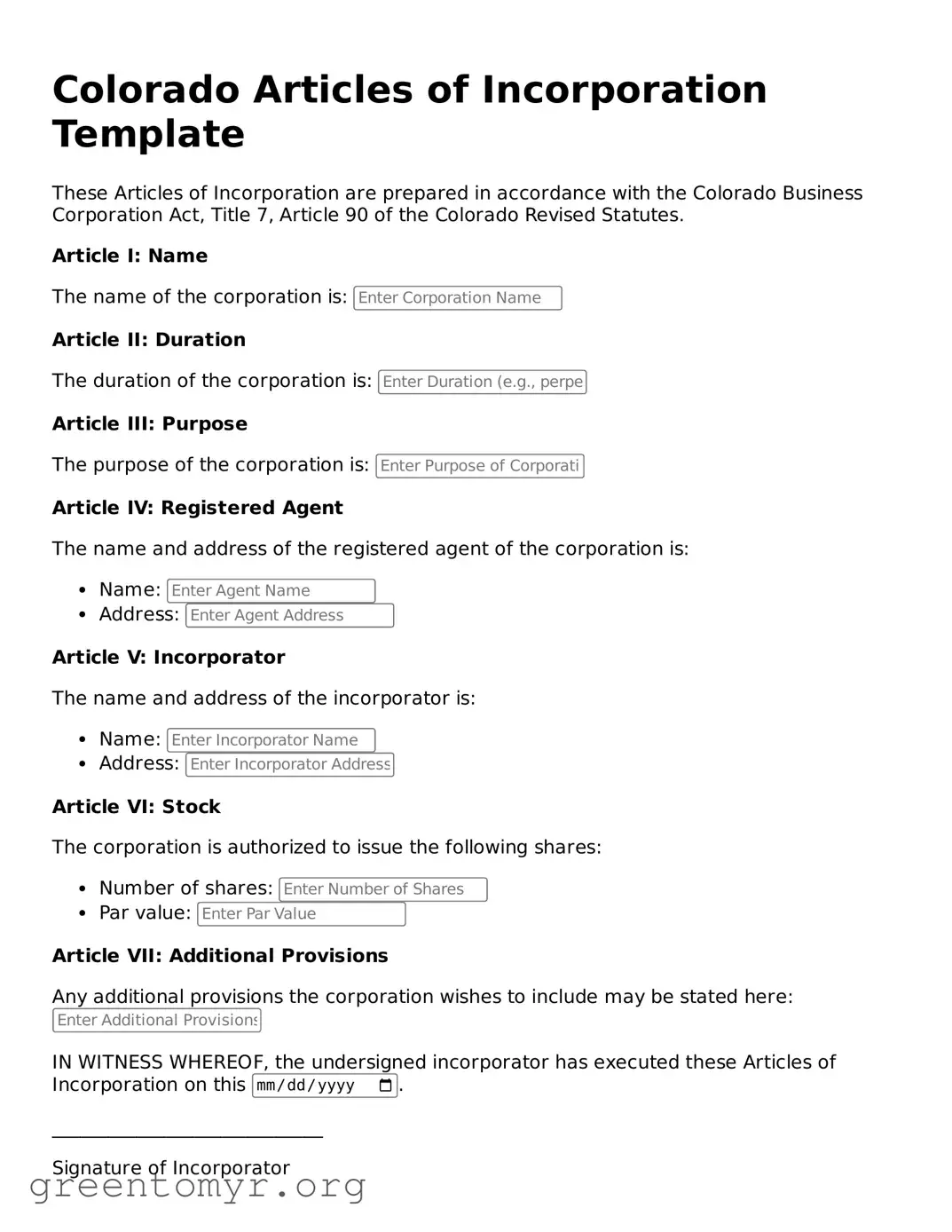
Colorado Articles of Incorporation Template
These Articles of Incorporation are prepared in accordance with the Colorado Business Corporation Act, Title 7, Article 90 of the Colorado Revised Statutes.
Article I: Name
The name of the corporation is:
Article II: Duration
The duration of the corporation is:
Article III: Purpose
The purpose of the corporation is:
Article IV: Registered Agent
The name and address of the registered agent of the corporation is:
Article V: Incorporator
The name and address of the incorporator is:
Article VI: Stock
The corporation is authorized to issue the following shares:
Article VII: Additional Provisions
Any additional provisions the corporation wishes to include may be stated here:
IN WITNESS WHEREOF, the undersigned incorporator has executed these Articles of Incorporation on this .
_____________________________
Signature of Incorporator
| Fact Name | Description |
|---|---|
| Purpose | The Colorado Articles of Incorporation form is used to officially create a corporation in the state of Colorado. |
| Governing Laws | The form is governed by the Colorado Business Corporation Act, specifically Title 7, Article 101 of the Colorado Revised Statutes. |
| Filing Requirement | To legally establish a corporation, the Articles of Incorporation must be filed with the Colorado Secretary of State. |
| Information Needed | Key information includes the corporation's name, registered agent, and the number of shares the corporation is authorized to issue. |
| Filing Fees | A filing fee is required when submitting the Articles of Incorporation. As of the latest update, the fee is $50. |
Filling out the Colorado Articles of Incorporation form is an important step in establishing your business as a legal entity. After completing the form, you will need to submit it to the Colorado Secretary of State's office along with the required filing fee. This process sets the foundation for your corporation and allows you to operate legally within the state.
The Articles of Incorporation is a legal document that establishes a corporation in the state of Colorado. This document is essential for anyone looking to create a corporation, as it outlines the basic structure and purpose of the business. It includes important information such as the corporation's name, registered agent, and the number of shares the corporation is authorized to issue. By filing this document, you formally register your corporation with the state, granting it legal recognition.
Filing the Articles of Incorporation in Colorado can be done online or by mail. Here’s a simple guide to help you through the process:
When filling out the Articles of Incorporation, you will need to provide several key pieces of information:
The filing fee for the Articles of Incorporation in Colorado is typically $50 if submitted online. If you choose to file by mail, the fee remains the same, but you may need to account for additional mailing costs. It’s important to check the Colorado Secretary of State’s website for the most current fee structure, as fees can change.
Yes, you can amend the Articles of Incorporation after they have been filed. If there are changes to the corporation’s name, registered agent, or other important details, an amendment must be filed with the Colorado Secretary of State. This process involves completing the appropriate amendment form and paying a filing fee. Keeping your Articles of Incorporation up to date is crucial for maintaining good standing with the state and ensuring compliance with legal requirements.
Filling out the Colorado Articles of Incorporation form can be a straightforward process, but mistakes can lead to delays or even rejection of the application. One common error is not providing the correct name for the corporation. The name must be unique and distinguishable from other registered entities in Colorado. If someone chooses a name that is too similar to an existing business, it will be rejected.
Another frequent mistake involves failing to include the required registered agent information. The registered agent must have a physical address in Colorado and be available during business hours. Omitting this information or providing an incorrect address can result in complications later on.
People often overlook the importance of specifying the purpose of the corporation. While it may seem like a minor detail, the purpose must be clear and compliant with Colorado law. Vague descriptions can lead to questions from the state, causing delays in processing.
Additionally, many applicants forget to indicate the number of shares the corporation is authorized to issue. This section is crucial, as it determines how ownership is divided among shareholders. Leaving it blank or entering an incorrect number can create issues down the line.
Another mistake is not signing the form. The Articles of Incorporation must be signed by the incorporator. A missing signature will result in the form being returned for correction, which can slow down the incorporation process.
Some individuals also fail to include the correct filing fee. The state requires a specific fee to process the Articles of Incorporation. If the payment is incorrect or missing, the application will not be accepted.
Finally, people sometimes neglect to keep a copy of the submitted form. Having a copy can be helpful for future reference and for ensuring that all information provided is accurate. Without a copy, it can be challenging to track down what was submitted if any issues arise.
When incorporating a business in Colorado, several forms and documents may accompany the Articles of Incorporation. Each of these documents serves a specific purpose and helps ensure compliance with state regulations. Below is a list of commonly used forms and documents that may be required or beneficial during the incorporation process.
Understanding these documents can help streamline the incorporation process and ensure that all necessary steps are taken to establish a business legally and effectively. Consulting with a professional can provide additional guidance tailored to individual circumstances.
The Articles of Incorporation form is a key document for establishing a corporation. It shares similarities with several other important documents. Here’s a list of those documents and how they relate:
When filling out the Colorado Articles of Incorporation form, it is crucial to follow specific guidelines to ensure your submission is accurate and complete. Here is a list of things you should and shouldn't do:
By adhering to these guidelines, you can help ensure a smooth incorporation process in Colorado.
The Colorado Articles of Incorporation form is a critical document for establishing a corporation in the state. However, several misconceptions surround its use and requirements. Below is a list of ten common misconceptions, along with clarifications for each.
This is incorrect. Filing Articles of Incorporation is a mandatory step for anyone wishing to form a corporation in Colorado.
While individuals can complete the form, understanding the implications of the information provided is crucial. Misunderstandings can lead to legal issues down the line.
In Colorado, the Articles must include a statement of the business purpose, which is essential for legal recognition.
These are distinct documents. The Articles establish the corporation's existence, while the bylaws govern internal operations.
In fact, multiple individuals can be involved in the filing process, provided they meet the requirements set forth by the state.
This is false. Amendments can be made to the Articles of Incorporation as needed, following the proper legal procedures.
Fees vary depending on the type of corporation being formed, such as a nonprofit versus a for-profit entity.
There are specific timeframes and guidelines for filing, which must be adhered to in order to ensure compliance with state regulations.
Filing the Articles does not ensure profitability or success. It merely provides a legal framework for the business.
Ongoing compliance with state regulations, including annual reports and fees, is necessary to maintain the corporation's good standing.
When filling out and using the Colorado Articles of Incorporation form, several important points should be considered to ensure compliance and efficiency. Here are key takeaways:
Completing these steps accurately is crucial for the successful establishment of your corporation in Colorado. Take care to review all information before submission.