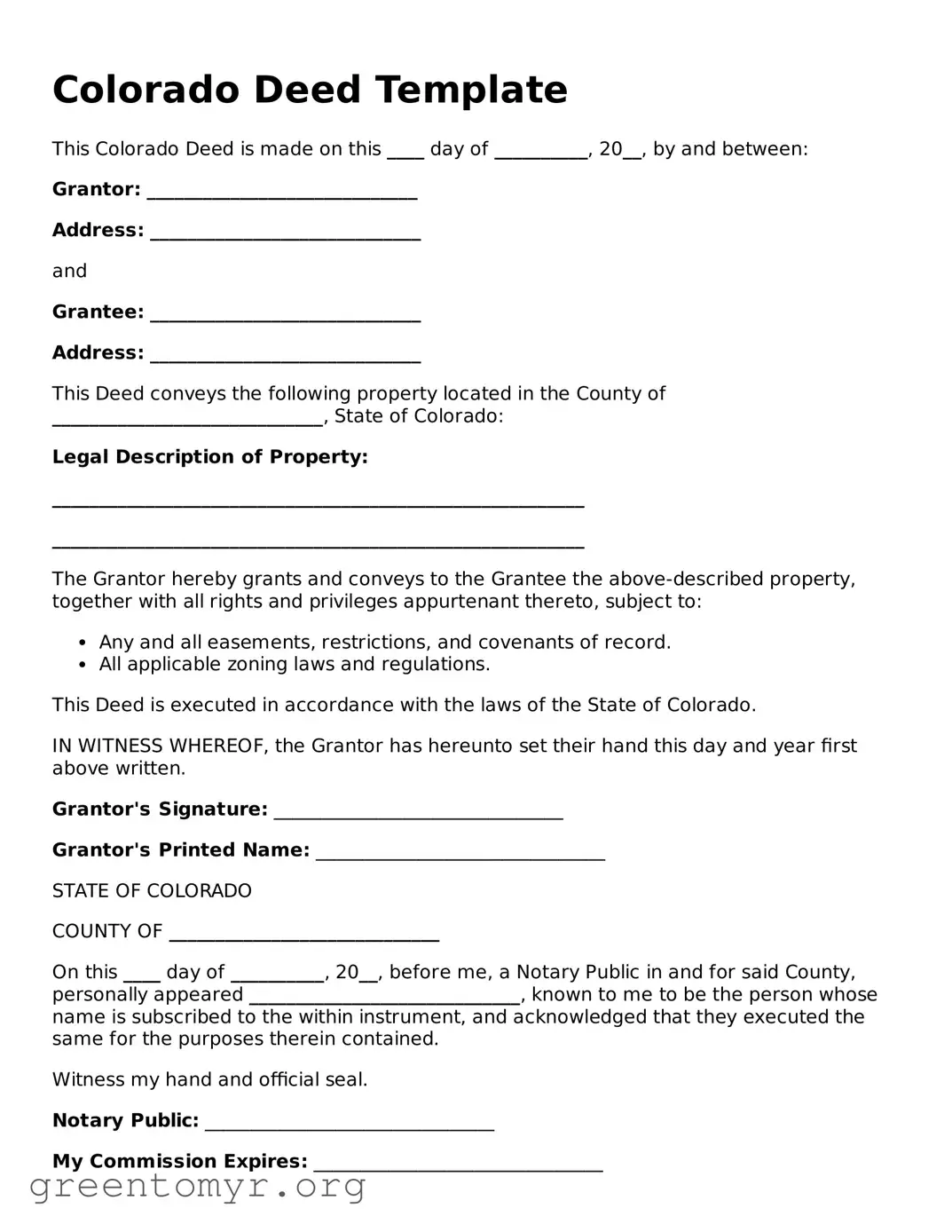
The Colorado Deed form serves as a critical document in real estate transactions, facilitating the transfer of property ownership from one party to another. This form outlines essential details, including the names of the grantor (the seller) and the grantee (the buyer), the legal description of the property, and the consideration paid for the transfer. Additionally, it may include specific covenants or warranties that protect the interests of the grantee. In Colorado, various types of deeds exist, such as warranty deeds and quitclaim deeds, each serving different purposes and providing varying levels of protection. Understanding the nuances of the Colorado Deed form is vital for anyone involved in property transactions, as it not only formalizes the transfer but also ensures compliance with state laws and regulations. Properly executed, this document can prevent future disputes and clarify ownership rights, making it an indispensable part of real estate dealings in the state.
Colorado Deed Template
This Colorado Deed is made on this ____ day of __________, 20__, by and between:
Grantor: _____________________________
Address: _____________________________
and
Grantee: _____________________________
Address: _____________________________
This Deed conveys the following property located in the County of _____________________________, State of Colorado:
Legal Description of Property:
_________________________________________________________
_________________________________________________________
The Grantor hereby grants and conveys to the Grantee the above-described property, together with all rights and privileges appurtenant thereto, subject to:
This Deed is executed in accordance with the laws of the State of Colorado.
IN WITNESS WHEREOF, the Grantor has hereunto set their hand this day and year first above written.
Grantor's Signature: _______________________________
Grantor's Printed Name: _______________________________
STATE OF COLORADO
COUNTY OF _____________________________
On this ____ day of __________, 20__, before me, a Notary Public in and for said County, personally appeared _____________________________, known to me to be the person whose name is subscribed to the within instrument, and acknowledged that they executed the same for the purposes therein contained.
Witness my hand and official seal.
Notary Public: _______________________________
My Commission Expires: _______________________________
| Fact Name | Description |
|---|---|
| Purpose | The Colorado Deed form is used to transfer ownership of real property from one party to another. |
| Types of Deeds | In Colorado, common types of deeds include Warranty Deeds, Quitclaim Deeds, and Special Warranty Deeds. |
| Governing Law | The Colorado Deed form is governed by Colorado Revised Statutes, specifically Title 38, Article 30. |
| Recording Requirement | To ensure legal protection, the deed must be recorded with the county clerk and recorder's office in the county where the property is located. |
Once you have the Colorado Deed form ready, it's time to fill it out accurately. Completing this form is crucial for ensuring that the transfer of property is legally recognized. Follow these steps carefully to ensure you provide all necessary information.
After completing the form, you will need to file it with the appropriate county clerk and recorder's office. This step is vital to officially record the transfer of property and protect the rights of both parties involved.
A Colorado Deed form is a legal document used to transfer ownership of real property in the state of Colorado. It provides a written record of the transaction and outlines the rights and responsibilities of the parties involved. Various types of deeds exist, including warranty deeds, quitclaim deeds, and special warranty deeds, each serving different purposes.
Anyone involved in the transfer of real property in Colorado will need a deed form. This includes:
In any of these cases, the deed serves as the official record of ownership transfer.
A Colorado Deed form typically requires the following information:
It is important to ensure all information is accurate to avoid complications during the transfer process.
To complete a Colorado Deed form, follow these steps:
Double-check all entries for accuracy before submission to prevent delays.
Yes, notarization is required for a Colorado Deed form. The grantor must sign the deed in front of a notary public. This step ensures that the signature is valid and that the grantor is willingly transferring ownership.
A Colorado Deed form can be used for various types of real property, including residential homes, commercial properties, and land. However, specific types of deeds may be more appropriate depending on the situation, such as a quitclaim deed for transferring property without warranties or a warranty deed for a full ownership transfer.
After filing the Colorado Deed form with the county clerk and recorder's office, the deed becomes part of the public record. This action officially documents the change in ownership. The new owner (grantee) should receive a copy of the recorded deed for their records.
A Colorado Deed form can be obtained from several sources, including:
Ensure that the form you obtain is up-to-date and complies with Colorado state laws.
When filling out the Colorado Deed form, many individuals make common mistakes that can lead to complications down the line. One frequent error is not providing complete information about the property. It's essential to include the correct legal description, which identifies the property precisely. Omitting or incorrectly stating this information can result in disputes or challenges to ownership.
Another mistake often seen is failing to properly identify the parties involved. The grantor (the person transferring the property) and the grantee (the person receiving the property) must be clearly named. If the names are misspelled or if titles such as "Mr." or "Mrs." are omitted, it may create confusion or legal issues later.
People sometimes overlook the necessity of signatures. The Colorado Deed form requires the grantor's signature to validate the transfer. If the grantor does not sign the document, or if the signature is not notarized, the deed may not be legally enforceable. This oversight can lead to significant delays in property transactions.
Additionally, individuals may neglect to consider the implications of how they hold title. The way property is titled can affect ownership rights, tax implications, and inheritance issues. For example, holding property as joint tenants with rights of survivorship differs significantly from holding it as tenants in common. Understanding these distinctions is crucial for proper estate planning.
Finally, many people fail to record the deed with the appropriate county clerk and recorder's office. While a deed may be valid upon signing, recording it provides public notice of ownership and protects against future claims. Failing to record the deed can leave the new owner vulnerable to disputes from third parties.
When completing a property transfer in Colorado, several forms and documents often accompany the Colorado Deed form. These documents help ensure that the transaction is legally sound and that all necessary information is provided. Below is a list of commonly used forms that may be required during the process.
Utilizing these forms alongside the Colorado Deed form can facilitate a smoother property transfer process. Each document serves a specific purpose, contributing to a comprehensive understanding of the transaction for all parties involved.
The Deed form is an important legal document that serves specific purposes in property transactions and other legal matters. Several documents share similarities with the Deed form in terms of function and intent. Here are four such documents:
When filling out the Colorado Deed form, it’s important to follow specific guidelines to ensure accuracy and compliance. Here’s a list of things to do and avoid:
By following these guidelines, you can help ensure that your Colorado Deed form is completed correctly and efficiently.
Understanding the Colorado Deed form can be challenging, and many misconceptions can lead to confusion. Here are ten common misconceptions about the Colorado Deed form, along with clarifications.
All deeds are the same. Many people believe that all deeds serve the same purpose. In reality, there are different types of deeds, such as warranty deeds and quitclaim deeds, each with specific legal implications and protections.
Deeds must be notarized to be valid. While notarization is important for many legal documents, in Colorado, a deed is valid if it is signed by the grantor. However, notarization is recommended for clarity and to prevent disputes.
A deed transfers ownership immediately. Some assume that signing a deed instantly transfers property ownership. In fact, the transfer becomes effective only when the deed is delivered and accepted by the grantee.
You cannot change a deed once it’s recorded. This is a common belief, but deeds can be amended or corrected through a new deed, such as a corrective deed, as long as the process is followed properly.
All deeds require a title search. While conducting a title search is highly advisable, it is not a legal requirement for the validity of a deed. However, it helps ensure there are no liens or claims against the property.
Only lawyers can prepare deeds. Many think that only licensed attorneys can draft deeds. In Colorado, property owners can prepare their own deeds, but it is wise to seek legal advice to avoid mistakes.
Property taxes are unaffected by the deed. Some believe that changing the deed has no impact on property taxes. However, a change in ownership can trigger a reassessment of property taxes in Colorado.
Once a deed is recorded, it cannot be challenged. This is a misconception. Even after recording, a deed can be contested in court if there are valid legal grounds, such as fraud or misrepresentation.
Deeds do not need to be filed with the county. Some people think that deeds can remain unfiled. In Colorado, recording a deed with the county clerk is essential to protect the grantee’s interests and provide public notice.
All deeds are public records. While most deeds are public, some may contain confidential information. However, the basic details, such as the names of the parties and property description, are generally accessible to the public.
Being aware of these misconceptions can help individuals navigate property transactions more effectively and understand the importance of the Colorado Deed form.
Filling out and using the Colorado Deed form is an important process in property transactions. Understanding the key elements can help ensure that the deed is completed correctly and serves its intended purpose. Here are five key takeaways:
By keeping these takeaways in mind, individuals can navigate the process of filling out and using the Colorado Deed form more effectively.