The Colorado Employment Verification form plays a crucial role in the hiring process for employers across the state. This form is essential for confirming an employee's eligibility to work in the United States, ensuring compliance with both state and federal regulations. Employers must complete this document accurately to avoid potential legal issues. The form requires specific information about the employee, including personal details, employment history, and verification of work authorization. It serves as a safeguard against hiring individuals who do not possess the necessary legal status to work. Additionally, the form must be retained in the employee's file for a specified period, emphasizing the importance of proper record-keeping. Understanding the requirements and implications of the Colorado Employment Verification form is vital for both employers and employees to navigate the complexities of employment law effectively.
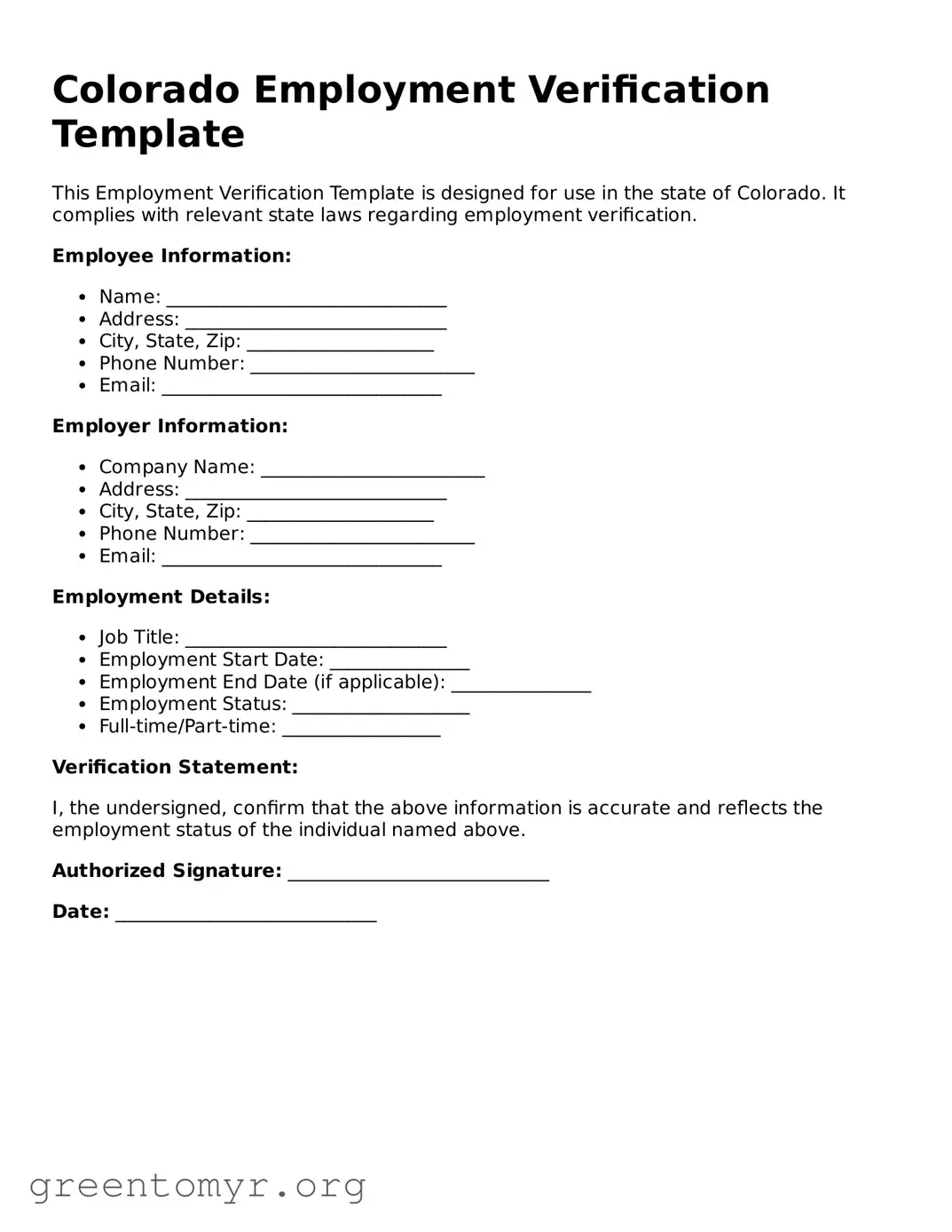
Colorado Employment Verification Template
This Employment Verification Template is designed for use in the state of Colorado. It complies with relevant state laws regarding employment verification.
Employee Information:
Employer Information:
Employment Details:
Verification Statement:
I, the undersigned, confirm that the above information is accurate and reflects the employment status of the individual named above.
Authorized Signature: ____________________________
Date: ____________________________
| Fact Name | Description |
|---|---|
| Purpose | The Colorado Employment Verification form is used to confirm the employment status of individuals for various purposes, including government benefits and legal matters. |
| Governing Law | This form is governed by Colorado Revised Statutes, particularly under Title 8, which pertains to labor and employment. |
| Mandatory Use | Employers in Colorado are required to use this form when verifying employment for certain state programs and benefits. |
| Information Required | The form typically requires details such as the employee's name, job title, and dates of employment. |
| Submission Process | Employers must submit the completed form to the appropriate state agency or organization requesting the verification. |
| Confidentiality | All information provided on the form is subject to privacy laws, ensuring that personal data is protected. |
| Signature Requirement | A signature from an authorized representative of the employer is typically required to validate the information provided. |
| Penalties for Non-Compliance | Failure to properly complete or submit the form may result in penalties for employers, including fines or loss of eligibility for state programs. |
After obtaining the Colorado Employment Verification form, you will need to complete it accurately to ensure it meets the necessary requirements. Follow these steps to fill out the form correctly.
The Colorado Employment Verification form is a document used by employers to verify the employment status of an individual. It serves as proof of employment for various purposes, such as applying for loans, housing, or other services that require confirmation of income and job status.
Typically, the form needs to be completed by employers when an employee requests verification of their employment. This may be necessary for employees applying for mortgages, rental agreements, or government assistance programs.
The form generally requires the following information:
An employee should contact their employer or human resources department to request the Employment Verification form. They may need to fill out a request form or provide written consent for the employer to release their employment details.
Yes, the form can be used to verify past employment. Employers can provide details regarding the employee's job title, dates of employment, and reasons for leaving, if applicable.
Generally, employers do not charge a fee for providing employment verification. However, some companies may have specific policies regarding this, so it is best to check with the employer's human resources department.
The time frame for receiving the Employment Verification can vary. Typically, employers process requests within a few business days. However, during busy periods, it may take longer. Employees should allow sufficient time for processing.
If an employer refuses to complete the Employment Verification form, the employee can ask for clarification on the reason. In some cases, it may be due to company policy or privacy concerns. Employees may also seek assistance from human resources or consider alternative methods to verify their employment.
Yes, third parties, such as lenders or landlords, can request Employment Verification. However, they typically need the employee's written consent to obtain this information from the employer.
The Employment Verification form is not a legally binding contract. It serves as a statement of employment status and is intended for informational purposes. Both parties should ensure the accuracy of the information provided to avoid any potential disputes.
Filling out the Colorado Employment Verification form can be straightforward, but many individuals make common mistakes that can lead to delays or complications. One frequent error is not providing accurate employee information. It’s essential to double-check names, Social Security numbers, and addresses. Incorrect details can cause significant issues down the line.
Another common mistake is failing to include all required signatures. The form typically requires signatures from both the employer and the employee. Missing one can render the entire document invalid. It’s crucial to ensure that all necessary parties have signed before submission.
Some people overlook the importance of providing complete employment details. This includes dates of employment, job titles, and descriptions of duties. Incomplete information can lead to confusion and may even result in a denial of benefits.
Additionally, many individuals forget to check the form for any updates or changes. Employment verification forms can be revised periodically. Using an outdated version can lead to errors and delays in processing.
Another mistake is not keeping a copy of the submitted form. It’s wise to maintain a record for future reference. This can be helpful if any questions arise or if there’s a need to verify the information later.
Some people rush through the process and fail to proofread their entries. Simple typos can change the meaning of the information provided. Taking a moment to review the form can prevent unnecessary complications.
It’s also important to understand the purpose of the form. Some individuals may not realize that the information provided will be used to verify employment history for loans, benefits, or other important matters. This understanding can emphasize the need for accuracy.
Lastly, not following up after submission is a mistake many make. After sending in the form, it’s essential to confirm receipt and check the status. This proactive approach can help ensure that everything is processed smoothly.
When employers in Colorado need to verify an employee's work history, they often use the Colorado Employment Verification form. However, several other forms and documents may accompany this verification process. Each serves a specific purpose in ensuring that the verification is accurate and compliant with legal requirements.
Understanding these documents can streamline the employment verification process. Each plays a crucial role in confirming an individual's employment history and qualifications, ensuring that employers make informed hiring decisions.
The Employment Verification form serves a crucial role in confirming an individual's employment status and history. Several other documents share similar purposes, each designed to provide verification or evidence of employment, income, or professional qualifications. Here are six documents that are similar to the Employment Verification form:
When filling out the Colorado Employment Verification form, it's essential to follow certain guidelines to ensure accuracy and compliance. Here’s a list of things you should and shouldn't do:
Understanding the Colorado Employment Verification form can be challenging due to various misconceptions. Below is a list of ten common misunderstandings regarding this form.
Being aware of these misconceptions can help individuals navigate the Employment Verification process more effectively.
Filling out the Colorado Employment Verification form is a straightforward process. Here are some key takeaways to keep in mind: