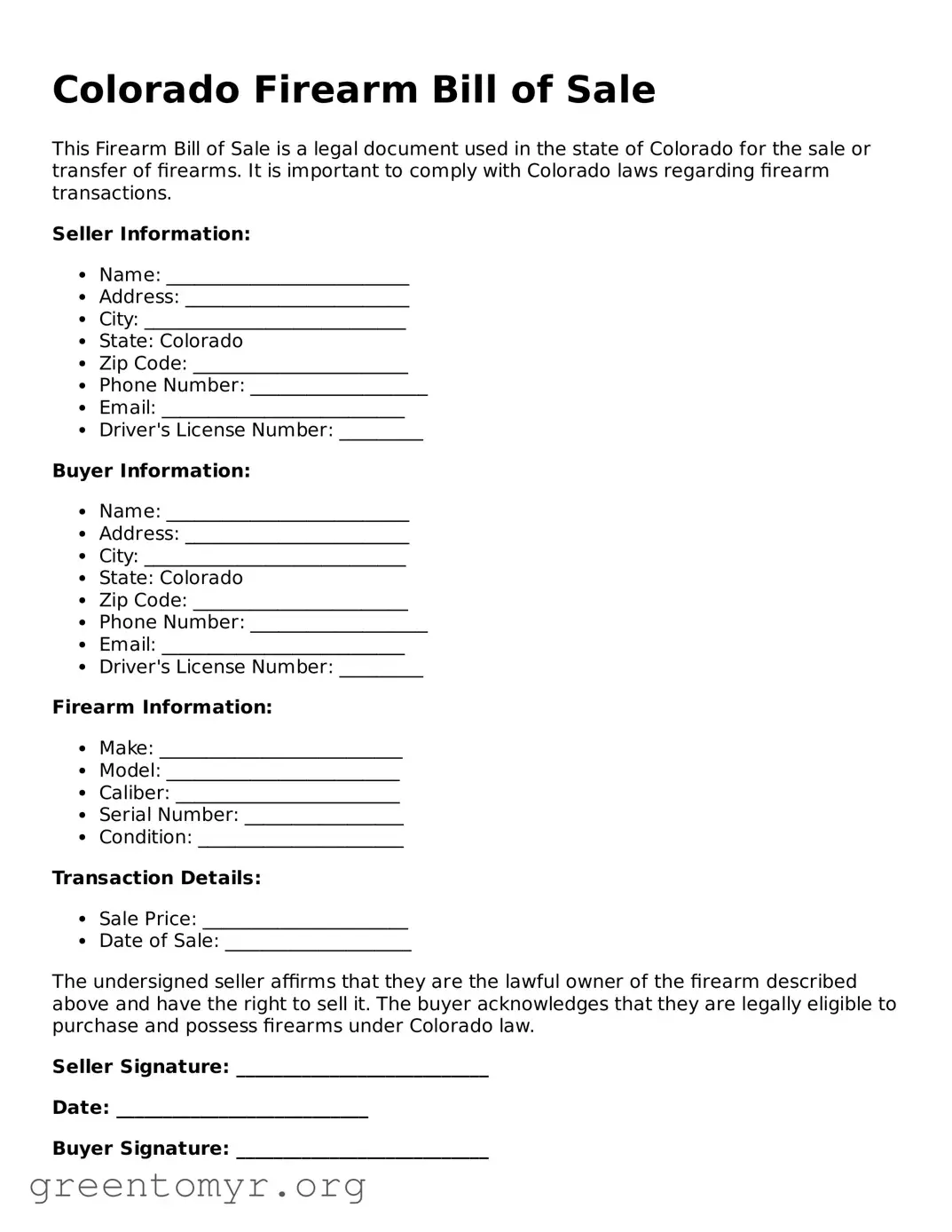
In Colorado, the Firearm Bill of Sale form plays a crucial role in the private sale of firearms, ensuring that both buyers and sellers are protected during the transaction. This form serves as a legal document that outlines the details of the sale, including the make, model, and serial number of the firearm, as well as the names and contact information of both parties involved. By documenting the transaction, the form helps establish ownership and can be invaluable in the event of future disputes or legal inquiries. Additionally, it provides a clear record of the sale, which is essential for compliance with state laws regarding firearm transfers. Understanding the importance of this form is vital for anyone engaging in the buying or selling of firearms in Colorado, as it not only safeguards individual rights but also promotes responsible ownership within the community.
Colorado Firearm Bill of Sale
This Firearm Bill of Sale is a legal document used in the state of Colorado for the sale or transfer of firearms. It is important to comply with Colorado laws regarding firearm transactions.
Seller Information:
Buyer Information:
Firearm Information:
Transaction Details:
The undersigned seller affirms that they are the lawful owner of the firearm described above and have the right to sell it. The buyer acknowledges that they are legally eligible to purchase and possess firearms under Colorado law.
Seller Signature: ___________________________
Date: ___________________________
Buyer Signature: ___________________________
Date: ___________________________
This document serves as a record of the transaction and should be retained by both parties for their records.
| Fact Name | Description |
|---|---|
| Purpose | The Colorado Firearm Bill of Sale form serves as a legal document to record the sale or transfer of a firearm between parties. |
| Legal Requirement | While not required by law, it is highly recommended to complete this form for personal protection and record-keeping. |
| Governing Law | The transfer of firearms in Colorado is governed by Colorado Revised Statutes, Title 18, Article 12. |
| Parties Involved | The form should include the names, addresses, and signatures of both the seller and the buyer. |
| Firearm Description | A detailed description of the firearm being sold must be included, such as make, model, and serial number. |
| Age Requirement | Both parties must be at least 18 years old to legally complete the transaction. |
| Background Check | In Colorado, a background check is required for all firearm sales conducted through licensed dealers. |
| Record Keeping | Both the buyer and seller should keep a copy of the completed Bill of Sale for their records. |
| Transfer of Ownership | The Bill of Sale signifies the transfer of ownership from the seller to the buyer once signed. |
| State Compliance | Completing the form helps ensure compliance with state laws regarding firearm transactions. |
Completing the Colorado Firearm Bill of Sale form is a straightforward process that requires careful attention to detail. Once filled out, this document serves as a record of the transaction between the buyer and the seller. It is essential to ensure all information is accurate and complete to avoid potential legal complications.
A Colorado Firearm Bill of Sale form is a document used to record the sale or transfer of a firearm between two parties. This form serves as proof of the transaction and includes essential details such as the names and addresses of both the seller and buyer, a description of the firearm, and the sale price. While it is not legally required in Colorado to have a bill of sale for private firearm sales, having one can provide legal protection for both parties involved in the transaction.
Using a Bill of Sale when selling or buying a firearm is important for several reasons:
When completing a Colorado Firearm Bill of Sale, it is essential to include specific information to ensure clarity and legal validity. The following details should be present:
In Colorado, it is not a legal requirement to have a Bill of Sale notarized for firearm transactions. However, having the document notarized can add an extra layer of authenticity and can be beneficial if any disputes arise in the future. Notarization can help verify the identities of the parties involved and confirm that both individuals willingly entered into the agreement. Therefore, while it is not mandatory, it is often a good practice to consider.
Filling out the Colorado Firearm Bill of Sale form requires attention to detail. One common mistake is failing to include all required information. Buyers and sellers must provide their full names, addresses, and identification details. Omitting any of this information can lead to complications in the transaction. Ensure that every section of the form is completed accurately to avoid potential issues.
Another frequent error is not properly identifying the firearm being sold. The form requires specific details, such as the make, model, and serial number of the firearm. Leaving out any of these details can create confusion or disputes later on. Always double-check that the firearm is correctly described to ensure clarity in the transaction.
Additionally, some individuals neglect to sign the form. Both the buyer and seller must sign the Bill of Sale to validate the transaction. Without signatures, the document may not hold up if there are any legal questions in the future. It’s crucial to remember that a signed form serves as proof of the sale.
Finally, failing to keep a copy of the completed form is a mistake that can lead to problems down the line. After filling out the Bill of Sale, both parties should retain a copy for their records. This documentation can be invaluable if questions arise about the transaction later on. Keeping a copy ensures that both parties have a reference point should any issues occur.
When engaging in the sale or transfer of firearms in Colorado, several documents may accompany the Firearm Bill of Sale form. These documents help ensure compliance with state laws and provide clarity for both parties involved in the transaction. Below are some commonly used forms and documents that may be relevant.
Utilizing these documents alongside the Firearm Bill of Sale form can help facilitate a smooth and legally compliant transfer of firearms. Always ensure that all forms are completed accurately to avoid any potential legal issues in the future.
The Firearm Bill of Sale form serves as an important document in the sale or transfer of firearms. Several other documents share similarities with this form, primarily in their purpose of recording transactions or agreements. Below is a list of nine documents that are similar to the Firearm Bill of Sale form:
When filling out the Colorado Firearm Bill of Sale form, it is essential to approach the process with care and attention to detail. Below is a list of ten important dos and don'ts to guide you through this task effectively.
Being diligent in following these guidelines will help ensure a smooth and legal transaction. Take this process seriously to protect both parties involved.
Understanding the Colorado Firearm Bill of Sale form can be challenging, and several misconceptions often arise. Here are eight common misunderstandings:
The Bill of Sale is not required for private sales. Many believe that a Bill of Sale is unnecessary when selling a firearm privately. However, while it may not be legally required, having one is a good practice to protect both the buyer and seller.
All firearms sales require a background check. Some people think that every sale of a firearm must involve a background check. In Colorado, private sales do not require background checks unless the seller is a licensed dealer.
The Bill of Sale serves as a registration of the firearm. Many assume that completing a Bill of Sale automatically registers the firearm with the state. In reality, Colorado does not have a firearm registration system for private sales.
Only licensed dealers can use a Bill of Sale. This misconception suggests that only licensed dealers need to complete a Bill of Sale. In fact, private sellers can and should use this document to ensure clarity in the transaction.
There is a standard form that must be used. Some people think that there is a specific form mandated by law for the Bill of Sale. While using a standard template is common, any written agreement that includes the necessary details can serve as a Bill of Sale.
The Bill of Sale must be notarized. Many believe that notarization is required for the Bill of Sale to be valid. Notarization is not required in Colorado, but it can add an extra layer of security to the transaction.
Buyers do not need to provide identification. Some think that buyers can remain anonymous during the sale. However, it is advisable for buyers to provide identification to confirm their eligibility to own a firearm.
Once the Bill of Sale is signed, the seller has no further responsibilities. This misconception implies that the seller is free from all obligations after the sale. Sellers should still ensure they are compliant with any applicable laws regarding the sale of firearms.
Clarifying these misconceptions can help individuals navigate firearm transactions more safely and responsibly in Colorado.
When filling out and using the Colorado Firearm Bill of Sale form, keep the following key takeaways in mind:
Following these guidelines will help ensure a smooth and legal transfer of firearm ownership.