In Colorado, the General Power of Attorney form serves as a crucial legal document that empowers an individual, known as the agent or attorney-in-fact, to make decisions on behalf of another person, referred to as the principal. This form is particularly significant for managing financial matters, such as handling bank transactions, paying bills, and managing investments, especially when the principal is unable to do so due to illness, absence, or incapacity. Importantly, the General Power of Attorney can be tailored to meet specific needs, allowing the principal to grant broad or limited powers. The document can also be durable, meaning it remains effective even if the principal becomes incapacitated, or it can be non-durable, ceasing to be effective upon the principal's incapacity. Understanding the implications of this form is essential, as it not only facilitates financial management but also ensures that the principal's wishes are respected and followed. Proper execution of the form, which includes signatures and notarization, is vital for its validity, making it imperative for individuals to pay close attention to the requirements outlined by Colorado law.
Colorado General Power of Attorney
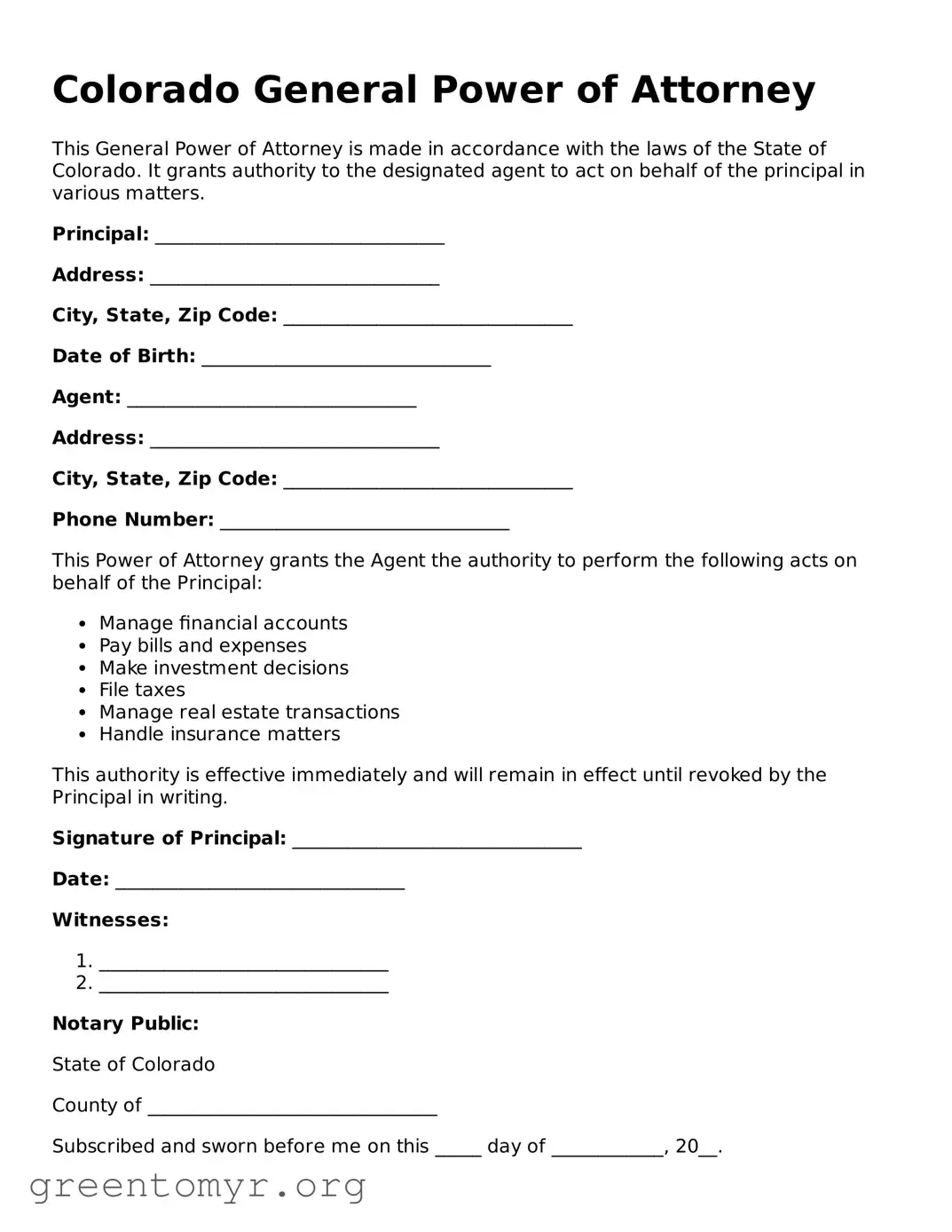
This General Power of Attorney is made in accordance with the laws of the State of Colorado. It grants authority to the designated agent to act on behalf of the principal in various matters.
Principal: _______________________________
Address: _______________________________
City, State, Zip Code: _______________________________
Date of Birth: _______________________________
Agent: _______________________________
Address: _______________________________
City, State, Zip Code: _______________________________
Phone Number: _______________________________
This Power of Attorney grants the Agent the authority to perform the following acts on behalf of the Principal:
This authority is effective immediately and will remain in effect until revoked by the Principal in writing.
Signature of Principal: _______________________________
Date: _______________________________
Witnesses:
Notary Public:
State of Colorado
County of _______________________________
Subscribed and sworn before me on this _____ day of ____________, 20__.
Notary Signature: _______________________________
My Commission Expires: _______________________________
| Fact Name | Description |
|---|---|
| Definition | The Colorado General Power of Attorney form allows an individual to grant another person the authority to make financial and legal decisions on their behalf. |
| Governing Law | This form is governed by the Colorado Revised Statutes, specifically Title 15, Article 14. |
| Durability | The power of attorney can be durable, meaning it remains in effect even if the principal becomes incapacitated. |
| Agent's Authority | The agent can manage a wide range of financial transactions, including banking, real estate, and tax matters. |
| Revocation | The principal can revoke the power of attorney at any time, provided they are mentally competent. |
| Witness Requirement | The form must be signed in the presence of a notary public or two witnesses to be valid. |
After obtaining the Colorado General Power of Attorney form, you will need to complete it accurately. This form allows you to designate someone to make decisions on your behalf regarding financial matters. Follow these steps to fill it out properly.
A General Power of Attorney is a legal document that allows one person, known as the principal, to appoint another person, called the agent, to act on their behalf. This document grants the agent broad authority to make decisions regarding financial and legal matters. In Colorado, this form can be used for a variety of purposes, including managing bank accounts, signing contracts, and handling real estate transactions.
In Colorado, any adult can serve as an agent under a General Power of Attorney. This includes family members, friends, or professionals such as attorneys or financial advisors. It is important to choose someone trustworthy, as they will have significant control over your financial and legal affairs.
The General Power of Attorney can grant a wide range of powers, including but not limited to:
However, the principal can specify which powers are granted and can limit the agent's authority if desired.
No, a General Power of Attorney typically becomes invalid if the principal becomes incapacitated. To ensure that the agent can continue to act on behalf of the principal in such situations, a Durable Power of Attorney should be considered. A Durable Power of Attorney remains effective even if the principal is unable to make decisions due to illness or disability.
A principal can revoke a General Power of Attorney at any time as long as they are mentally competent. To do this, the principal should create a written document stating the revocation and notify the agent. It is also advisable to inform any institutions or individuals that may have relied on the original document.
Yes, in Colorado, a General Power of Attorney must be signed in the presence of a notary public to be legally valid. Notarization helps verify the identity of the principal and ensures that the document was signed voluntarily. Additionally, some institutions may require notarization for their records.
General Power of Attorney forms can be obtained from various sources, including:
Ensure that the form complies with Colorado state laws and includes all necessary provisions for your specific needs.
Filling out the Colorado General Power of Attorney form can be a straightforward process, but there are common mistakes that people often make. One significant error is not specifying the powers granted. It’s essential to clearly outline what authority you are giving to your agent. If the powers are vague, it may lead to confusion and potential legal disputes.
Another frequent mistake is failing to date the document. A date is crucial as it indicates when the power of attorney becomes effective. Without a date, there could be questions about the validity of the document, especially if it is challenged later on.
People sometimes overlook the requirement for witnesses or notarization. In Colorado, a General Power of Attorney must be signed in front of a notary public or witnessed by two individuals. Not including these signatures can render the document invalid.
Additionally, individuals often forget to inform their agents about the powers they are being granted. It’s vital to have a conversation with your agent beforehand. This ensures they understand your wishes and are prepared to act on your behalf when needed.
Another mistake is neglecting to update the document after significant life changes. If you experience a major life event, such as marriage, divorce, or the birth of a child, it’s important to revisit your power of attorney. Not doing so may lead to complications down the road.
Some people assume that a General Power of Attorney remains in effect indefinitely. However, it’s essential to specify whether the powers are durable or non-durable. A non-durable power of attorney ends if you become incapacitated, while a durable one continues even in such circumstances.
Moreover, using outdated forms can be problematic. Laws change, and using an old version of the General Power of Attorney may not comply with current regulations. Always ensure that you are using the most recent form available.
Finally, many individuals forget to keep copies of the completed document. It’s wise to provide copies to your agent, your attorney, and any relevant financial institutions. This way, everyone involved is aware of the arrangement, which can help avoid confusion when the time comes to use the power of attorney.
A Colorado General Power of Attorney form is an important document that allows an individual to designate another person to act on their behalf in financial and legal matters. Along with this form, several other documents may be relevant to ensure comprehensive management of personal affairs. Below is a list of these forms and documents, each described briefly.
Understanding these documents can help individuals make informed decisions about their personal and financial affairs. Properly executed, they provide peace of mind and clarity for both the principal and their loved ones.
The General Power of Attorney (GPOA) form is a powerful legal document that allows one person to act on behalf of another in a wide range of matters. However, it shares similarities with several other documents. Here are four documents that are comparable to the GPOA:
Understanding these documents can help individuals make informed choices about their legal and healthcare needs.
When filling out the Colorado General Power of Attorney form, it is essential to approach the task with care and attention to detail. Below are some important dos and don'ts to consider.
When it comes to the Colorado General Power of Attorney form, several misconceptions can lead to confusion for individuals considering its use. Understanding these common myths is essential for making informed decisions regarding financial and legal matters.
This is not true. While many people associate this document with older adults or those facing health challenges, anyone can benefit from having a General Power of Attorney. It is a useful tool for anyone who wants to ensure that their financial affairs can be managed by a trusted individual in case they become unable to do so themselves.
In reality, a General Power of Attorney can be revoked at any time, as long as the person who created it is mentally competent. This means that if circumstances change or trust in the appointed agent diminishes, the document can be formally canceled.
While the agent does have significant authority, their powers are not unlimited. The agent is required to act in the best interest of the principal and must adhere to the specific powers granted within the document. Misusing this authority can lead to legal consequences.
This is a common misunderstanding. In Colorado, a General Power of Attorney can be drafted to become effective immediately or to spring into effect only upon the principal's incapacity. It is crucial to clearly specify the desired terms in the document.
While it is possible to create a General Power of Attorney without legal assistance, consulting with a lawyer is highly advisable. A legal professional can ensure that the document meets all legal requirements and accurately reflects the principal's wishes, minimizing the risk of future disputes.
When dealing with the Colorado General Power of Attorney form, it's essential to understand its significance and how to use it properly. Here are some key takeaways:
Understanding these points can help ensure that the General Power of Attorney serves its intended purpose effectively.