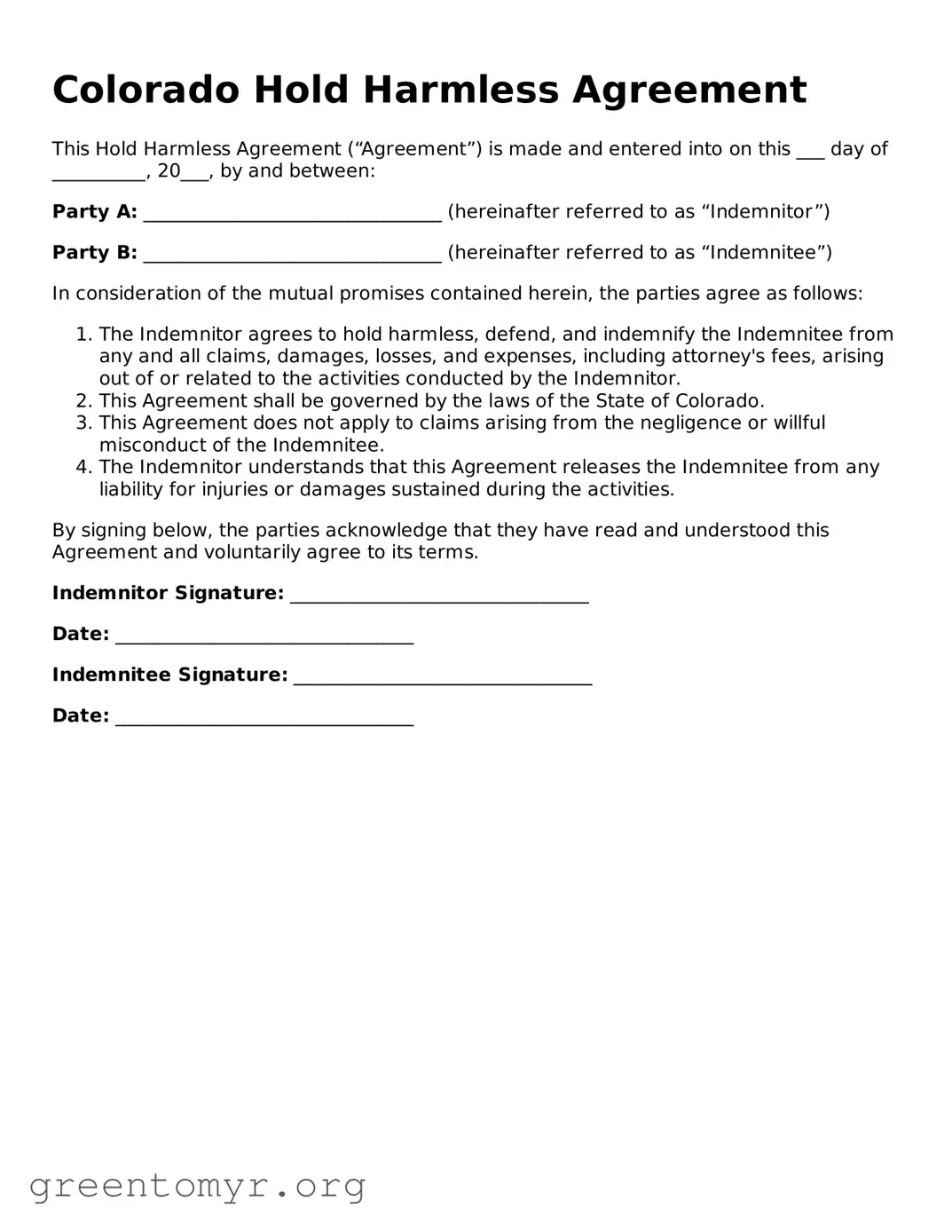
In the realm of legal agreements, the Colorado Hold Harmless Agreement form serves a crucial purpose in protecting parties from liability. This form is particularly significant in various contexts, such as events, construction projects, and recreational activities. By signing this agreement, one party agrees to assume responsibility for any potential damages or injuries that may occur, thereby shielding the other party from legal claims. It outlines the specific conditions under which liability is waived and emphasizes the importance of clear communication between the involved parties. Additionally, the form often requires signatures from all parties, indicating their understanding and acceptance of the terms. This mutual acknowledgment fosters trust and encourages a safer environment, whether at a community event or on a construction site. Understanding the nuances of this agreement is essential for anyone looking to navigate the complexities of liability in Colorado.
Colorado Hold Harmless Agreement
This Hold Harmless Agreement (“Agreement”) is made and entered into on this ___ day of __________, 20___, by and between:
Party A: ________________________________ (hereinafter referred to as “Indemnitor”)
Party B: ________________________________ (hereinafter referred to as “Indemnitee”)
In consideration of the mutual promises contained herein, the parties agree as follows:
By signing below, the parties acknowledge that they have read and understood this Agreement and voluntarily agree to its terms.
Indemnitor Signature: ________________________________
Date: ________________________________
Indemnitee Signature: ________________________________
Date: ________________________________
| Fact Name | Details |
|---|---|
| Definition | A Hold Harmless Agreement is a legal document that protects one party from liability or claims that may arise from certain activities or situations. |
| Purpose | This agreement is often used to ensure that one party will not hold another party responsible for any damages or injuries that occur during a specific activity. |
| Common Uses | Hold Harmless Agreements are commonly used in rental agreements, construction contracts, and event planning to mitigate risks. |
| Enforceability | These agreements are generally enforceable in Colorado as long as they are clear, specific, and not contrary to public policy. |
| Governing Law | The Hold Harmless Agreement in Colorado is governed by Colorado state law, specifically under the Colorado Revised Statutes. |
| Mutuality | In some cases, both parties may agree to hold each other harmless, creating a mutual Hold Harmless Agreement. |
| Limitations | These agreements cannot protect against gross negligence or willful misconduct. Courts may not enforce clauses that attempt to waive liability for such actions. |
| Legal Advice | It is advisable to consult with a legal professional when drafting or signing a Hold Harmless Agreement to ensure that it meets legal standards and adequately protects your interests. |
Filling out the Colorado Hold Harmless Agreement form is a straightforward process that requires careful attention to detail. Once you have completed the form, it will need to be submitted to the appropriate party or organization as specified in your situation.
A Hold Harmless Agreement is a legal document that protects one party from liability for certain actions or events. In Colorado, these agreements are often used in various contexts, such as construction projects, events, or rental agreements. The agreement typically states that one party agrees not to hold the other responsible for injuries, damages, or losses that may occur.
Various individuals and organizations utilize Hold Harmless Agreements. Common users include:
A well-drafted Hold Harmless Agreement generally includes several important components:
Yes, Hold Harmless Agreements can be enforceable in Colorado, provided they are properly drafted. Courts will consider the clarity of the language and whether the agreement was entered into voluntarily. However, certain limitations exist, especially concerning gross negligence or willful misconduct, which may not be waived.
While it is not legally required to have a lawyer draft a Hold Harmless Agreement, consulting with legal counsel is advisable. A lawyer can ensure that the agreement is comprehensive, clear, and compliant with Colorado law. This can help prevent misunderstandings and potential legal issues in the future.
Yes, a Hold Harmless Agreement can cover future claims, as long as the language of the agreement explicitly states this. It is crucial that the agreement clearly outlines the scope of coverage to avoid ambiguity about what is included.
Signing a Hold Harmless Agreement carries certain risks. By signing, an individual may waive their right to seek compensation for injuries or damages that arise from the activities covered by the agreement. It is essential to fully understand the implications of the agreement before signing.
To ensure the validity of a Hold Harmless Agreement, consider the following steps:
Filling out the Colorado Hold Harmless Agreement form can be straightforward, but many people make common mistakes that can lead to confusion or legal issues. One frequent error is failing to provide accurate personal information. Ensure that names, addresses, and contact details are correct. Missing or incorrect information can invalidate the agreement.
Another mistake is neglecting to read the entire document before signing. Understanding all terms and conditions is crucial. Skipping sections may lead to unintended liabilities. Take the time to review each part of the agreement thoroughly.
Many individuals also overlook the importance of specifying the scope of the agreement. Clearly outline what activities or situations the hold harmless provision covers. A vague description can lead to misunderstandings later on.
Some people forget to include dates. Without a clear start and end date, the agreement may lack clarity. This can complicate matters if disputes arise. Always include specific dates to avoid confusion.
Another common mistake is not having witnesses or notarization when required. Certain agreements may need to be signed in front of a witness or notarized to be enforceable. Check the requirements to ensure compliance.
Additionally, people often fail to consider the implications of the agreement. It’s essential to understand what rights you are waiving. Take the time to consider the potential risks involved in the activities covered by the agreement.
Some individuals may mistakenly think that a Hold Harmless Agreement protects against all forms of liability. This is not always the case. The agreement typically covers negligence but may not protect against gross negligence or intentional misconduct.
Another error is not keeping a copy of the signed agreement. After filling it out, always make sure to keep a copy for your records. This can be vital if any disputes arise in the future.
Lastly, people sometimes fail to update the agreement when circumstances change. If there are changes in activities or participants, it’s important to revise the agreement accordingly. Regularly review and update the document to reflect current situations.
A Hold Harmless Agreement is an important document that helps protect one party from legal liability for any injuries or damages that may occur during a specific activity or event. However, there are several other forms and documents that are often used in conjunction with this agreement to ensure comprehensive protection and clarity for all parties involved. Below is a list of these documents, along with a brief description of each.
Using these documents in conjunction with a Hold Harmless Agreement can provide a more robust framework for managing risks and protecting all parties involved. It’s essential to understand each document's purpose to ensure that you are adequately covered in any situation.
When filling out the Colorado Hold Harmless Agreement form, it's important to approach the task carefully. Here are some key do's and don'ts to keep in mind:
There are several misconceptions surrounding the Colorado Hold Harmless Agreement form. Understanding these can help clarify its purpose and usage. Here are eight common misconceptions:
It absolves all liability. Many people believe that signing a Hold Harmless Agreement means that one party can never be held responsible for any harm. However, this is not entirely true. While the agreement can limit liability in certain situations, it does not protect against gross negligence or willful misconduct.
It is only for businesses. Some think that Hold Harmless Agreements are only relevant for businesses or commercial activities. In reality, individuals can also use these agreements in personal transactions, such as renting property or participating in recreational activities.
It is a legally binding contract in all situations. While Hold Harmless Agreements can be legally binding, they may not always be enforceable. Courts may refuse to enforce them if they are deemed unfair or if they violate public policy.
All Hold Harmless Agreements are the same. There is a misconception that all Hold Harmless Agreements have the same language and terms. In fact, these agreements can vary widely based on the specific situation and the parties involved.
They eliminate the need for insurance. Some people believe that signing a Hold Harmless Agreement means they do not need insurance. This is misleading. While the agreement may provide some level of protection, having insurance is still advisable to cover potential liabilities.
They can be signed after an incident occurs. A common misunderstanding is that Hold Harmless Agreements can be signed after an incident has taken place. For these agreements to be effective, they should be executed before any activity that could lead to liability.
They are only for physical injuries. Many assume that Hold Harmless Agreements only apply to physical injuries. However, these agreements can also address other types of liabilities, including property damage and financial losses.
They are difficult to understand. Some believe that Hold Harmless Agreements are overly complex and hard to comprehend. While legal language can be dense, many agreements can be written in clear and straightforward terms, making them accessible to the average person.
By addressing these misconceptions, individuals and businesses can better understand the Colorado Hold Harmless Agreement and its implications.
When filling out and using the Colorado Hold Harmless Agreement form, keep these key takeaways in mind:
These points will help you navigate the process effectively and ensure that the agreement serves its intended purpose.