Content Navigation

The Colorado Homeschool Letter of Intent form serves as a crucial document for families who choose to educate their children at home. This form must be submitted to the local school district to officially notify them of the intent to homeschool. It includes essential details such as the names and ages of the children being homeschooled, as well as the educational curriculum that will be utilized. Parents or guardians must also provide their contact information, ensuring that the school district can communicate effectively regarding the homeschooling process. The form is typically required to be filed annually, allowing the district to maintain an accurate record of homeschooling families. By completing and submitting this form, parents take an important step in establishing their commitment to providing a tailored educational experience for their children outside of traditional school settings.

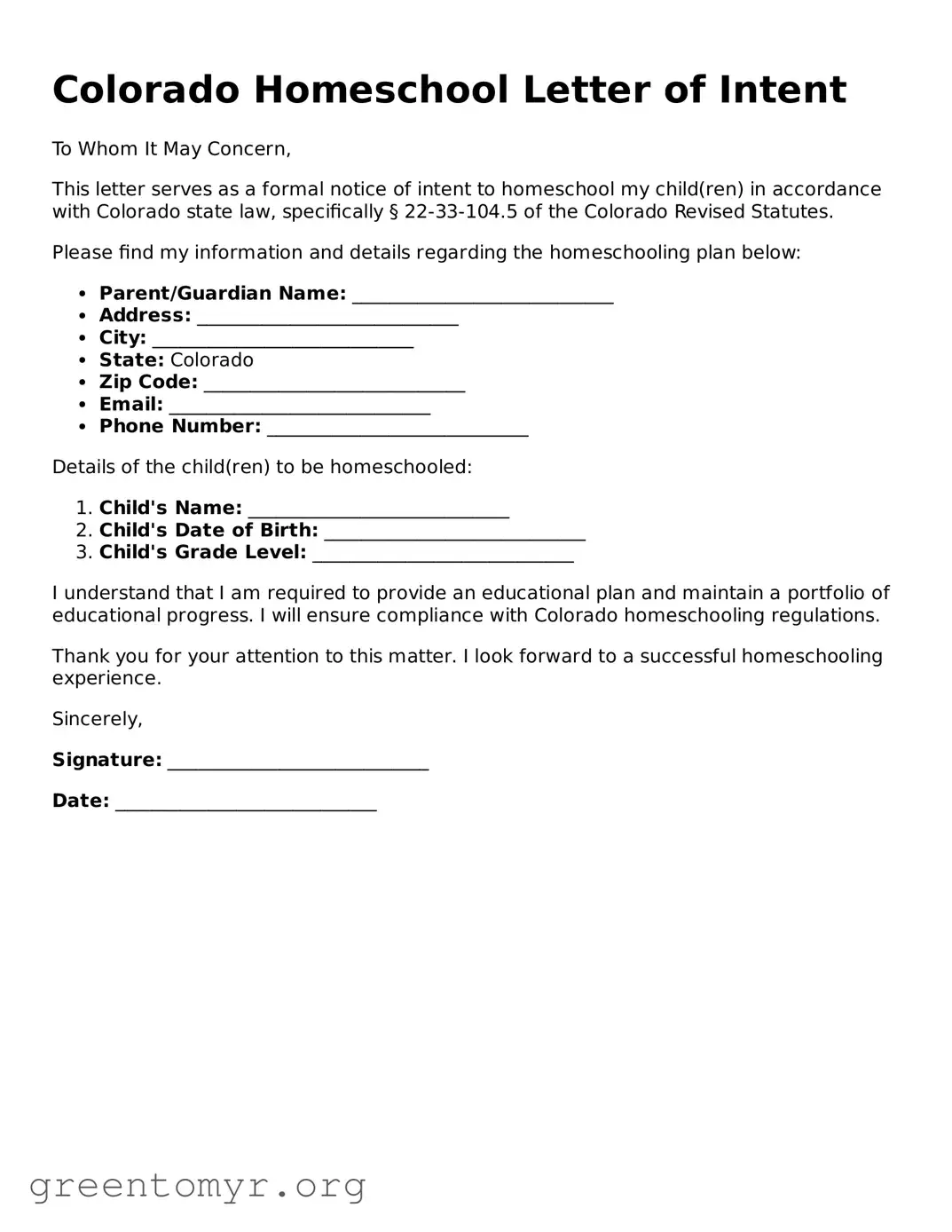
Colorado Homeschool Letter of Intent Example

Colorado Homeschool Letter of Intent

To Whom It May Concern,

This letter serves as a formal notice of intent to homeschool my child(ren) in accordance with Colorado state law, specifically § 22-33-104.5 of the Colorado Revised Statutes.

Please find my information and details regarding the homeschooling plan below:

  • Parent/Guardian Name: ____________________________
  • Address: ____________________________
  • City: ____________________________
  • State: Colorado
  • Zip Code: ____________________________
  • Email: ____________________________
  • Phone Number: ____________________________

Details of the child(ren) to be homeschooled:

  1. Child's Name: ____________________________
  2. Child's Date of Birth: ____________________________
  3. Child's Grade Level: ____________________________

I understand that I am required to provide an educational plan and maintain a portfolio of educational progress. I will ensure compliance with Colorado homeschooling regulations.

Thank you for your attention to this matter. I look forward to a successful homeschooling experience.

Sincerely,

Signature: ____________________________

Date: ____________________________

PDF Form Features

Fact Name Description
Governing Law The Colorado Homeschool Letter of Intent is governed by Colorado Revised Statutes § 22-33-104.5.
Purpose This form notifies the local school district of the intent to homeschool a child.
Submission Deadline The Letter of Intent must be submitted within 14 days of beginning homeschooling.
Required Information It must include the child's name, age, and address, as well as the name and address of the parent.
Annual Updates Parents must submit a new Letter of Intent each year to continue homeschooling.
Educational Plan An educational plan is not required with the initial submission but is necessary for ongoing compliance.
Privacy Considerations Information provided in the Letter of Intent is typically kept confidential by the school district.
Non-Compliance Consequences Failure to submit the Letter of Intent can result in legal consequences, including potential truancy charges.
Resources for Parents Colorado offers various resources and support groups for homeschooling families to assist with the process.

Guide to Using Colorado Homeschool Letter of Intent

Once you have decided to homeschool your child in Colorado, you'll need to fill out the Homeschool Letter of Intent form. This form is a crucial step in notifying your school district of your plans. After submitting it, you can begin preparing your curriculum and educational activities.

  1. Gather necessary information: Before starting, collect your child's name, birthdate, and address. You will also need to know the name of the school district.
  2. Download the form: Visit the Colorado Department of Education website to find the Homeschool Letter of Intent form. You can usually download it as a PDF.
  3. Fill in your child's information: Enter your child's full name, date of birth, and address in the designated fields on the form.
  4. Provide your information: Fill in your name, address, and contact information. This is typically the parent or guardian's information.
  5. Specify the school district: Clearly write the name of the school district where you reside. This is important for proper processing.
  6. Sign and date the form: At the bottom of the form, sign your name and include the date. This confirms your intent to homeschool.
  7. Submit the form: Send the completed form to your school district. You can do this via mail or, in some cases, electronically if the district allows it.

Get Answers on Colorado Homeschool Letter of Intent

  1. What is the Colorado Homeschool Letter of Intent form?

    The Colorado Homeschool Letter of Intent form is a document that parents or guardians must submit to notify their school district of their intention to homeschool their children. This form serves as an official declaration and must be filed before beginning homeschooling.

  2. Who needs to submit the Letter of Intent?

    Parents or guardians of children who are between the ages of 6 and 17 and who wish to homeschool must submit the Letter of Intent. This applies to all students who are not enrolled in a public or private school.

  3. When should the Letter of Intent be submitted?

    The Letter of Intent should be submitted at least 14 days before beginning the homeschooling process. This allows the school district sufficient time to process the form and respond if necessary.

  4. What information is required on the form?

    The form typically requires the following information:

    • The name and address of the parent or guardian.
    • The names and ages of the children being homeschooled.
    • The school district where the children would otherwise be enrolled.
  5. Is there a specific format for the Letter of Intent?

    While there is no specific format mandated by the state, the Letter of Intent must include the necessary information outlined above. It is recommended to keep the letter clear and concise.

  6. What happens after the Letter of Intent is submitted?

    Once the Letter of Intent is submitted, the school district will acknowledge receipt. Parents should keep a copy of the submitted form for their records. The district may contact the parents for any additional information, but typically no further action is required from the parents at this stage.

  7. Can the Letter of Intent be revoked?

    Yes, parents can revoke the Letter of Intent if they decide to enroll their children in a public or private school. It is advisable to notify the school district in writing to ensure that all records are updated accordingly.

  8. Are there any consequences for not submitting the Letter of Intent?

    Failure to submit the Letter of Intent may result in the school district considering the child truant. This could lead to legal implications, including potential fines or mandatory enrollment in a school.

  9. Where can I find the Letter of Intent form?

    The Letter of Intent form can usually be found on the website of your local school district. Additionally, many homeschooling organizations provide templates and guidance for completing the form.

Common mistakes

Filling out the Colorado Homeschool Letter of Intent form can be a straightforward process, but many families make mistakes that could lead to unnecessary complications. One common error is failing to provide complete and accurate information about the child. This includes the child's full name, date of birth, and address. Omitting even one detail can cause delays or confusion in the approval process.

Another frequent mistake involves not signing the form. A signature is essential as it indicates that the parent or guardian is officially declaring their intent to homeschool. Without a signature, the form is considered incomplete, which may lead to rejection or the need for resubmission.

Some parents overlook the requirement to submit the form within the designated timeframe. Colorado law mandates that the Letter of Intent must be submitted within a certain period before the start of the school year. Missing this deadline can result in the loss of the opportunity to homeschool for that year.

Additionally, individuals sometimes fail to keep a copy of the submitted form. Having a record is important for personal reference and can be helpful if any questions arise later. Without a copy, parents may find themselves in a difficult position if they need to verify what information was submitted.

Lastly, many families do not take the time to read the instructions thoroughly. Each section of the form has specific requirements, and misunderstanding these can lead to mistakes. By carefully reviewing the guidelines, parents can ensure that they provide all necessary information correctly and completely.

Documents used along the form

When families decide to homeschool in Colorado, submitting the Homeschool Letter of Intent is just the first step in a larger process. Several other forms and documents may be required or helpful in ensuring compliance with state regulations and facilitating a smooth homeschooling experience. Below is a list of commonly used forms and documents that complement the Homeschool Letter of Intent.

  • Curriculum Plan: This document outlines the educational materials and subjects that will be taught throughout the year. It helps parents stay organized and ensures that they cover all necessary topics.
  • Attendance Record: Keeping track of daily attendance is essential. This record shows the number of days of instruction and can be requested by the school district if needed.
  • Assessment Results: At the end of the school year, parents may need to provide evidence of their child's academic progress. This can include standardized test scores or evaluations by a qualified individual.
  • Portfolio of Student Work: Compiling a portfolio that showcases the student's work throughout the year can be beneficial. It provides tangible proof of learning and growth in various subjects.
  • Educational Philosophy Statement: Some families choose to include a brief statement explaining their educational philosophy. This document can clarify their approach to homeschooling and learning styles.
  • Extracurricular Activity Participation Forms: If students participate in community activities or classes outside the home, documentation of these involvements may be required for certain programs.
  • Notification of Withdrawal from Public School: If a child is transitioning from public school to homeschooling, a formal withdrawal notice may be necessary to ensure that the school district updates its records.
  • Health and Safety Guidelines: While not always required, having a set of health and safety guidelines can help families maintain a safe learning environment at home.
  • Resource List: A list of books, websites, and other educational resources can serve as a helpful reference for parents as they plan lessons and activities.

Having these documents prepared and organized can greatly assist families in navigating the homeschooling process in Colorado. Each form plays a role in ensuring that educational standards are met while also providing a structured approach to learning at home.

Similar forms

  • School Enrollment Form: This document is submitted to officially enroll a student in a school. Similar to the Homeschool Letter of Intent, it outlines the student's information and indicates the parent's decision regarding their education.
  • Withdrawal Form: When a student is withdrawn from a traditional school, this form is required. Like the Homeschool Letter of Intent, it communicates a change in the student's educational status and the parent's intention to pursue homeschooling.
  • Curriculum Plan: This document outlines the educational materials and subjects to be covered during the school year. It is similar to the Homeschool Letter of Intent in that it reflects the educational approach and goals set by the parent.
  • Educational Assessment Report: This report evaluates a student's academic progress. It shares similarities with the Homeschool Letter of Intent, as both documents are used to monitor and communicate educational development.
  • Attendance Record: This document tracks a student's daily attendance. Like the Homeschool Letter of Intent, it serves as an official record of the student's educational journey and compliance with state requirements.
  • Progress Report: This report provides updates on a student's achievements and challenges. Similar to the Homeschool Letter of Intent, it is a means of communicating educational progress to relevant authorities.
  • Educational Philosophy Statement: This document outlines a parent's educational beliefs and methods. It parallels the Homeschool Letter of Intent by articulating the rationale behind the choice to homeschool.

Dos and Don'ts

When filling out the Colorado Homeschool Letter of Intent form, it's important to approach the process thoughtfully. Here are some key things to do and avoid:

  • Do: Ensure that all information is accurate and up to date. Double-check names, addresses, and dates.
  • Do: Submit the form to your local school district within the required timeframe. Timeliness is crucial.
  • Do: Keep a copy of the completed form for your records. This can be helpful for future reference.
  • Do: Familiarize yourself with Colorado's homeschooling laws. Understanding your rights and responsibilities is essential.
  • Don't: Leave any sections of the form blank. Incomplete forms may lead to delays or rejections.
  • Don't: Provide false information. Honesty is vital, as inaccuracies can have serious consequences.
  • Don't: Submit the form late. Missing deadlines can affect your ability to homeschool legally.
  • Don't: Ignore any follow-up requests from the school district. Responding promptly can help avoid complications.

Misconceptions

Misconceptions about the Colorado Homeschool Letter of Intent form can lead to confusion for families considering homeschooling. Here are four common misunderstandings:

  • It's a binding contract. Many people believe that submitting the Letter of Intent creates a legally binding agreement. In reality, it simply notifies the school district of your intent to homeschool your child.
  • It must be submitted at the beginning of the school year. Some think that the Letter of Intent must be filed at a specific time, such as the start of the academic year. However, you can submit it at any point during the year, as long as you do so before you begin homeschooling.
  • All children must be registered. There is a misconception that every child in a household must be registered on the Letter of Intent. This is not true; you only need to register the child or children you intend to homeschool.
  • It's a complicated process. Many families feel overwhelmed by the idea of filling out the form. In fact, the process is straightforward and requires minimal information, making it accessible for most parents.

Key takeaways

When filling out and using the Colorado Homeschool Letter of Intent form, consider the following key takeaways:

  • Complete the Form Accurately: Ensure all required fields are filled out correctly. This helps avoid any delays in processing your intent to homeschool.
  • Submit on Time: The letter must be submitted within the designated timeframe. Late submissions may lead to complications with your homeschooling status.
  • Keep Copies: Always retain a copy of the completed form for your records. This can be helpful for future reference or in case any questions arise.
  • Understand Local Regulations: Familiarize yourself with local homeschooling laws and guidelines. This knowledge will support your homeschooling journey and ensure compliance.