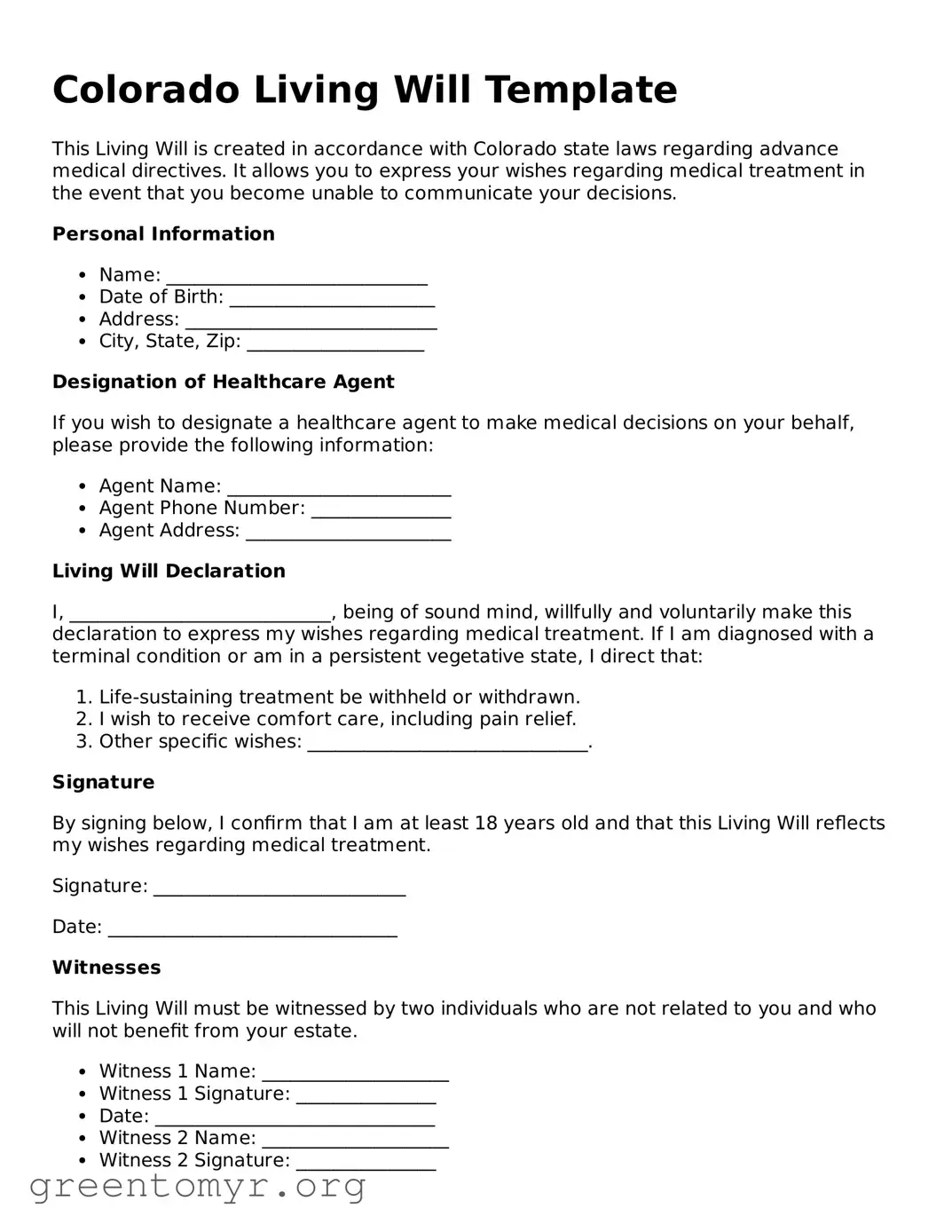
In the state of Colorado, the Living Will form serves as a crucial document that empowers individuals to express their healthcare preferences in the event that they become unable to communicate their wishes. This legal tool allows you to outline specific medical treatments you would or would not want, particularly in situations involving terminal illness or irreversible conditions. By clearly articulating your desires regarding life-sustaining measures, such as resuscitation or artificial nutrition, you ensure that your values and choices are respected. Additionally, the form can alleviate the burden on family members who may otherwise face difficult decisions during emotionally challenging times. Understanding the nuances of this document is essential, as it not only provides guidance to healthcare providers but also fosters peace of mind for you and your loved ones. In Colorado, completing a Living Will is a straightforward process, yet it carries significant implications for your future healthcare decisions.
Colorado Living Will Template
This Living Will is created in accordance with Colorado state laws regarding advance medical directives. It allows you to express your wishes regarding medical treatment in the event that you become unable to communicate your decisions.
Personal Information
Designation of Healthcare Agent
If you wish to designate a healthcare agent to make medical decisions on your behalf, please provide the following information:
Living Will Declaration
I, ____________________________, being of sound mind, willfully and voluntarily make this declaration to express my wishes regarding medical treatment. If I am diagnosed with a terminal condition or am in a persistent vegetative state, I direct that:
Signature
By signing below, I confirm that I am at least 18 years old and that this Living Will reflects my wishes regarding medical treatment.
Signature: ___________________________
Date: _______________________________
Witnesses
This Living Will must be witnessed by two individuals who are not related to you and who will not benefit from your estate.
This document is effective immediately upon signing and remains in effect until revoked. Please keep a copy for your records and provide copies to your healthcare agent and family members.
| Fact Name | Description |
|---|---|
| Definition | A Colorado Living Will is a legal document that outlines a person's wishes regarding medical treatment in case they become unable to communicate their preferences. |
| Governing Law | The Colorado Living Will is governed by the Colorado Revised Statutes, specifically Title 15, Article 18. |
| Eligibility | Any adult who is 18 years or older can create a Living Will in Colorado. |
| Witness Requirements | The document must be signed in the presence of two adult witnesses who are not related to the individual or entitled to any part of their estate. |
| Revocation | A Living Will can be revoked at any time by the individual, either verbally or in writing. |
| Health Care Provider Obligations | Health care providers must comply with the wishes expressed in a Living Will, provided it is valid and properly executed. |
| Durable Power of Attorney | A Living Will can be used alongside a Durable Power of Attorney for Health Care, which designates someone to make medical decisions on behalf of the individual. |
| Specific Instructions | The document allows individuals to specify their preferences for life-sustaining treatment, including the use of ventilators and feeding tubes. |
| Storage and Access | It is advisable to keep the Living Will in a safe but accessible location and to provide copies to family members and health care providers. |
| Legal Recognition | Colorado recognizes Living Wills created in other states, as long as they comply with the laws of the state where they were executed. |
After obtaining the Colorado Living Will form, you will need to complete it accurately. This form allows you to express your wishes regarding medical treatment in the event that you are unable to communicate your preferences. Follow the steps below to fill out the form correctly.
Once you have filled out the form, ensure that it is stored in a safe place and that your loved ones and healthcare providers are aware of its location. This will help ensure that your wishes are followed in the event of a medical emergency.
A Living Will is a legal document that allows individuals to express their wishes regarding medical treatment in the event that they become unable to communicate their preferences. This document specifically addresses end-of-life care and outlines what types of medical interventions a person does or does not want if they are terminally ill or in a persistent vegetative state.
Anyone over the age of 18 who is capable of making informed decisions about their medical care should consider creating a Living Will. This is particularly important for individuals with serious health conditions, those undergoing major surgery, or anyone who wants to ensure their healthcare preferences are honored in the future.
To create a Living Will in Colorado, you can follow these steps:
Your Living Will should clearly outline your preferences regarding:
Be specific about the circumstances under which you would want these interventions or refuse them.
Yes, you can change or revoke your Living Will at any time as long as you are mentally competent. To revoke it, simply destroy the document and inform your healthcare provider and any individuals who have copies. If you create a new Living Will, it will automatically revoke any previous versions.
No, a Living Will and a Durable Power of Attorney for Health Care are distinct documents. While a Living Will specifies your wishes regarding medical treatment, a Durable Power of Attorney for Health Care designates someone to make healthcare decisions on your behalf if you become unable to do so. Many people choose to have both documents to ensure comprehensive planning for their healthcare.
While it is not legally required to have a lawyer to create a Living Will in Colorado, consulting with one can be beneficial. A lawyer can help ensure that your document is properly drafted, reflects your wishes accurately, and complies with state laws.
If you do not have a Living Will and become unable to communicate your healthcare preferences, your family members or healthcare providers may be forced to make decisions on your behalf. This can lead to confusion, disagreements, or decisions that do not align with your values and wishes.
To ensure your Living Will is honored, consider the following steps:
For more information about Living Wills in Colorado, you can visit the Colorado Secretary of State’s website or consult with local healthcare providers and legal professionals. Many nonprofit organizations also offer resources and guidance on advance care planning.
Filling out a Colorado Living Will form can be a straightforward process, but many individuals make common mistakes that can lead to complications later. Understanding these pitfalls is essential for ensuring that your wishes are respected in the event of a medical emergency.
One frequent mistake is failing to specify the types of medical treatment you do or do not want. Many people assume that general statements are sufficient. However, being specific about your preferences regarding life-sustaining treatments, resuscitation, and other interventions is crucial. This clarity helps healthcare providers understand your wishes more accurately.
Another common error is not signing the form correctly. A Living Will must be signed by the individual creating it, and in some cases, it requires witnesses. Not adhering to these requirements can render the document invalid. It’s important to double-check that all necessary signatures are present before considering the form complete.
Many individuals also neglect to discuss their Living Will with family members or healthcare proxies. This lack of communication can lead to confusion and conflict during critical moments. Sharing your wishes with loved ones ensures that they understand your decisions and can advocate on your behalf.
Additionally, some people forget to update their Living Will as circumstances change. Life events such as marriage, divorce, or changes in health status can impact your preferences. Regularly reviewing and revising your document is essential to ensure it reflects your current wishes.
Another mistake is using outdated forms. Laws and regulations can change, and it’s important to use the most current version of the Colorado Living Will form. Using an outdated form may not comply with current legal standards, which could jeopardize your intentions.
Lastly, individuals often overlook the importance of appointing a healthcare proxy. While a Living Will outlines your wishes, having someone designated to make decisions on your behalf can provide additional clarity and support. This person should be someone you trust to honor your wishes and communicate effectively with medical professionals.
A Colorado Living Will form is an important document for individuals who want to specify their wishes regarding medical treatment in the event they become unable to communicate. However, several other forms and documents can complement a Living Will, ensuring that your healthcare preferences are clearly understood and respected. Below is a list of these related documents.
Having these documents in place alongside your Colorado Living Will can significantly enhance your ability to communicate your healthcare preferences. It is essential to keep these forms updated and share them with your healthcare providers and family members to ensure your wishes are honored.
A Living Will form is a crucial document for expressing one's wishes regarding medical treatment in situations where an individual cannot communicate their preferences. It shares similarities with several other important documents. Below is a list of six documents that are similar to a Living Will:
Each of these documents serves a unique purpose but ultimately aims to ensure that an individual's health care preferences are respected and followed. Understanding these similarities can help in making informed decisions about personal health care planning.
When filling out the Colorado Living Will form, it is essential to approach the task with care and consideration. Below are some important guidelines to follow, as well as common pitfalls to avoid.
Things You Should Do:
Things You Shouldn't Do:
Understanding the Colorado Living Will form is essential for making informed decisions about end-of-life care. However, several misconceptions can lead to confusion. Below are eight common misconceptions about the Colorado Living Will form, along with clarifications.
By understanding these misconceptions, individuals can better navigate their options and ensure their healthcare preferences are honored.
Filling out and using the Colorado Living Will form is an important step in ensuring that your healthcare wishes are respected. Here are some key takeaways to consider:
Taking these steps can help ensure that your healthcare preferences are honored and respected when it matters most.