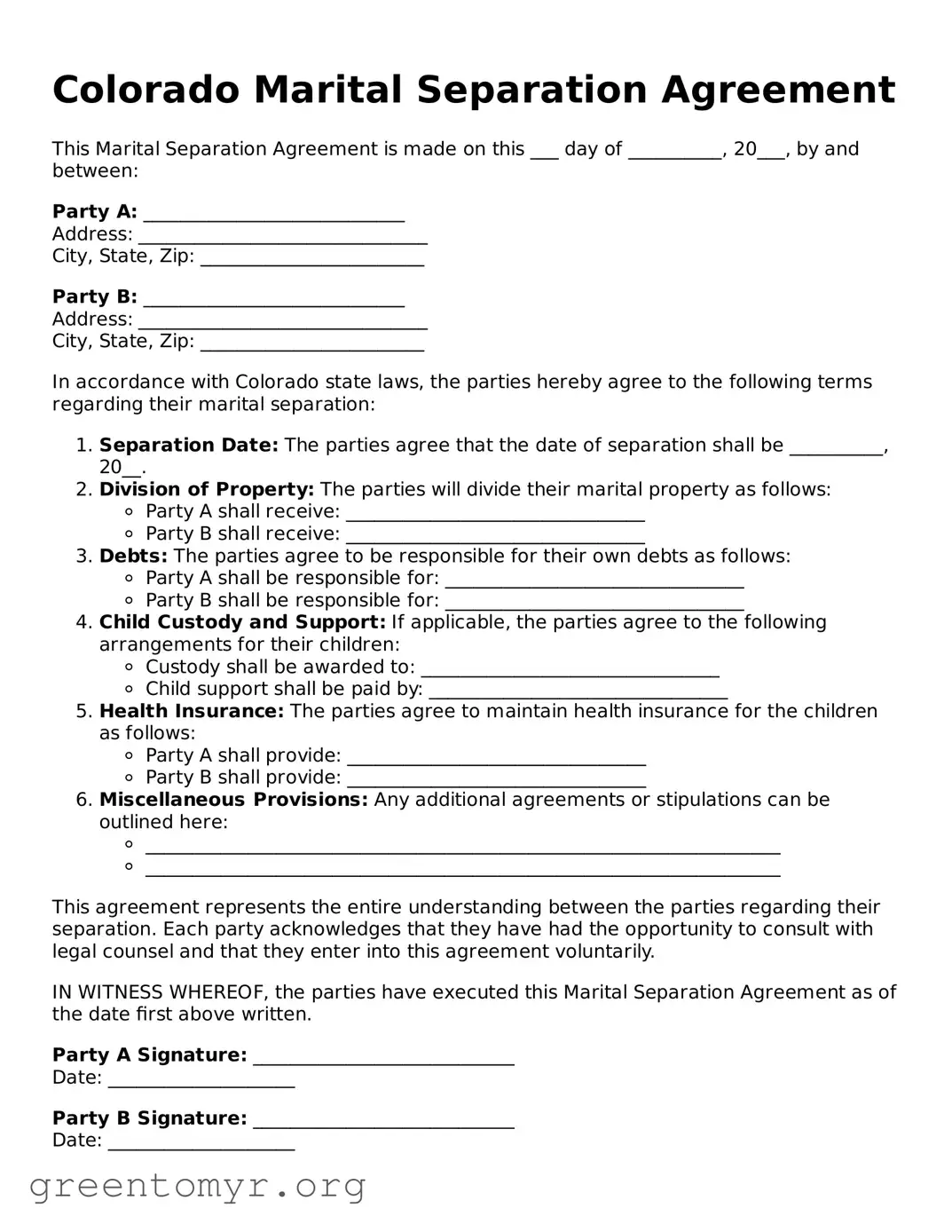
In the intricate landscape of family law, the Colorado Marital Separation Agreement form serves as a crucial tool for couples navigating the often tumultuous waters of separation. This document outlines the terms of a couple's separation, addressing vital aspects such as the division of property, child custody arrangements, and spousal support. By clearly delineating responsibilities and expectations, the agreement helps to minimize conflict and confusion during a challenging time. It is designed to protect the interests of both parties while ensuring that the needs of any children involved are prioritized. Additionally, the form provides a framework for future interactions, potentially easing the transition into a new phase of life. Understanding the components of this agreement is essential for anyone considering separation, as it lays the groundwork for a more amicable resolution and a clearer path forward.
Colorado Marital Separation Agreement
This Marital Separation Agreement is made on this ___ day of __________, 20___, by and between:
Party A: ____________________________
Address: _______________________________
City, State, Zip: ________________________
Party B: ____________________________
Address: _______________________________
City, State, Zip: ________________________
In accordance with Colorado state laws, the parties hereby agree to the following terms regarding their marital separation:
This agreement represents the entire understanding between the parties regarding their separation. Each party acknowledges that they have had the opportunity to consult with legal counsel and that they enter into this agreement voluntarily.
IN WITNESS WHEREOF, the parties have executed this Marital Separation Agreement as of the date first above written.
Party A Signature: ____________________________
Date: ____________________
Party B Signature: ____________________________
Date: ____________________
| Fact Name | Details |
|---|---|
| Purpose | The Colorado Marital Separation Agreement outlines the terms of separation between spouses, covering issues like property division, child custody, and support. |
| Governing Law | This agreement is governed by Colorado state law, specifically the Colorado Revised Statutes Title 14, Article 10. |
| Filing Requirements | While the agreement itself does not need to be filed with the court, it is essential to present it during divorce proceedings if applicable. |
| Mutual Consent | Both parties must agree to the terms outlined in the agreement for it to be valid and enforceable. |
Completing the Colorado Marital Separation Agreement form is an important step in the process of separating from your spouse. After filling out this form, you will be able to outline the terms of your separation, which can help facilitate a smoother transition for both parties. Here’s how to fill out the form step-by-step.
Once you have completed the form, consider discussing it with a legal professional to ensure that all aspects are fair and compliant with Colorado laws. This step can help you avoid potential issues down the line.
A Colorado Marital Separation Agreement is a legal document that outlines the terms under which a couple separates while remaining legally married. This agreement typically covers various aspects of the couple's life, including division of property, child custody, and support obligations. It serves as a framework for how both parties will manage their responsibilities during the separation period.
There are several reasons to consider a Marital Separation Agreement:
Creating a Marital Separation Agreement involves several steps:
Yes, a Marital Separation Agreement can be modified. If both parties agree to changes, they can draft an amendment to the original agreement. It’s important to document any modifications in writing and have both parties sign the updated agreement. This ensures that all changes are legally recognized and enforceable.
Filling out the Colorado Marital Separation Agreement form can be a daunting task. It is essential to approach this process with care to avoid common pitfalls that could impact the separation process. One frequent mistake is failing to provide complete and accurate information. Omitting details about assets, debts, or personal information can lead to complications later on. Ensuring that every section is filled out completely is vital.
Another common error is misunderstanding the difference between separation and divorce. Some individuals mistakenly believe that a marital separation agreement is the same as a divorce decree. In reality, a separation agreement outlines the terms of living apart while still legally married. Clarifying this distinction can prevent confusion and potential legal issues down the line.
People often neglect to address all relevant issues in their agreement. This includes not just property division but also child custody, visitation rights, and support obligations. Leaving out these critical components can lead to disputes and misunderstandings in the future. It is crucial to consider all aspects of the separation to create a comprehensive agreement.
Another mistake is not consulting with a legal professional. While it may seem tempting to fill out the form without assistance, having a lawyer review the agreement can provide valuable insights. Legal professionals can help ensure that the terms are fair and enforceable, reducing the risk of future conflicts.
In addition, some individuals rush through the process, failing to take the time to fully understand the implications of their agreement. A rushed decision can lead to unfavorable terms that may not serve one’s best interests. Taking the time to carefully consider each provision is essential for a fair outcome.
Furthermore, people often forget to include a dispute resolution clause. This clause can outline how disputes will be handled in the future, such as through mediation or arbitration. Without this provision, parties may find themselves in prolonged conflicts over issues that could have been easily resolved.
Another frequent oversight is not updating the agreement as circumstances change. Life is unpredictable, and situations can evolve. Failing to amend the agreement when necessary can lead to legal challenges or enforceability issues. Regularly reviewing and updating the agreement is a wise practice.
Some individuals also make the mistake of not considering tax implications. The division of assets and support payments can have significant tax consequences. It is crucial to understand how these factors will affect one’s financial situation post-separation.
Additionally, people sometimes overlook the importance of clarity in language. Ambiguous terms can lead to different interpretations, which may result in disputes. Using clear and precise language helps ensure that both parties understand their rights and obligations.
Lastly, many fail to sign and date the agreement properly. An unsigned or improperly dated document may not hold up in court. Ensuring that all parties have signed and dated the agreement is a simple yet essential step in the process.
When couples decide to separate, they often use a variety of forms and documents to ensure that the process is clear and legally binding. In Colorado, the Marital Separation Agreement is one important document, but there are several others that can complement it. Below is a list of common forms and documents that may be used alongside the Marital Separation Agreement.
Each of these documents plays a crucial role in the separation process, helping to clarify expectations and responsibilities. Together, they contribute to a smoother transition for both parties involved, especially when children are part of the equation.
A Marital Separation Agreement is a document that outlines the terms of a couple's separation. While it has its unique features, several other documents share similarities in purpose or content. Here are seven documents that are comparable to a Marital Separation Agreement:
When filling out the Colorado Marital Separation Agreement form, it's important to approach the process with care. Here are ten things to consider—five dos and five don'ts—to ensure that your agreement is comprehensive and legally sound.
By following these guidelines, you can help ensure that your Colorado Marital Separation Agreement is clear, fair, and legally binding.
Understanding the Colorado Marital Separation Agreement form is crucial for anyone considering separation. However, several misconceptions can lead to confusion. Here are six common misunderstandings:
A marital separation agreement is not a divorce. It outlines the terms of separation but does not legally dissolve the marriage. Couples remain married until they file for divorce.
While the agreement is a contract between the parties, it may require court approval to be enforceable. Courts often review the terms to ensure fairness and legality.
The agreement primarily addresses separation issues such as property division and child custody. It does not finalize divorce-related matters, which must be handled in a separate divorce proceeding.
While mutual agreement is ideal, it is possible for one party to propose terms that the other can accept or negotiate. Disputes can be settled through mediation or court intervention.
Even without children, a marital separation agreement can be essential for addressing property division, debts, and other financial matters. It provides clarity and protection for both parties.
Changes can be made to the agreement if both parties consent. Modifications should be documented in writing and may require court approval, especially if they affect child custody or support.
Clarifying these misconceptions can help individuals make informed decisions during a challenging time. It is advisable to seek professional guidance when navigating this process.
When filling out and using the Colorado Marital Separation Agreement form, there are several important points to keep in mind. This document is essential for couples who are separating and want to outline the terms of their separation. Here are some key takeaways:
By following these guidelines, you can navigate the process of completing the Colorado Marital Separation Agreement more effectively and with greater confidence.