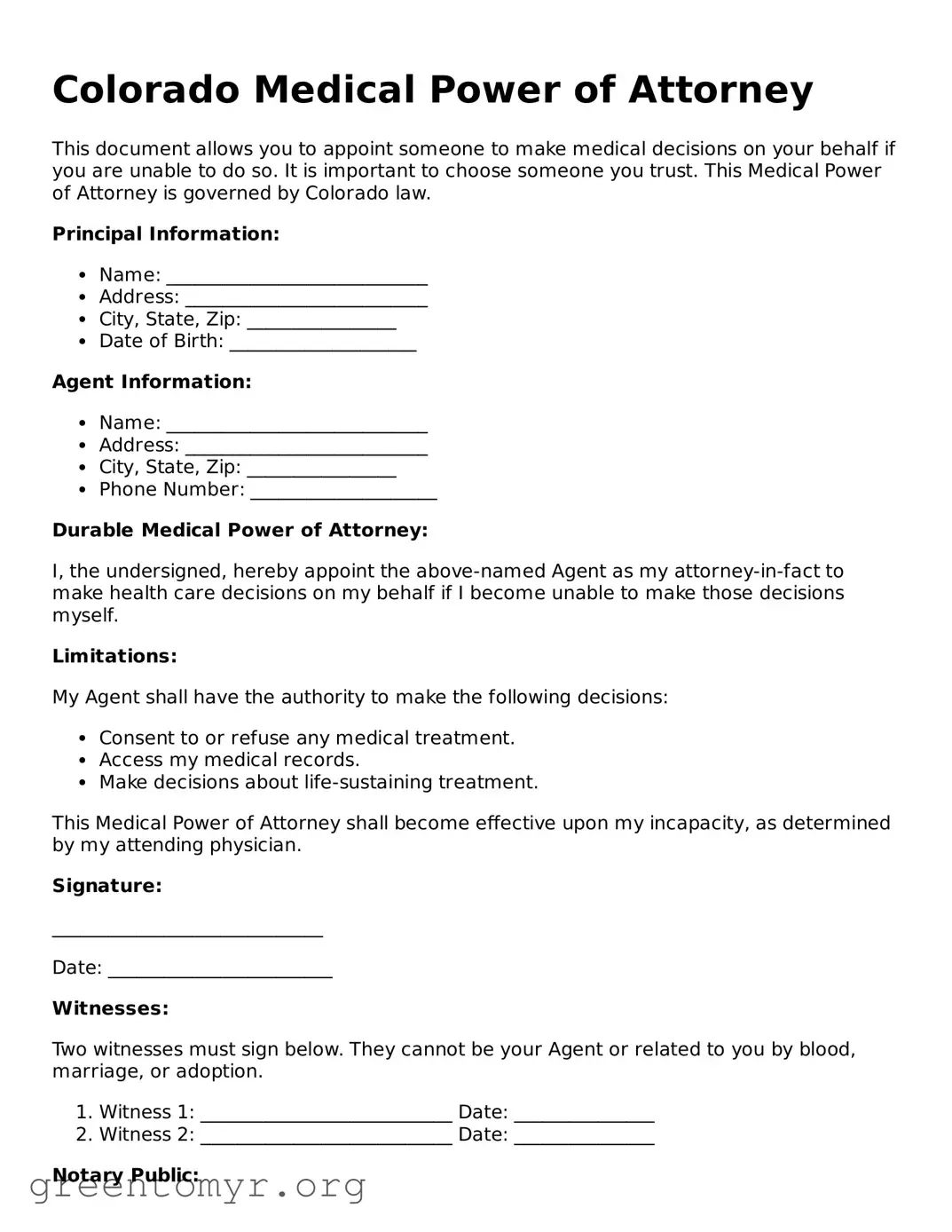
In Colorado, the Medical Power of Attorney form plays a crucial role in ensuring that individuals can make their healthcare preferences known, especially when they are unable to communicate those wishes themselves. This legal document allows a person, known as the principal, to designate a trusted individual, referred to as the agent, to make medical decisions on their behalf. It encompasses various aspects of healthcare, including treatment options, end-of-life care, and the authority to access medical records. By using this form, individuals can express their desires regarding specific medical treatments and interventions, ensuring that their values and preferences are respected even in challenging circumstances. The form is designed to be straightforward, allowing for easy customization to fit personal needs, while also adhering to Colorado's legal requirements. Understanding how to properly fill out and implement this document can empower individuals to take control of their healthcare decisions and provide peace of mind for both themselves and their loved ones.
Colorado Medical Power of Attorney
This document allows you to appoint someone to make medical decisions on your behalf if you are unable to do so. It is important to choose someone you trust. This Medical Power of Attorney is governed by Colorado law.
Principal Information:
Agent Information:
Durable Medical Power of Attorney:
I, the undersigned, hereby appoint the above-named Agent as my attorney-in-fact to make health care decisions on my behalf if I become unable to make those decisions myself.
Limitations:
My Agent shall have the authority to make the following decisions:
This Medical Power of Attorney shall become effective upon my incapacity, as determined by my attending physician.
Signature:
_____________________________
Date: ________________________
Witnesses:
Two witnesses must sign below. They cannot be your Agent or related to you by blood, marriage, or adoption.
Notary Public:
State of Colorado
County of _______________
Subscribed and sworn before me on this _____ day of ____________, 20__.
_____________________________
Notary Public
My commission expires: _______________
| Fact Name | Details |
|---|---|
| Purpose | The Colorado Medical Power of Attorney allows individuals to designate someone to make medical decisions on their behalf if they become unable to do so. |
| Governing Law | This form is governed by Colorado Revised Statutes, specifically Title 15, Article 18. |
| Requirements | The form must be signed by the principal and witnessed by two adults or notarized to be valid. |
| Revocation | Individuals can revoke the Medical Power of Attorney at any time, as long as they are mentally competent. |
| Durability | This power of attorney remains effective even if the principal becomes incapacitated, unless stated otherwise. |
After obtaining the Colorado Medical Power of Attorney form, you will need to fill it out accurately to ensure it reflects your wishes regarding medical decisions. Follow these steps carefully to complete the form.
A Medical Power of Attorney (MPOA) in Colorado is a legal document that allows an individual, known as the principal, to designate another person, referred to as the agent, to make medical decisions on their behalf in case they become unable to do so. This document ensures that the principal's healthcare preferences are honored even when they cannot communicate them directly.
In Colorado, any competent adult can be appointed as an agent. This includes family members, friends, or trusted individuals. It is important to choose someone who understands your values and wishes regarding medical treatment and is willing to advocate for you in a healthcare setting.
To create a Medical Power of Attorney in Colorado, follow these steps:
Yes, in Colorado, the Medical Power of Attorney must be signed in the presence of a notary public or two witnesses who are not related to you and do not stand to inherit from you. This requirement helps to ensure that the document is valid and reflects your true intentions.
Absolutely. You have the right to revoke your Medical Power of Attorney at any time, as long as you are competent to do so. To revoke it, you can create a written notice stating your intention to revoke the MPOA and notify your agent and healthcare providers. It is advisable to destroy any copies of the previous MPOA to avoid confusion.
If you do not have a Medical Power of Attorney and become unable to make your own medical decisions, your family members may have to go through a legal process to determine who will make those decisions for you. This process can be lengthy and may not align with your personal wishes, making it essential to have a MPOA in place.
Yes, you can include specific medical wishes in your Medical Power of Attorney. While the primary purpose is to appoint an agent, you can also provide guidance on your preferences for medical treatment, end-of-life care, and other healthcare decisions. This can help your agent make choices that align with your values and beliefs.
It is advisable to review your Medical Power of Attorney periodically, especially after significant life events such as marriage, divorce, or the birth of a child. Changes in your health status or personal relationships may also warrant a review. Ensuring that your MPOA reflects your current wishes is crucial for effective decision-making.
Your Medical Power of Attorney should be kept in a safe but accessible place. Consider providing copies to your appointed agent, close family members, and your healthcare provider. This ensures that those involved in your care are aware of your wishes and can easily access the document when needed.
When filling out the Colorado Medical Power of Attorney form, individuals often make several common mistakes that can lead to confusion or even invalidate the document. One frequent error is failing to specify the agent clearly. The agent is the person who will make medical decisions on your behalf. If the name is not written clearly or if there is ambiguity about who the agent is, it can create issues when the document needs to be used.
Another common mistake is neglecting to sign and date the form. Both your signature and the date are crucial for the document's validity. Without these, the form may be considered incomplete, rendering it ineffective when needed. Additionally, witnesses must also sign the form. Failing to have the required number of witnesses can lead to complications, as Colorado law mandates that at least two witnesses be present during the signing.
People often overlook the importance of discussing their wishes with their chosen agent. It is vital that your agent understands your preferences regarding medical treatment. Without this communication, the agent may make decisions that do not align with your values or desires, which can lead to distress for both you and your loved ones.
Another mistake involves not reviewing the form after it has been filled out. Errors in personal information, such as the agent's contact details or your own, can lead to complications. Always double-check the information to ensure it is accurate and up-to-date.
Some individuals forget to consider alternate agents. If your primary agent is unavailable or unable to act, having an alternate can ensure that your medical decisions are still made according to your wishes. Not including this can leave a gap in decision-making during critical times.
Furthermore, people may not understand the scope of authority granted to the agent. The Colorado Medical Power of Attorney allows the agent to make a wide range of medical decisions. If you want to limit this authority, you must specify those limitations clearly in the document.
Another mistake is failing to keep the document accessible. Once the form is completed, it should be stored in a place where your loved ones can easily find it. If the document is not accessible when needed, it defeats its purpose.
Finally, individuals sometimes forget to revoke previous powers of attorney. If you have created a new Medical Power of Attorney, ensure that any prior documents are formally revoked. This step prevents confusion about which document is currently in effect.
When preparing a Colorado Medical Power of Attorney form, several other documents may be useful to ensure comprehensive planning for healthcare decisions. Each of these forms serves a specific purpose and can help clarify an individual's wishes regarding medical treatment and end-of-life care.
These documents complement the Colorado Medical Power of Attorney form, helping to create a clear and comprehensive plan for healthcare decisions. By preparing these forms, individuals can ensure their wishes are honored and that their loved ones are supported during difficult times.
A Medical Power of Attorney (MPOA) allows someone to make healthcare decisions on your behalf if you are unable to do so. Several other documents serve similar purposes, offering varying degrees of authority and focus. Here are ten documents that share similarities with the MPOA:
When filling out the Colorado Medical Power of Attorney form, it’s important to follow certain guidelines to ensure that your document is valid and reflects your wishes. Here’s a list of things you should and shouldn’t do:
Understanding the Colorado Medical Power of Attorney (MPOA) form is essential for ensuring that your healthcare wishes are respected. However, there are several misconceptions surrounding this important document. Here are four common misunderstandings:
By addressing these misconceptions, individuals can better prepare for their healthcare decisions and ensure their preferences are known and respected.
Here are some key takeaways about filling out and using the Colorado Medical Power of Attorney form: