Content Navigation

The Colorado Mobile Home Bill of Sale form is an essential document for anyone involved in the buying or selling of mobile homes in the state. This form serves as a legal record of the transaction, providing vital details such as the names and addresses of both the buyer and seller, the mobile home's identification number, and its make, model, and year. Additionally, it outlines the sale price and any terms or conditions agreed upon by both parties. Completing this form accurately is crucial, as it not only facilitates a smooth transfer of ownership but also ensures that the transaction is compliant with state regulations. Furthermore, the document may require notarization to enhance its legal validity, making it imperative for both buyers and sellers to understand its significance. By utilizing the Colorado Mobile Home Bill of Sale form, individuals can protect their interests and ensure a transparent process during the sale or purchase of a mobile home.

Colorado Mobile Home Bill of Sale Example

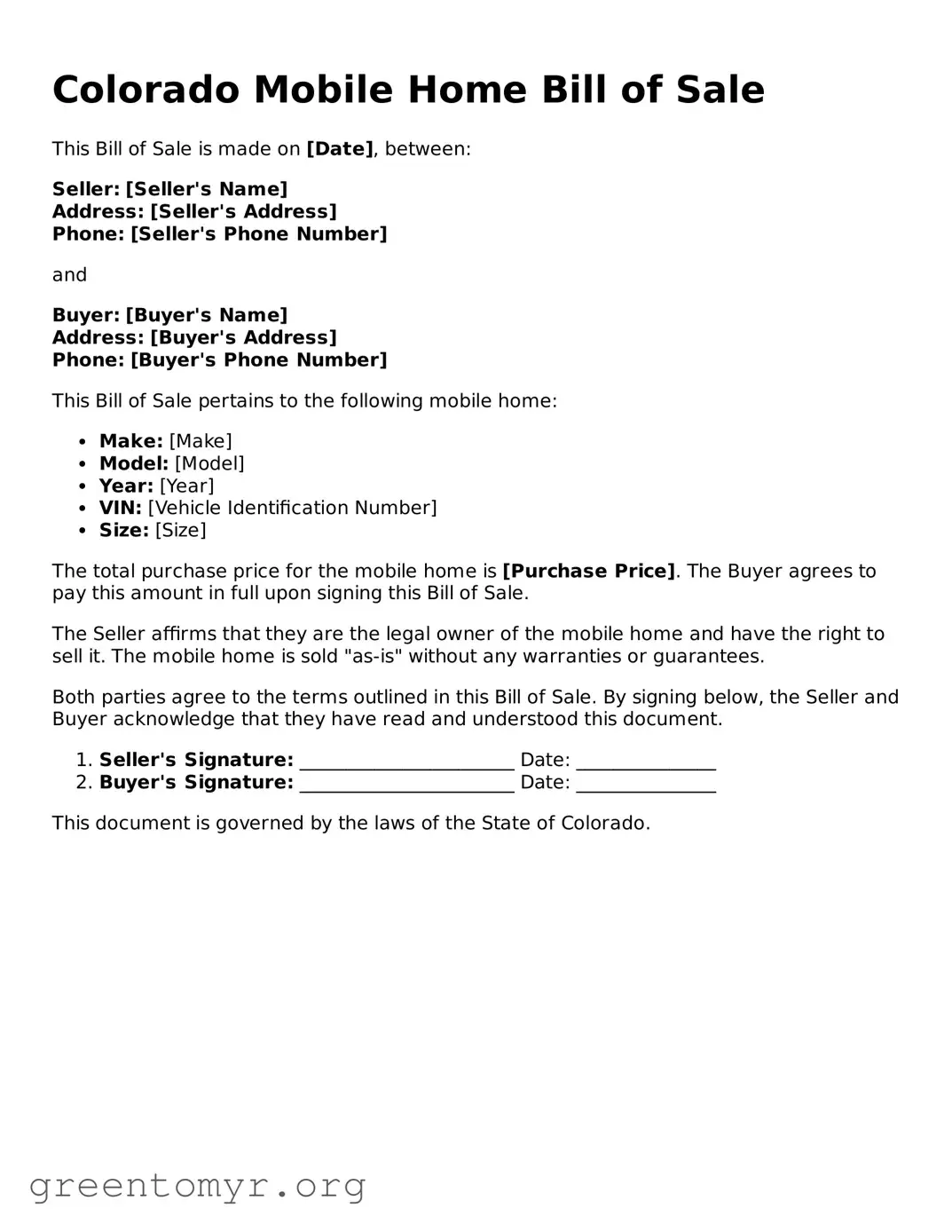
Colorado Mobile Home Bill of Sale

This Bill of Sale is made on [Date], between:

Seller: [Seller's Name]
Address: [Seller's Address]
Phone: [Seller's Phone Number]

and

Buyer: [Buyer's Name]
Address: [Buyer's Address]
Phone: [Buyer's Phone Number]

This Bill of Sale pertains to the following mobile home:

  • Make: [Make]
  • Model: [Model]
  • Year: [Year]
  • VIN: [Vehicle Identification Number]
  • Size: [Size]

The total purchase price for the mobile home is [Purchase Price]. The Buyer agrees to pay this amount in full upon signing this Bill of Sale.

The Seller affirms that they are the legal owner of the mobile home and have the right to sell it. The mobile home is sold "as-is" without any warranties or guarantees.

Both parties agree to the terms outlined in this Bill of Sale. By signing below, the Seller and Buyer acknowledge that they have read and understood this document.

  1. Seller's Signature: _______________________ Date: _______________
  2. Buyer's Signature: _______________________ Date: _______________

This document is governed by the laws of the State of Colorado.

PDF Form Features

Fact Name Description
Purpose The Colorado Mobile Home Bill of Sale form is used to document the sale of a mobile home in the state of Colorado.
Governing Law This form is governed by Colorado state law, particularly the Colorado Revised Statutes Title 38, Article 29.
Parties Involved The form requires information about the seller and the buyer, ensuring both parties are clearly identified.
Property Description A detailed description of the mobile home must be included, such as the make, model, year, and Vehicle Identification Number (VIN).
Purchase Price The agreed-upon purchase price for the mobile home should be clearly stated in the form.
Date of Sale The date when the sale takes place must be recorded to establish the timeline of the transaction.
Signatures Required Both the seller and the buyer must sign the form to validate the transaction.
Notarization While notarization is not always required, having the form notarized can provide an additional layer of authenticity.
Transfer of Ownership This form facilitates the legal transfer of ownership from the seller to the buyer.
Record Keeping It is advisable for both parties to keep a copy of the completed Bill of Sale for their records.

Guide to Using Colorado Mobile Home Bill of Sale

Once you have the Colorado Mobile Home Bill of Sale form in hand, you will need to complete it accurately to ensure a smooth transfer of ownership. The following steps outline how to fill out the form properly.

  1. Obtain the Form: Start by downloading or printing the Colorado Mobile Home Bill of Sale form from a reliable source.
  2. Seller Information: Enter the full name and address of the seller in the designated fields. This identifies the current owner of the mobile home.
  3. Buyer Information: Fill in the buyer's full name and address. This section should clearly state who will be receiving ownership of the mobile home.
  4. Mobile Home Details: Provide the specifics of the mobile home, including the make, model, year, and Vehicle Identification Number (VIN). This information is crucial for identifying the mobile home accurately.
  5. Sale Price: Indicate the agreed-upon sale price for the mobile home. This amount should reflect what the buyer and seller have agreed to.
  6. Date of Sale: Write the date when the sale is taking place. This helps establish the timeline of ownership transfer.
  7. Signatures: Both the seller and buyer must sign the form. Their signatures validate the transaction and confirm that both parties agree to the terms outlined in the bill of sale.
  8. Witness or Notary (if required): Depending on local regulations, you may need a witness or notary to sign the document as well. Check local requirements to ensure compliance.

After completing the form, both parties should keep a copy for their records. This documentation will serve as proof of the transaction and may be needed for future reference, especially when registering the mobile home with the state.

Get Answers on Colorado Mobile Home Bill of Sale

What is a Colorado Mobile Home Bill of Sale form?

The Colorado Mobile Home Bill of Sale form is a legal document used to transfer ownership of a mobile home from one person to another. This form provides essential details about the transaction, including the names of the buyer and seller, the description of the mobile home, and the sale price. It serves as proof of ownership and can be crucial for future transactions or registrations.

Why is a Bill of Sale important for mobile home transactions?

A Bill of Sale is important for several reasons:

  1. Legal Protection: It protects both the buyer and seller by documenting the sale. This reduces the risk of disputes over ownership or terms of the sale.
  2. Proof of Ownership: The form serves as evidence that the buyer has purchased the mobile home, which is necessary for registration and titling.
  3. Tax Purposes: It can be useful for tax records, helping both parties report the sale appropriately.
  4. Transfer of Responsibilities: It clearly outlines any responsibilities or conditions that may come with the sale.

How do I fill out the Colorado Mobile Home Bill of Sale form?

Filling out the form is straightforward. Here are the steps to follow:

  • Identify the Parties: Enter the full names and addresses of both the buyer and seller.
  • Describe the Mobile Home: Provide detailed information about the mobile home, including its make, model, year, and vehicle identification number (VIN).
  • State the Sale Price: Clearly indicate the amount agreed upon for the sale.
  • Sign and Date: Both parties should sign and date the form to make it legally binding.

Do I need to have the Bill of Sale notarized?

In Colorado, notarization of the Bill of Sale is not strictly required for the sale of a mobile home. However, having it notarized can add an extra layer of security and authenticity to the document. It may also be beneficial if there are any disputes in the future. Always check with local regulations or consult a legal expert if you have specific concerns.

Common mistakes

Filling out the Colorado Mobile Home Bill of Sale form can seem straightforward, but many people make common mistakes that can lead to complications down the line. One frequent error is neglecting to include all required information. Buyers and sellers must provide details such as the mobile home’s identification number, make, model, and year. Omitting even one piece of information can render the document incomplete.

Another common mistake involves incorrect signatures. Both the buyer and seller must sign the form for it to be legally binding. If one party forgets to sign or if the signatures do not match the names printed on the form, it could cause issues with ownership transfer. Always double-check that both parties have signed in the appropriate places.

People often fail to date the form properly. The date of the transaction is crucial for legal records. Without a clear date, it can be challenging to establish when the sale took place, which can complicate matters if disputes arise later. Always ensure that the date is filled in accurately.

Another mistake is not providing the correct payment details. The Bill of Sale should specify the purchase price and any terms of payment. Leaving this information vague can lead to misunderstandings between the buyer and seller. Clarity is essential to avoid future conflicts.

Some individuals overlook the importance of notary acknowledgment. While it may not be required for every transaction, having the document notarized adds an extra layer of protection and authenticity. This can be particularly helpful if either party needs to prove the transaction occurred in the future.

Additionally, people sometimes forget to keep copies of the completed Bill of Sale. It’s important for both the buyer and seller to retain a copy for their records. This serves as proof of the transaction and can be vital if any issues arise later regarding ownership or payment.

Lastly, failing to understand state-specific regulations can lead to significant problems. Each state has its own laws governing mobile home sales. Ignoring these regulations can result in fines or complications during the title transfer process. Researching Colorado’s specific requirements before completing the form is essential for a smooth transaction.

Documents used along the form

When purchasing or selling a mobile home in Colorado, several important documents accompany the Mobile Home Bill of Sale. Each document plays a crucial role in ensuring a smooth transaction and protecting the rights of both parties involved. Here’s a brief overview of some essential forms and documents you may need.

  • Title Transfer Form: This document is necessary to officially transfer ownership of the mobile home from the seller to the buyer. It must be completed and submitted to the appropriate state agency.
  • Affidavit of Affixation: If the mobile home is being permanently affixed to a piece of land, this affidavit certifies that it will no longer be treated as personal property but as real estate.
  • Sales Agreement: This written contract outlines the terms of the sale, including the purchase price, payment method, and any contingencies. It serves as a binding agreement between the buyer and seller.
  • Inspection Report: An inspection report, often conducted by a professional, details the condition of the mobile home. This document can help the buyer make an informed decision and negotiate repairs or price adjustments.
  • Bill of Sale for Personal Property: In addition to the Mobile Home Bill of Sale, this document may be used to list any personal property being sold along with the mobile home, such as appliances or fixtures.
  • Tax Clearance Certificate: This certificate verifies that all property taxes associated with the mobile home have been paid. It is often required before a sale can be finalized.
  • Proof of Insurance: Buyers may need to provide proof of insurance coverage for the mobile home before the sale is completed. This document protects both the buyer and seller in case of unforeseen events.
  • Financing Documents: If the buyer is financing the purchase, documents from the lender detailing the loan terms, interest rates, and payment schedules will be necessary to finalize the transaction.

Having these documents ready can significantly streamline the buying or selling process of a mobile home in Colorado. Each form serves a specific purpose, ensuring that all legal requirements are met and protecting the interests of everyone involved. Always consult with a legal professional if you have questions about these documents or the transaction process.

Similar forms

The Mobile Home Bill of Sale form serves as a crucial document in the transfer of ownership for mobile homes. It shares similarities with several other legal documents. Below are four documents that are comparable to the Mobile Home Bill of Sale:

  • Vehicle Bill of Sale: This document is used to transfer ownership of a motor vehicle. Like the Mobile Home Bill of Sale, it includes details such as the buyer's and seller's information, vehicle identification number, and sale price.
  • Real Estate Purchase Agreement: This agreement outlines the terms of a real estate transaction. Similar to the Mobile Home Bill of Sale, it specifies the parties involved, property details, and the agreed-upon price, ensuring a clear transfer of ownership.
  • Boat Bill of Sale: This document is utilized when selling a boat. It shares common elements with the Mobile Home Bill of Sale, including the identification of the buyer and seller, a description of the boat, and the sale price, facilitating a smooth transfer of ownership.
  • Personal Property Bill of Sale: This form is used for the sale of personal property items. Like the Mobile Home Bill of Sale, it includes the names of the buyer and seller, a description of the item being sold, and the transaction amount, ensuring both parties have a record of the sale.

Dos and Don'ts

When filling out the Colorado Mobile Home Bill of Sale form, it's important to follow certain guidelines to ensure the process goes smoothly. Below are ten things to keep in mind.

  • Do ensure that all information is accurate and complete.
  • Do include the vehicle identification number (VIN) of the mobile home.
  • Do sign the form in the presence of a notary, if required.
  • Do provide the correct sale price and date of the transaction.
  • Do keep a copy of the completed form for your records.
  • Don't leave any sections blank; fill in all required fields.
  • Don't use abbreviations or shorthand that may cause confusion.
  • Don't forget to include the buyer's and seller's contact information.
  • Don't sign the form without verifying all details are correct.
  • Don't submit the form without checking for any additional requirements in your county.

Misconceptions

Understanding the Colorado Mobile Home Bill of Sale form can be tricky. Here are seven common misconceptions that people have about this important document:

  • It is not necessary for private sales. Many believe that a Bill of Sale is only needed for transactions involving dealers. In reality, it is essential for any private sale to protect both the buyer and seller.
  • The form is the same as a traditional vehicle Bill of Sale. While both documents serve similar purposes, the Mobile Home Bill of Sale has specific requirements and details that differ from standard vehicle sales.
  • Once signed, the Bill of Sale is final and cannot be changed. This is not true. If both parties agree, the Bill of Sale can be amended or updated as needed, provided that both signatures are obtained on the new document.
  • Only the seller needs to sign the form. Some think that only the seller's signature is required. However, both the buyer and seller must sign to validate the transaction.
  • The form does not need to be notarized. While notarization is not always required, having the document notarized can add an extra layer of authenticity and protection for both parties.
  • The Bill of Sale is not needed for transferring ownership. This misconception can lead to complications. The Bill of Sale is crucial for transferring ownership and should always be completed during the sale.
  • It is a complicated document. Many people think that the Bill of Sale is difficult to understand. In reality, it is a straightforward form that outlines essential details of the transaction.

By clearing up these misconceptions, individuals can approach the Mobile Home Bill of Sale with confidence, ensuring a smooth and secure transaction.

Key takeaways

When dealing with the Colorado Mobile Home Bill of Sale form, it’s important to keep several key points in mind to ensure a smooth transaction. Below are some essential takeaways to consider:

  • Accurate Information: Ensure all details about the mobile home, such as the make, model, year, and vehicle identification number (VIN), are filled out accurately. This information is crucial for proper identification and registration.
  • Seller and Buyer Details: Both the seller and buyer must provide their full names and addresses. This helps establish clear ownership and can be important for future correspondence.
  • Purchase Price: Clearly state the purchase price of the mobile home. This amount should reflect the agreed-upon price between the seller and buyer.
  • Signatures Required: Both parties must sign the bill of sale. Without signatures, the document may not be considered valid, and the transaction could be disputed.
  • Notarization: While notarization is not mandatory, having the document notarized can add an extra layer of authenticity and may help in case of future disputes.
  • Keep Copies: After completing the form, both the seller and buyer should keep copies for their records. This can be helpful for future reference or if any issues arise regarding the sale.

By following these guidelines, both sellers and buyers can navigate the process of transferring ownership of a mobile home more effectively.