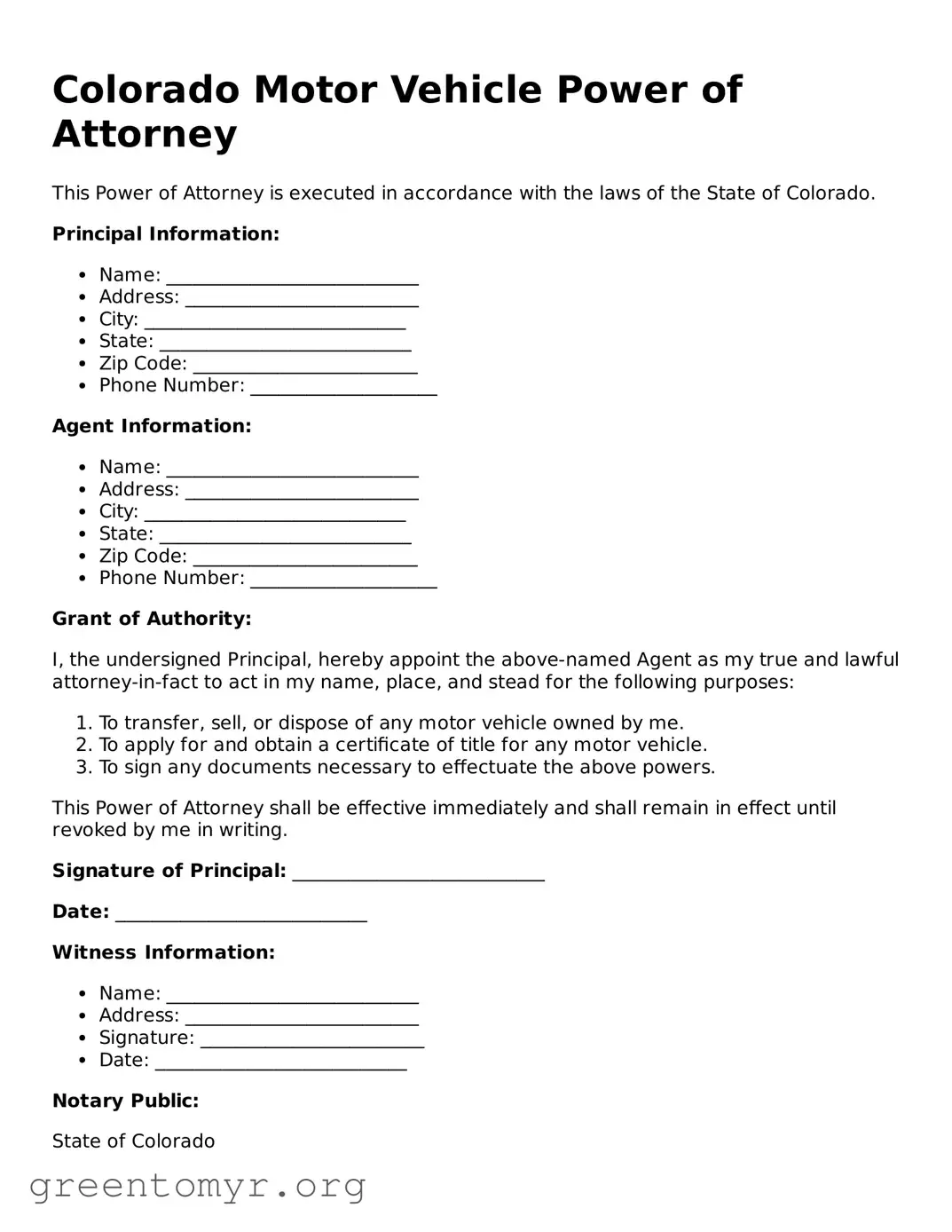
The Colorado Motor Vehicle Power of Attorney form serves as a vital tool for individuals needing to delegate authority regarding their motor vehicle transactions. This form allows one person, known as the principal, to appoint another person, referred to as the agent, to act on their behalf in matters related to vehicle ownership, registration, and title transfers. Whether you are unable to attend to these tasks due to time constraints, health issues, or other obligations, this form ensures that your interests are represented. It is important to note that the agent must act in accordance with the principal’s wishes and within the scope defined in the document. The form is straightforward, requiring essential information such as the names and addresses of both the principal and agent, as well as details about the vehicle in question. By completing this form, individuals can streamline the process of managing their vehicle-related affairs, providing peace of mind and clarity in situations where personal involvement may not be feasible.
Colorado Motor Vehicle Power of Attorney
This Power of Attorney is executed in accordance with the laws of the State of Colorado.
Principal Information:
Agent Information:
Grant of Authority:
I, the undersigned Principal, hereby appoint the above-named Agent as my true and lawful attorney-in-fact to act in my name, place, and stead for the following purposes:
This Power of Attorney shall be effective immediately and shall remain in effect until revoked by me in writing.
Signature of Principal: ___________________________
Date: ___________________________
Witness Information:
Notary Public:
State of Colorado
County of ___________________________
Subscribed and sworn to before me this ____ day of __________, 20__.
Notary Signature: ___________________________
My Commission Expires: ______________________
| Fact Name | Description |
|---|---|
| Purpose | The Colorado Motor Vehicle Power of Attorney form allows an individual to authorize another person to handle specific motor vehicle-related transactions on their behalf. |
| Governing Law | This form is governed by the Colorado Revised Statutes, specifically § 15-14-740, which outlines powers of attorney in the state. |
| Usage | Commonly used for tasks such as transferring vehicle ownership, registering vehicles, or obtaining duplicate titles. |
| Signature Requirement | The form must be signed by the principal, the person granting the power, and may require notarization to be valid. |
| Duration | The power of attorney remains effective until revoked by the principal or until the specified tasks are completed. |
Completing the Colorado Motor Vehicle Power of Attorney form is an important step in delegating authority for vehicle-related matters. This process ensures that your designated representative can act on your behalf effectively. Follow the steps outlined below to fill out the form accurately.
Once the form is filled out and properly executed, it can be submitted to the appropriate authorities or kept for personal records as needed. Ensure that all parties involved understand their responsibilities under this power of attorney.
The Colorado Motor Vehicle Power of Attorney form allows you to appoint someone else to act on your behalf regarding motor vehicle transactions. This can include tasks like registering a vehicle, transferring ownership, or obtaining a title. It's a helpful tool when you can't be present to handle these matters yourself.
Any adult can be appointed as your agent. This could be a family member, friend, or even a professional service. Just make sure the person you choose is trustworthy and understands your needs regarding the vehicle.
No, the Colorado Motor Vehicle Power of Attorney form does not require notarization. However, it’s a good idea to have it signed in front of a witness to ensure that everything is clear and above board.
The Power of Attorney remains valid until you revoke it or until the specific task is completed. If you want to terminate it, you can do so by providing written notice to your agent.
Yes, you can use the Colorado Motor Vehicle Power of Attorney form for multiple vehicles. Just be sure to list each vehicle clearly on the form to avoid any confusion.
If you decide to revoke the Power of Attorney, you should do so in writing. Notify your agent and any relevant parties, such as the Department of Motor Vehicles (DMV), to ensure that they are aware of the change.
There is no fee for completing the Colorado Motor Vehicle Power of Attorney form itself. However, there may be fees associated with the transactions your agent performs on your behalf, such as registration or title transfer fees.
You can obtain the Colorado Motor Vehicle Power of Attorney form online through the Colorado DMV website or at your local DMV office. It’s important to use the most current version of the form to ensure it meets all requirements.
If you suspect that your agent is misusing the Power of Attorney, take action immediately. You can revoke the Power of Attorney and notify the DMV. If necessary, consider seeking legal advice to address any potential issues.
Filling out the Colorado Motor Vehicle Power of Attorney form can be a straightforward process, but mistakes can easily occur. One common error is failing to provide complete information about the vehicle. This includes not listing the vehicle identification number (VIN), make, model, and year. Incomplete details can lead to confusion or delays when the power of attorney is being used. It is crucial to ensure that all relevant information is accurately included to avoid any potential issues.
Another frequent mistake involves the selection of the authorized agent. Some individuals may choose someone who is not fully aware of their responsibilities or may not have the necessary knowledge to handle the transaction. It is essential to select an agent who understands the process and can act in the best interest of the vehicle owner. This choice can significantly impact the effectiveness of the power of attorney.
Additionally, many people overlook the requirement for signatures. The form must be signed by the vehicle owner, and in some cases, it may also require a witness or notarization. Skipping this step can render the document invalid. Therefore, verifying that all necessary signatures are present before submitting the form is a critical step that should not be neglected.
Lastly, individuals often forget to keep a copy of the completed form for their records. Once the power of attorney is executed, having a copy can provide peace of mind and serve as a reference in the future. It is advisable to store this document in a safe place where it can be easily accessed if needed. Taking these simple precautions can help ensure that the process goes smoothly and that the power of attorney is effective when needed.
When dealing with vehicle transactions in Colorado, several forms and documents often accompany the Motor Vehicle Power of Attorney form. These documents help ensure that all necessary legal aspects are covered, providing clarity and protection for both parties involved.
Using these documents in conjunction with the Motor Vehicle Power of Attorney form can simplify the process of managing vehicle transactions in Colorado. Proper documentation ensures that all parties are protected and that the transfer of ownership is conducted smoothly.
The Motor Vehicle Power of Attorney form allows one person to authorize another to act on their behalf regarding vehicle-related matters. This document shares similarities with several other legal documents. Here are five such documents:
When filling out the Colorado Motor Vehicle Power of Attorney form, it's important to follow certain guidelines to ensure everything is completed correctly. Here’s a list of things you should and shouldn't do:
When dealing with the Colorado Motor Vehicle Power of Attorney form, several misconceptions can lead to confusion. Understanding these misconceptions can help individuals navigate the process more effectively.
This is not accurate. While the form is commonly used for ownership transfers, it also allows someone to handle various tasks related to the vehicle, such as registering it or obtaining a title.
In reality, the vehicle owner must sign the form, but they can designate another person to act on their behalf. This is particularly useful for individuals who are unable to attend to vehicle matters personally.
This is misleading. The Colorado Motor Vehicle Power of Attorney can be revoked at any time by the principal, as long as they are of sound mind. It is essential to communicate any revocation to the appointed agent.
While notarization is not always necessary for the form to be valid, having it notarized can add an extra layer of authenticity and may be required by certain institutions or in specific situations.
Filling out and using the Colorado Motor Vehicle Power of Attorney form is a straightforward process, but there are several important points to consider. Below are key takeaways that can help ensure a smooth experience.
By following these guidelines, individuals can effectively utilize the Colorado Motor Vehicle Power of Attorney form, facilitating important vehicle-related transactions with ease.