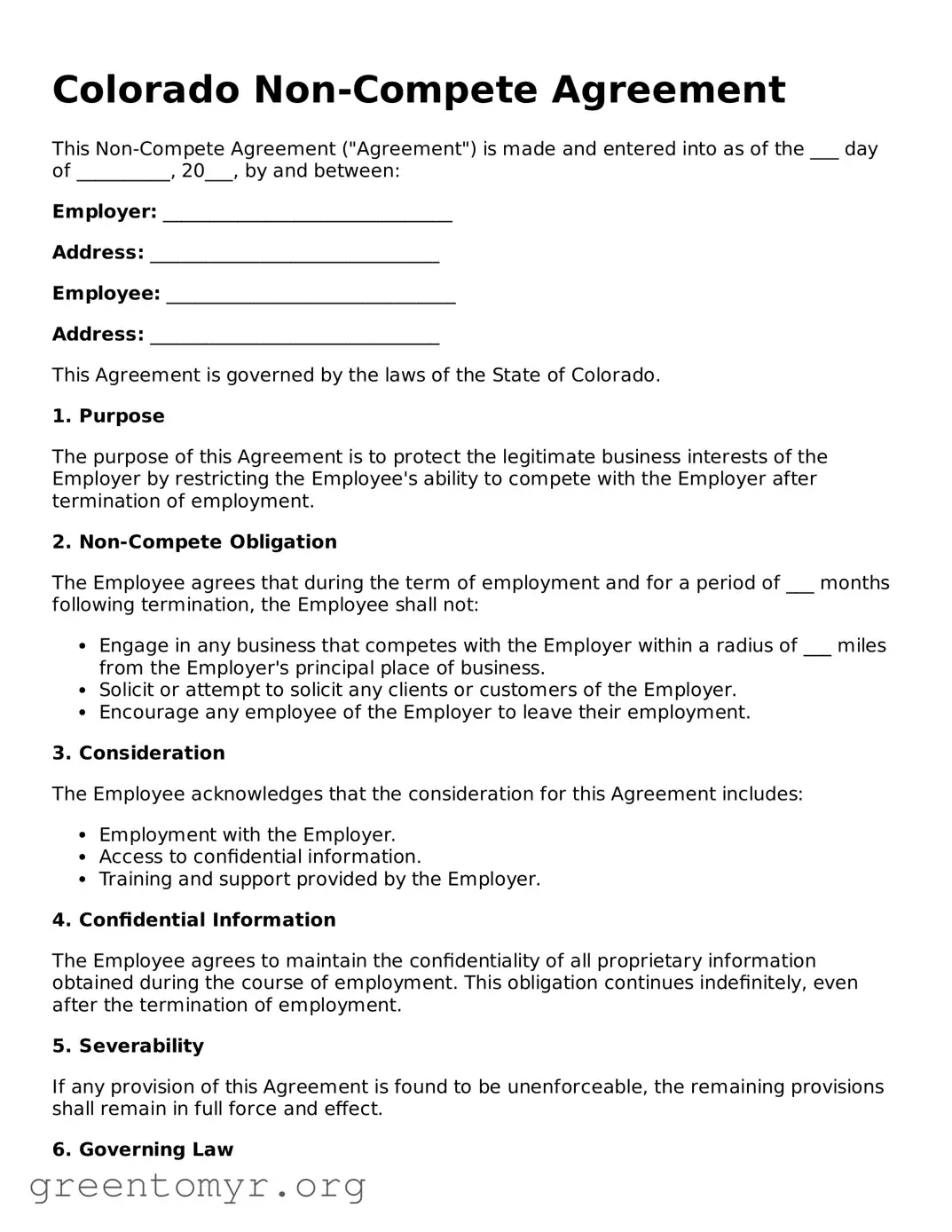
In the competitive landscape of employment, many businesses in Colorado seek to protect their interests through non-compete agreements. These legal documents serve as a way to restrict employees from engaging in similar work with competitors after leaving a job. The Colorado Non-compete Agreement form outlines specific terms and conditions that both the employer and employee must understand. It typically includes details such as the duration of the non-compete period, the geographical area covered, and the types of activities that are prohibited. By clearly defining these elements, the form aims to balance the employer's need for protection with the employee's right to seek new opportunities. Understanding the nuances of this agreement is crucial for both parties, as it can significantly impact future employment prospects and business operations.
Colorado Non-Compete Agreement
This Non-Compete Agreement ("Agreement") is made and entered into as of the ___ day of __________, 20___, by and between:
Employer: _______________________________
Address: _______________________________
Employee: _______________________________
Address: _______________________________
This Agreement is governed by the laws of the State of Colorado.
1. Purpose
The purpose of this Agreement is to protect the legitimate business interests of the Employer by restricting the Employee's ability to compete with the Employer after termination of employment.
2. Non-Compete Obligation
The Employee agrees that during the term of employment and for a period of ___ months following termination, the Employee shall not:
3. Consideration
The Employee acknowledges that the consideration for this Agreement includes:
4. Confidential Information
The Employee agrees to maintain the confidentiality of all proprietary information obtained during the course of employment. This obligation continues indefinitely, even after the termination of employment.
5. Severability
If any provision of this Agreement is found to be unenforceable, the remaining provisions shall remain in full force and effect.
6. Governing Law
This Agreement shall be governed by and construed in accordance with the laws of the State of Colorado.
7. Entire Agreement
This Agreement constitutes the entire understanding between the parties regarding the subject matter herein and supersedes all prior agreements or understandings.
IN WITNESS WHEREOF, the parties have executed this Non-Compete Agreement as of the date first above written.
Employer Signature: ___________________________
Date: ___________________________
Employee Signature: ___________________________
Date: ___________________________
| Fact Name | Description |
|---|---|
| Governing Law | The Colorado Non-compete Agreement is governed by Colorado Revised Statutes, specifically C.R.S. § 8-2-113. |
| Enforceability | In Colorado, non-compete agreements are generally enforceable only if they protect a legitimate business interest. |
| Duration Limit | The duration of a non-compete agreement in Colorado cannot exceed one year from the date of termination of employment. |
| Geographic Scope | Colorado law requires that the geographic area covered by a non-compete agreement must be reasonable and not overly broad. |
Once you have the Colorado Non-compete Agreement form in hand, it's time to fill it out accurately. Completing this form involves several straightforward steps. Ensure you have all necessary information ready to streamline the process.
After completing the form, ensure that each party retains a copy for their records. This will help avoid any misunderstandings in the future.
A non-compete agreement is a contract between an employer and an employee. It restricts the employee from working for competitors or starting a competing business after leaving the company. In Colorado, these agreements must meet specific criteria to be enforceable. They should be reasonable in duration and geographic scope. The goal is to protect the employer’s legitimate business interests without unfairly limiting the employee’s ability to find work.
Yes, non-compete agreements can be enforceable in Colorado, but there are strict limitations. Colorado law generally favors employee mobility. For a non-compete to be valid, it must be related to the protection of trade secrets or other legitimate business interests. Additionally, the agreement must be signed at the time of employment or when there is a significant change in employment conditions. Courts will often evaluate the reasonableness of the agreement in terms of time and geographic area.
Colorado imposes several limitations on non-compete agreements:
These limitations help ensure that employees are not unfairly restricted from pursuing their careers.
Before signing a non-compete agreement, consider the following:
Taking these steps can help you make an informed decision about signing a non-compete agreement.
When filling out the Colorado Non-compete Agreement form, individuals often overlook critical details that can lead to complications down the line. One common mistake is failing to clearly define the scope of the agreement. Without precise language, it becomes challenging to enforce the non-compete clause. The parties involved should take time to specify what activities are restricted, which can prevent misunderstandings later.
Another frequent error is neglecting to include a reasonable duration for the non-compete. Colorado law requires that the time frame be fair and justifiable. If the duration is too long, a court may deem the agreement unenforceable. Therefore, it is essential to consider how long the restrictions should last in relation to the industry and the specific role of the employee.
Additionally, individuals often forget to address geographical limitations. A non-compete that applies to an overly broad area may not hold up in court. It’s vital to limit the geographical scope to where the business operates or where the employee had significant influence. This specificity not only strengthens the agreement but also makes it more likely to be upheld if challenged.
Lastly, many people fail to understand the importance of mutual consideration. A non-compete agreement should benefit both parties involved. If only one party is receiving benefits, it may lead to questions about the validity of the agreement. To avoid this pitfall, ensure that both parties are providing something of value, which can include employment, training, or access to proprietary information.
When entering into a non-compete agreement in Colorado, it’s important to understand that this document often works in conjunction with several other forms and agreements. Each of these documents serves a specific purpose, helping to clarify the relationship between employer and employee while protecting business interests. Below is a list of commonly used forms that complement the Colorado Non-compete Agreement.
Understanding these documents and their purposes can significantly enhance the clarity and effectiveness of your non-compete agreement. Each form plays a vital role in ensuring that both parties are protected and aware of their rights and obligations. Always consider seeking professional advice when navigating these agreements to ensure compliance and protection of your interests.
When filling out the Colorado Non-compete Agreement form, it is important to approach the process thoughtfully. Adhering to certain guidelines can help ensure that the agreement is valid and enforceable. Below is a list of things to do and avoid during this process.
Things You Should Do:
Things You Shouldn't Do:
Understanding the Colorado Non-compete Agreement can be challenging, especially with the many misconceptions surrounding it. Here are ten common misunderstandings, explained clearly.
This is not true. In Colorado, non-compete agreements must meet specific criteria to be enforceable, including being reasonable in scope and duration.
While many people associate non-compete agreements with higher-level positions, they can apply to various roles, depending on the nature of the job and the business.
Negotiation is possible. Employees can discuss terms with their employers to reach a mutually agreeable arrangement.
This is misleading. A non-compete may restrict you from working for certain competitors, but it does not ban you from your entire profession.
These are different documents. A non-disclosure agreement protects confidential information, while a non-compete restricts employment with competitors.
Not necessarily. Non-compete agreements can have expiration dates or may be challenged in court if deemed unreasonable.
This is incorrect. Each state has its own laws regarding non-compete agreements, and Colorado has specific regulations that must be followed.
Every non-compete agreement can vary significantly based on the employer's needs and the employee's role. Each agreement should be reviewed individually.
Employees do have rights. They can seek legal advice and may challenge the agreement if it seems unfair or overly restrictive.
This is a misconception. Non-compete agreements can also be used by public companies, although they may be subject to different regulations.
By debunking these misconceptions, individuals can better navigate the complexities of non-compete agreements in Colorado. Always consider seeking legal advice to understand your rights and obligations fully.
Filling out and using the Colorado Non-compete Agreement form can be a straightforward process if you keep a few key points in mind. Here are some important takeaways to consider:
By keeping these points in mind, you can navigate the process of filling out and using the Colorado Non-compete Agreement form more effectively.