Content Navigation

In the realm of business and professional relationships, confidentiality plays a crucial role in protecting sensitive information. The Colorado Non-disclosure Agreement (NDA) form serves as a vital tool for individuals and organizations seeking to safeguard proprietary data, trade secrets, and other confidential materials from unauthorized disclosure. This legally binding document outlines the obligations of the parties involved, ensuring that shared information remains protected. Key components of the form include definitions of what constitutes confidential information, the duration of the confidentiality obligation, and the permissible uses of the disclosed information. Additionally, it may address the consequences of breaching the agreement, providing a clear framework for enforcement. By utilizing the Colorado NDA, parties can foster trust and collaboration while minimizing the risk of information leaks that could harm their competitive edge.

Colorado Non-disclosure Agreement Example

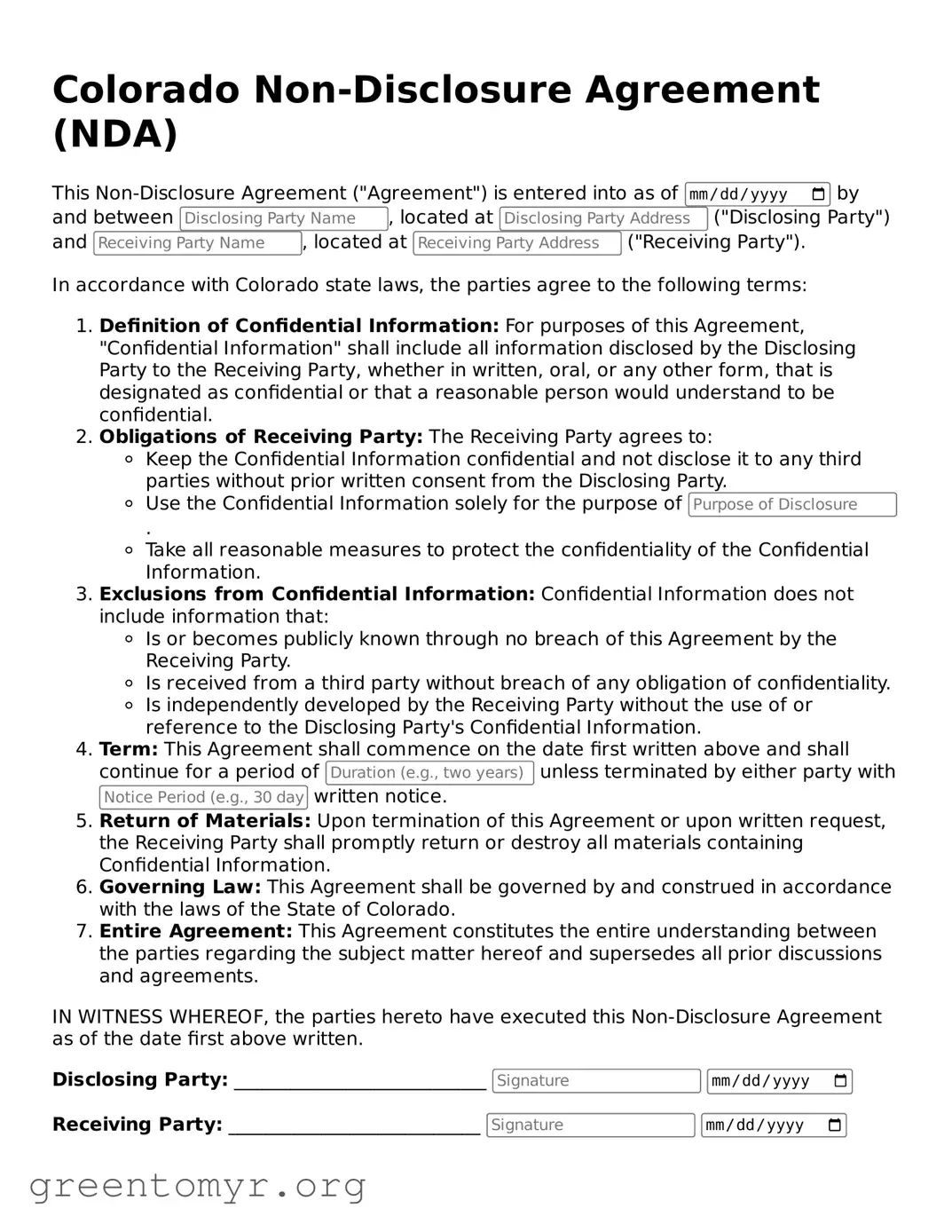
Colorado Non-Disclosure Agreement (NDA)

This Non-Disclosure Agreement ("Agreement") is entered into as of by and between , located at ("Disclosing Party") and , located at ("Receiving Party").

In accordance with Colorado state laws, the parties agree to the following terms:

  1. Definition of Confidential Information: For purposes of this Agreement, "Confidential Information" shall include all information disclosed by the Disclosing Party to the Receiving Party, whether in written, oral, or any other form, that is designated as confidential or that a reasonable person would understand to be confidential.
  2. Obligations of Receiving Party: The Receiving Party agrees to:
    • Keep the Confidential Information confidential and not disclose it to any third parties without prior written consent from the Disclosing Party.
    • Use the Confidential Information solely for the purpose of .
    • Take all reasonable measures to protect the confidentiality of the Confidential Information.
  3. Exclusions from Confidential Information: Confidential Information does not include information that:
    • Is or becomes publicly known through no breach of this Agreement by the Receiving Party.
    • Is received from a third party without breach of any obligation of confidentiality.
    • Is independently developed by the Receiving Party without the use of or reference to the Disclosing Party's Confidential Information.
  4. Term: This Agreement shall commence on the date first written above and shall continue for a period of unless terminated by either party with written notice.
  5. Return of Materials: Upon termination of this Agreement or upon written request, the Receiving Party shall promptly return or destroy all materials containing Confidential Information.
  6. Governing Law: This Agreement shall be governed by and construed in accordance with the laws of the State of Colorado.
  7. Entire Agreement: This Agreement constitutes the entire understanding between the parties regarding the subject matter hereof and supersedes all prior discussions and agreements.

IN WITNESS WHEREOF, the parties hereto have executed this Non-Disclosure Agreement as of the date first above written.

Disclosing Party: ___________________________

Receiving Party: ___________________________

PDF Form Features

Fact Name Details
Definition A Non-disclosure Agreement (NDA) is a legal contract that prevents one party from disclosing confidential information shared by another party.
Purpose NDAs are commonly used to protect sensitive information, trade secrets, and proprietary data in business relationships.
Governing Law The NDA is governed by Colorado state law, which provides the framework for enforcement and interpretation of the agreement.
Parties Involved Typically, there are two parties in an NDA: the disclosing party and the receiving party.
Duration The duration of confidentiality obligations is usually specified in the agreement, often lasting several years or until the information becomes public.
Enforceability For an NDA to be enforceable, it must be reasonable in scope and duration and must not violate public policy.
Exceptions Common exceptions to confidentiality include information that is publicly available, independently developed, or required to be disclosed by law.
Consequences of Breach If a party breaches the NDA, they may face legal action, including potential damages and injunctions to prevent further disclosure.

Guide to Using Colorado Non-disclosure Agreement

After obtaining the Colorado Non-disclosure Agreement form, you will need to complete it accurately to ensure it serves its intended purpose. Follow these steps carefully to fill out the form correctly.

  1. Begin by entering the date at the top of the form. Use the format MM/DD/YYYY.
  2. Identify the parties involved. Clearly write the names of the disclosing party and the receiving party. Ensure that the names are spelled correctly.
  3. Provide the addresses for both parties. Include street addresses, cities, states, and zip codes.
  4. Specify the purpose of the non-disclosure agreement. Briefly describe the nature of the confidential information being protected.
  5. Detail the obligations of the receiving party. Clearly outline how the receiving party should handle the confidential information.
  6. Include any exclusions to the confidentiality obligations. Specify what information is not covered by the agreement.
  7. Set the duration of the agreement. Indicate how long the confidentiality obligations will remain in effect.
  8. Both parties must sign and date the form. Ensure that each signature is accompanied by the printed name of the signer.

After completing these steps, review the form for accuracy. Make sure all information is clear and legible. Once finalized, distribute copies to all parties involved.

Get Answers on Colorado Non-disclosure Agreement

What is a Colorado Non-disclosure Agreement (NDA)?

A Colorado Non-disclosure Agreement is a legal contract that protects confidential information shared between parties. It ensures that sensitive information, such as trade secrets or proprietary data, is not disclosed to unauthorized individuals or entities.

When should I use a Non-disclosure Agreement?

Consider using an NDA when:

  • You plan to share sensitive business information with potential partners or investors.
  • You are hiring employees who will have access to confidential data.
  • You are discussing a merger or acquisition with another company.

Who can be a party to a Non-disclosure Agreement?

Any individual or entity can enter into an NDA. This includes businesses, freelancers, employees, and contractors. Each party must agree to the terms outlined in the agreement.

What types of information are typically protected by an NDA?

Common types of protected information include:

  • Business plans
  • Financial data
  • Customer lists
  • Marketing strategies
  • Technical specifications

How long does the confidentiality obligation last?

The duration of confidentiality obligations can vary. Typically, it lasts for a specified period, often between two to five years. However, some information may remain confidential indefinitely, especially if it is a trade secret.

Can I modify a Colorado Non-disclosure Agreement?

Yes, you can modify an NDA to fit your specific needs. It’s important to ensure that any changes are clearly documented and agreed upon by all parties involved.

What happens if someone breaches the NDA?

If a party breaches the NDA, the injured party may seek legal remedies. This can include monetary damages, injunctive relief, or specific performance to enforce the agreement. Legal action can be costly and time-consuming, so it’s best to adhere to the terms.

Is a Non-disclosure Agreement enforceable in Colorado?

Yes, NDAs are generally enforceable in Colorado as long as they meet legal requirements. These include being clear, reasonable in scope, and not overly restrictive. Consulting with a legal professional can help ensure enforceability.

Do I need a lawyer to create a Non-disclosure Agreement?

While it’s not strictly necessary to hire a lawyer, it’s highly recommended. A legal professional can help you draft an NDA that meets your specific needs and complies with Colorado laws, reducing the risk of future disputes.

Where can I find a template for a Colorado Non-disclosure Agreement?

Templates for NDAs can be found online through legal websites, or you can consult with a lawyer for a custom agreement. Ensure that any template you use is specific to Colorado law and tailored to your situation.

Common mistakes

Filling out the Colorado Non-disclosure Agreement (NDA) form can be straightforward, but many make common mistakes that can lead to issues down the line. One frequent error is failing to clearly define the confidential information. Without a precise definition, it becomes difficult to enforce the agreement later. Parties must specify what information is considered confidential to avoid confusion.

Another mistake is neglecting to identify all parties involved. It’s essential to list everyone who will have access to the confidential information. Omitting a party can weaken the agreement’s effectiveness and create potential legal loopholes. Ensure that all individuals and entities are included to maintain clarity.

Many people also overlook the importance of the duration of the confidentiality obligation. The NDA should specify how long the information must remain confidential. A vague or overly long duration can lead to disputes. Clearly state the time frame to protect both parties’ interests.

Additionally, individuals often forget to include the purpose of sharing the confidential information. The NDA should outline why the information is being shared and how it will be used. This context is crucial for understanding the agreement's scope and limitations.

Another common mistake is not considering the consequences of a breach. The NDA should detail what happens if one party violates the agreement. This can include legal remedies or specific penalties. Clear consequences can deter breaches and provide a framework for resolution.

Some people fail to review the terms before signing. It’s important to read the entire agreement thoroughly. Rushing through the process can lead to misunderstandings. Take the time to ensure all terms are understood and agreed upon.

In addition, individuals often neglect to seek legal advice. Consulting with a legal professional can help identify potential issues and ensure that the NDA meets all necessary requirements. This step can save time and resources in the long run.

Lastly, not keeping a copy of the signed NDA is a frequent oversight. After the agreement is executed, both parties should retain a copy for their records. This ensures that everyone has access to the terms and can refer back to them if needed.

Documents used along the form

The Colorado Non-disclosure Agreement (NDA) is a vital document for protecting sensitive information shared between parties. However, it is often used in conjunction with several other forms and documents that help clarify the terms of the relationship and ensure compliance with legal standards. Below is a list of documents commonly associated with NDAs in Colorado.

  • Confidentiality Agreement: Similar to an NDA, this document outlines the obligations of parties to keep certain information confidential. It may be used in various contexts, including employment and business negotiations.
  • Mutual Non-disclosure Agreement: This type of NDA is designed for situations where both parties will be sharing confidential information. It establishes mutual obligations to protect each other's sensitive data.
  • Employment Agreement: Often includes clauses regarding confidentiality and non-disclosure. This agreement sets the terms of employment, including duties, compensation, and the handling of proprietary information.
  • Non-compete Agreement: This document restricts an employee from engaging in business activities that compete with their employer after leaving the company. It often complements NDAs by protecting business interests.
  • Letter of Intent: This preliminary document outlines the intentions of parties to enter into a future agreement. It often includes confidentiality provisions to protect sensitive information shared during negotiations.
  • Service Agreement: When services are provided, this document outlines the terms and conditions of the service relationship, including confidentiality obligations related to proprietary information.
  • Intellectual Property Assignment Agreement: This agreement transfers ownership of intellectual property from one party to another. It may include clauses that ensure any shared information remains confidential.

Understanding these associated documents can enhance the effectiveness of a Non-disclosure Agreement. Each serves a unique purpose, contributing to a comprehensive legal framework that protects sensitive information and fosters trust between parties.

Similar forms

A Non-disclosure Agreement (NDA) is a vital document used to protect confidential information. Several other documents serve similar purposes in safeguarding sensitive information or establishing trust in various contexts. Here are six documents that share similarities with an NDA:

  • Confidentiality Agreement: This document is often used interchangeably with an NDA. It emphasizes the obligation to keep specific information private and outlines the consequences of disclosure.
  • Mutual Non-disclosure Agreement: Unlike a standard NDA, this agreement involves two parties sharing confidential information with each other. Both parties agree to keep the information shared by the other confidential.
  • Non-compete Agreement: While primarily focused on restricting competition, this document often includes clauses that protect sensitive business information. It prevents individuals from using confidential knowledge to gain an unfair advantage.
  • Employment Agreement: Many employment contracts include confidentiality clauses. These clauses ensure that employees do not disclose proprietary information acquired during their employment.
  • Partnership Agreement: This document outlines the terms of a business partnership. It typically includes provisions for confidentiality to protect trade secrets and sensitive business strategies shared among partners.
  • License Agreement: When one party licenses its intellectual property to another, a license agreement often contains confidentiality provisions. These clauses ensure that the licensee does not disclose or misuse the licensed material.

Dos and Don'ts

When filling out a Non-disclosure Agreement (NDA) form in Colorado, it’s crucial to approach the process thoughtfully. Here’s a list of essential do's and don'ts to guide you.

  • Do read the entire agreement carefully before signing.
  • Do ensure all parties involved are clearly identified in the document.
  • Do specify the information that is considered confidential.
  • Do include the duration of the confidentiality obligation.
  • Don't sign the agreement without understanding your obligations.
  • Don't leave blank spaces in the form; fill in all required fields.
  • Don't ignore the consequences of breaching the agreement.

By following these guidelines, you can help ensure that your Non-disclosure Agreement is both effective and enforceable.

Misconceptions

Misconceptions about the Colorado Non-disclosure Agreement (NDA) can lead to confusion and misuse. Here are seven common misunderstandings:

  1. All NDAs are the same. Many believe that all NDAs have the same terms and conditions. In reality, each NDA can be tailored to fit specific situations, making them unique.
  2. NDAs are only for businesses. While businesses often use NDAs, individuals can also benefit from them. Anyone sharing sensitive information can use an NDA to protect their interests.
  3. Signing an NDA means you cannot talk about anything. NDAs protect specific information, not all conversations. You can still discuss general topics or information that is not covered by the agreement.
  4. NDAs are only enforceable if signed in front of a lawyer. While having a lawyer review an NDA is beneficial, it is not a requirement for enforceability. As long as both parties agree to the terms, the NDA can be valid.
  5. Once signed, an NDA lasts forever. Many think NDAs are indefinite. However, most NDAs specify a time period for confidentiality, after which the obligation may expire.
  6. Breaking an NDA is a minor issue. Violating an NDA can lead to serious legal consequences, including lawsuits and financial penalties. It is crucial to take these agreements seriously.
  7. NDAs can prevent all types of information disclosure. NDAs cannot protect against information that is already public knowledge or that is disclosed through legal means. They only cover what is explicitly stated in the agreement.

Understanding these misconceptions can help individuals and businesses navigate the complexities of NDAs more effectively.

Key takeaways

Filling out and using the Colorado Non-disclosure Agreement (NDA) form is an important step for individuals and businesses looking to protect sensitive information. Here are some key takeaways to consider:

  1. Understand the Purpose: An NDA is designed to protect confidential information from being disclosed to unauthorized parties.
  2. Identify the Parties: Clearly define who is involved in the agreement. This includes the disclosing party and the receiving party.
  3. Specify Confidential Information: Clearly outline what constitutes confidential information. This can include trade secrets, business plans, and proprietary data.
  4. Duration of Confidentiality: Determine how long the information must remain confidential. This period should be reasonable and clearly stated in the agreement.
  5. Permitted Disclosures: Identify any circumstances under which the receiving party may disclose the confidential information, such as legal requirements.
  6. Consequences of Breach: Include a section detailing the consequences if the NDA is violated. This may involve legal action or financial penalties.
  7. Governing Law: Specify that Colorado law governs the agreement, ensuring clarity on legal jurisdiction in case of disputes.
  8. Signatures Required: Ensure that all parties sign the NDA. This formalizes the agreement and makes it enforceable.
  9. Consult Legal Counsel: It is advisable to seek legal advice before finalizing the NDA to ensure it meets all legal requirements and adequately protects your interests.

By following these key points, individuals and businesses can effectively use the Colorado Non-disclosure Agreement form to safeguard their confidential information.