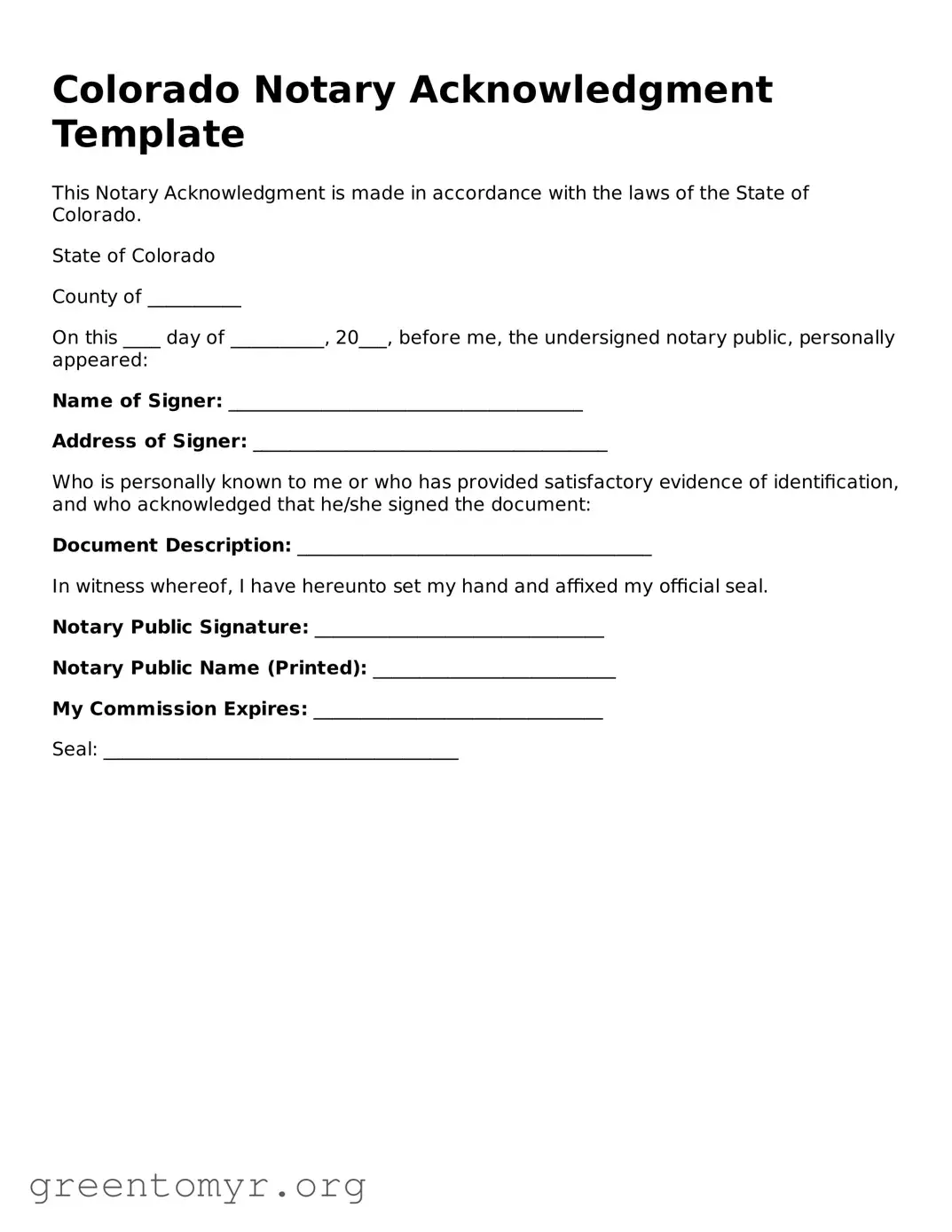
In the state of Colorado, the Notary Acknowledgement form plays a crucial role in the notarization process, serving as a vital tool for verifying the identity of individuals signing important documents. This form is designed to confirm that the signer has willingly and knowingly signed a document in the presence of a notary public. It is often utilized in various legal and financial transactions, such as real estate deals, power of attorney documents, and other agreements requiring formal acknowledgment. The form typically includes essential details such as the name of the signer, the date of the acknowledgment, and the notary's signature and seal. By ensuring that the signer’s identity is properly verified, the Notary Acknowledgement form helps to prevent fraud and provides a layer of security for all parties involved. Understanding the significance of this form is essential for anyone engaged in legal matters in Colorado, as it not only facilitates the execution of documents but also upholds the integrity of the notarization process.
Colorado Notary Acknowledgment Template
This Notary Acknowledgment is made in accordance with the laws of the State of Colorado.
State of Colorado
County of __________
On this ____ day of __________, 20___, before me, the undersigned notary public, personally appeared:
Name of Signer: ______________________________________
Address of Signer: ______________________________________
Who is personally known to me or who has provided satisfactory evidence of identification, and who acknowledged that he/she signed the document:
Document Description: ______________________________________
In witness whereof, I have hereunto set my hand and affixed my official seal.
Notary Public Signature: _______________________________
Notary Public Name (Printed): __________________________
My Commission Expires: _______________________________
Seal: ______________________________________
| Fact Name | Description |
|---|---|
| Definition | A Colorado Notary Acknowledgment form is a document used to verify the identity of a signer and their willingness to sign a document. |
| Governing Law | The use of the Notary Acknowledgment form is governed by Colorado Revised Statutes, Title 12, Article 55. |
| Purpose | This form serves to provide legal proof that a document was signed in the presence of a notary public. |
| Signers | Both individuals and representatives of organizations can use this form for notarization. |
| Identification | The notary must verify the identity of the signer using a government-issued ID or other acceptable identification. |
| Signature Requirement | The signer must personally appear before the notary to sign the document. |
| Notary Seal | A notary public must affix their official seal to the acknowledgment form after notarization. |
| Record Keeping | Notaries are required to maintain a record of each acknowledgment performed in their notary journal. |
| Expiration | The acknowledgment does not expire but is tied to the validity of the document it accompanies. |
| Form Availability | The Colorado Notary Acknowledgment form can be obtained from various sources, including online legal document providers and state resources. |
Once you have the Colorado Notary Acknowledgement form ready, you will need to fill it out carefully. This form is essential for verifying signatures and ensuring that documents are properly executed. Follow these steps to complete the form accurately.
After completing these steps, you will be ready to present the form for notarization. Ensure that the signer is present when you take the form to the notary, as their signature will need to be witnessed.
The Colorado Notary Acknowledgment form is a legal document used to confirm that a signer has willingly and knowingly signed a document in front of a notary public. This form helps to provide assurance that the signature is genuine and can be trusted in legal proceedings.
You typically need to use a Notary Acknowledgment form when you are signing important documents such as:
Using this form helps to ensure that the document is legally binding and that the signer's identity has been verified.
Completing a Notary Acknowledgment form involves several steps:
It is important to complete the form accurately to avoid any issues later on.
Yes, Colorado allows remote notarization. This means that a notary public can perform the acknowledgment via audio-visual technology. Both the signer and the notary must be able to see and hear each other in real-time. However, specific procedures and requirements must be followed, including using approved technology and ensuring that all parties are in a state where remote notarization is permitted.
Yes, notaries in Colorado can charge a fee for their services. As of the latest guidelines, the maximum fee for a standard notarization is $5 per signature. However, additional fees may apply for services such as remote notarization or traveling to a location. Always confirm the fee with the notary before the service is provided.
A Notary Acknowledgment does not have an expiration date in itself; however, the document it accompanies may have its own validity period. It is crucial to check the specific requirements related to the document to ensure it remains enforceable. Generally, once notarized, the acknowledgment remains valid as long as the document is not altered or revoked.
Filling out the Colorado Notary Acknowledgement form can seem straightforward, but many individuals make common mistakes that can lead to complications. Understanding these pitfalls can help ensure the process goes smoothly.
One frequent mistake is failing to provide the correct date. The date of the acknowledgment is crucial, as it establishes when the notary performed their duties. If this field is left blank or filled out incorrectly, it could raise questions about the validity of the document.
Another common error is not having the signer present during the notarization. A notary must witness the signing of the document to properly acknowledge it. If the signer is not physically present, the acknowledgment cannot be valid. This requirement is essential for maintaining the integrity of the notarization process.
People often overlook the importance of identifying the signer accurately. The notary must confirm the identity of the person signing the document. If the name on the acknowledgment does not match the identification provided, it could invalidate the notarization. Always ensure that the name is spelled correctly and matches the ID.
In some cases, individuals forget to include the notary's signature or seal. The notary’s signature and official seal are vital components of the acknowledgment. Without these, the document may not be recognized as properly notarized. It is essential to double-check that both elements are included before submitting the form.
Another mistake is not providing the appropriate information about the document being acknowledged. The form should clearly indicate what document is being notarized. Omitting this information can lead to confusion and potential legal issues later on.
Lastly, people sometimes neglect to check for any additional state-specific requirements. Colorado may have specific guidelines that need to be followed when completing the acknowledgment form. Familiarizing oneself with these requirements can prevent errors and ensure compliance.
The Colorado Notary Acknowledgement form is often accompanied by several other documents that serve various purposes in the notarization process. Understanding these documents can help ensure that all necessary steps are taken for proper legal verification. Below is a list of commonly used forms and documents that may be used alongside the Notary Acknowledgement form.
Each of these documents plays a crucial role in various legal transactions. By familiarizing yourself with them, you can ensure that all necessary paperwork is in order and that the notarization process goes smoothly.
The Notary Acknowledgment form serves a crucial role in the verification of signatures and the authenticity of documents. Several other documents share similarities with this form in terms of purpose and function. Below is a list of ten documents that are comparable to the Notary Acknowledgment form:
Each of these documents plays a vital role in legal and financial transactions, just as the Notary Acknowledgment form does. Understanding their similarities can help individuals navigate the complexities of legal documentation more effectively.
When filling out the Colorado Notary Acknowledgement form, it’s important to follow certain guidelines to ensure everything is completed correctly. Here’s a helpful list of dos and don’ts:
Understanding the Colorado Notary Acknowledgement form is essential for both notaries and the public. However, several misconceptions can lead to confusion. Below is a list of nine common misconceptions along with clarifications.
Notaries do not verify the content of the documents they acknowledge. Their role is to confirm the identity of the signer and ensure that the signing is done voluntarily.
Not all documents need to be notarized. The requirement for notarization depends on the type of document and its intended use.
Notaries are not authorized to give legal advice. Their duties are limited to witnessing signatures and performing specific acts as defined by law.
Individuals from outside Colorado can have their documents notarized by a Colorado notary, provided the notary is authorized to perform the act.
Colorado law sets limits on the fees that notaries can charge for their services. It is important to check current regulations for specific fee structures.
Notaries must witness the signing of the document in person. Remote notarization is not permitted in Colorado without specific provisions.
A notary acknowledgment is a specific type of notary certificate that verifies the identity of the signer. Notary certificates can take various forms depending on the act performed.
Notary acknowledgments can also be used for businesses and other entities. The representative of the entity must provide proper identification.
A notarization does not guarantee the validity of the document or its contents. It simply attests to the signing process.
Awareness of these misconceptions can help individuals navigate the notary process more effectively and ensure compliance with Colorado regulations.
When filling out and using the Colorado Notary Acknowledgement form, it is essential to keep several key points in mind. Understanding these can streamline the process and ensure compliance with state laws.
By following these guidelines, individuals can ensure that their use of the Colorado Notary Acknowledgement form is effective and legally sound. Always double-check the form for completeness and accuracy before finalizing any documents.