Content Navigation

The Colorado Operating Agreement form plays a crucial role in the establishment and management of limited liability companies (LLCs) in the state. This document outlines the internal workings of the LLC, detailing the rights and responsibilities of its members. It typically includes essential components such as the management structure, voting procedures, and profit distribution methods. Additionally, the agreement addresses the process for adding or removing members, as well as the procedure for resolving disputes among them. By providing clarity on these aspects, the Operating Agreement helps to prevent misunderstandings and conflicts down the line. Furthermore, while the state of Colorado does not mandate that LLCs have an Operating Agreement, having one is highly advisable to ensure smooth operations and legal protection. Overall, this form serves as a foundational tool for LLCs, promoting transparency and stability within the business framework.

Colorado Operating Agreement Example

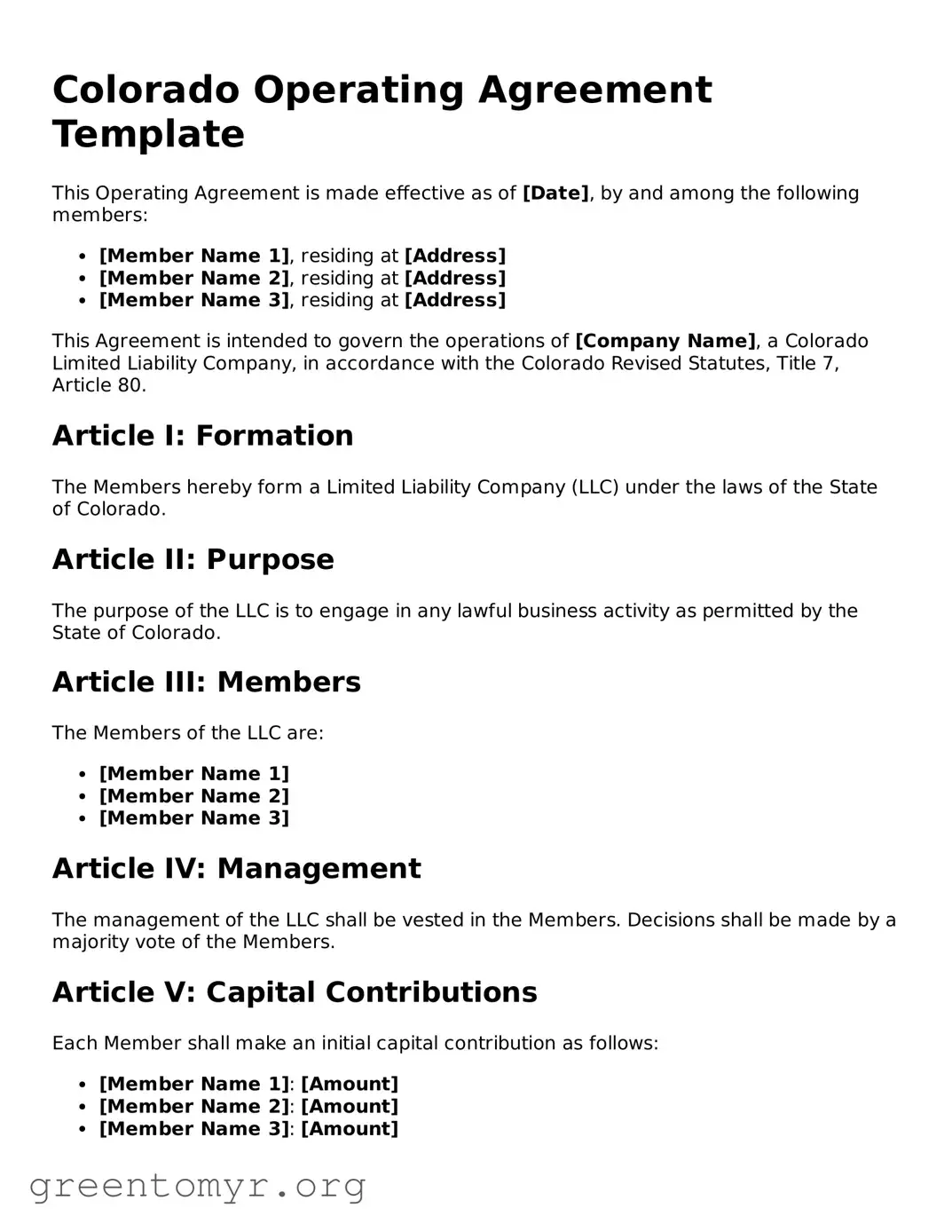
Colorado Operating Agreement Template

This Operating Agreement is made effective as of [Date], by and among the following members:

  • [Member Name 1], residing at [Address]
  • [Member Name 2], residing at [Address]
  • [Member Name 3], residing at [Address]

This Agreement is intended to govern the operations of [Company Name], a Colorado Limited Liability Company, in accordance with the Colorado Revised Statutes, Title 7, Article 80.

Article I: Formation

The Members hereby form a Limited Liability Company (LLC) under the laws of the State of Colorado.

Article II: Purpose

The purpose of the LLC is to engage in any lawful business activity as permitted by the State of Colorado.

Article III: Members

The Members of the LLC are:

  • [Member Name 1]
  • [Member Name 2]
  • [Member Name 3]

Article IV: Management

The management of the LLC shall be vested in the Members. Decisions shall be made by a majority vote of the Members.

Article V: Capital Contributions

Each Member shall make an initial capital contribution as follows:

  • [Member Name 1]: [Amount]
  • [Member Name 2]: [Amount]
  • [Member Name 3]: [Amount]

Article VI: Distributions

Distributions of profits and losses shall be allocated to the Members in proportion to their respective capital contributions.

Article VII: Indemnification

The LLC shall indemnify any Member or Manager against any losses, liabilities, or expenses incurred in connection with the LLC, to the fullest extent permitted by law.

Article VIII: Amendments

This Operating Agreement may be amended only by a written agreement signed by all Members.

Article IX: Governing Law

This Agreement shall be governed by the laws of the State of Colorado.

IN WITNESS WHEREOF, the Members have executed this Operating Agreement as of the date first above written.

_____________________________

[Member Name 1]

_____________________________

[Member Name 2]

_____________________________

[Member Name 3]

PDF Form Features

Fact Name Description
Purpose The Colorado Operating Agreement outlines the management structure and operating procedures of a limited liability company (LLC) in Colorado.
Governing Law This agreement is governed by the Colorado Limited Liability Company Act, specifically Title 7, Article 80 of the Colorado Revised Statutes.
Member Rights It specifies the rights and responsibilities of the members, ensuring clarity in decision-making and profit distribution.
Flexibility The agreement allows for flexibility in terms of management structure, enabling members to choose between member-managed or manager-managed LLCs.
Amendments Members can amend the Operating Agreement as needed, provided all members agree to the changes, ensuring adaptability to evolving business needs.
Dispute Resolution The agreement often includes provisions for resolving disputes among members, which can help prevent lengthy legal battles.

Guide to Using Colorado Operating Agreement

Filling out the Colorado Operating Agreement form is an important step in establishing your business structure. This document outlines the management and operational procedures of your company. Once you have completed the form, you will be ready to take the next steps in forming your business.

  1. Gather necessary information about your business, including its name, address, and purpose.
  2. Identify the members of the LLC and their respective ownership percentages.
  3. Decide on the management structure of the LLC, whether it will be member-managed or manager-managed.
  4. Outline the voting rights of members and how decisions will be made.
  5. Include provisions for adding new members or transferring ownership interests.
  6. Specify how profits and losses will be allocated among members.
  7. Detail the process for dissolving the LLC if necessary.
  8. Review the completed form for accuracy and completeness.
  9. Have all members sign the agreement to make it official.

Get Answers on Colorado Operating Agreement

What is a Colorado Operating Agreement?

A Colorado Operating Agreement is a legal document that outlines the management structure and operating procedures of a Limited Liability Company (LLC) in Colorado. It serves as an internal guideline for the members of the LLC, detailing their rights, responsibilities, and the operational framework of the business.

Is an Operating Agreement required in Colorado?

While Colorado law does not mandate that LLCs have an Operating Agreement, it is highly recommended. Having an Operating Agreement can help prevent disputes among members, clarify financial arrangements, and provide a clear framework for decision-making within the company.

What should be included in a Colorado Operating Agreement?

A comprehensive Operating Agreement typically includes the following sections:

  1. Company Information: Name, address, and purpose of the LLC.
  2. Members: Names and contributions of each member.
  3. Management Structure: Details on whether the LLC is member-managed or manager-managed.
  4. Voting Rights: Procedures for decision-making and voting thresholds.
  5. Profit and Loss Distribution: How profits and losses will be allocated among members.
  6. Amendments: Process for making changes to the Operating Agreement.

How does an Operating Agreement benefit LLC members?

An Operating Agreement provides clarity and protection for LLC members. It helps to:

  • Define the roles and responsibilities of each member.
  • Establish procedures for resolving disputes.
  • Prevent misunderstandings regarding financial contributions and distributions.
  • Provide a framework for business continuity in the event of a member's departure.

Can an Operating Agreement be changed after it is created?

Yes, an Operating Agreement can be amended. The process for making changes should be outlined within the document itself. Typically, amendments require a vote from the members, and a written record of the changes should be maintained to ensure clarity and compliance.

How is an Operating Agreement executed?

To execute an Operating Agreement, all members of the LLC should review the document thoroughly. Once everyone agrees to the terms, each member should sign the agreement. While notarization is not required in Colorado, it can add an additional layer of authenticity to the document.

Where should the Operating Agreement be kept?

The Operating Agreement should be kept in a secure location, such as a business file or a safe. It is important that all members have access to the document, as it serves as a reference for the operational guidelines and member responsibilities.

What happens if an LLC does not have an Operating Agreement?

If an LLC operates without an Operating Agreement, it may face challenges in decision-making and conflict resolution. In the absence of this document, Colorado state laws will govern the LLC's operations, which may not align with the members' intentions or preferences. This can lead to potential disputes and complications in managing the business.

Common mistakes

Filling out the Colorado Operating Agreement form can be a straightforward process, but many people make common mistakes that can lead to issues down the road. One frequent error is failing to include all members of the LLC. Every member should be listed in the agreement to ensure that all parties are recognized and their rights and responsibilities are clearly defined.

Another mistake is neglecting to specify the management structure of the LLC. Some individuals assume that the default management structure will suffice. However, clearly stating whether the LLC will be member-managed or manager-managed is crucial. This clarity helps prevent misunderstandings and disputes among members.

People often overlook the importance of outlining the voting rights of each member. Not specifying how decisions will be made can lead to confusion and conflict later. It is essential to detail the voting process, including how many votes each member has and what constitutes a quorum for decision-making.

Additionally, failing to address the distribution of profits and losses is a common oversight. The agreement should explicitly state how profits and losses will be allocated among members. Without this information, members may have different expectations, leading to potential disputes.

Lastly, some individuals forget to review and update the Operating Agreement as needed. Life changes, such as the addition of new members or changes in management, can affect the agreement. Regularly revisiting and revising the document ensures that it remains relevant and accurate, safeguarding the interests of all members involved.

Documents used along the form

The Colorado Operating Agreement is a crucial document for limited liability companies (LLCs) in Colorado, outlining the management structure and operational guidelines of the business. However, several other forms and documents are often used in conjunction with the Operating Agreement to ensure comprehensive legal and operational compliance. Below is a list of these important documents.

  • Articles of Organization: This document officially establishes the LLC with the state. It includes essential details such as the company name, address, and registered agent information.
  • Member Consent Form: This form records the agreement of members regarding significant decisions or actions, ensuring that all members are on the same page.
  • Bylaws: While not required for LLCs, bylaws can provide additional governance rules, detailing how the LLC will be run beyond what is covered in the Operating Agreement.
  • Membership Certificates: These documents serve as proof of ownership for members in the LLC, indicating their percentage of interest and rights within the company.
  • Meeting Minutes: Keeping a record of meetings helps document decisions made by members or managers, providing a clear history of the LLC's operations.
  • Financial Statements: These documents include balance sheets and income statements, which are essential for tracking the financial health of the LLC.
  • Tax Forms: Various forms, such as IRS Form 1065 for partnerships, are necessary for tax reporting and compliance based on the LLC's structure.
  • Operating Procedures Manual: This manual outlines the day-to-day operational procedures, helping to ensure consistency and clarity in business operations.
  • Non-Disclosure Agreements (NDAs): NDAs protect sensitive information shared among members or with third parties, ensuring confidentiality in business dealings.

Utilizing these documents alongside the Colorado Operating Agreement can help establish a solid foundation for the LLC, promoting clarity and legal compliance. Each document plays a unique role in the overall management and operation of the business, contributing to its long-term success.

Similar forms

  • Partnership Agreement: Similar to an Operating Agreement, this document outlines the roles and responsibilities of partners in a business. It specifies how profits and losses are shared among partners.
  • Bylaws: Bylaws govern the internal management of a corporation. Like an Operating Agreement, they set rules for meetings, voting, and the roles of officers.
  • Shareholder Agreement: This document is used in corporations to define the rights and obligations of shareholders. It often includes buy-sell provisions, similar to how an Operating Agreement addresses ownership interests.
  • Joint Venture Agreement: A joint venture agreement outlines the terms of a partnership between two or more parties for a specific project. It shares similarities with an Operating Agreement in defining contributions and profit-sharing.
  • LLC Membership Certificate: This document certifies ownership in an LLC. It works alongside an Operating Agreement, which details the rights and responsibilities of the members.
  • Non-Disclosure Agreement (NDA): While not directly related, an NDA can be included as part of an Operating Agreement. It protects sensitive information shared among members.
  • Franchise Agreement: This document outlines the rights and obligations of the franchisor and franchisee. Similar to an Operating Agreement, it includes operational guidelines and financial arrangements.
  • Business Plan: A business plan outlines the strategy and goals of a business. It may complement an Operating Agreement by providing context for the business structure and operations.

Dos and Don'ts

When filling out the Colorado Operating Agreement form, it's important to approach the process thoughtfully. Here are some key dos and don'ts to keep in mind:

  • Do ensure that all members' names and addresses are accurately listed. This information is crucial for legal recognition.
  • Do specify the management structure clearly. Whether it’s member-managed or manager-managed, clarity helps prevent future disputes.
  • Do include provisions for profit and loss distribution. Clearly outlining how profits will be shared can save confusion later on.
  • Do review the document carefully before submitting. A thorough review can help catch any errors or omissions.
  • Don't leave any sections blank. Incomplete forms may lead to delays or rejection.
  • Don't use vague language. Being specific helps avoid misunderstandings among members.
  • Don't forget to date and sign the agreement. An unsigned document may not hold up in legal situations.
  • Don't ignore state-specific requirements. Familiarize yourself with Colorado laws to ensure compliance.

Misconceptions

Understanding the Colorado Operating Agreement form can be challenging. Many people hold misconceptions about it. Here are five common misunderstandings:

  • It’s only necessary for large businesses. Many believe that only big companies need an Operating Agreement. In reality, even small businesses and LLCs benefit from having this document. It helps clarify roles and responsibilities among members.
  • It is a government requirement. Some think that an Operating Agreement is mandated by the state. While it is not legally required in Colorado, having one is highly recommended. It provides structure and can prevent disputes.
  • It cannot be changed once created. A common myth is that once an Operating Agreement is signed, it cannot be altered. In fact, members can amend the agreement as needed, allowing flexibility as the business evolves.
  • All Operating Agreements are the same. Many assume that there is a one-size-fits-all template for Operating Agreements. This is incorrect. Each agreement should be tailored to the specific needs and circumstances of the business and its members.
  • It only covers financial matters. Some people think that the Operating Agreement focuses solely on finances. While it does address financial aspects, it also outlines management structure, decision-making processes, and member responsibilities.

Key takeaways

When filling out and using the Colorado Operating Agreement form, there are several important points to keep in mind. Here are six key takeaways:

  1. Understand the Purpose: The Operating Agreement outlines the management structure and operating procedures of your LLC. It serves as a crucial document for establishing roles and responsibilities among members.
  2. Customize the Agreement: While templates are available, it’s important to tailor the agreement to fit your specific business needs. Consider factors such as profit distribution, decision-making processes, and member roles.
  3. Include Essential Clauses: Make sure to incorporate key clauses, such as member contributions, voting rights, and procedures for adding or removing members. These elements can prevent disputes down the line.
  4. Review State Requirements: Familiarize yourself with Colorado’s specific requirements for Operating Agreements. Although not mandatory for all LLCs, having one can provide legal protection and clarify operations.
  5. Update as Necessary: As your business evolves, so should your Operating Agreement. Regularly review and amend the document to reflect any changes in membership or business structure.
  6. Seek Legal Guidance: If you’re unsure about any part of the agreement, consulting with a legal professional can provide clarity. They can help ensure your agreement complies with state laws and adequately protects your interests.

By keeping these takeaways in mind, you can create a comprehensive Operating Agreement that supports your LLC's success and stability.