When it comes to ensuring the well-being of a child in Colorado, the Power of Attorney for a Child form serves as a crucial tool for parents and guardians. This legal document allows a parent to grant another trusted adult the authority to make decisions on behalf of their child, particularly in situations where the parent may be unavailable. It covers various aspects, including medical care, educational decisions, and general welfare, providing peace of mind that the child’s needs will be met in the parent’s absence. The form is designed to be straightforward, making it accessible for parents to complete without excessive legal knowledge. Additionally, it is important to note that this power can be limited to specific time frames or particular decisions, offering flexibility to fit individual circumstances. Understanding the nuances of this form can empower parents to make informed choices, ensuring their child's best interests are always prioritized.
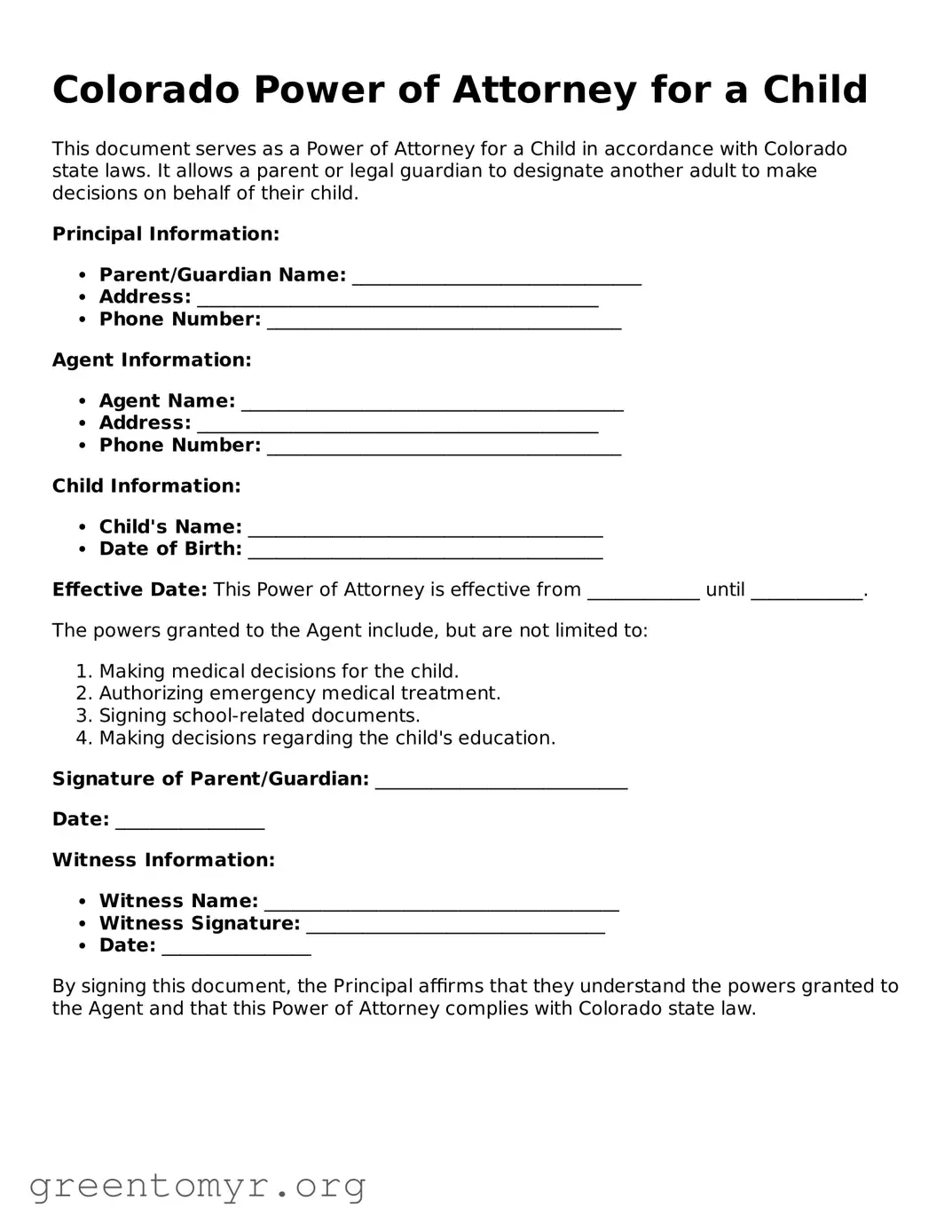
Colorado Power of Attorney for a Child
This document serves as a Power of Attorney for a Child in accordance with Colorado state laws. It allows a parent or legal guardian to designate another adult to make decisions on behalf of their child.
Principal Information:
Agent Information:
Child Information:
Effective Date: This Power of Attorney is effective from ____________ until ____________.
The powers granted to the Agent include, but are not limited to:
Signature of Parent/Guardian: ___________________________
Date: ________________
Witness Information:
By signing this document, the Principal affirms that they understand the powers granted to the Agent and that this Power of Attorney complies with Colorado state law.
| Fact Name | Description |
|---|---|
| Purpose | The Colorado Power of Attorney for a Child form allows a parent or guardian to designate another adult to make decisions for their child. |
| Governing Law | This form is governed by Colorado Revised Statutes § 15-14-501 to § 15-14-503. |
| Duration | The authority granted by this form can last up to 12 months, unless revoked earlier. |
| Eligibility | Only a parent or legal guardian can complete this form to delegate authority. |
| Revocation | A parent can revoke the Power of Attorney at any time, provided they do so in writing. |
| Limitations | This form does not allow the designated adult to make decisions regarding the child's education or medical treatment unless specified. |
| Notarization | The form must be signed in the presence of a notary public to be valid. |
| Usage | This form is useful for temporary situations, such as travel or emergency care, where a parent cannot be present. |
Completing the Colorado Power of Attorney for a Child form is straightforward. Follow these steps carefully to ensure that all necessary information is accurately provided.
Once completed, keep a copy for your records and provide the original to the agent. This ensures that they have the authority to act on behalf of the child as specified in the document.
A Power of Attorney for a Child in Colorado is a legal document that allows a parent or legal guardian to designate another adult to make decisions on behalf of their child. This can include decisions about medical care, education, and general welfare. It is often used when parents are unable to care for their child temporarily.
Any responsible adult can be designated as an agent. This may include relatives, family friends, or trusted individuals. However, it is important to choose someone who is capable of making decisions in the best interest of the child.
The Power of Attorney can be set for a specific duration or until a certain event occurs, such as the return of the parent or guardian. If no end date is specified, it typically remains in effect until the child turns 18 or until it is revoked by the parent or guardian.
Yes, in Colorado, the Power of Attorney form must be signed in front of a notary public to be legally valid. This ensures that the document is authentic and that the signatures are verified.
Yes, the Power of Attorney can be revoked at any time by the parent or legal guardian. It is advisable to do this in writing and to inform the designated agent of the revocation. This helps prevent any confusion regarding the authority granted.
The agent can make a variety of decisions, including:
However, the specific powers granted can be limited or expanded based on the preferences of the parent or guardian.
No, a Power of Attorney for a Child is not the same as guardianship. Guardianship is a more permanent arrangement that involves legal custody of the child. A Power of Attorney is temporary and does not transfer legal custody or parental rights.
Filling out the Colorado Power of Attorney for a Child form can be a straightforward process, but there are common mistakes that individuals often make. These errors can lead to confusion or even invalidate the document. One frequent mistake is not clearly identifying the child involved. It’s essential to provide the child’s full name, date of birth, and any other identifying information to ensure there is no ambiguity about who the power of attorney pertains to.
Another common error is failing to specify the duration of the power of attorney. Without a clear start and end date, the authority granted may be questioned. It’s important to indicate whether the power of attorney is effective immediately, for a specific period, or until a certain condition is met. This clarity helps prevent misunderstandings later on.
People often overlook the importance of detailing the specific powers being granted. The form allows you to outline what decisions the agent can make on behalf of the child. Vague language can lead to complications. Clearly stating whether the agent can make decisions regarding medical care, education, or travel ensures that the agent knows their limits and responsibilities.
Additionally, not having the document properly signed and notarized can be a significant oversight. In Colorado, a power of attorney for a child must be signed by the parent or legal guardian and may need to be notarized to be legally binding. Failing to complete this step can render the document ineffective.
Another mistake involves neglecting to inform the child about the power of attorney. It is crucial for the child to understand who will be making decisions on their behalf and why. This helps in maintaining trust and transparency, especially if the child is old enough to comprehend the situation.
Some individuals forget to provide a copy of the completed form to the agent. The agent should always have a copy of the power of attorney to ensure they can act on behalf of the child without delay. Without this, they may face challenges in executing their responsibilities.
People sometimes fail to review the form for errors before submission. Typos or incorrect information can lead to complications. Taking the time to double-check all details can save a lot of trouble in the future.
Another common mistake is not updating the power of attorney when circumstances change. If there are changes in the child’s living situation or the relationship with the agent, it’s vital to revisit and potentially revise the document. Keeping it current ensures that it reflects the current wishes and needs of the family.
Finally, some individuals do not seek legal advice when needed. While the form may seem straightforward, consulting with a legal professional can provide clarity and help avoid pitfalls. This step can be particularly beneficial for those with complex family situations or specific concerns.
The Colorado Power of Attorney for a Child form allows a parent or guardian to grant temporary authority to another adult to make decisions for their child. When using this form, several other documents may also be beneficial to ensure comprehensive legal coverage. Below is a list of common forms and documents that often accompany the Power of Attorney for a Child form.
Each of these documents serves a specific purpose and can help facilitate the responsibilities assigned through the Power of Attorney for a Child form. It is essential to ensure that all necessary forms are completed and properly executed to avoid any potential legal complications.
The Power of Attorney for a Child form allows a parent or guardian to designate another adult to make decisions on behalf of a child. This document is similar to several other legal forms that grant authority or responsibility in various contexts. Here are nine documents that share similarities with the Power of Attorney for a Child:
Understanding these documents can help parents and guardians navigate the complexities of child care and decision-making authority. Each serves a unique purpose, yet they all share the common goal of ensuring a child's best interests are met.
When filling out the Colorado Power of Attorney for a Child form, it’s important to follow some guidelines to ensure that the document is valid and effective. Here are ten things to keep in mind:
Understanding the Colorado Power of Attorney for a Child form is essential for parents and guardians. However, several misconceptions can lead to confusion. Here is a list of ten common misconceptions, along with clarifications to help set the record straight.
Many believe this form is only necessary in emergencies, but it can also be useful for everyday situations, such as travel or temporary caregiving arrangements.
Some think that signing this form gives the agent full custody of the child. In reality, it only allows the agent to make specific decisions outlined in the document.
While notarization is recommended for authenticity, the form can still be valid without it, as long as it is properly completed and signed.
People often assume that any adult can be chosen as an agent. However, it is important to select someone who is trustworthy and capable of making decisions in the child's best interest.
Some believe the Power of Attorney lasts forever. In fact, it is typically effective for a specific period or until revoked by the parent or guardian.
While this form is specific to Colorado, it can be recognized in other states, especially if it is properly executed and meets their requirements.
This form is often confused with a medical Power of Attorney. They serve different purposes; the former is for general care decisions, while the latter specifically addresses healthcare choices.
Many think a lawyer must draft this document. However, parents can prepare it themselves using available templates, provided they understand the requirements.
Some people mistakenly believe this form allows for financial decision-making. It does not; a separate financial Power of Attorney is needed for that purpose.
Even if both parents are in agreement, having a Power of Attorney can provide clarity and protection in situations where one parent is unavailable.
By understanding these misconceptions, parents and guardians can make informed decisions regarding the care and well-being of their children. It is always advisable to seek guidance if there are any uncertainties about the form or its implications.
When considering the Colorado Power of Attorney for a Child form, it is important to understand its purpose and implications. Here are some key takeaways to keep in mind: