In the state of Colorado, couples contemplating marriage often consider the importance of a prenuptial agreement, a legal document designed to clarify the financial rights and responsibilities of each party in the event of a divorce or separation. This agreement typically addresses the division of assets and debts acquired before and during the marriage, ensuring that both individuals have a clear understanding of their financial arrangements. Additionally, the Colorado Prenuptial Agreement form allows couples to outline provisions for spousal support, thereby reducing potential disputes in the future. It is essential for both parties to fully disclose their assets and liabilities, as transparency is a critical component in the enforceability of the agreement. Furthermore, the form must be executed voluntarily and without coercion, ensuring that both individuals enter into the contract with mutual consent. By taking these steps, couples can foster a sense of security and clarity as they embark on their marital journey, ultimately promoting a more harmonious relationship.
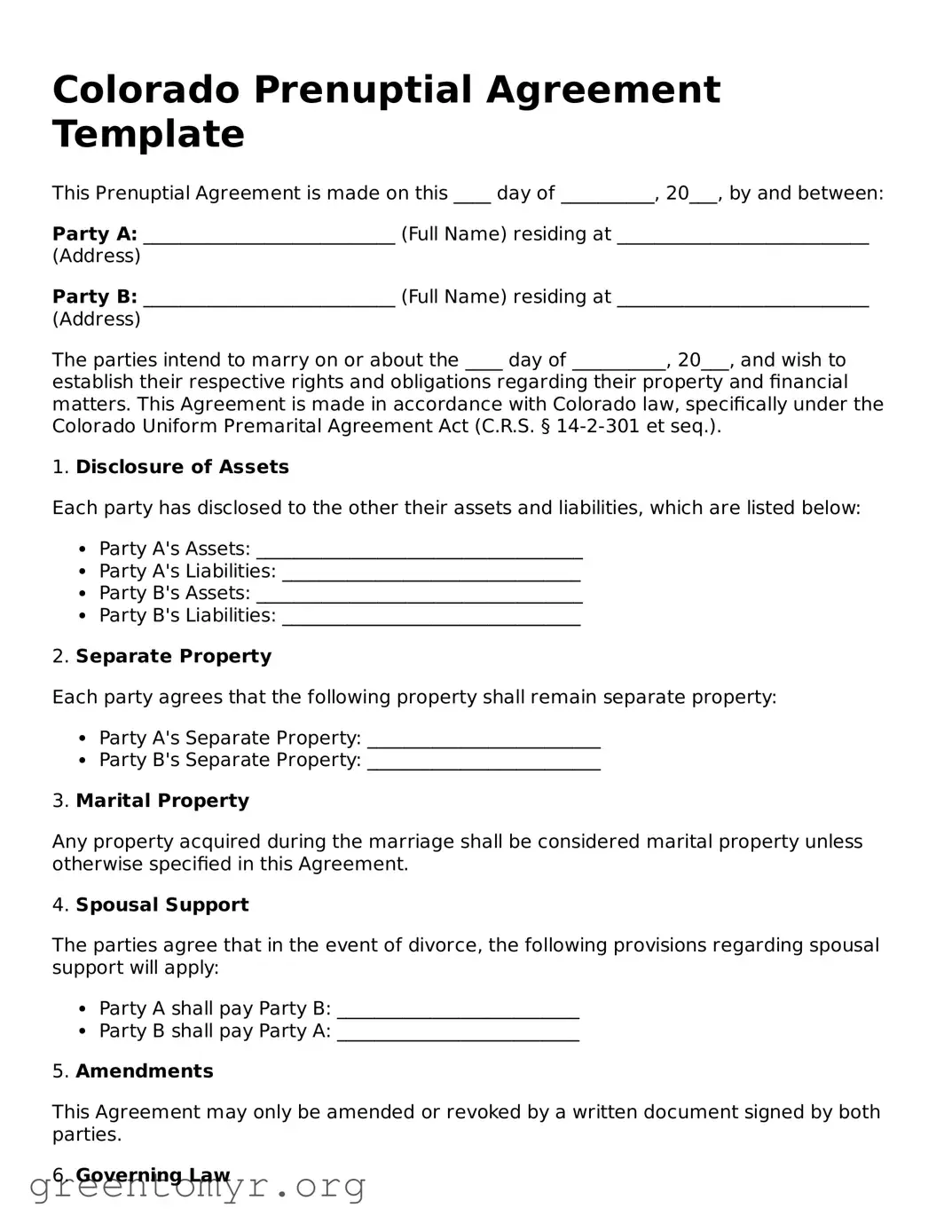
Colorado Prenuptial Agreement Template
This Prenuptial Agreement is made on this ____ day of __________, 20___, by and between:
Party A: ___________________________ (Full Name) residing at ___________________________ (Address)
Party B: ___________________________ (Full Name) residing at ___________________________ (Address)
The parties intend to marry on or about the ____ day of __________, 20___, and wish to establish their respective rights and obligations regarding their property and financial matters. This Agreement is made in accordance with Colorado law, specifically under the Colorado Uniform Premarital Agreement Act (C.R.S. § 14-2-301 et seq.).
1. Disclosure of Assets
Each party has disclosed to the other their assets and liabilities, which are listed below:
2. Separate Property
Each party agrees that the following property shall remain separate property:
3. Marital Property
Any property acquired during the marriage shall be considered marital property unless otherwise specified in this Agreement.
4. Spousal Support
The parties agree that in the event of divorce, the following provisions regarding spousal support will apply:
5. Amendments
This Agreement may only be amended or revoked by a written document signed by both parties.
6. Governing Law
This Agreement shall be governed by the laws of the State of Colorado.
IN WITNESS WHEREOF, the parties have executed this Prenuptial Agreement on the date first above written.
_____________________________
Party A Signature
_____________________________
Party B Signature
_____________________________
Witness Signature
_____________________________
Witness Signature
| Fact Name | Details |
|---|---|
| Governing Law | The Colorado Prenuptial Agreement is governed by Colorado Revised Statutes, Title 14, Article 2. |
| Purpose | These agreements outline the division of assets and debts in the event of divorce or separation. |
| Voluntary Agreement | Both parties must enter into the agreement voluntarily without coercion or undue influence. |
| Full Disclosure | Each party must provide full and fair disclosure of their financial situation before signing. |
| Written Form | The agreement must be in writing to be enforceable in Colorado. |
| Independent Counsel | It is advisable for both parties to seek independent legal counsel before signing. |
| Enforceability | A prenuptial agreement can be challenged in court if it is found to be unconscionable. |
| Amendments | Parties can amend the agreement, but any changes must also be in writing. |
| Timing | It is recommended to finalize the agreement well before the wedding date to avoid any claims of pressure. |
| Notarization | While notarization is not required, it can add an extra layer of authenticity to the agreement. |
Filling out the Colorado Prenuptial Agreement form requires careful attention to detail. Once completed, the form will need to be signed by both parties in the presence of a notary public to ensure its validity. Below are the steps to guide you through the process of completing the form.
After completing these steps, ensure that both parties retain a copy of the signed agreement for their records. It is advisable to consult with a legal professional to confirm that the agreement meets all necessary legal standards.
A prenuptial agreement, often called a prenup, is a legal document that a couple signs before getting married. It outlines how assets and debts will be handled in the event of a divorce or separation. In Colorado, prenups can also address spousal support and other financial matters.
To be considered valid in Colorado, a prenuptial agreement must meet several criteria:
Yes, a prenuptial agreement can be modified after marriage. Both parties must agree to the changes, and the modifications should be made in writing and signed by both individuals. It is advisable to consult with legal counsel when making changes to ensure that the new terms are enforceable.
If a prenuptial agreement is challenged in court, the judge will review the circumstances under which it was created. Common reasons for challenges include:
The court will then determine whether the agreement is enforceable based on these factors.
While it is not legally required for both parties to have separate legal representation, it is highly recommended. Having independent legal counsel ensures that both parties fully understand the terms and implications of the agreement. This can also help prevent future disputes regarding the agreement's validity.
A prenuptial agreement can significantly influence property division in the event of a divorce. It can specify how assets and debts will be divided, overriding Colorado's default property division laws. However, the agreement must comply with legal standards to be enforceable. If valid, it can provide clarity and reduce conflict during the divorce process.
No, a prenuptial agreement is not exclusively for wealthy individuals. People from various financial backgrounds may choose to create a prenup to protect personal assets, clarify financial responsibilities, or address potential future issues. It can be a practical tool for anyone entering into a marriage, regardless of their financial situation.
When completing the Colorado Prenuptial Agreement form, individuals often overlook critical details that can lead to complications later. One common mistake is failing to fully disclose assets and debts. Transparency is vital in a prenuptial agreement. If one party hides financial information, it may render the agreement invalid in the eyes of the court.
Another frequent error is neglecting to specify how assets will be divided in the event of a divorce. Vague language can create confusion and disputes down the line. It’s essential to clearly outline the division of property, including any inheritance or gifts received during the marriage.
Many people also forget to consider changes in circumstances. Life events such as the birth of children or significant changes in income should prompt a review of the agreement. Updating the prenup ensures that it remains relevant and fair for both parties.
Lastly, individuals sometimes fail to seek legal advice before finalizing the agreement. While it may seem straightforward, legal nuances can impact the enforceability of the prenup. Consulting with an attorney can help ensure that both parties understand their rights and obligations, ultimately leading to a more secure agreement.
When preparing for a marriage, many couples consider a prenuptial agreement to outline their financial expectations and responsibilities. Alongside this important document, there are several other forms and documents that can enhance clarity and ensure that both parties are on the same page. Below are four commonly used documents that often accompany a Colorado Prenuptial Agreement.
Utilizing these documents alongside a prenuptial agreement can provide a comprehensive framework for financial and personal expectations within a marriage. Each document plays a vital role in fostering open communication and protecting the interests of both individuals.
A Prenuptial Agreement, often called a prenup, is a legal document that outlines the division of assets and responsibilities in the event of divorce or separation. There are several other documents that share similarities with a prenup. Here’s a list of eight such documents:
When filling out a Colorado Prenuptial Agreement form, it's essential to approach the process thoughtfully. Here are some important dos and don'ts to keep in mind:
Many people have misunderstandings about prenuptial agreements, particularly in Colorado. Here are six common misconceptions:
Understanding these misconceptions can help individuals make informed decisions about prenuptial agreements in Colorado.
When considering a prenuptial agreement in Colorado, it is essential to understand the key elements involved in filling out and utilizing the form effectively. Here are some important takeaways:
Taking these points into account will help in creating a solid foundation for the prenuptial agreement, ensuring that both parties are protected and informed.