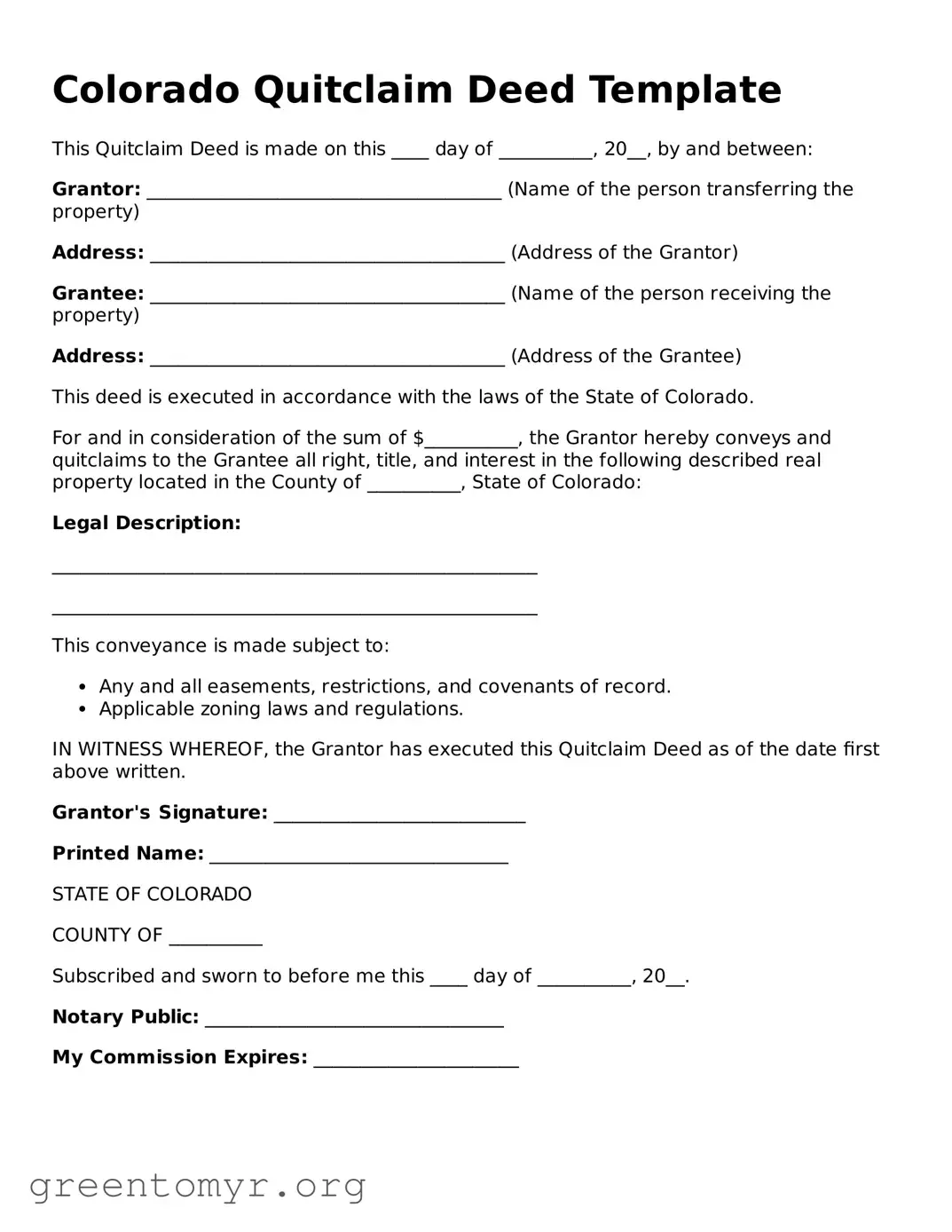
The Colorado Quitclaim Deed form serves as a straightforward tool for transferring property rights from one party to another. This document allows the grantor, or the person transferring the property, to convey their interest in the property without making any guarantees about the title. This means that the grantee, or the person receiving the property, accepts whatever interest the grantor has, if any, and assumes the risks associated with potential title issues. The form typically includes essential details such as the names of the parties involved, a description of the property, and the date of the transfer. It must be signed by the grantor and may require notarization for it to be legally binding. While a quitclaim deed is often used in informal transactions, such as transferring property between family members or clearing up title issues, it is important for all parties to understand its implications. By using this form, individuals can facilitate property transfers efficiently, but they should also consider seeking legal advice to ensure their interests are protected.
Colorado Quitclaim Deed Template
This Quitclaim Deed is made on this ____ day of __________, 20__, by and between:
Grantor: ______________________________________ (Name of the person transferring the property)
Address: ______________________________________ (Address of the Grantor)
Grantee: ______________________________________ (Name of the person receiving the property)
Address: ______________________________________ (Address of the Grantee)
This deed is executed in accordance with the laws of the State of Colorado.
For and in consideration of the sum of $__________, the Grantor hereby conveys and quitclaims to the Grantee all right, title, and interest in the following described real property located in the County of __________, State of Colorado:
Legal Description:
____________________________________________________
____________________________________________________
This conveyance is made subject to:
IN WITNESS WHEREOF, the Grantor has executed this Quitclaim Deed as of the date first above written.
Grantor's Signature: ___________________________
Printed Name: ________________________________
STATE OF COLORADO
COUNTY OF __________
Subscribed and sworn to before me this ____ day of __________, 20__.
Notary Public: ________________________________
My Commission Expires: ______________________
| Fact Name | Details |
|---|---|
| Definition | A quitclaim deed is a legal document used to transfer ownership of real estate without any warranties or guarantees. |
| Purpose | This form is commonly used to transfer property between family members or to clear up title issues. |
| Governing Law | The Colorado Quitclaim Deed is governed by Colorado Revised Statutes, Title 38, Article 30. |
| Requirements | The deed must be signed by the grantor and notarized to be legally effective. |
| Recording | To ensure public notice, the quitclaim deed should be recorded with the county clerk and recorder where the property is located. |
| Limitations | A quitclaim deed does not guarantee that the grantor has clear title to the property. |
After you complete the Colorado Quitclaim Deed form, you will need to sign it in front of a notary public. Once notarized, the deed should be filed with the appropriate county clerk and recorder's office to ensure it is legally recognized.
A Quitclaim Deed is a legal document used to transfer ownership of real property from one party to another without any warranties or guarantees. In Colorado, this type of deed is commonly used among family members or in situations where the parties know each other well. It allows the grantor (the person transferring the property) to relinquish any interest they may have in the property, but it does not assure the grantee (the person receiving the property) that the title is clear or free of liens.
Quitclaim Deeds are often used in specific situations, including:
While they are convenient for these scenarios, it is essential to understand that a Quitclaim Deed does not protect the grantee from potential claims against the property.
To complete a Quitclaim Deed in Colorado, several key pieces of information must be included:
It is also advisable to include a statement that indicates the consideration (the amount paid or exchanged) for the transfer, even if it is nominal.
Once the Quitclaim Deed is completed and signed, it must be recorded with the county clerk and recorder in the county where the property is located. To do this, follow these steps:
Recording the deed is crucial as it provides public notice of the transfer and protects the grantee's interest in the property.
Generally, transferring property using a Quitclaim Deed may not trigger immediate tax consequences. However, it is important to consider the following:
Consulting with a tax professional is advisable to understand any potential implications specific to your situation.
Once a Quitclaim Deed has been executed and recorded, it cannot be revoked unilaterally. However, if both parties agree, they can execute a new deed to reverse the transfer. This new deed would need to be recorded to be effective. It is important to approach this process carefully, as revoking a deed can have significant legal and financial consequences.
Filling out a Colorado Quitclaim Deed form can be straightforward, but many people make mistakes that can lead to delays or complications. One common error is failing to provide complete information about the property. It’s essential to include the full legal description of the property, not just the address. Omitting details can create confusion and may even result in the deed being deemed invalid.
Another frequent mistake involves the names of the parties involved. Some individuals mistakenly use nicknames or abbreviations instead of the full legal names. Always ensure that the names of both the grantor (the person transferring the property) and the grantee (the person receiving the property) are written clearly and correctly. Any discrepancies can lead to issues later on.
Many people overlook the necessity of having the document notarized. A Quitclaim Deed must be signed in front of a notary public to be legally binding. Without this important step, the deed may not be recognized by the county clerk's office, which can lead to further complications in the property transfer process.
Additionally, failing to check the county requirements can be a significant oversight. Each county in Colorado may have specific rules regarding the submission of Quitclaim Deeds. Before submitting the form, it’s wise to verify that you meet all local regulations and requirements to avoid unnecessary delays.
Another common pitfall is not including the appropriate transfer tax, if applicable. Some counties in Colorado require a transfer tax to be paid when a property changes hands. Be sure to check if this applies to your situation and include the correct payment with your deed submission.
Moreover, many people forget to keep a copy of the completed Quitclaim Deed for their records. After filing the deed, it’s crucial to retain a copy for future reference. This can serve as proof of the property transfer and may be needed for tax purposes or future transactions.
Lastly, individuals often neglect to follow up on the filing status. After submitting the Quitclaim Deed, it's important to confirm that it has been recorded properly. Checking with the county clerk’s office ensures that the transfer has been officially documented and helps avoid any potential issues down the line.
A Colorado Quitclaim Deed is a legal document used to transfer ownership of real property. When completing this process, several other forms and documents may be required to ensure a smooth transfer. Below is a list of common documents often used alongside the Quitclaim Deed.
Gathering these documents can help facilitate the property transfer process. It is advisable to review local requirements and consult with a professional if needed.
A Quitclaim Deed is a specific legal document used to transfer ownership of property. It is important to understand that there are other documents that serve similar purposes in property transactions. Here are five documents that share similarities with a Quitclaim Deed:
When filling out the Colorado Quitclaim Deed form, it's important to follow specific guidelines to ensure the document is completed correctly. Here are seven things you should and shouldn't do:
Adhering to these guidelines will help ensure that your Quitclaim Deed is valid and enforceable.
Understanding the Colorado Quitclaim Deed form is crucial for anyone involved in property transactions. However, several misconceptions can lead to confusion. Here are nine common misconceptions:
Being aware of these misconceptions can help you navigate property transactions more effectively. Always consider seeking professional guidance when dealing with legal documents.
When filling out and using the Colorado Quitclaim Deed form, keep the following key takeaways in mind: