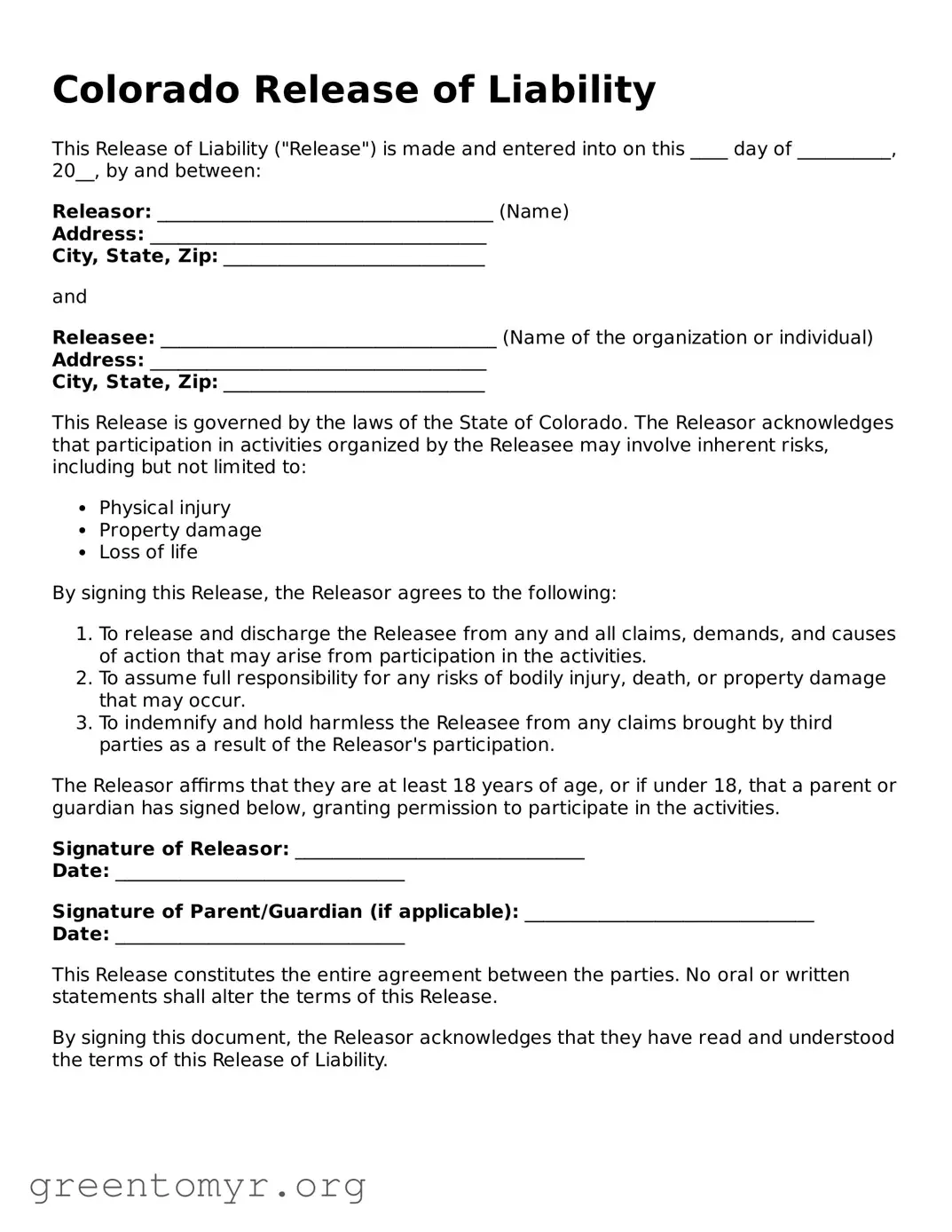
The Colorado Release of Liability form serves as an essential tool for individuals and organizations to protect themselves from potential legal claims. This document outlines the risks associated with specific activities, such as recreational sports, outdoor adventures, or events, and requires participants to acknowledge these risks before engaging. By signing the form, participants agree to waive their right to sue for any injuries or damages that may occur as a result of their involvement. It is crucial that the form is clear and comprehensive, detailing the nature of the activities involved, the inherent risks, and the responsibilities of both parties. Properly executed, this form not only helps to minimize legal exposure but also fosters a sense of understanding and acceptance of risks among participants. Knowing the importance of such a document can provide peace of mind, allowing individuals to focus on enjoying their experiences without the burden of potential liabilities hanging overhead.
Colorado Release of Liability
This Release of Liability ("Release") is made and entered into on this ____ day of __________, 20__, by and between:
Releasor: ____________________________________ (Name)
Address: ____________________________________
City, State, Zip: ____________________________
and
Releasee: ____________________________________ (Name of the organization or individual)
Address: ____________________________________
City, State, Zip: ____________________________
This Release is governed by the laws of the State of Colorado. The Releasor acknowledges that participation in activities organized by the Releasee may involve inherent risks, including but not limited to:
By signing this Release, the Releasor agrees to the following:
The Releasor affirms that they are at least 18 years of age, or if under 18, that a parent or guardian has signed below, granting permission to participate in the activities.
Signature of Releasor: _______________________________
Date: _______________________________
Signature of Parent/Guardian (if applicable): _______________________________
Date: _______________________________
This Release constitutes the entire agreement between the parties. No oral or written statements shall alter the terms of this Release.
By signing this document, the Releasor acknowledges that they have read and understood the terms of this Release of Liability.
| Fact Name | Details |
|---|---|
| Purpose | The Colorado Release of Liability form is designed to protect businesses and individuals from legal claims resulting from injuries or damages that occur during activities. |
| Governing Laws | The form is governed by Colorado state laws, particularly under the Colorado Revised Statutes (C.R.S.) Section 13-21-119, which addresses liability waivers. |
| Voluntary Agreement | Participants must voluntarily agree to the terms outlined in the form, indicating they understand the risks involved in the activity. |
| Scope of Liability | The release typically covers ordinary negligence but may not protect against gross negligence or willful misconduct. |
| Signature Requirement | A valid signature from the participant or their guardian is required for the release to be enforceable. |
| Minors | If the participant is a minor, a parent or legal guardian must sign the form to waive liability on their behalf. |
| Legal Enforceability | The enforceability of the release may depend on its clarity and whether it meets specific legal standards set by Colorado courts. |
| Duration | The release typically remains in effect for the duration of the activity and may include future claims arising from the same activity. |
| Customizable | Organizations can customize the form to fit their specific activities and risks, but legal review is advisable. |
| Not a Substitute for Insurance | While the form limits liability, it does not replace the need for liability insurance, which is essential for comprehensive protection. |
Once you have the Colorado Release of Liability form in hand, you will need to complete it accurately to ensure its validity. This process involves providing specific information and signatures, which will facilitate the next steps in your intended activity.
The Colorado Release of Liability form is a legal document that protects an organization or individual from being held liable for injuries or damages that may occur during a specific activity or event. By signing this form, participants acknowledge the risks involved and agree not to hold the organizer responsible for any accidents or injuries that may arise. This form is commonly used in various settings, such as recreational activities, sports events, and other situations where risk is present.
A Release of Liability form should be used by anyone organizing an event or activity that involves potential risks. This includes, but is not limited to:
By utilizing this form, organizers can ensure that participants are aware of the risks and agree to waive their right to sue for injuries that may occur.
Yes, a Release of Liability form can be legally binding in Colorado, provided that it meets certain criteria. For the form to be enforceable, it must be clear, specific, and unambiguous. Additionally, it should not violate public policy or involve gross negligence. It is advisable to consult with a legal professional to ensure that the form is properly drafted and compliant with state laws.
To properly execute a Release of Liability form, follow these steps:
Proper execution helps protect both the organizer and the participant by ensuring that all parties understand the risks involved.
Once a participant has signed a Release of Liability form, they generally cannot revoke their consent retroactively. However, it is important to note that participants may still have the right to pursue legal action if the organizer engages in gross negligence or fails to uphold safety standards. Clear communication about the risks and responsibilities before signing the form can help mitigate misunderstandings later on.
When completing the Colorado Release of Liability form, individuals often overlook important details that can lead to complications. One common mistake is failing to provide accurate personal information. This includes names, addresses, and contact numbers. Errors in this section can result in difficulties during any potential claims or disputes.
Another frequent error is not reading the entire form thoroughly. Many people skim through the document, missing critical clauses or terms. Understanding the implications of each section is essential. Without this knowledge, individuals may inadvertently agree to conditions they do not fully comprehend.
Inadequate signatures represent another common mistake. The form typically requires signatures from all parties involved. Omitting a signature can render the document invalid. Additionally, individuals sometimes forget to date the form, which can create confusion regarding when the agreement was made.
People also often neglect to check for specific state requirements. Each state may have unique regulations regarding liability waivers. Failing to adhere to these requirements can affect the enforceability of the release. It is crucial to ensure that the form complies with Colorado laws.
Moreover, individuals sometimes do not consider the scope of the release. They may inadvertently sign away rights for activities or situations they did not intend to include. It is important to clearly understand what rights are being waived and to ensure that the language reflects the intended scope.
Lastly, many individuals do not seek legal advice before signing the form. While it may seem straightforward, having a legal expert review the document can provide valuable insights. This step can prevent misunderstandings and ensure that the release is properly executed and enforceable.
The Colorado Release of Liability form is often used in various activities to protect organizations from legal claims. However, it is commonly accompanied by other documents that serve different purposes. Below are four forms that are frequently used alongside the Release of Liability form.
Using these forms in conjunction with the Colorado Release of Liability can help ensure a clear understanding of responsibilities and risks for all parties involved. Each document plays a crucial role in protecting both the organization and the participants.
A Release of Liability form is a legal document that helps protect one party from claims made by another party. It is often used in various situations where risks are involved. Here are eight documents that share similarities with a Release of Liability form:
When filling out the Colorado Release of Liability form, it's important to approach the task carefully. Here are five things you should and shouldn't do:
Understanding the Colorado Release of Liability form is essential for anyone considering its use. However, several misconceptions often arise. Below are some common misunderstandings about this legal document.
Being aware of these misconceptions can help individuals make informed decisions when considering a Release of Liability form in Colorado.
When filling out and using the Colorado Release of Liability form, keep these key takeaways in mind: