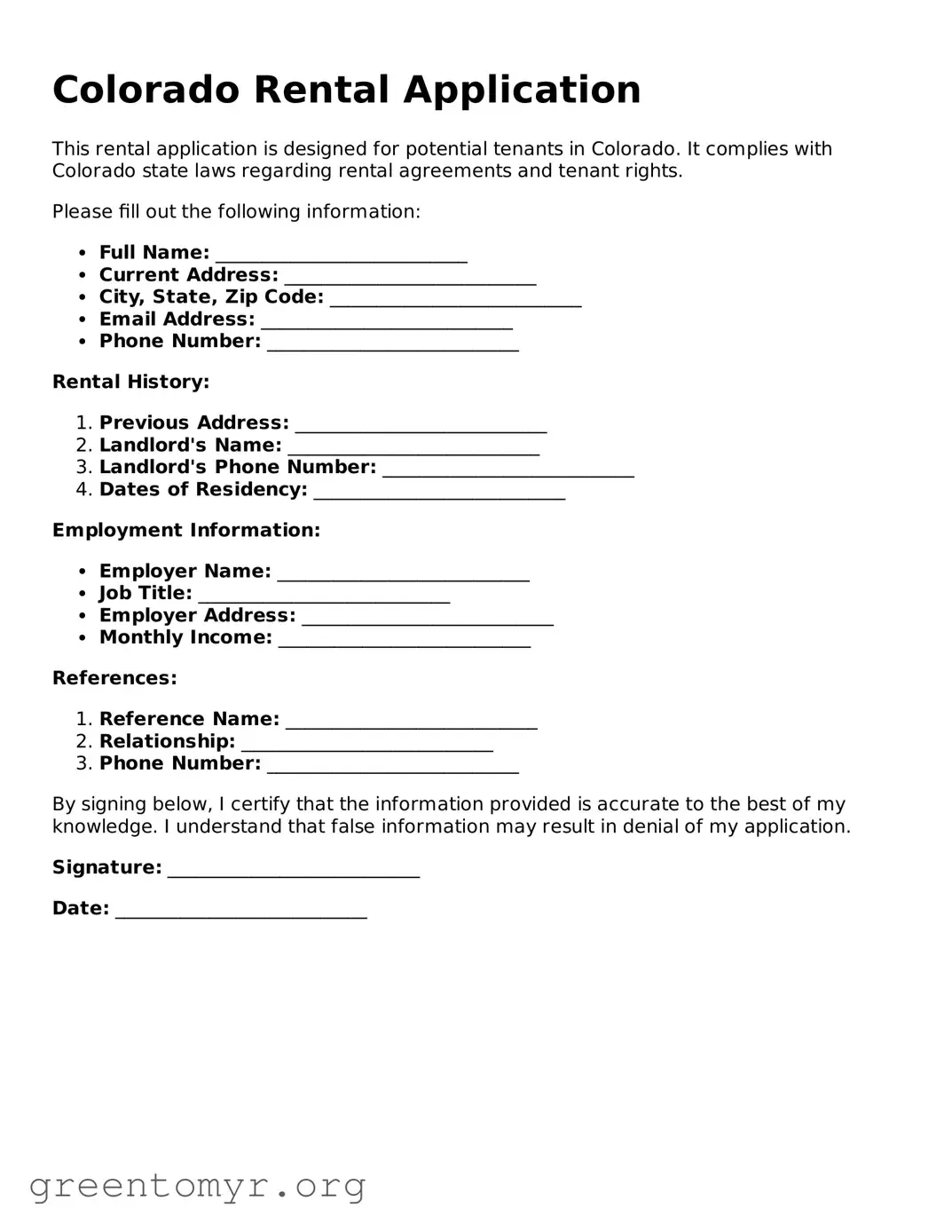
When seeking a new place to call home in Colorado, the rental application form plays a crucial role in the process. This essential document helps landlords evaluate potential tenants by gathering important information. Typically, the form requests personal details such as your name, contact information, and social security number. Additionally, it may ask about your employment history and income to assess your financial stability. References from previous landlords can also be included, providing insight into your rental history and behavior as a tenant. Understanding the nuances of the Colorado rental application form can empower you as a renter, ensuring you present your best self to prospective landlords while navigating the competitive housing market.
Colorado Rental Application
This rental application is designed for potential tenants in Colorado. It complies with Colorado state laws regarding rental agreements and tenant rights.
Please fill out the following information:
Rental History:
Employment Information:
References:
By signing below, I certify that the information provided is accurate to the best of my knowledge. I understand that false information may result in denial of my application.
Signature: ___________________________
Date: ___________________________
| Fact Name | Description |
|---|---|
| Purpose | The Colorado Rental Application form is used by landlords to screen potential tenants. |
| Information Required | Applicants typically provide personal details, rental history, employment information, and references. |
| Application Fee | Landlords may charge a non-refundable application fee to cover the cost of screening. |
| Screening Process | Landlords often conduct background checks, credit checks, and verify employment and rental history. |
| Fair Housing Compliance | The application process must comply with the Fair Housing Act to prevent discrimination. |
| Governing Laws | Colorado rental applications are governed by Colorado Revised Statutes, particularly Title 38, Article 12. |
| Right to Privacy | Applicants have the right to privacy, and landlords must handle personal information confidentially. |
After you have gathered all necessary information, it’s time to fill out the Colorado Rental Application form. This process is straightforward but requires attention to detail. Make sure to provide accurate information to avoid any delays in your application.
Once you have completed the form, review it carefully. Ensure that all fields are filled out correctly before submitting it to the landlord or property manager. This step is crucial for a smooth application process.
The Colorado Rental Application form is a document used by landlords to collect important information from potential tenants. This form typically includes personal details, rental history, employment information, and references. It serves as a tool for landlords to assess the suitability of applicants for their rental properties.
A typical Colorado Rental Application will ask for the following information:
Yes, many landlords charge an application fee to cover the cost of background checks and processing the application. This fee can vary but typically ranges from $30 to $75. It’s important to ask the landlord about the fee before submitting your application.
The length of the application process can vary. Generally, landlords may take anywhere from a few hours to several days to review applications. Factors that can influence this timeline include the number of applications received, the thoroughness of background checks, and the landlord’s availability to make a decision.
If your application is denied, the landlord is required to provide you with a notice explaining the reasons for the denial. Common reasons include poor credit history, insufficient income, or negative rental history. You have the right to request a copy of the report used in the decision-making process.
Yes, Colorado law provides certain protections for rental applicants. For example, landlords cannot discriminate based on race, color, national origin, religion, sex, familial status, or disability. Additionally, landlords must comply with the Fair Credit Reporting Act when conducting background checks, ensuring that applicants are treated fairly throughout the process.
When filling out a rental application in Colorado, many individuals inadvertently make mistakes that can hinder their chances of securing a desired rental property. One common error is providing incomplete personal information. Landlords need accurate details to verify your identity and rental history. Omitting crucial information, such as a middle name or previous addresses, can raise red flags.
Another frequent mistake involves failing to disclose income sources. Applicants often overlook mentioning additional income streams, which can strengthen their application. Providing a comprehensive view of your financial situation is essential, as landlords seek assurance that tenants can meet rental obligations.
Some applicants neglect to check their credit report before submitting the application. A poor credit history can significantly affect approval chances. By reviewing your credit report in advance, you can address any discrepancies and be prepared to explain any negative marks.
Additionally, people sometimes provide inaccurate references. Listing friends or family members who cannot vouch for your rental history may backfire. It is advisable to choose references who can genuinely speak to your reliability as a tenant.
Many applicants also fail to read the application thoroughly. Ignoring specific requirements or terms can lead to misunderstandings later. Taking the time to read through the entire application ensures that you understand what is expected and can avoid unnecessary mistakes.
Another mistake is not providing proper documentation. Landlords often require proof of income, identification, and rental history. Failing to include these documents can delay the application process or lead to outright rejection.
Some individuals make the error of underestimating the importance of neatness. A messy application can reflect poorly on an applicant. Taking the time to fill out the form neatly and legibly demonstrates professionalism and attention to detail.
People also sometimes forget to sign the application. A missing signature can render the application invalid. Always double-check to ensure that all required signatures are included before submission.
Another common oversight is not being transparent about past evictions. If you have a history of eviction, it is better to address it upfront rather than risk discovery later. Honesty can foster trust with potential landlords.
Lastly, many applicants neglect to follow up after submitting their application. A simple phone call or email can show your continued interest in the property and may help you stand out in a competitive rental market.
When applying for a rental property in Colorado, the Rental Application form is just one piece of the puzzle. Several other documents can help landlords assess potential tenants and ensure a smooth rental process. Here’s a brief overview of some commonly used forms and documents that often accompany the Colorado Rental Application.
Having these documents ready can streamline the application process and foster a transparent relationship between landlords and tenants. Being prepared not only reflects well on the applicant but also sets the stage for a positive rental experience.
Lease Agreement: Both documents establish the terms of a rental arrangement. A lease agreement outlines the responsibilities of both the landlord and tenant, similar to how a rental application gathers information to assess the suitability of a potential tenant.
Employment Application: Just as a rental application collects personal and financial information to evaluate a candidate, an employment application seeks to determine an applicant's qualifications for a job. Both require detailed information about income and background.
Credit Application: This document is used to assess an individual's creditworthiness, much like a rental application evaluates a prospective tenant’s ability to pay rent. Both require personal financial data and can influence approval decisions.
Loan Application: Similar to a rental application, a loan application requests information about an individual's financial situation and history. Both documents are critical in determining whether an applicant is a good fit for financial obligations.
Background Check Authorization: This document allows a landlord to verify the information provided in a rental application. It serves a similar purpose to background checks for employment, where an employer seeks to confirm the integrity of an applicant's credentials.
Tenant Screening Report: This report, often generated after a rental application is submitted, compiles various checks, such as credit and rental history. It is akin to a comprehensive report generated from an employment application process.
Insurance Application: Just as a rental application assesses risk related to tenancy, an insurance application evaluates the risk associated with providing coverage. Both require detailed personal information and often include financial disclosures.
Membership Application: Similar to a rental application, a membership application collects personal information to determine eligibility for joining an organization. Both processes assess whether the applicant meets specific criteria.
School Enrollment Form: This form collects essential information about a student to determine eligibility for enrollment, akin to how a rental application gathers tenant information to ensure a good fit for the rental property.
Utility Service Application: When applying for utility services, individuals provide personal and financial information to establish service, just as they do on a rental application to secure a lease. Both processes involve evaluating an applicant's reliability.
When filling out the Colorado Rental Application form, it's important to be thorough and honest. Here are some things to keep in mind:
Understanding the Colorado Rental Application form is essential for both tenants and landlords. However, several misconceptions can lead to confusion. Here are five common misconceptions:
This is not true. Each landlord or property management company can create their own rental application form. While many may follow similar guidelines, the specific details can vary significantly.
Submitting a rental application does not guarantee that a tenant will be approved. Landlords consider various factors, including credit history, income verification, and rental history before making a decision.
Many landlords charge a non-refundable application fee to cover the cost of background checks and processing. This fee is not universally applicable, but it is common practice.
While landlords must adhere to fair housing laws, they can deny applications based on legitimate business reasons. These may include insufficient income, poor credit history, or negative references.
This misconception overlooks privacy laws. Landlords are required to handle personal information with care and confidentiality, ensuring that sensitive data is not misused.
When filling out and using the Colorado Rental Application form, there are several important aspects to keep in mind. Here are key takeaways that can help ensure a smooth process:
By keeping these points in mind, you can navigate the Colorado Rental Application process more effectively and increase your chances of securing your desired rental property.