The Colorado Self-Proving Affidavit form is an important legal document that simplifies the process of validating a will. By allowing witnesses to affirm the will's authenticity at the time of signing, this form eliminates the need for them to testify in court later. This can save time and reduce complications during the probate process. The affidavit must be signed by the testator, who is the person making the will, as well as by the witnesses. It serves to confirm that the testator was of sound mind and not under any undue influence when creating the will. Additionally, this form must be notarized to ensure its legitimacy. Understanding how to properly complete and file this affidavit can help ensure that a person’s final wishes are honored without unnecessary delays or disputes.
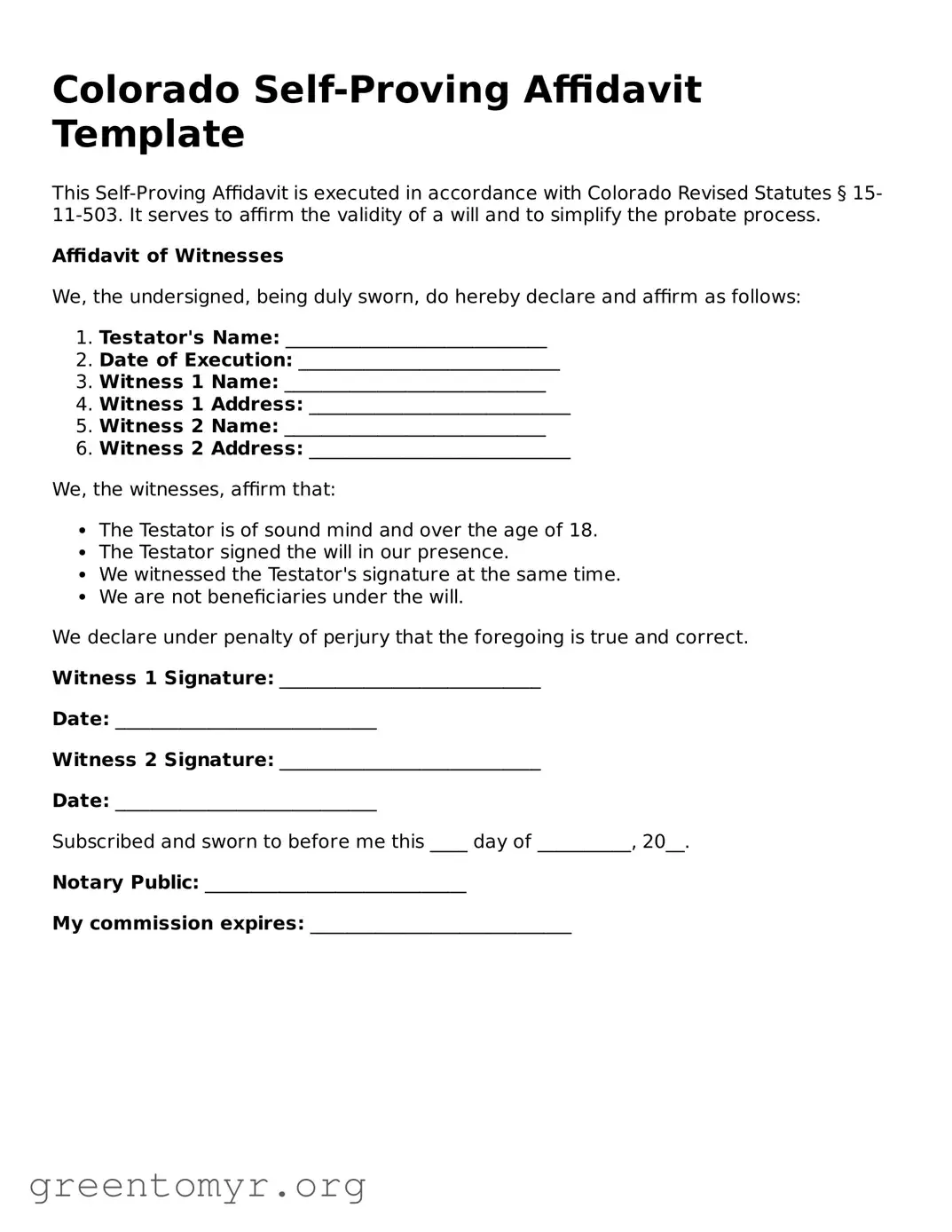
Colorado Self-Proving Affidavit Template
This Self-Proving Affidavit is executed in accordance with Colorado Revised Statutes § 15-11-503. It serves to affirm the validity of a will and to simplify the probate process.
Affidavit of Witnesses
We, the undersigned, being duly sworn, do hereby declare and affirm as follows:
We, the witnesses, affirm that:
We declare under penalty of perjury that the foregoing is true and correct.
Witness 1 Signature: ____________________________
Date: ____________________________
Witness 2 Signature: ____________________________
Date: ____________________________
Subscribed and sworn to before me this ____ day of __________, 20__.
Notary Public: ____________________________
My commission expires: ____________________________
| Fact Name | Details |
|---|---|
| Purpose | The Colorado Self-Proving Affidavit form allows a will to be validated without the need for witnesses to testify in court. |
| Governing Law | This form is governed by Colorado Revised Statutes, specifically § 15-11-503. |
| Signatories | The form must be signed by the testator and two witnesses in the presence of each other. |
| Notarization | A notary public must also sign the affidavit to confirm the identities of the signatories. |
| Effectiveness | Once executed, the self-proving affidavit can simplify the probate process by eliminating the need for witness testimony. |
Once you have the Colorado Self-Proving Affidavit form ready, you will need to complete it carefully. This process involves providing specific information about the testator and witnesses, as well as ensuring that all parties sign the document properly. Following these steps will help ensure that the form is filled out correctly.
After completing these steps, the form should be properly executed. It is advisable to keep the original document in a safe place along with the will, as it may be needed in the future.
A Colorado Self-Proving Affidavit is a legal document that allows a testator's will to be validated without the need for witnesses to testify in court. This affidavit is signed by the testator and witnesses, confirming that they witnessed the signing of the will and that the testator was of sound mind when doing so.
Using a Self-Proving Affidavit simplifies the probate process. It can save time and reduce potential disputes among heirs. When the affidavit is submitted with the will, it eliminates the need for witnesses to appear in court, making the process smoother and more efficient.
The Self-Proving Affidavit must be signed by:
All parties must sign the affidavit in front of a notary public to ensure its validity.
To complete a Self-Proving Affidavit, follow these steps:
No, a Self-Proving Affidavit is not required in Colorado. However, it is highly recommended. Without it, witnesses may need to testify in court, which can complicate the probate process and lead to delays.
Yes, a Self-Proving Affidavit can be revoked. If you create a new will or modify an existing one, the previous affidavit becomes void. Always ensure that your latest will and any accompanying affidavits are properly executed to reflect your current wishes.
Filling out the Colorado Self-Proving Affidavit form is a crucial step in the estate planning process. However, individuals often make several common mistakes that can lead to complications. Understanding these errors can help ensure that the affidavit is completed correctly and serves its intended purpose.
One frequent mistake is failing to include all required signatures. The affidavit must be signed by the testator, as well as by two witnesses. Omitting one of these signatures can invalidate the document, making it less effective in proving the will's authenticity.
Another common error is not having witnesses present during the signing. The law requires that witnesses observe the testator sign the will and the affidavit. If witnesses are not present, the affidavit may not hold up in court.
People also often neglect to provide accurate dates. The date on which the affidavit is signed should reflect the actual date of the signing. An incorrect date can raise questions about the validity of the document and the circumstances surrounding its execution.
Some individuals mistakenly use outdated forms. Legal documents can change over time, and using an old version of the affidavit may result in compliance issues. It is essential to ensure that the most current form is being utilized.
In addition, individuals sometimes fail to provide adequate identification. The affidavit may require the testator and witnesses to provide identification to confirm their identities. Not including this information can lead to challenges regarding the affidavit's legitimacy.
Another mistake involves not following the proper format. The Colorado Self-Proving Affidavit has a specific structure that must be adhered to. Deviating from this format can cause confusion and may render the affidavit ineffective.
People may also overlook the importance of notarization. While notarization is not always required for the affidavit itself, having it notarized can add an additional layer of credibility. Failing to do so may weaken the document's standing in legal proceedings.
Additionally, some individuals do not keep copies of the affidavit. It is vital to maintain copies for personal records and to provide to relevant parties. Without copies, proving the existence and validity of the affidavit can become problematic.
Another common oversight is not reviewing the completed form for errors. Simple mistakes, such as typos or incorrect information, can undermine the document's effectiveness. A thorough review can help catch these issues before the affidavit is submitted.
Lastly, individuals sometimes misunderstand the purpose of the affidavit. The Self-Proving Affidavit is designed to streamline the probate process, but it does not replace the need for a valid will. Understanding its role can help individuals use it effectively in conjunction with their estate planning documents.
The Colorado Self-Proving Affidavit is an important document that helps streamline the probate process by confirming the validity of a will. However, it is often accompanied by several other forms and documents that support estate planning and management. Below is a list of commonly used documents that may be relevant when dealing with a Self-Proving Affidavit in Colorado.
Understanding these documents is crucial for effective estate planning and management. Each plays a unique role in ensuring that a person's wishes are honored and that their estate is handled efficiently. Consulting with a legal professional can provide clarity and guidance on how to best utilize these forms in conjunction with the Colorado Self-Proving Affidavit.
The Self-Proving Affidavit is a legal document that serves to validate a will without requiring the presence of witnesses during probate. It provides assurance that the testator (the person who made the will) signed the document willingly and was of sound mind. Several other documents share similarities with the Self-Proving Affidavit in terms of purpose and function. Below are five such documents:
When filling out the Colorado Self-Proving Affidavit form, it is important to follow certain guidelines to ensure accuracy and compliance with legal standards. Here is a list of things you should and shouldn't do:
When it comes to the Colorado Self-Proving Affidavit form, several misconceptions can lead to confusion. Here are six common misunderstandings, along with clarifications to help you navigate this important document.
Misconception 1: A Self-Proving Affidavit is only for wealthy individuals.
This is not true. Anyone can benefit from a Self-Proving Affidavit, regardless of their financial status. It simply helps to streamline the probate process for all individuals.
Misconception 2: You need a lawyer to create a Self-Proving Affidavit.
While having legal assistance can be helpful, it is not a requirement. Many people successfully complete this form on their own, as long as they follow the guidelines.
Misconception 3: The Self-Proving Affidavit replaces the will.
This is incorrect. The Self-Proving Affidavit complements the will by providing evidence of its validity, but it does not take the place of the will itself.
Misconception 4: You must sign the Self-Proving Affidavit in front of a notary.
While notarization is a key part of the process, the affidavit must also be signed by witnesses. Both elements are essential for it to be considered valid.
Misconception 5: The Self-Proving Affidavit is only necessary in Colorado.
This is misleading. Many states offer similar forms, but the requirements and processes may vary. It's important to understand the rules specific to your state.
Misconception 6: A Self-Proving Affidavit can be created at any time.
While you can technically draft one whenever you wish, it's best to do so at the same time you create your will. This ensures that all documents are aligned and up to date.
When considering the Colorado Self-Proving Affidavit, there are several important points to keep in mind. This form can simplify the probate process and ensure that your wishes are honored. Here are some key takeaways:
Understanding these key aspects can help ensure that the Self-Proving Affidavit serves its intended purpose effectively, providing peace of mind for both the testator and their loved ones.