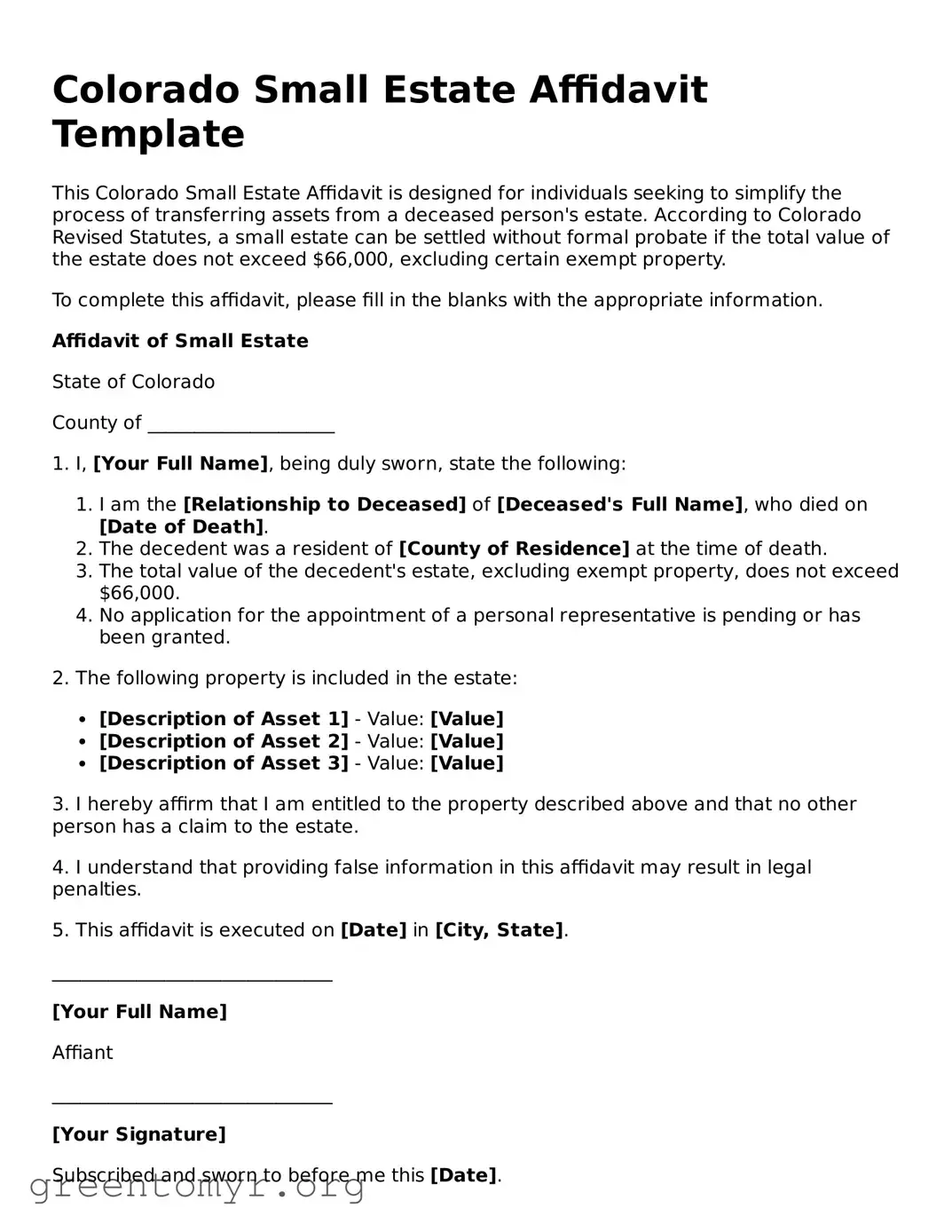
In Colorado, navigating the complexities of estate management can be simplified through the use of the Small Estate Affidavit form, a vital tool for those dealing with the estates of deceased individuals. This form is particularly beneficial for estates valued at $66,000 or less, allowing heirs to bypass the lengthy probate process. By completing the affidavit, individuals can assert their right to inherit property and assets without the need for court intervention, streamlining what can often be a cumbersome procedure. The form requires specific information, including details about the deceased, the nature of the assets, and the identities of the claimants. Furthermore, it mandates that the affiant affirm the absence of any pending probate proceedings and declare that all debts of the deceased have been settled. This mechanism not only expedites the transfer of assets but also provides a clear framework for ensuring that the rightful heirs receive their inheritance in a timely manner.
Colorado Small Estate Affidavit Template
This Colorado Small Estate Affidavit is designed for individuals seeking to simplify the process of transferring assets from a deceased person's estate. According to Colorado Revised Statutes, a small estate can be settled without formal probate if the total value of the estate does not exceed $66,000, excluding certain exempt property.
To complete this affidavit, please fill in the blanks with the appropriate information.
Affidavit of Small Estate
State of Colorado
County of ____________________
1. I, [Your Full Name], being duly sworn, state the following:
2. The following property is included in the estate:
3. I hereby affirm that I am entitled to the property described above and that no other person has a claim to the estate.
4. I understand that providing false information in this affidavit may result in legal penalties.
5. This affidavit is executed on [Date] in [City, State].
______________________________
[Your Full Name]
Affiant
______________________________
[Your Signature]
Subscribed and sworn to before me this [Date].
______________________________
[Notary Public's Name]
Notary Public
My commission expires: [Expiration Date]
| Fact Name | Detail |
|---|---|
| Governing Law | The Colorado Small Estate Affidavit is governed by Colorado Revised Statutes § 15-12-1201 to § 15-12-1205. |
| Eligibility | This form is typically used when the total value of the estate is less than $75,000, excluding certain assets. |
| Purpose | The affidavit allows heirs to claim property without going through formal probate. |
| Required Information | Affidavit must include details about the deceased, their assets, and the heirs. |
| Filing Location | The completed affidavit is filed with the probate court in the county where the deceased resided. |
| Signature Requirement | All heirs must sign the affidavit, affirming their relationship to the deceased. |
After gathering the necessary information and documents, you are ready to fill out the Colorado Small Estate Affidavit form. This form is a straightforward way to handle the estate of a deceased individual when the total value of the estate is below a certain threshold. Completing the form accurately is essential for ensuring a smooth process.
A Small Estate Affidavit is a legal document that allows heirs or beneficiaries to claim assets of a deceased person without going through the formal probate process. In Colorado, this option is available if the total value of the estate is $74,000 or less, excluding certain assets like real estate. This process simplifies the transfer of assets, making it easier for families during a difficult time.
Generally, any person who is entitled to inherit from the deceased can use the Small Estate Affidavit. This includes:
It’s important to ensure that the estate meets the value requirements and that you have a right to claim the assets.
To complete the Small Estate Affidavit, follow these steps:
Make sure to keep copies of all documents for your records.
You can claim various types of assets through a Small Estate Affidavit, including:
However, real estate and certain types of jointly owned property are typically excluded from this process.
Filing a Small Estate Affidavit usually does not involve court fees, as it is not filed with the court. However, there may be notary fees when signing the affidavit. Additionally, some financial institutions may have their own requirements or fees when processing the affidavit. It's a good idea to check with each institution for their specific policies.
If the total value of the estate exceeds $74,000, you will need to go through the regular probate process. This involves filing a petition with the probate court and may require more time and legal assistance. It’s essential to assess the value of the estate accurately to determine the appropriate course of action.
Filling out the Colorado Small Estate Affidavit can be a straightforward process, but there are common mistakes that people often make. One frequent error is failing to accurately identify the deceased. It's crucial to include the full legal name of the deceased as it appears on official documents. Omitting middle names or using nicknames can lead to complications in the estate settlement process.
Another common mistake is not providing the correct date of death. This date is essential for determining whether the estate qualifies under Colorado's small estate laws. If the date is incorrect, it can cause delays or even disqualify the estate from being processed as a small estate.
Many individuals also overlook the importance of listing all assets accurately. People sometimes forget to include certain assets or underestimate their value. This can create issues later, especially if the total value of the estate exceeds the threshold for small estate eligibility. Each asset should be documented clearly, with its estimated value provided.
Additionally, signatures can be a point of confusion. The affidavit requires the signatures of all heirs or beneficiaries. Failing to obtain these signatures can invalidate the affidavit. It's essential to ensure that everyone involved understands their role and agrees to the contents of the affidavit.
Another mistake is neglecting to attach necessary supporting documents. The Small Estate Affidavit may require additional paperwork, such as a death certificate or proof of asset ownership. Skipping this step can lead to delays, as the court may request these documents later.
Finally, people often misinterpret the requirements for notarization. The affidavit must be notarized to be legally binding. Failing to have it properly notarized can render the document ineffective. Always double-check that the notarization is complete before submitting the affidavit.
When dealing with the Colorado Small Estate Affidavit, several other forms and documents may be necessary to ensure a smooth process. Each of these documents serves a specific purpose in the estate settlement process, helping to clarify ownership and facilitate the transfer of assets.
Gathering these documents can help simplify the estate settlement process. Each plays a vital role in ensuring that the wishes of the deceased are honored and that the heirs receive their rightful inheritance without unnecessary complications.
The Small Estate Affidavit form is a useful tool for settling the estates of deceased individuals without going through a lengthy probate process. Several other documents serve similar purposes in estate management. Here are eight documents that share similarities with the Small Estate Affidavit:
When filling out the Colorado Small Estate Affidavit form, it is important to follow certain guidelines to ensure accuracy and compliance. Below is a list of things you should and shouldn't do.
The Colorado Small Estate Affidavit is a useful tool for settling the estates of individuals who have passed away with limited assets. However, several misconceptions can lead to confusion and complications. Here are five common misunderstandings:
Understanding these misconceptions can help individuals navigate the process more effectively. It is crucial to gather accurate information and seek guidance when needed to ensure a smooth transition of assets.
When dealing with the Colorado Small Estate Affidavit form, it is important to understand the key points that will guide you through the process. Here are some essential takeaways:
Understanding these key points will help streamline the process of using the Colorado Small Estate Affidavit form and ensure that you can effectively manage the estate in question.