The Colorado Transfer-on-Death Deed is a valuable tool for individuals looking to simplify the transfer of real property upon their passing. This legal instrument allows property owners to designate a beneficiary who will automatically receive the property without the need for probate, thereby streamlining the process and reducing associated costs. By completing this form, property owners can retain full control over their assets during their lifetime, as the transfer only occurs after death. The deed must be properly executed and recorded to be effective, ensuring that the beneficiary's rights are protected. Furthermore, the Transfer-on-Death Deed can be revoked or altered at any time, providing flexibility for property owners as their circumstances change. Understanding the nuances of this deed is essential for anyone considering its use, as it offers a straightforward way to pass on property while minimizing legal complexities for loved ones left behind.
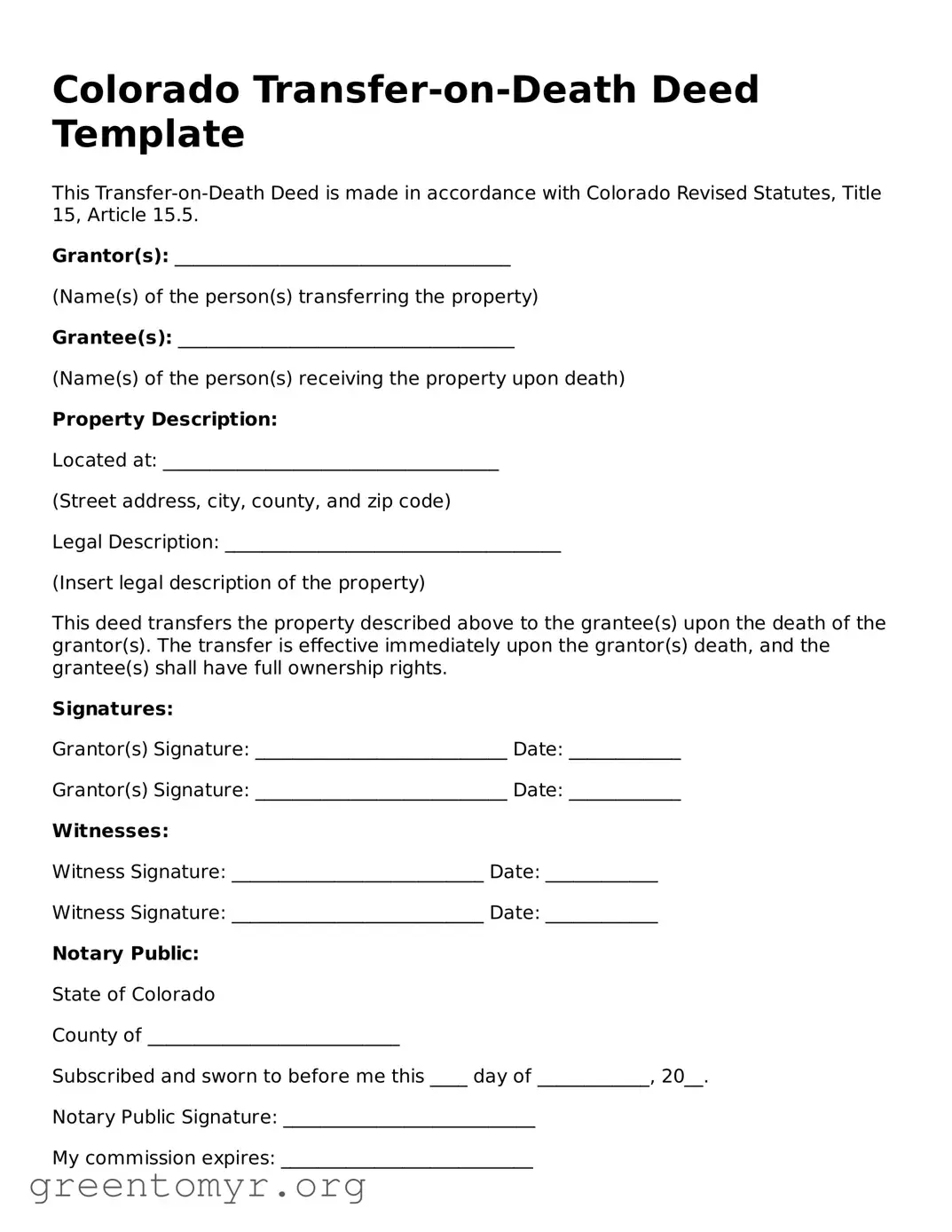
Colorado Transfer-on-Death Deed Template
This Transfer-on-Death Deed is made in accordance with Colorado Revised Statutes, Title 15, Article 15.5.
Grantor(s): ____________________________________
(Name(s) of the person(s) transferring the property)
Grantee(s): ____________________________________
(Name(s) of the person(s) receiving the property upon death)
Property Description:
Located at: ____________________________________
(Street address, city, county, and zip code)
Legal Description: ____________________________________
(Insert legal description of the property)
This deed transfers the property described above to the grantee(s) upon the death of the grantor(s). The transfer is effective immediately upon the grantor(s) death, and the grantee(s) shall have full ownership rights.
Signatures:
Grantor(s) Signature: ___________________________ Date: ____________
Grantor(s) Signature: ___________________________ Date: ____________
Witnesses:
Witness Signature: ___________________________ Date: ____________
Witness Signature: ___________________________ Date: ____________
Notary Public:
State of Colorado
County of ___________________________
Subscribed and sworn to before me this ____ day of ____________, 20__.
Notary Public Signature: ___________________________
My commission expires: ___________________________
By signing this deed, the grantor(s) confirm their intention to transfer the property to the grantee(s) upon their death.
| Fact Name | Description |
|---|---|
| Definition | A Transfer-on-Death (TOD) Deed allows an individual to transfer real property to a beneficiary upon their death without going through probate. |
| Governing Law | The TOD Deed in Colorado is governed by Colorado Revised Statutes, specifically § 15-15-401 to § 15-15-409. |
| Eligibility | Any individual who owns real property in Colorado can create a TOD Deed to designate a beneficiary. |
| Beneficiary Designation | Multiple beneficiaries can be named, and they can receive equal shares or specified percentages of the property. |
| Revocation | The property owner can revoke or change the TOD Deed at any time before their death, ensuring flexibility. |
| Filing Requirements | The TOD Deed must be recorded with the county clerk and recorder in the county where the property is located to be effective. |
| Tax Implications | Transfer-on-Death Deeds do not trigger immediate tax consequences; however, beneficiaries may face tax obligations upon inheritance. |
| Limitations | Real estate subject to a mortgage or other liens can still be transferred via a TOD Deed, but the beneficiary may inherit the debt. |
| Post-Death Process | After the property owner's death, the beneficiary must file an affidavit and provide a copy of the death certificate to claim the property. |
After obtaining the Colorado Transfer-on-Death Deed form, you will need to fill it out accurately. This process involves providing specific information about the property and the parties involved. Once completed, the form will need to be signed and recorded with the appropriate county office.
A Transfer-on-Death Deed (TOD Deed) is a legal document that allows a property owner to transfer real estate to a designated beneficiary upon their death, without the need for probate. This means that the property can pass directly to the beneficiary, simplifying the transfer process and potentially saving time and money.
Any individual who owns real property in Colorado can use a Transfer-on-Death Deed. This includes homeowners, landowners, and individuals holding property in their name. However, it is essential to ensure that the deed is executed correctly and in accordance with Colorado law to be valid.
Creating a Transfer-on-Death Deed involves several steps:
It is advisable to consult with a legal professional to ensure that all requirements are met and that the deed reflects your intentions accurately.
Yes, you can change or revoke a Transfer-on-Death Deed at any time before your death. To do so, you must execute a new deed that either designates a different beneficiary or explicitly revokes the previous deed. This new deed must also be signed, notarized, and recorded in the same manner as the original.
Generally, a Transfer-on-Death Deed does not trigger any immediate tax consequences. The property is not considered part of the deceased's estate for probate purposes. However, it is essential for beneficiaries to consult with a tax professional to understand any potential tax liabilities that may arise upon inheriting the property, such as property taxes or capital gains taxes when they decide to sell.
If a Transfer-on-Death Deed does not name a beneficiary, the property will not transfer as intended upon the owner’s death. Instead, it will become part of the deceased's estate and will be subject to probate. This could lead to delays and additional costs for the heirs, so it is crucial to ensure that a beneficiary is designated.
A Transfer-on-Death Deed can be a beneficial estate planning tool for many individuals, but it may not be suitable for everyone. Factors such as the complexity of your estate, family dynamics, and specific goals should be considered. Consulting with an estate planning attorney can help determine if this option aligns with your overall estate planning strategy.
Filling out a Colorado Transfer-on-Death Deed form can be a straightforward process, but several common mistakes can lead to complications. One frequent error is failing to properly identify the property. It is crucial to provide a complete legal description of the property being transferred. Relying solely on a street address can lead to ambiguity and potential disputes over ownership.
Another common mistake is neglecting to include the full names of the beneficiaries. When listing beneficiaries, it’s essential to use their legal names as they appear on official documents. Omitting middle names or using nicknames can create confusion and may complicate the transfer process.
People often overlook the importance of signatures. The form must be signed by the property owner, and in some cases, witnesses may be required. Failing to sign the deed correctly can render it invalid. Additionally, not having the deed notarized, when necessary, is another frequent oversight.
Some individuals mistakenly believe that a Transfer-on-Death Deed is irrevocable. In fact, the property owner retains the right to change or revoke the deed at any time before their death. Failing to understand this can lead to unintended consequences, especially if circumstances change.
Another error involves not recording the deed with the appropriate county clerk and recorder’s office. Even if the form is filled out correctly, if it is not recorded, the transfer will not take effect. This step is essential to ensure that the beneficiaries' rights are protected.
People sometimes forget to check for existing liens or encumbrances on the property. If there are outstanding debts tied to the property, those issues must be resolved before the transfer can occur. Ignoring this can lead to complications for the beneficiaries.
Misunderstanding the implications of state laws can also lead to mistakes. Each state has specific rules regarding Transfer-on-Death Deeds. Not being aware of Colorado's requirements can result in errors that affect the validity of the deed.
Finally, many individuals do not seek legal advice when necessary. While it is possible to fill out the form independently, consulting with a legal professional can help avoid pitfalls and ensure that the deed meets all legal requirements. Seeking guidance can provide peace of mind and clarity throughout the process.
The Colorado Transfer-on-Death Deed form is a useful tool for individuals looking to transfer property to beneficiaries without going through probate. However, there are several other documents that may be needed to ensure the process is smooth and legally sound. Below is a list of related forms and documents commonly used in conjunction with the Transfer-on-Death Deed.
Using these forms and documents in conjunction with the Colorado Transfer-on-Death Deed can help ensure that property transfers are handled efficiently and according to the owner’s wishes. It is always advisable to consult with a legal professional for guidance specific to individual circumstances.
The Transfer-on-Death Deed (TOD Deed) is a unique legal document that allows individuals to pass on property to their beneficiaries without the need for probate. However, several other documents serve similar purposes in estate planning and property transfer. Here are four documents that share similarities with the Transfer-on-Death Deed:
Understanding these documents can empower individuals to make informed decisions about their estate planning needs. Each serves a distinct purpose, yet they all aim to simplify the transfer of assets and ensure that one's wishes are honored after passing.
When filling out the Colorado Transfer-on-Death Deed form, it is essential to follow specific guidelines to ensure accuracy and compliance. Below are some key dos and don'ts to keep in mind.
Understanding the Colorado Transfer-on-Death Deed can be challenging due to several misconceptions. Here are six common misunderstandings:
The Transfer-on-Death Deed does not transfer property until the owner passes away. Until that point, the owner retains full control over the property.
The deed does not replace a will. It is a separate legal document that only addresses the transfer of specific real estate upon death.
Not all types of property qualify. Only real estate can be transferred using a Transfer-on-Death Deed in Colorado.
This deed does not require court approval to be valid. It is effective immediately upon signing and recording.
The deed can be revoked or changed at any time before the owner's death, as long as the owner follows the proper procedures.
While it does allow for a simpler transfer of property, it does not completely avoid probate for other assets or issues that may arise.
Being aware of these misconceptions can help individuals make informed decisions regarding their estate planning in Colorado.
Filling out and utilizing the Colorado Transfer-on-Death Deed form can be a straightforward process when you understand the key elements involved. Here are some essential takeaways to keep in mind: