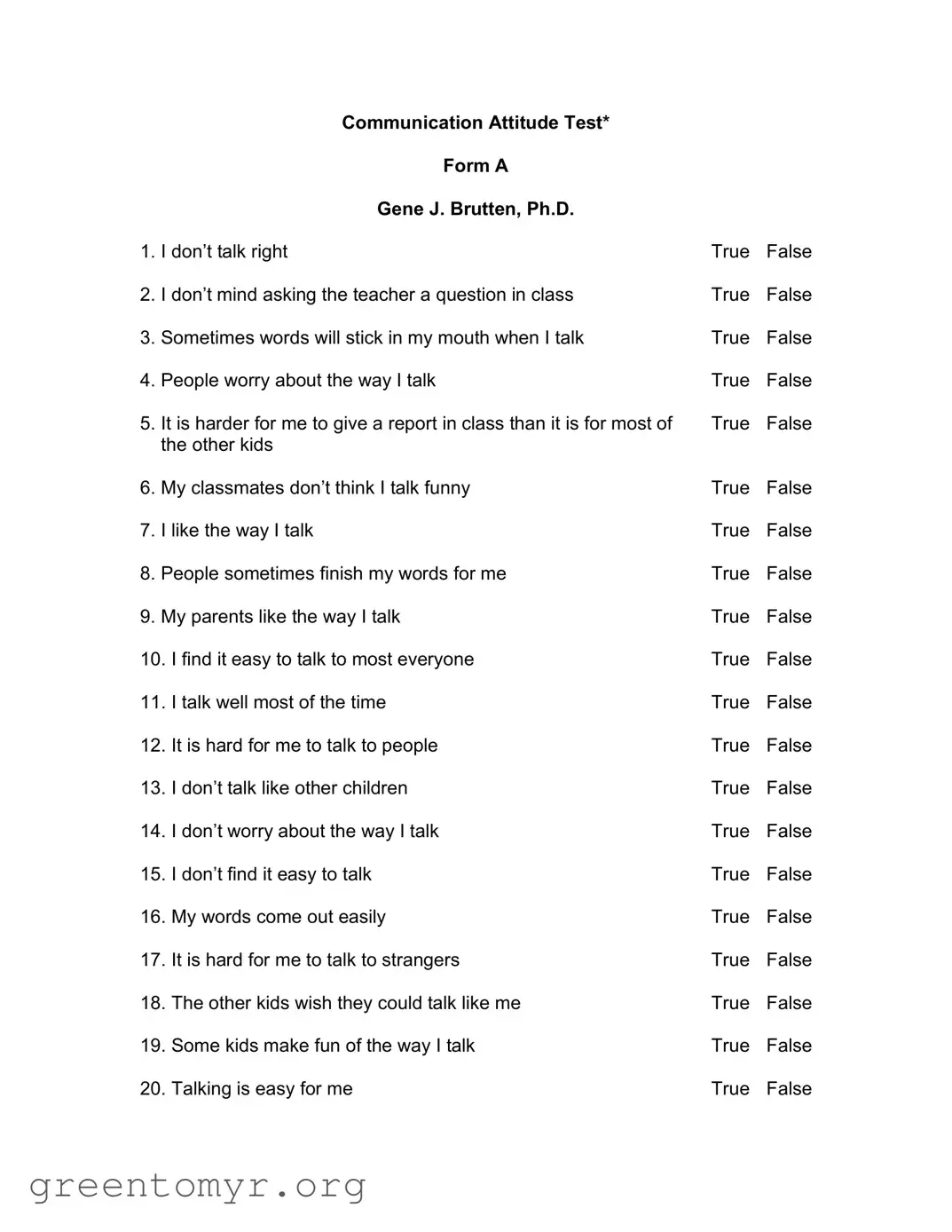
The Communication Attitude Test A (CAT-A) is a valuable tool designed to assess an individual's feelings and attitudes toward their own communication abilities. This assessment comprises a series of statements that respondents answer with either "True" or "False," providing insights into their self-perception regarding speaking and interaction. The test explores various dimensions of communication, including ease of speaking, comfort in social situations, and concerns about how one is perceived by peers and adults. For instance, questions range from whether a person feels they talk "right" to whether they find it difficult to talk to strangers. By evaluating responses to these statements, the CAT-A can help identify areas where individuals may struggle with communication, as well as highlight strengths. This understanding can be crucial for educators, speech-language pathologists, and parents, as it enables them to tailor support and interventions to foster better communication skills and confidence in children. Ultimately, the CAT-A serves as a bridge to understanding the nuanced relationship between self-image and communication capabilities, offering a pathway to improvement and empowerment.
|
|
COMMUNICATION ATTITUDE TEST* |
|
|
|
|
FORM A |
|
|
|
|
GENE J. BRUTTEN, PH.D. |
|
|
1. |
I don’t talk right |
True |
False |
|
2. |
I don’t mind asking the teacher a question in class |
True |
False |
|
3. |
Sometimes words will stick in my mouth when I talk |
True |
False |
|
4. |
People worry about the way I talk |
True |
False |
|
5. |
It is harder for me to give a report in class than it is for most of |
True |
False |
|
|
the other kids |
|
|
|
6. |
My classmates don’t think I talk funny |
True |
False |
|
7. |
I like the way I talk |
True |
False |
|
8. |
People sometimes finish my words for me |
True |
False |
|
9. |
My parents like the way I talk |
True |
False |
|
10. |
I find it easy to talk to most everyone |
True |
False |
|
11. |
I talk well most of the time |
True |
False |
|
12. |
It is hard for me to talk to people |
True |
False |
|
13. |
I don’t talk like other children |
True |
False |
|
14. |
I don’t worry about the way I talk |
True |
False |
|
15. |
I don’t find it easy to talk |
True |
False |
|
16. |
My words come out easily |
True |
False |
|
17. |
It is hard for me to talk to strangers |
True |
False |
|
18. |
The other kids wish they could talk like me |
True |
False |
|
19. |
Some kids make fun of the way I talk |
True |
False |
|
20. |
Talking is easy for me |
True |
False |
|
21. |
Telling someone my name is hard for me |
True |
False |
22. |
Words are hard for me to say |
True |
False |
23. |
I talk well with most everyone |
True |
False |
24. |
Sometimes I have trouble talking |
True |
False |
25. |
I would rather talk than write |
True |
False |
26. |
I like to talk |
True |
False |
27. |
I am not a good talker |
True |
False |
28. |
I wish I could talk like other children |
True |
False |
29. |
My words do not come out easily |
True |
False |
30. |
My friends don’t talk as well as I do |
True |
False |
31. |
I don’t worry about talking on the phone |
True |
False |
32. |
I talk better with a friend |
True |
False |
33. |
People don’t seem to like the way I talk |
True |
False |
34. |
I let others talk for me |
True |
False |
35. |
Reading out loud in class is easy for me |
True |
False |
*Copyright, Gene J. Brutten, 1985 – Revised 1997
| Fact Name | Description |
|---|---|
| Creator | The Communication Attitude Test A form was developed by Gene J. Brutten, Ph.D. |
| Purpose | This test assesses an individual's attitudes toward communication and speaking abilities. |
| Format | The test consists of 35 statements requiring a response of "True" or "False." |
| Target Group | The test is primarily designed for children to evaluate their communication attitudes. |
| Copyright Information | The form is copyrighted by Gene J. Brutten, with original copyright in 1985 and a revision in 1997. |
Completing the Communication Attitude Test A form involves a series of statements that require a response indicating agreement or disagreement. Each statement is designed to assess your communication experiences and feelings. Follow the steps below to accurately fill out the form.
The Communication Attitude Test A form is a tool designed to assess an individual's feelings and attitudes towards their communication abilities. It consists of a series of statements that respondents answer with "True" or "False." The responses help identify areas where a person may feel confident or struggle in their communication skills.
This test is suitable for children and adolescents who are experiencing challenges with communication. It is often used by educators, speech-language pathologists, and psychologists to better understand a young person's self-perception regarding their speech and language abilities.
The test can be administered individually or in a group setting. A facilitator typically reads each statement aloud, allowing participants to respond. Alternatively, participants may complete the form independently, marking their answers as "True" or "False" for each statement.
The test includes a variety of statements that reflect different aspects of communication attitudes. For example, some statements address feelings of confidence, while others explore concerns about how others perceive one's speech. Respondents may encounter statements like "I don’t mind asking the teacher a question in class" or "People sometimes finish my words for me."
Results are interpreted based on the pattern of responses. A higher number of "True" responses to negative statements may indicate areas of concern, such as anxiety or lack of confidence in communication. Conversely, a higher number of "True" responses to positive statements may suggest a more favorable view of one's communication abilities.
The primary purpose of this test is to gain insight into a child's self-perception regarding their communication skills. It can help identify specific areas where support may be needed, allowing for targeted interventions to improve communication confidence and effectiveness.
Yes, the test was developed by Dr. Gene J. Brutten and has undergone revisions to enhance its reliability and validity. It is widely used in educational and clinical settings to assess communication attitudes among children and adolescents.
The Communication Attitude Test A form is primarily designed for children and adolescents. While adults may have similar communication concerns, a different assessment tool may be more appropriate for evaluating adult communication attitudes.
After completing the test, it is important to discuss the results with a qualified professional, such as a speech-language pathologist or educator. They can provide insights into the findings and recommend strategies for improvement, if necessary. Follow-up support can help individuals build confidence and enhance their communication skills.
Filling out the Communication Attitude Test A form can be a straightforward task, but many individuals make common mistakes that can lead to inaccurate results. One frequent error is misunderstanding the questions. Some people may misinterpret the phrasing or the intent behind a statement, which can skew their responses. For example, a question like "I don’t talk right" might be taken literally, causing confusion about what "talking right" actually means.
Another common mistake involves inconsistency in answering. Respondents may begin with a certain mindset but shift their perspective as they progress through the test. This can result in contradictory answers, such as stating they find it easy to talk to most people while also claiming they struggle with speaking in class. Such inconsistencies can complicate the interpretation of their communication attitudes.
Additionally, some individuals might rush through the form without taking the time to reflect on their true feelings. This hurried approach can lead to superficial answers that don’t accurately represent their communication experiences. It’s important to take a moment to consider each question carefully, as this can significantly impact the overall accuracy of the assessment.
Lastly, emotional state can play a significant role in how someone responds to the test. If a person feels anxious or self-conscious while filling out the form, they may answer in a way that reflects those feelings rather than their actual communication abilities. For instance, someone who is generally confident might downplay their skills due to temporary nerves. Recognizing this influence can help individuals provide more honest and reflective answers.
The Communication Attitude Test A form is a valuable tool for assessing an individual's feelings about their communication skills. Along with this form, several other documents can enhance understanding and provide a comprehensive view of a person's communication abilities. Here are some commonly used forms and documents that complement the Communication Attitude Test A:
Using these forms together with the Communication Attitude Test A can lead to a more thorough understanding of an individual's communication abilities. This comprehensive approach ensures that all aspects of communication are considered, allowing for tailored support and interventions.
When filling out the Communication Attitude Test A form, it's important to approach the task thoughtfully. Here are some guidelines to help you navigate the process effectively:
Understanding the Communication Attitude Test A can help clarify its purpose and application. However, several misconceptions often arise regarding this tool. Here are nine common misunderstandings:
By dispelling these misconceptions, individuals can better appreciate the value of the Communication Attitude Test A in fostering effective communication skills in children.
When utilizing the Communication Attitude Test A form, several important points should be considered to ensure its effectiveness and accuracy. Here are some key takeaways: