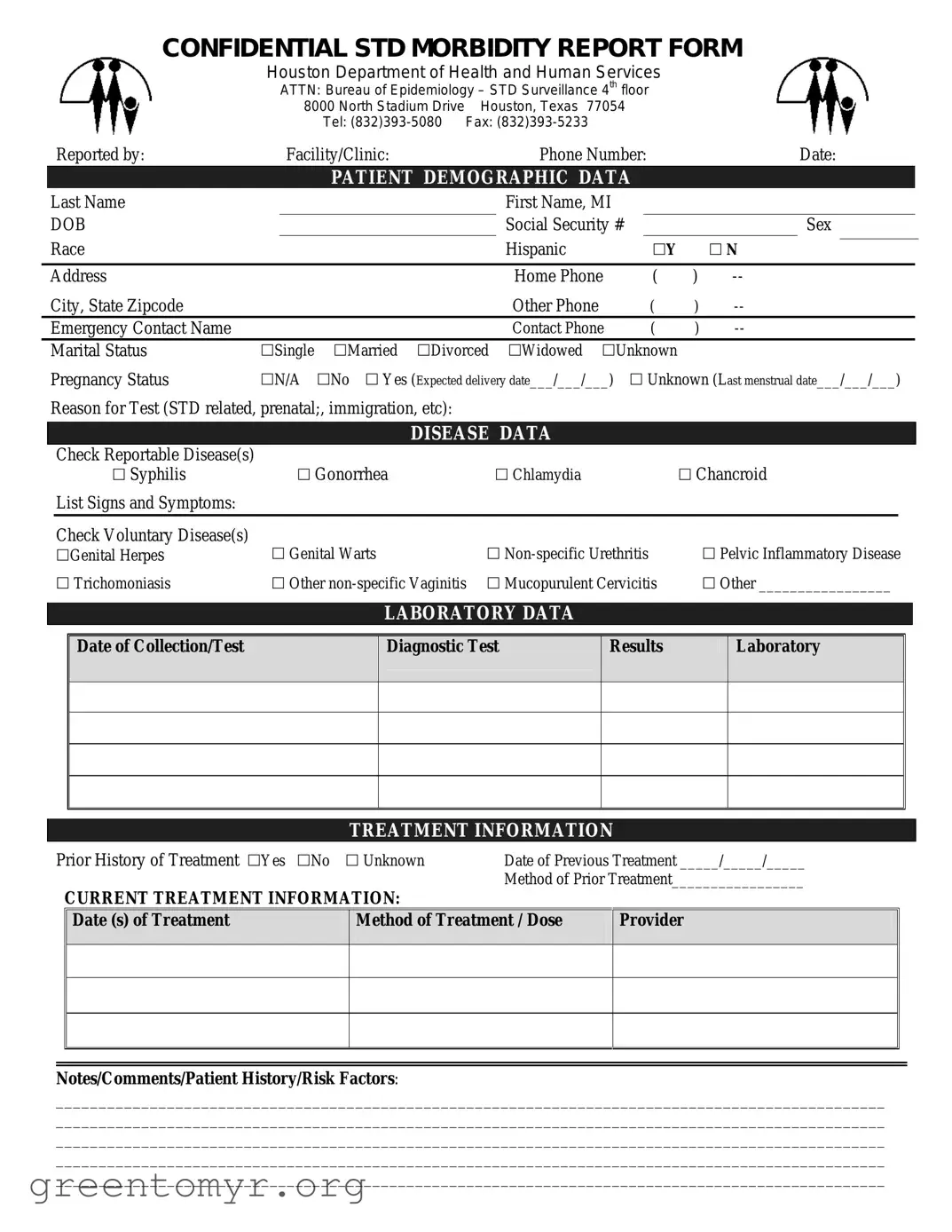
The Confidential STD Morbidity Report form is an essential tool used by healthcare providers to report cases of sexually transmitted diseases (STDs) to the Houston Department of Health and Human Services. This form plays a crucial role in public health surveillance, helping to track and manage the incidence of STDs within the community. It collects vital patient demographic information, including the individual's name, date of birth, and contact details, ensuring that the data remains confidential while allowing for effective follow-up. Additionally, the form requires information about the patient's marital status and pregnancy status, which can be relevant to their care and treatment. Healthcare providers must indicate the specific STD diagnoses, such as syphilis, gonorrhea, or chlamydia, as well as any voluntary diseases that may be present. Laboratory data, including the date of sample collection and test results, are also recorded to provide a comprehensive overview of the patient's health status. Treatment history, both prior and current, is crucial for understanding the patient's journey and determining the most effective care moving forward. Overall, this form serves as a vital link between patients and public health efforts, facilitating necessary interventions and promoting community well-being.
CONFIDENTIAL STD MORBIDITY REPORT FORM
Houston Department of Health and Human Services
|
|
|
|
ATTN: Bureau of Epidemiology – STD Surveillance 4th floor |
|
|
|
|
|
|
|
|
||||||
|
|
|
|
8000 North Stadium Drive |
Houston, Texas 77054 |
|
|
|
|
|
|
|
|
|
|
|
||
|
|
|
|
|
Tel: |
|
|
|
|
|
|
|
|
|
|
|
||
|
|
Reported by: |
|
Facility/Clinic: |
|
Phone Number: |
|
|
|
|
Date: |
|
|
|||||
|
|
|
|
|
PATIENT DEMOGRAPHIC DATA |
|
|
|
|
|
|
|
|
|||||
|
Last Name |
|
|
|
|
First Name, MI |
|
|
|
|
|
|
|
|
|
|
|
|
|
DOB |
|
|
|
|
Social Security # |
|
|
|
|
|
|
Sex |
|
|
|||
|
Race |
|
|
|
|
Hispanic |
|
|
|
|
|
|
||||||
|
|
|
|
|
|
Y |
|
N |
|
|
|
|||||||
|
|
|
|
|
|
|
|
|
|
|
|
|
|
|
|
|
|
|
|
Address |
|
|
|
|
Home Phone |
( |
|
) |
|
|
|
|
|
|
|||
|
City, State Zipcode |
|
|
|
|
Other Phone |
( |
|
) |
|
|
|
|
|
|
|||
|
Emergency Contact Name |
|
|
|
|
Contact Phone |
( |
|
) |
|
|
|
|
|
|
|||
|
Marital Status |
Single |
Married Divorced Widowed Unknown |
|
|
|
|
|
|
|
|
|||||||
|
Pregnancy Status |
N/A |
No Yes (Expected delivery date___/___/___) |
Unknown (Last menstrual date___/___/___) |
|
|
||||||||||||
|
Reason for Test (STD related, prenatal;, immigration, etc): |
|
|
|
|
|
|
|
|
|
|
|
|
|
||||
|
|
|
|
|
|
|
|
|
|
|
|
|
|
|
|
|
||
|
|
|
|
|
DISEASE DATA |
|
|
|
|
|
|
|
|
|
|
|
||
|
|
Check Reportable Disease(s) |
|
|
|
|
|
|
|
|
|
|
|
|
|
|
|
|
|
|
Syphilis |
|
Gonorrhea |
Chlamydia |
|
|
|
Chancroid |
|
|
|||||||
|
|
List Signs and Symptoms: |
|
|
|
|
|
|
|
|
|
|
|
|
|
|
|
|
|
|
Check Voluntary Disease(s) |
Genital Warts |
|
|
Pelvic Inflammatory Disease |
|
|
||||||||||
|
|
Genital Herpes |
|
|
|
|||||||||||||
|
|
Trichomoniasis |
Other |
Mucopurulent Cervicitis |
|
Other _________________ |
|
|
||||||||||
LABORATORY DATA
Date of Collection/Test
Diagnostic Test
Results
Laboratory
TREATMENT INFORMATION
Prior History of Treatment Yes No |
Unknown |
Date of Previous Treatment _____/_____/_____ |
|
|
|||||
|
CURRENT TREATMENT INFORMATION: |
Method of Prior Treatment_________________ |
|
|
|||||
|
|
|
|
|
|
||||
|
|
Date (s) of Treatment |
|
Method of Treatment / Dose |
|
Provider |
|
|
|
|
|
|
|
|
|
|
|
|
|
|
|
|
|
|
|
|
|
|
|
|
|
|
|
|
|
|
|
|
|
|
|
|
|
|
|
|
|
|
|
|
|
|
|
|
|
|
|
|
|
|
|
|
|
|
|
|
|
|
|
Notes/Comments/Patient History/Risk Factors:
_________________________________________________________________________________________________
_________________________________________________________________________________________________
_________________________________________________________________________________________________
_________________________________________________________________________________________________
_________________________________________________________________________________________________
| Fact Name | Details |
|---|---|
| Purpose | The Confidential STD Morbidity Report Form is used to report cases of sexually transmitted diseases to health authorities. |
| Confidentiality | All information submitted is confidential, ensuring patient privacy is maintained throughout the reporting process. |
| Governing Body | The form is managed by the Houston Department of Health and Human Services. |
| Contact Information | For inquiries, individuals can reach the Bureau of Epidemiology – STD Surveillance at (832) 393-5080. |
| Patient Demographics | The form collects essential demographic data, including name, date of birth, and contact information. |
| Reportable Diseases | Diseases reported include syphilis, gonorrhea, chlamydia, and chancroid. |
| Voluntary Diseases | Providers can also report voluntary diseases such as genital warts and pelvic inflammatory disease. |
| Treatment History | The form includes sections to document prior treatment history and current treatment information. |
| State-Specific Law | In Texas, the governing law for reporting STDs is found in Title 25, Chapter 97 of the Texas Administrative Code. |
After completing the Confidential STD Morbidity Report form, it should be submitted to the Houston Department of Health and Human Services for processing. Ensure all required fields are filled out accurately to facilitate effective reporting.
The Confidential STD Morbidity Report form is designed to collect essential data regarding sexually transmitted diseases (STDs) for public health surveillance. It helps health departments monitor the incidence and prevalence of STDs, which is crucial for developing prevention strategies and allocating resources effectively. By reporting cases, healthcare providers contribute to a broader understanding of STD trends within the community.
This form should be completed by healthcare providers, including physicians, nurses, or other authorized personnel at clinics and facilities that diagnose or treat STDs. It is important that the report is filled out accurately to ensure that the information gathered is reliable and useful for public health purposes.
The form requires several types of information, including:
Completing all sections thoroughly ensures accurate reporting and aids in effective public health responses.
Patient confidentiality is a priority when handling the Confidential STD Morbidity Report form. The form is designed to be submitted securely to the Bureau of Epidemiology at the Houston Department of Health and Human Services. Only authorized personnel have access to the information collected. Additionally, the data is used in aggregate form to analyze trends, ensuring that individual patient identities remain protected throughout the process.
Filling out the Confidential STD Morbidity Report form is a crucial task that requires attention to detail. One common mistake is failing to provide complete patient demographic data. Missing information such as the patient's last name, first name, or date of birth can lead to delays in processing the report. Ensure that every field is filled out accurately to avoid complications.
Another frequent error involves the incorrect selection of reportable diseases. People may check boxes without fully understanding the conditions. It is essential to carefully review the list of diseases and only mark those that apply to the patient. This ensures that the report reflects the true medical situation and aids in proper surveillance.
Omitting the reason for the test is also a notable mistake. This section is vital as it provides context for the testing. Whether the test is STD-related, prenatal, or for immigration purposes, clarity in this area helps healthcare providers understand the patient's circumstances better.
Inaccuracies in the laboratory data can lead to misunderstandings. Some individuals may forget to include the date of collection or test results. Providing this information is necessary for tracking and analyzing disease trends effectively. Always double-check that all laboratory data is complete and correct.
Another area where mistakes often occur is in the treatment information section. Some individuals may overlook prior treatment history or fail to specify the method of treatment. It is crucial to provide a comprehensive history, including any previous treatments and their dates. This information can significantly impact ongoing patient care and follow-up.
People sometimes neglect to include notes or comments about the patient’s history or risk factors. This section is an opportunity to provide additional context that may not be captured in other parts of the form. Including relevant details can assist healthcare providers in making informed decisions about the patient's care.
Finally, failing to verify contact information for the reporting facility or clinic can hinder communication. If any follow-up is necessary, having accurate contact details is essential. Ensure that the phone number and other contact information are correct before submitting the form. Taking these steps can help prevent delays and ensure that the report is processed smoothly.
The Confidential STD Morbidity Report form is a critical document used in public health to track and manage sexually transmitted diseases (STDs). Alongside this form, several other documents may be utilized to ensure comprehensive data collection and reporting. Below is a list of related forms and documents that are often used in conjunction with the Confidential STD Morbidity Report form.
These documents collectively enhance the management and reporting of STDs, ensuring that healthcare providers have the necessary information to deliver effective care. By utilizing these forms, public health officials can better understand and address the challenges posed by STDs in the community.
The Confidential STD Morbidity Report form plays a crucial role in public health by collecting data on sexually transmitted diseases. Several other documents share similarities with this form in terms of purpose, structure, and the type of information they gather. Here’s a look at eight such documents:
Understanding these similarities can help streamline the process of gathering essential health data and improve patient care across various healthcare settings.
When filling out the Confidential STD Morbidity Report form, it is essential to ensure accuracy and confidentiality. Below are some guidelines on what to do and what to avoid during this process.
The Confidential STD Morbidity Report form serves a crucial role in public health, yet several misconceptions surround its use and purpose. Below are some common misunderstandings:
This is not accurate. The form is designed to collect data on both positive and negative test results, as well as other relevant patient information. This comprehensive approach helps public health officials monitor and respond to STD trends effectively.
While it is understandable to be concerned about privacy, the form is specifically structured to maintain confidentiality. Personal identifiers are handled with strict protocols to ensure that patient information remains protected.
Although healthcare providers typically submit the form, anyone involved in the patient’s care, including nurses and administrative staff, may assist in its completion. It is important that the information is accurate and complete, regardless of who fills it out.
This belief is misleading. The data collected through the Confidential STD Morbidity Report form is vital for tracking disease outbreaks, allocating resources, and implementing public health initiatives. It plays an essential role in protecting community health.
When filling out the Confidential STD Morbidity Report form, it is essential to ensure accuracy and completeness. Here are some key takeaways to consider:
By following these guidelines, you can help ensure that the report serves its purpose effectively while maintaining the confidentiality of the patient.