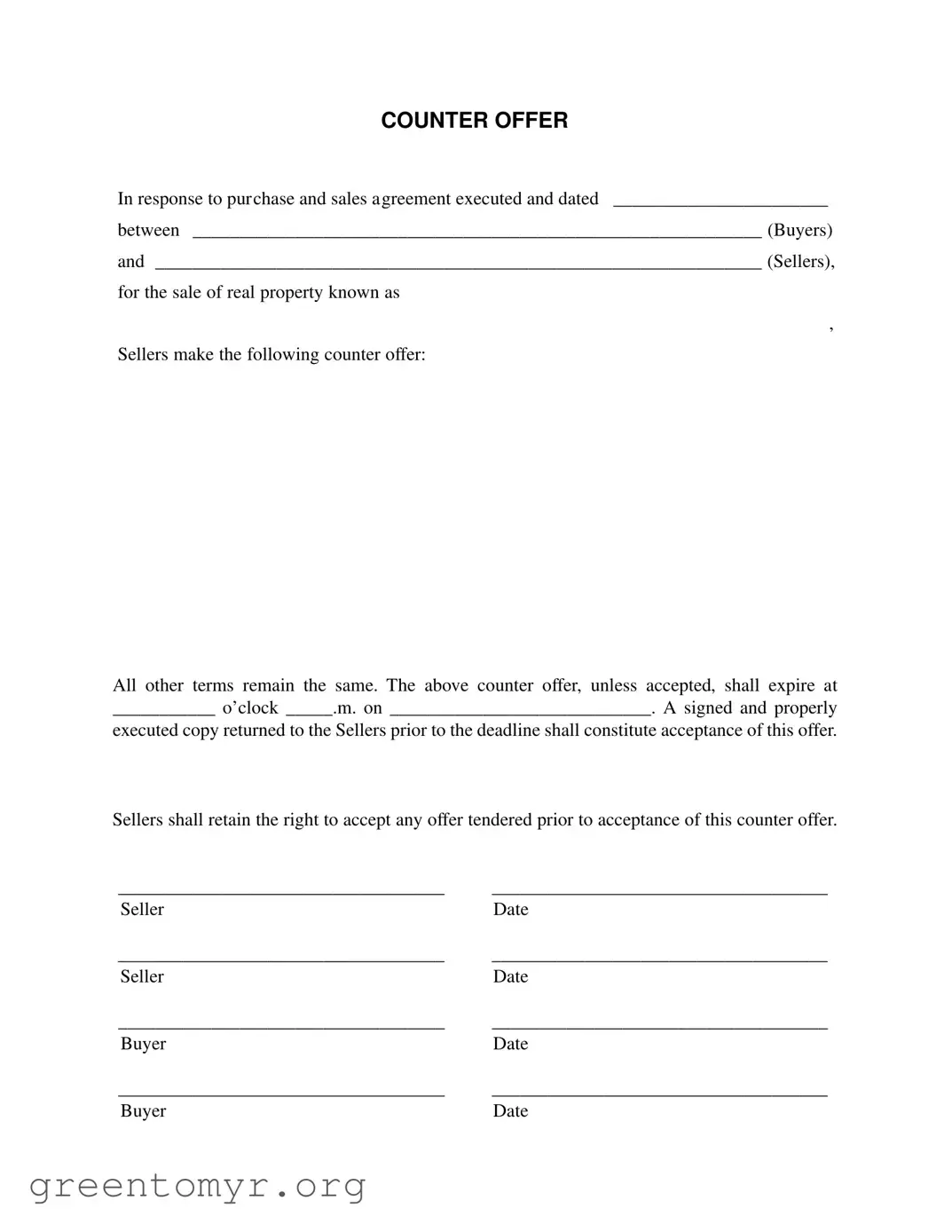
When navigating the world of real estate transactions, the Counter Offer form plays a crucial role in facilitating negotiations between buyers and sellers. This form is used when sellers wish to propose changes to the terms outlined in an initial purchase and sales agreement. It specifies the date of the original agreement, identifies the parties involved, and clearly states the seller's revised terms. Importantly, the counter offer maintains that all other conditions of the original agreement remain unchanged, ensuring that the negotiation process is streamlined. Additionally, the form includes a deadline for acceptance, emphasizing the time-sensitive nature of real estate deals. This deadline is critical, as it provides a clear timeframe for buyers to respond. Should the buyers agree to the new terms, a signed copy of the counter offer must be returned to the sellers before the specified expiration time. Notably, sellers retain the right to consider other offers that may come in before the acceptance of their counter offer, allowing them flexibility in their negotiations. By understanding the components of the Counter Offer form, both buyers and sellers can effectively communicate their intentions and work towards a mutually beneficial agreement.
COUNTER OFFER
In response to purchase and sales agreement executed and dated _______________________
between _____________________________________________________________ (Buyers)
and _________________________________________________________________ (Sellers),
for the sale of real property known as
,
Sellers make the following counter offer:
All other terms remain the same. The above counter offer, unless accepted, shall expire at
___________ o’clock _____.m. on ____________________________. A signed and properly
executed copy returned to the Sellers prior to the deadline shall constitute acceptance of this offer.
Sellers shall retain the right to accept any offer tendered prior to acceptance of this counter offer.
___________________________________ |
____________________________________ |
Seller |
Date |
___________________________________ |
____________________________________ |
Seller |
Date |
___________________________________ |
____________________________________ |
Buyer |
Date |
___________________________________ |
____________________________________ |
Buyer |
Date |
| Fact Name | Description |
|---|---|
| Purpose | The Counter Offer form is used by sellers to respond to a purchase and sales agreement, allowing them to propose different terms while keeping other conditions unchanged. |
| Expiration | The counter offer must include an expiration time, after which it is no longer valid unless accepted by the buyers. |
| Acceptance | A signed and properly executed copy of the counter offer must be returned to the sellers before the expiration time to constitute acceptance. |
| Governing Law | In states like California, the governing law for real estate transactions, including counter offers, is based on the California Civil Code. |
Once you have received a purchase and sales agreement, you may need to respond with a counter offer. This process allows you to propose different terms while keeping the original agreement intact. Follow these steps to fill out the Counter Offer form accurately.
A Counter Offer form is a document used in real estate transactions when one party (typically the seller) responds to an initial offer made by another party (typically the buyer). It outlines the terms that the seller is willing to accept, while also indicating that the original offer is no longer valid. This form is crucial for negotiating the sale of a property and ensures that all parties are clear on the terms being proposed.
You should use a Counter Offer form when you receive an offer on your property that you wish to modify rather than accept outright. This form allows you to specify changes to the price, closing date, contingencies, or any other terms of the sale. It is an essential tool for negotiating a deal that better meets your needs while still keeping the lines of communication open with the buyer.
The Counter Offer form requires several key pieces of information, including:
All parties involved must sign and date the form to ensure that the counter offer is legally binding once accepted.
The validity of a Counter Offer is determined by the expiration date and time specified in the document. If the buyer does not accept the counter offer by that deadline, the offer becomes void. It is important to communicate clearly and promptly to avoid any misunderstandings. Sellers retain the right to accept other offers that may come in before the counter offer is accepted.
If the buyer accepts the Counter Offer, they must sign and return the form to the seller before the expiration date. Once the signed Counter Offer is received by the seller, it becomes a binding agreement. At this point, both parties are expected to proceed with the transaction according to the terms outlined in the Counter Offer.
When filling out the Counter Offer form, one common mistake people make is forgetting to include the date of the original purchase and sales agreement. This date is crucial as it establishes the timeline for the transaction. Without it, the context of the counter offer may be unclear, leading to confusion for all parties involved. Always double-check that this information is accurately filled in to avoid potential disputes.
Another frequent error is neglecting to specify the property involved. The form includes a section for the property’s name or address, and leaving this blank can result in significant complications. If the property is not clearly identified, it can lead to misunderstandings about which property is being discussed. Always ensure that this detail is complete and precise.
Additionally, people often overlook the expiration time of the counter offer. The form clearly states that the offer will expire at a specific time, but many forget to fill in this critical detail. Without a defined expiration time, the offer may linger indefinitely, creating uncertainty for both buyers and sellers. It’s essential to set a clear deadline to keep the transaction moving smoothly.
Finally, signatures are sometimes missed. A counter offer is not valid without the necessary signatures from all parties involved. Each seller and buyer must sign the document for it to be legally binding. Failing to obtain these signatures can invalidate the entire counter offer, so it’s important to ensure that everyone has signed before submitting the form.
When dealing with real estate transactions, several important documents accompany the Counter Offer form. Each document plays a crucial role in ensuring clarity and legality in the negotiation process. Here’s a brief overview of some of these essential forms:
Understanding these documents can significantly enhance the negotiation process and lead to a smoother transaction. Each form serves a distinct purpose, helping to protect the interests of all parties involved.
The Counter Offer form shares similarities with several other documents commonly used in real estate transactions. Below is a list of these documents, each highlighting a specific aspect that aligns with the Counter Offer form.
When filling out the Counter Offer form, it's important to approach the task carefully. Here are five things you should and shouldn't do:
By following these guidelines, you can help ensure that your counter offer is clear and effective.
There are several misconceptions surrounding the Counter Offer form that can lead to confusion. Here are six common misunderstandings:
When filling out and using the Counter Offer form, keep the following key takeaways in mind: