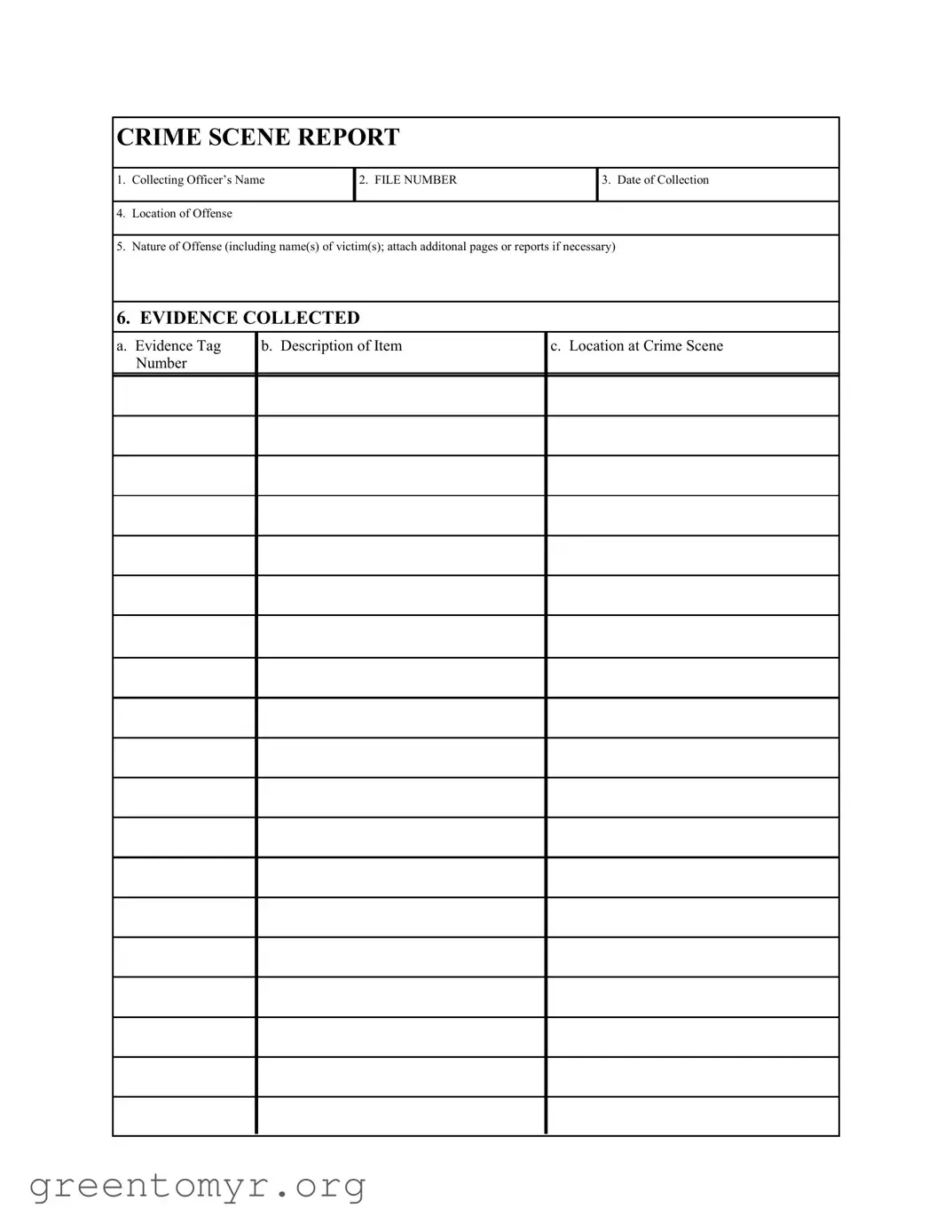
The Crime Scene Report form serves as a vital tool in the documentation of criminal investigations. It captures essential information that aids law enforcement in piecing together the events surrounding an offense. Key components of the form include the name of the collecting officer, which establishes accountability, and the file number that links the report to a specific case. The date of collection is crucial for maintaining an accurate timeline, while the location of the offense provides context for the investigation. Additionally, the nature of the offense is detailed, often including the names of victims and any pertinent information that may require further elaboration on additional pages. The section dedicated to evidence collected is particularly significant; it lists evidence tag numbers, descriptions of items, and their specific locations at the crime scene. This thorough documentation not only supports the investigation but also plays a critical role in any subsequent legal proceedings.

CRIME SCENE REPORT
1. Collecting Officer’s Name
2. FILE NUMBER
3. Date of Collection
4.Location of Offense
5.Nature of Offense (including name(s) of victim(s); attach additonal pages or reports if necessary)
6.EVIDENCE COLLECTED
a.Evidence Tag Number
b. Description of Item
c. Location at Crime Scene
| Fact Name | Description |
|---|---|
| Collecting Officer’s Name | This is the name of the officer responsible for collecting evidence at the crime scene. |
| File Number | A unique identifier assigned to the case for tracking and reference purposes. |
| Date of Collection | The specific date when the evidence was collected from the crime scene. |
| Location of Offense | The exact address or location where the crime took place, which is crucial for investigation. |
| Nature of Offense | This section describes the type of crime committed and includes the names of any victims involved. |
| Evidence Collected | This section details the items collected as evidence, which are critical to the investigation. |
| Evidence Tag Number | A specific number assigned to each piece of evidence for identification and tracking. |
| Description of Item | A brief description of each piece of evidence collected, providing context for its relevance. |
| Location at Crime Scene | This indicates where each piece of evidence was found within the crime scene, aiding in reconstruction. |
Completing the Crime Scene Report form is an essential step in documenting the details of an incident. Accurate and thorough information helps ensure that all aspects of the crime are recorded properly. Follow these steps to fill out the form correctly.
The Crime Scene Report form requires several key pieces of information to ensure a comprehensive account of the incident. Specifically, you need to provide:
Accurate completion of the Crime Scene Report is crucial for several reasons. First, it serves as an official record that can be referenced throughout the investigation and any subsequent legal proceedings. A well-documented report helps maintain the integrity of the evidence collected. Furthermore, inaccuracies or omissions can lead to misunderstandings or misinterpretations of the case, potentially affecting the outcome. Ensuring all details are correct supports the overall effectiveness of law enforcement and the judicial process.
If you find that you need more space to provide necessary details, it is perfectly acceptable to attach additional pages to the Crime Scene Report form. Be sure to clearly label these pages with relevant information, such as the file number and the specific section they correspond to. This practice ensures that all pertinent information is easily accessible and organized for review.
When collecting evidence at a crime scene, it is essential to follow proper procedures to maintain its integrity. Each piece of evidence should be carefully tagged and described on the form. You will need to record:
Accurate documentation at this stage is vital for ensuring the evidence is admissible in court.
The responsibility for completing the Crime Scene Report lies primarily with the collecting officer, who is usually the first responder to the scene. This officer is tasked with gathering all necessary information, documenting evidence, and ensuring that the report is thorough and accurate. However, it may also involve collaboration with other law enforcement personnel or forensic specialists, depending on the complexity of the case.
Once the Crime Scene Report is completed, it is submitted to the appropriate law enforcement agency for review and filing. The report becomes part of the official case file, which may be accessed by investigators, legal teams, and other authorized personnel throughout the course of the investigation and any ensuing legal proceedings. Maintaining a secure and organized filing system for these reports is essential for ongoing case management and for ensuring the integrity of the evidence collected.
Filling out the Crime Scene Report form accurately is crucial for documenting evidence and ensuring a thorough investigation. One common mistake is neglecting to provide the Collecting Officer’s Name. Without this information, it can be challenging to trace back to the individual responsible for the evidence collection.
Another frequent error involves omitting the FILE NUMBER. This number is essential for tracking the case and linking all related documents. If it’s missing, it can create confusion and hinder the investigative process.
Many individuals also forget to include the Date of Collection. This date is vital for establishing a timeline of events. If the date is inaccurate or missing, it can affect the credibility of the evidence presented in court.
Providing an incomplete or vague Location of Offense is another mistake. The exact location helps investigators and legal professionals understand the context of the crime. A precise address or description ensures that everyone is on the same page.
When detailing the Nature of Offense, people often fail to list the names of the victim(s). This omission can lead to misunderstandings about the case. Including this information not only clarifies the situation but also helps in tracking related incidents.
In the section for EVIDENCE COLLECTED, individuals sometimes forget to include the Evidence Tag Number. This number is crucial for cataloging evidence properly. Without it, tracking and referencing the evidence later becomes complicated.
Descriptions of items collected may be vague or insufficient. A clear and detailed Description of Item is essential. This detail helps investigators understand the significance of the evidence and its potential role in the case.
Lastly, neglecting to specify the Location at Crime Scene for each piece of evidence can lead to significant issues. Accurate documentation of where each item was found is critical for establishing its relevance and connection to the crime.
The Crime Scene Report form is a crucial document in the investigation of criminal activities. It serves as a primary record of the details surrounding a crime scene, including the collection of evidence and the identification of involved parties. Alongside this report, several other forms and documents are often utilized to ensure a comprehensive understanding of the incident. Below are four commonly used forms that complement the Crime Scene Report.
Each of these documents plays a significant role in the investigation process. Together, they create a fuller picture of the crime and aid law enforcement in their efforts to solve cases effectively.
The Crime Scene Report form shares similarities with several other documents used in law enforcement and legal contexts. Each of these documents serves a specific purpose in documenting incidents, collecting evidence, and ensuring accountability. Below is a list of documents that are similar to the Crime Scene Report form:
When filling out the Crime Scene Report form, it’s crucial to ensure accuracy and clarity. Here are some important dos and don'ts to keep in mind:
Following these guidelines will help maintain the integrity of the report and support any subsequent investigations.
Misconceptions about the Crime Scene Report form can lead to misunderstandings about its purpose and use. Here are eight common misconceptions:
When filling out and using the Crime Scene Report form, it is essential to ensure accuracy and thoroughness. Here are some key takeaways to keep in mind:
By following these guidelines, you can help ensure that the Crime Scene Report is comprehensive and useful for all parties involved.