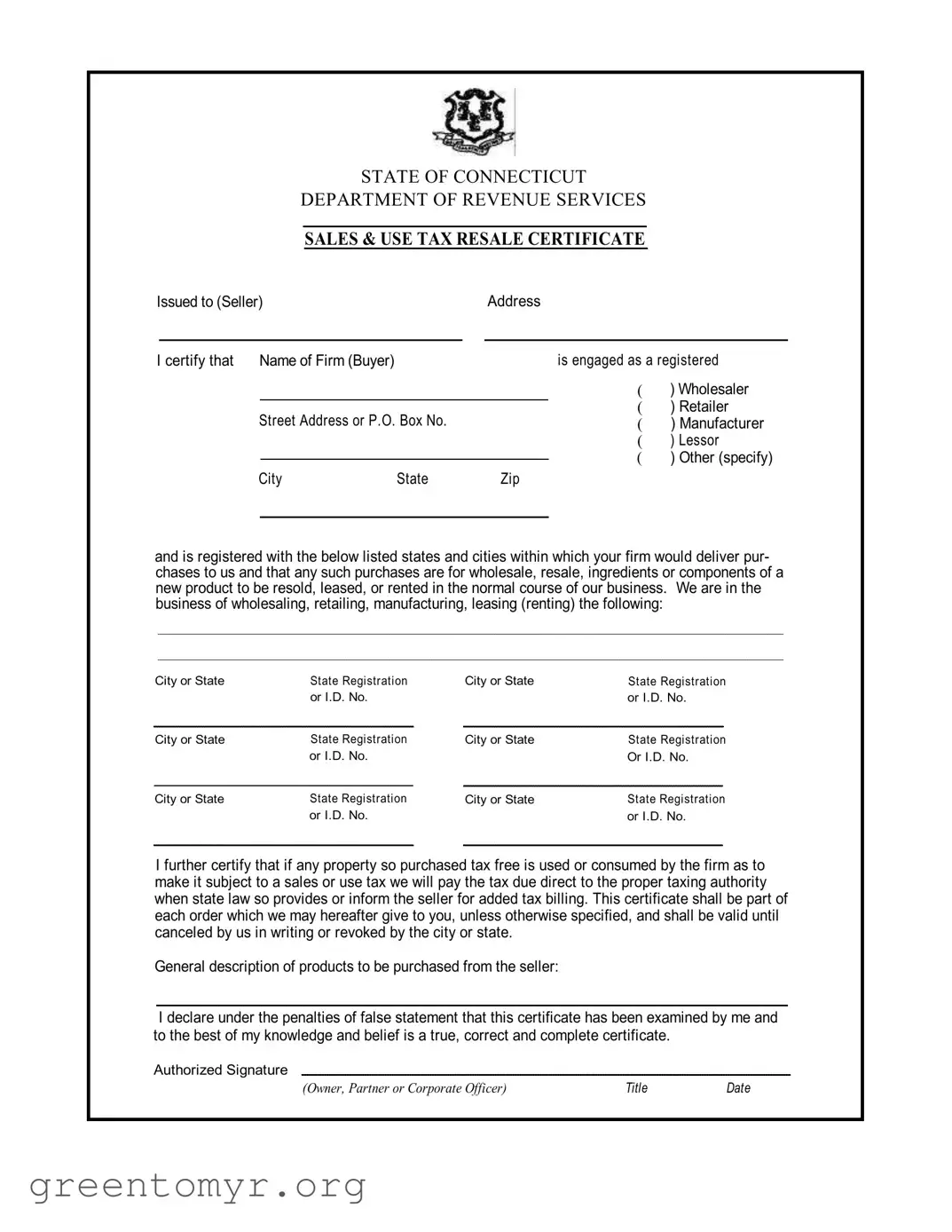
The Connecticut Resale Certificate form serves as an essential document for businesses engaged in wholesale, retail, manufacturing, or leasing activities. This form is issued by the Connecticut Department of Revenue Services and is designed to facilitate tax-exempt purchases of goods intended for resale. By completing the form, the buyer certifies their status as a registered wholesaler, retailer, manufacturer, lessor, or other specified entity. It includes vital information such as the seller's name and address, the buyer's firm name, and their respective state registration or identification numbers. Furthermore, the buyer affirms that the purchases made will be used solely for wholesale or resale purposes, ensuring compliance with state tax regulations. Should any of the purchased items be used in a manner that incurs sales or use tax, the buyer commits to paying the appropriate tax to the relevant taxing authority. The certificate remains valid for future transactions unless canceled or revoked in writing, providing a streamlined process for ongoing business relationships. Additionally, the buyer must provide a general description of the products they intend to purchase, reinforcing transparency and accountability in the transaction. This form ultimately protects both parties and fosters a clear understanding of tax obligations in the realm of commerce.
STATE OF CONNECTICUT
DEPARTMENT OF REVENUE SERVICES
SALES & USE TAX RESALE CERTIFICATE
Issued to (Seller) |
|
|
Address |
|
||||
|
|
|
|
|
|
|
|
|
I certify that |
Name of Firm (Buyer) |
|
|
|
is engaged as a registered |
|||
|
|
|
|
|
|
|
( |
) Wholesaler |
|
|
Street Address or P.O. Box No. |
( |
) Retailer |
||||
|
|
( |
) Manufacturer |
|||||
|
|
|
|
|
|
( |
) Lessor |
|
|
|
|
|
|
|
|
( |
) Other (specify) |
|
|
|
|
State |
|
|||
|
|
City |
Zip |
|
||||
|
|
|
|
|
|
|
|
|
and is registered with the below listed states and cities within which your firm would deliver pur- chases to us and that any such purchases are for wholesale, resale, ingredients or components of a new product to be resold, leased, or rented in the normal course of our business. We are in the business of wholesaling, retailing, manufacturing, leasing (renting) the following:
City or State |
State Registration |
|
or I.D. No. |
City or State |
State Registration |
|
or I.D. No. |
City or State |
State Registration |
|
or I.D. No. |
City or State |
State Registration |
|
or I.D. No. |
City or State |
State Registration |
|
Or I.D. No. |
City or State |
State Registration |
|
or I.D. No. |
I further certify that if any property so purchased tax free is used or consumed by the firm as to make it subject to a sales or use tax we will pay the tax due direct to the proper taxing authority when state law so provides or inform the seller for added tax billing. This certificate shall be part of each order which we may hereafter give to you, unless otherwise specified, and shall be valid until canceled by us in writing or revoked by the city or state.
General description of products to be purchased from the seller:
I declare under the penalties of false statement that this certificate has been examined by me and to the best of my knowledge and belief is a true, correct and complete certificate.
Authorized Signature
(Owner, Partner or Corporate Officer) |
TITLE |
DATE |
| Fact Name | Description |
|---|---|
| Purpose | The Connecticut Resale Certificate allows businesses to purchase items tax-free for resale, rental, or leasing purposes. |
| Eligibility | Only registered wholesalers, retailers, manufacturers, and lessors can use this certificate to make tax-exempt purchases. |
| Governing Law | This form is governed by the Connecticut General Statutes, specifically Section 12-410(5). |
| Validity | The certificate remains valid until canceled in writing by the buyer or revoked by the state or city. |
| Use of Property | If property purchased tax-free is used for non-resale purposes, the buyer must pay the applicable sales or use tax. |
| Signature Requirement | An authorized signature from an owner, partner, or corporate officer is required to validate the certificate. |
After gathering the necessary information, proceed to complete the Ct Resale Certificate form. Ensure all fields are accurately filled out to avoid any issues with tax compliance. This certificate will serve as documentation for your purchases and must be kept on file by the seller.
The Connecticut Resale Certificate is a form used by businesses to purchase goods without paying sales tax. This certificate allows registered wholesalers, retailers, manufacturers, and lessors to buy items intended for resale, lease, or rental in the normal course of their business.
Only businesses that are registered in Connecticut and have a valid sales tax registration can use this certificate. This includes:
To fill out the certificate, you need to provide the following information:
No, the Resale Certificate remains valid until you cancel it in writing or it is revoked by the state or city. However, always ensure that the information is up to date.
If you use the certificate to purchase items that you do not intend to resell, you may be subject to penalties. This includes paying the sales tax owed and potential fines for false statements.
The Connecticut Resale Certificate is specifically for use within Connecticut. If you are purchasing items in another state, you must follow that state’s regulations and may need to use their resale certificate.
If you lose your certificate, you can fill out a new one. Make sure to inform your suppliers that you are issuing a new certificate to avoid any confusion regarding tax exemptions.
Yes, the Connecticut Department of Revenue Services provides a specific format for the Resale Certificate. It is important to use this format to ensure that all required information is included and to avoid any issues with tax compliance.
You can obtain a copy of the Connecticut Resale Certificate from the Connecticut Department of Revenue Services website or through your business’s tax advisor. It's also advisable to keep a few copies on hand for future purchases.
When filling out the Connecticut Resale Certificate form, individuals often make several common mistakes that can lead to complications. One frequent error is leaving out essential information. It is crucial to provide complete details, including the name of the buyer's firm, address, and the specific type of business. Omitting any of this information can result in the certificate being deemed invalid.
Another common mistake involves incorrectly identifying the type of business. The form requires the buyer to select one or more categories, such as wholesaler, retailer, manufacturer, or lessor. Failing to accurately indicate the correct category can create confusion and lead to tax issues later on.
In addition, some individuals neglect to list all relevant state registrations or identification numbers. The form allows for multiple entries, and it is important to include all states where the business is registered. Missing this information could cause problems with compliance and verification.
People also sometimes forget to provide a general description of the products they intend to purchase. This section is vital, as it clarifies the nature of the transaction. Without a clear description, the seller may be unsure about the legitimacy of the resale certificate.
Another mistake is failing to sign the form. The authorized signature is a critical component of the certificate. Without it, the document lacks authenticity and cannot be accepted. It is essential to ensure that the signature is provided by an owner, partner, or corporate officer.
Moreover, individuals may overlook the importance of keeping a copy of the completed certificate. Retaining a copy is crucial for record-keeping purposes and can help resolve any disputes that may arise in the future.
Lastly, some buyers do not understand that the resale certificate is valid until it is canceled or revoked. It is important to communicate any changes in status or business operations to the seller to avoid any misunderstandings regarding tax responsibilities.
The Connecticut Resale Certificate form is an essential document for businesses engaged in wholesale or retail activities. It certifies that the buyer is purchasing goods for resale rather than for personal use. In addition to this form, several other documents are often used in conjunction to ensure compliance with state regulations and facilitate smooth transactions. Below is a list of these related documents.
Understanding these documents can help streamline business operations and ensure compliance with tax regulations. Each form plays a specific role in the purchasing and sales process, contributing to effective record-keeping and legal adherence.
The Connecticut Resale Certificate form serves a specific purpose in sales tax exemptions. Several other documents share similarities with it, primarily in their function of certifying tax-exempt transactions. Here are eight such documents:
When filling out the Connecticut Resale Certificate form, it is important to follow certain guidelines to ensure accuracy and compliance. Below is a list of things you should and shouldn't do.
Understanding the Connecticut Resale Certificate can be crucial for businesses engaged in wholesale, retail, or manufacturing. However, several misconceptions often arise regarding its use and implications. Below are some common misunderstandings:
Many believe that only wholesalers can use the Connecticut Resale Certificate. In reality, retailers, manufacturers, and lessors can also utilize this form. Any business that purchases goods for resale, leasing, or rental purposes may qualify.
It is a common belief that presenting a resale certificate eliminates sales tax on all purchases. However, the certificate only applies to items intended for resale or use in creating a new product. If a business uses the purchased items for other purposes, sales tax must be paid.
Some individuals think that once a resale certificate is issued, it remains valid forever. This is not the case. The certificate must be canceled in writing by the buyer or revoked by the state or city to be considered invalid.
Another misconception is that sellers can simply accept a resale certificate without any due diligence. Sellers should verify the legitimacy of the certificate and ensure it is being used correctly. Failure to do so may result in liability for unpaid sales taxes.
Being informed about these misconceptions can help businesses navigate their responsibilities and ensure compliance with state tax laws. Understanding the correct use of the Connecticut Resale Certificate fosters better relationships between buyers and sellers while promoting transparency in transactions.
When filling out and using the Connecticut Resale Certificate form, keep these key takeaways in mind:
By following these guidelines, you can ensure a smoother process when using the Connecticut Resale Certificate.