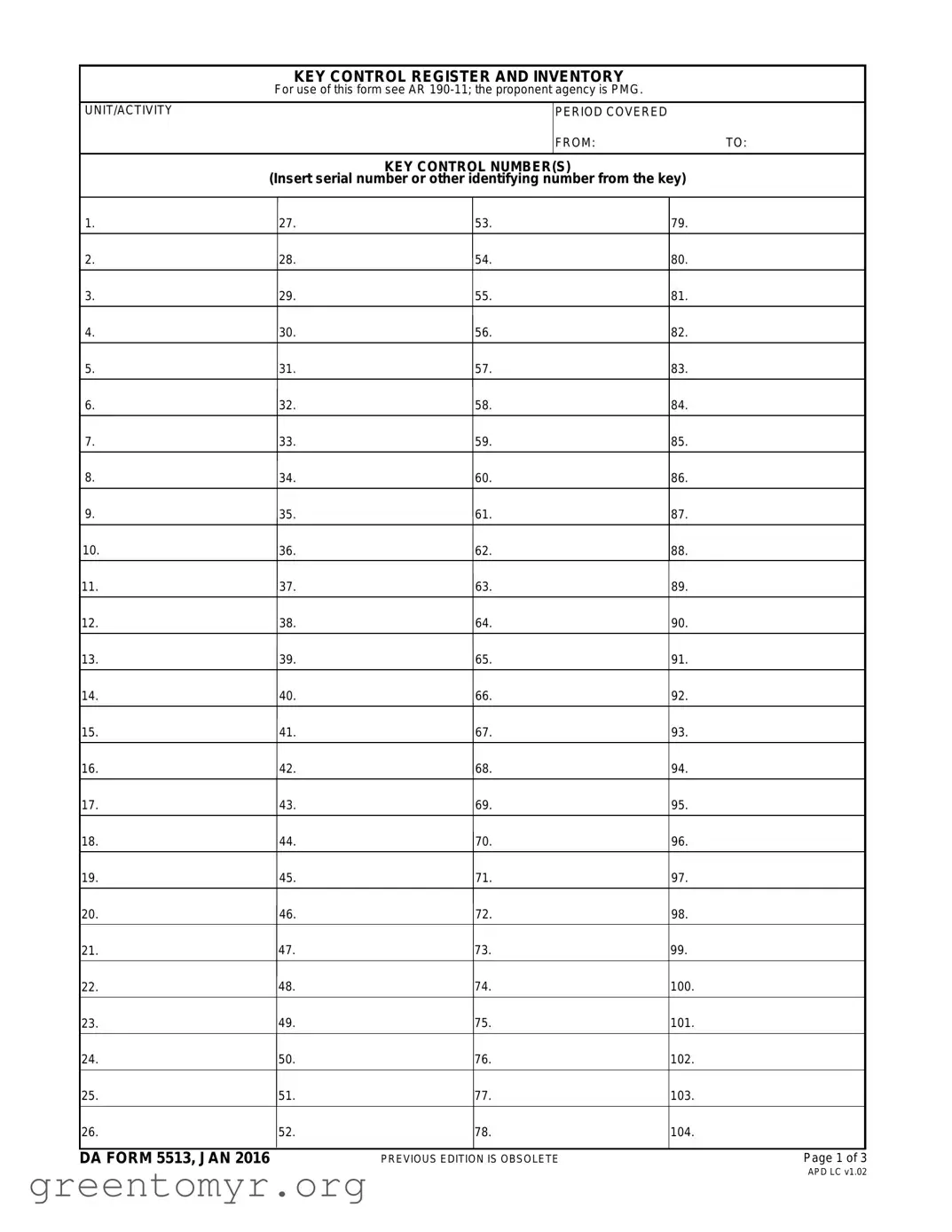
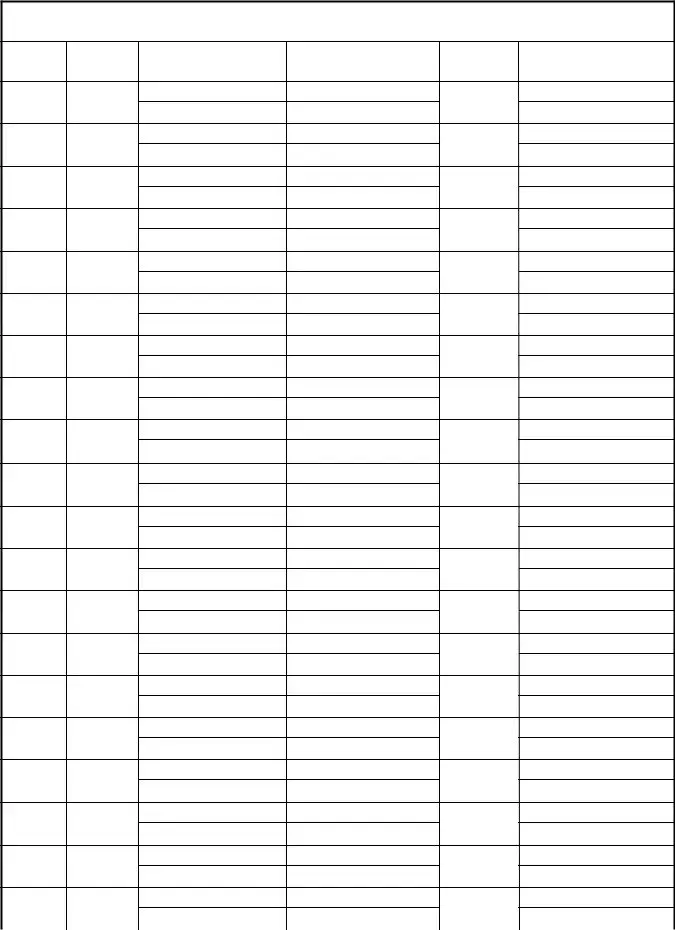
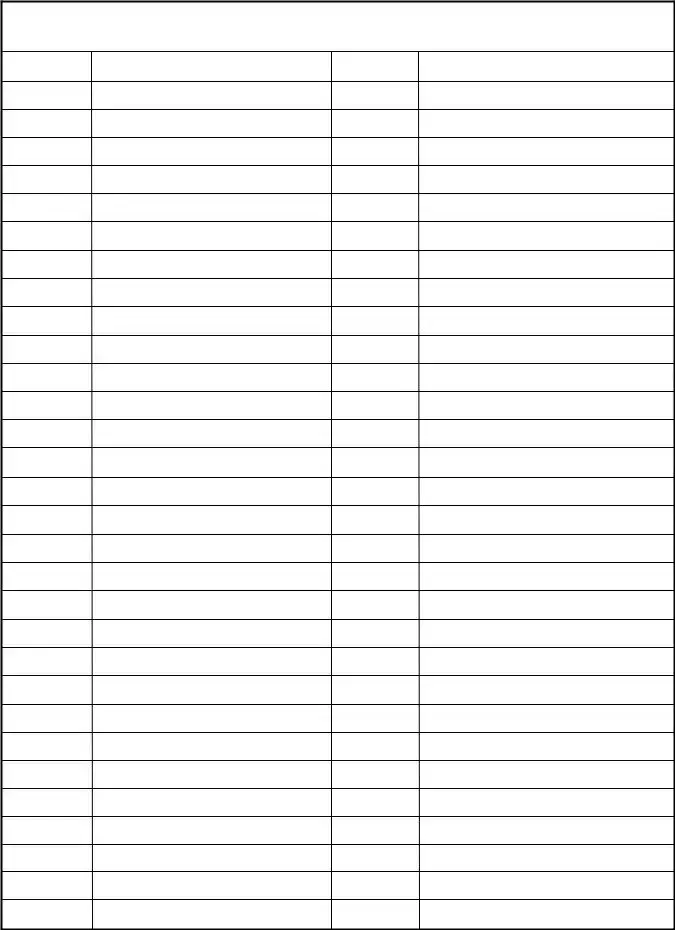
The DA Form 5513 serves as an essential tool for managing key control within military units and activities. This form is designed to track the issuance and return of keys, ensuring accountability and security in various settings. It includes sections for recording key control numbers, which are vital for identifying each key accurately. Users fill in details such as the period covered, the names of individuals who issue and receive keys, and the dates and times of these transactions. Additionally, the form contains a section for conducting joint or semiannual inventories, further enhancing the oversight of key management. By maintaining detailed records on this form, military personnel can uphold safety and organization, which are crucial in maintaining operational integrity.

|
|
KEY CONTROL REGISTER AND INVENTORY |
|
||
|
For use of this form see AR |
|
|||
UNIT/ACTIVITY |
|
|
|
PERIOD COVERED |
|
|
|
|
|
FROM: |
TO: |
|
|
|
KEY CONTROL NUMBER(S) |
|
|
(Insert serial number or other identifying number from the key) |
|||||
|
|
|
|
|
|
1. |
27. |
53. |
|
79. |
|
|
|
|
|
|
|
2. |
28. |
54. |
|
80. |
|
3. |
29. |
55. |
|
81. |
|
4. |
30. |
56. |
|
82. |
|
5. |
31. |
57. |
|
83. |
|
|
|
|
|
|
|
6. |
32. |
58. |
|
84. |
|
|
|
|
|
|
|
7. |
33. |
59. |
|
85. |
|
8. |
34. |
60. |
|
86. |
|
9. |
35. |
61. |
|
87. |
|
10. |
36. |
62. |
|
88. |
|
11. |
|
37. |
63. |
|
89. |
12. |
|
38. |
64. |
|
90. |
13. |
|
39. |
65. |
|
91. |
14. |
|
40. |
66. |
|
92. |
15. |
|
41. |
67. |
|
93. |
16. |
|
42. |
68. |
|
94. |
17. |
|
43. |
69. |
|
95. |
18. |
|
44. |
70. |
|
96. |
19. |
|
45. |
71. |
|
97. |
20. |
|
46. |
72. |
|
98. |
21. |
47. |
73. |
|
99. |
|
22. |
48. |
74. |
|
100. |
|
23. |
49. |
75. |
|
101. |
|
24. |
50. |
76. |
|
102. |
|
25. |
51. |
77. |
|
103. |
|
|
|
|
|
|
|
26. |
52. |
78. |
|
104. |
|
|
|
|
|
|
|
DA FORM 5513, JAN 2016 |
|
|
PREVIOUS EDITION IS OBSOLETE |
Page 1 of 3 |
|
APD LC v1.02
KEY ISSUE AND TURN IN
(Continued)
KEY
NUMBER
ISSUED
(Date/Time)
ISSUED BY
(Printed Name/Signature)
ISSUED TO
(Printed Name/Signature)
TURNED IN |
RECEIVED BY |
(Date/Time) |
(Printed Name/Signature) |
DA FORM 5513, JAN 2016 |
PREVIOUS EDITION IS OBSOLETE |
Page 2 of 3 |
APD LC v1.02
INVENTORIES (JOINT/SEMIANNUAL)
DATE |
PRINTED NAME/SIGNATURE |
DATE |
PRINTED NAME/SIGNATURE |
DA FORM 5513, JAN 2016 |
PREVIOUS EDITION IS OBSOLETE |
Page 3 of 3 |
APD LC v1.02
| Fact Name | Description |
|---|---|
| Purpose | The DA 5513 form is used to maintain a record of key control and inventory management within military units. |
| Governing Law | This form is governed by AR 190-11, which outlines the policies for physical security and key control. |
| Usage Frequency | The form is typically utilized for joint or semiannual inventories to ensure accountability of issued keys. |
| Version Information | The current version of the DA 5513 form was issued in January 2016. Previous editions are considered obsolete. |
Filling out the DA 5513 form is essential for maintaining accurate key control and inventory records. Follow these steps carefully to ensure all required information is correctly provided.
The DA 5513 form is a Key Control Register and Inventory document used by military units and activities. Its primary purpose is to track the issuance and return of keys within an organization, ensuring proper accountability and security of facilities and equipment.
The responsibility for using the DA 5513 form typically falls on unit leaders and personnel tasked with key control. These individuals must ensure that the form is accurately filled out and maintained to reflect the current status of key issuance and returns.
To fill out the DA 5513 form, follow these steps:
The DA 5513 form requires several key pieces of information:
The DA 5513 form should be updated each time a key is issued or returned. Additionally, it is advisable to conduct joint or semiannual inventories to ensure all keys are accounted for and to identify any discrepancies in key control.
If keys are lost or not returned, it is crucial to report the incident immediately. The unit must follow its established protocols for handling lost keys, which may include changing locks or conducting an investigation to determine the circumstances surrounding the loss. Accountability measures should be enforced to prevent future occurrences.
Yes, the DA 5513 form should be retained in accordance with military records retention policies. Typically, it is advisable to keep these records for a minimum of three years, or as directed by your unit's regulations. This ensures that there is a historical record of key control activities.
While the DA 5513 form is specifically designed for military use, the principles of key control and inventory management can be adapted for non-military organizations. However, non-military entities may need to create a customized version of the form to suit their specific needs and compliance requirements.
Completing the DA 5513 form accurately is crucial for effective key control and inventory management. However, many individuals make common mistakes that can lead to confusion and errors in record-keeping. Understanding these pitfalls can help ensure a smoother process.
One frequent error is failing to include all required key control numbers. Each serial number or identifying number must be clearly listed. Omitting even one can create gaps in inventory tracking, which could lead to security issues.
Another mistake is incomplete signatures. Both the person issuing the keys and the individual receiving them must sign the form. Missing signatures can raise questions about accountability and responsibility.
People often overlook the importance of accurate date and time entries. Each key issue and return must be documented with precise dates and times. Inaccuracies can lead to discrepancies in inventory records.
Additionally, some individuals fail to double-check their entries before submitting the form. Simple typos or incorrect information can lead to significant problems down the line. Always review the form for accuracy.
Another common issue is not using the correct version of the form. Ensure that you are using the latest version, as outdated forms may not be accepted. Always verify the date of the form you are filling out.
Many people also neglect to keep a copy of the completed form for their records. Retaining a copy is essential for tracking and reference purposes. This can save time and effort if any questions arise later.
Some users mistakenly assume that all entries are self-explanatory. It's essential to provide clear and concise information in each section. Ambiguities can lead to misunderstandings regarding key control.
Moreover, failing to follow proper inventory procedures can lead to inconsistencies. Ensure that all joint or semiannual inventories are conducted according to established guidelines to maintain accuracy.
Another oversight is not training personnel on how to fill out the form correctly. Providing proper training can reduce errors and promote accountability among team members.
Lastly, some individuals may rush through the process, leading to hasty mistakes. Take the time to complete the form thoroughly. A careful approach can prevent many issues from arising in the future.
The DA 5513 form is utilized for key control and inventory management within military units. It serves as a record for issuing and returning keys, ensuring accountability and security. Several other forms and documents may accompany the DA 5513 to facilitate various processes related to key management and security operations. Below is a list of commonly used forms and documents that may be relevant.
These forms and documents play a crucial role in maintaining security and accountability within military operations. Proper use of the DA 5513, along with the associated documents, helps ensure that all key management processes are handled efficiently and effectively.
The DA Form 5513 is a key control register and inventory form used to track key issuance and returns. Several other forms serve similar purposes in managing inventory and accountability. Here’s a list of nine documents that are comparable to the DA Form 5513:
When filling out the DA 5513 form, it is essential to follow specific guidelines to ensure accuracy and compliance. Below is a list of things you should and shouldn't do:
This form is used by various units and activities, not just military personnel. It serves as a key control register and inventory tool for any organization that requires key management.
While it is crucial for audits, the DA 5513 should be maintained regularly. Keeping accurate records helps ensure accountability and security of keys at all times.
In reality, this form must be updated whenever keys are issued or returned. Regular updates are essential for maintaining accurate records.
This form is not a one-time use document. It is an ongoing record that should be utilized throughout the key management process.
Multiple individuals can be assigned responsibility for different keys. The form allows for tracking who has been issued specific keys, enhancing accountability.
Even if keys are secure, using the DA 5513 form is important for tracking and managing key access. It helps prevent unauthorized access and ensures that all keys are accounted for.
When it comes to the DA 5513 form, there are several important points to keep in mind. This form is essential for maintaining control over keys within a unit or activity. Here are some key takeaways:
By keeping these points in mind, you can effectively manage key control and maintain security within your unit or activity.