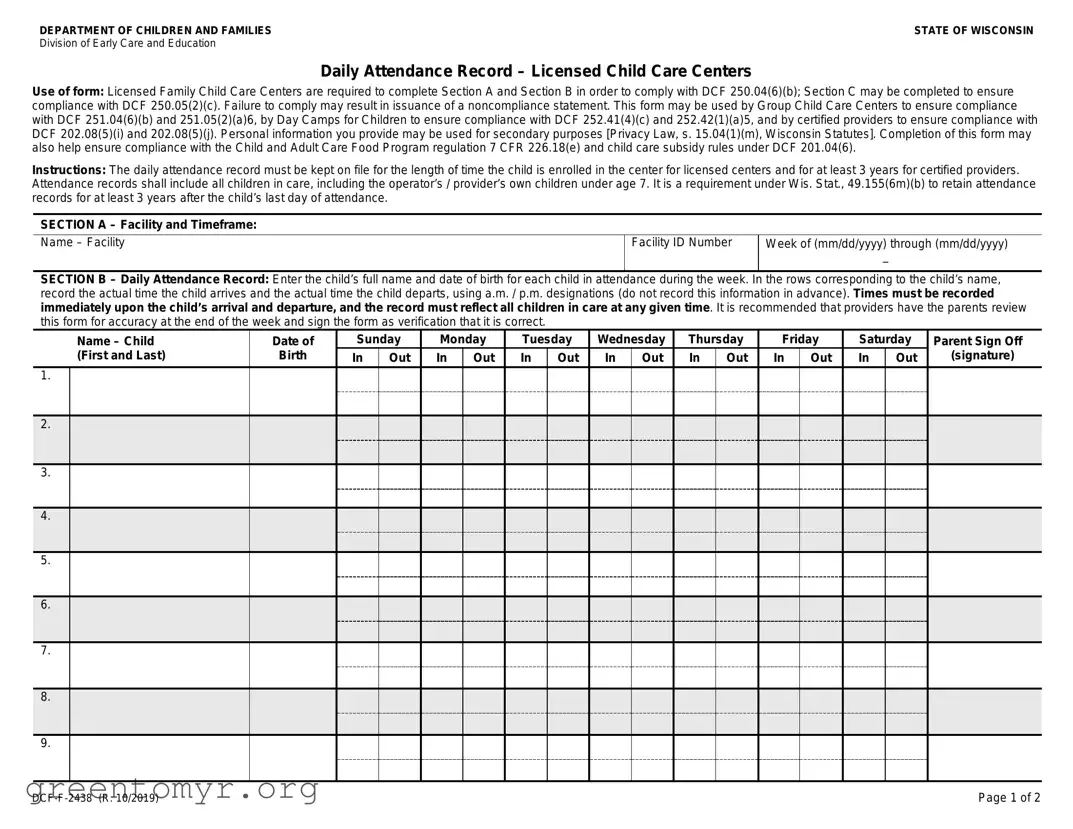
The Daily Attendance Record form is an essential tool for licensed child care centers in Wisconsin, ensuring compliance with various state regulations and standards. This form is divided into several sections, each designed to capture critical information about the children in care and the staff providing that care. Sections A and B require detailed entries, including the facility name, ID number, and the specific week for which attendance is being recorded. Providers must document the full names and dates of birth of each child attending, along with their arrival and departure times, recorded in real-time. This meticulous record-keeping is not just a best practice; it is mandated by state law to ensure accountability and safety. Section C allows for the documentation of staff schedules, detailing the names and positions of all providers present during the week. The form also emphasizes the importance of parental verification, encouraging parents to review and sign the attendance records weekly. Retaining these records is crucial, as they must be kept for the duration of the child's enrollment and for at least three years after their last day. Overall, the Daily Attendance Record form serves not only as a compliance tool but also as a safeguard for the well-being of children in care.
DEPARTMENT OF CHILDREN AND FAMILIES |
STATE OF WISCONSIN |
Division of Early Care and Education
Daily Attendance Record – Licensed Child Care Centers
Use of form: Licensed Family Child Care Centers are required to complete Section A and Section B in order to comply with DCF 250.04(6)(b); Section C may be completed to ensure compliance with DCF 250.05(2)(c). Failure to comply may result in issuance of a noncompliance statement. This form may be used by Group Child Care Centers to ensure compliance with DCF 251.04(6)(b) and 251.05(2)(a)6, by Day Camps for Children to ensure compliance with DCF 252.41(4)(c) and 252.42(1)(a)5, and by certified providers to ensure compliance with DCF 202.08(5)(i) and 202.08(5)(j). Personal information you provide may be used for secondary purposes [Privacy Law, s. 15.04(1)(m), Wisconsin Statutes]. Completion of this form may also help ensure compliance with the Child and Adult Care Food Program regulation 7 CFR 226.18(e) and child care subsidy rules under DCF 201.04(6).
Instructions: The daily attendance record must be kept on file for the length of time the child is enrolled in the center for licensed centers and for at least 3 years for certified providers. Attendance records shall include all children in care, including the operator’s / provider’s own children under age 7. It is a requirement under Wis. Stat., 49.155(6m)(b) to retain attendance records for at least 3 years after the child’s last day of attendance.
SECTION A – Facility and Timeframe: |
|
|
Name – Facility |
Facility ID Number |
Week of (mm/dd/yyyy) through (mm/dd/yyyy) |
|
|
– |
SECTION B – Daily Attendance Record: Enter the child’s full name and date of birth for each child in attendance during the week. In the rows corresponding to the child’s name, |
||
record the actual time the child arrives and the actual time the child departs, using a.m. / p.m. designations (do not record this information in advance). Times must be recorded immediately upon the child’s arrival and departure, and the record must reflect all children in care at any given time. It is recommended that providers have the parents review this form for accuracy at the end of the week and sign the form as verification that it is correct.
Name – Child |
Date of |
Sunday |
Monday |
Tuesday |
Wednesday |
Thursday |
Friday |
Saturday |
Parent Sign Off |
|||||||
(First and Last) |
Birth |
In |
Out |
In |
Out |
In |
Out |
In |
Out |
In |
Out |
In |
Out |
In |
Out |
(signature) |
1.
2. |
3. |
4. |
5. |
6. |
7. |
8. |
9. |
Page 1 of 2 |
DEPARTMENT OF CHILDREN AND FAMILIES |
STATE OF WISCONSIN |
Division of Early Care and Education
SECTION B – Daily Attendance Record (continued): Enter the child’s full name and date of birth for each child in attendance during the week. In the rows corresponding to the child’s name, record the actual time the child arrives and the actual time the child departs, using a.m. / p.m. designations (do not record this information in advance). Times must be recorded immediately upon the child’s arrival and departure, and the record must reflect all children in care at any given time. It is recommended that providers have the parents review
this form for accuracy at the end of the week and sign the form as verification that it is correct. |
|
|
|
|
|
|
|
|
|
|
|||||||
Name – Child |
|
Sunday |
Monday |
Tuesday |
Wednesday |
Thursday |
Friday |
Saturday |
Parent Sign |
||||||||
Date of Birth |
|
|
|
|
|
|
|
|
|
|
|
|
|
|
Off |
||
In |
Out |
In |
Out |
In |
Out |
In |
Out |
In |
Out |
In |
Out |
In |
Out |
||||
(First and Last) |
|||||||||||||||||
|
(signature) |
||||||||||||||||
|
|
|
|
|
|
|
|
|
|
|
|
|
|
|
|
||
10. |
11. |
12. |
13. |
14. |
15. |
Total Daily Attendance
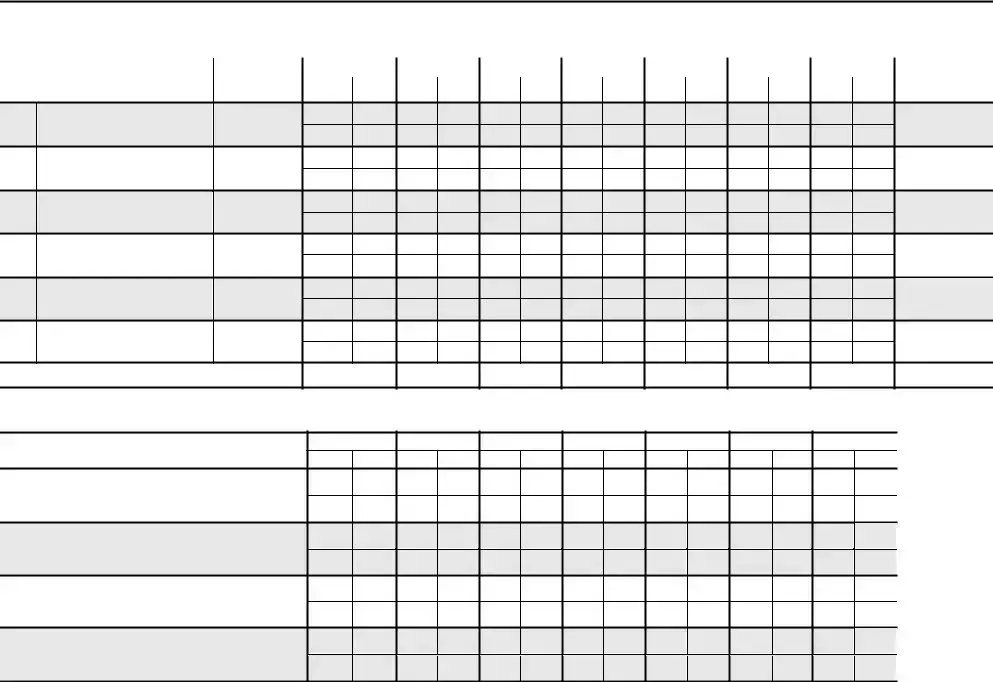
SECTION C – Provider Schedule: Enter full name and position title for each provider, additional provider, substitute or emergency backup provider who worked with the children during the week. In the rows corresponding to the provider’s name, record the actual times the provider, additional provider, substitute, or emergency backup provider was counted in
Provider Name and Position Title
Provider A:
Sunday
In Out
Monday |
Tuesday |
Wednesday |
Thursday |
Friday |
Saturday |
||||||
In |
Out |
In |
Out |
In |
Out |
In |
Out |
In |
Out |
In |
Out |
Provider B:
Provider C:
Provider D:
Page 2 of 2 |
| Fact Name | Details |
|---|---|
| Purpose of the Form | The Daily Attendance Record form is essential for licensed child care centers to track attendance and ensure compliance with state regulations. |
| Governing Laws | This form complies with DCF 250.04(6)(b) and DCF 250.05(2)(c) for Family Child Care Centers and various other regulations for different types of child care facilities. |
| Retention Requirements | Attendance records must be kept for the duration of a child's enrollment and for at least three years after their last day, as mandated by Wis. Stat. 49.155(6m)(b). |
| Information Recorded | Providers must record each child's full name, date of birth, arrival and departure times daily, ensuring accurate tracking of attendance. |
| Parental Verification | It is recommended that parents review and sign the form weekly to confirm the accuracy of the attendance records. |
| Secondary Use of Information | Personal information collected on this form may be used for secondary purposes in accordance with Privacy Law, s. 15.04(1)(m), Wisconsin Statutes. |
Completing the Daily Attendance Record form is essential for maintaining accurate attendance data for children in care. After filling out the form, it should be kept on file for the required duration to ensure compliance with regulations. Parents may need to review and sign the form at the end of the week to confirm its accuracy.
The Daily Attendance Record form is designed for licensed child care centers in Wisconsin to document the attendance of children. It ensures compliance with various regulations set forth by the Department of Children and Families (DCF). By maintaining accurate records, facilities can avoid noncompliance issues and ensure they are following state guidelines.
Licensed Family Child Care Centers must complete Sections A and B of the form. Group Child Care Centers, Day Camps for Children, and certified providers also use this form to meet specific compliance requirements. This includes documenting attendance accurately for all children in care, which includes the provider's own children under age 7.
Section B of the form requires the full name and date of birth of each child in attendance. Providers must record the actual arrival and departure times for each child using a.m. and p.m. designations. It is crucial to fill this information out immediately upon the child's arrival and departure to ensure accuracy.
Attendance records must be retained for the duration of a child's enrollment in the center for licensed facilities. For certified providers, records should be kept for at least three years after the child's last day of attendance. This retention period is mandated by Wisconsin law.
It is recommended that providers have parents review the Daily Attendance Record for accuracy at the end of each week. Parents should sign the form to verify that the recorded information is correct. This practice helps maintain transparency and accountability.
Section C is designated for documenting the schedule of providers, including any additional, substitute, or emergency backup providers who worked with the children during the week. Providers should record the actual times these individuals were present, which is important for maintaining appropriate staff-to-child ratios.
If a facility does not comply with the attendance record requirements, it may receive a noncompliance statement from the DCF. This can lead to further scrutiny or penalties, making it essential for child care centers to adhere strictly to the documentation guidelines.
Yes, the personal information provided on the Daily Attendance Record may be used for secondary purposes as permitted under Wisconsin's Privacy Law. This means that while the primary purpose is to document attendance, the information could potentially be utilized in other contexts as outlined by state regulations.
Providers who have questions regarding the Daily Attendance Record form should consult the DCF guidelines or reach out to their licensing representative for clarification. It is important to ensure that all aspects of the form are understood to maintain compliance with state regulations.
Completing the Daily Attendance Record form accurately is crucial for compliance with state regulations. However, many individuals make common mistakes that can lead to complications. One frequent error is failing to enter the child's full name and date of birth. Without this information, it becomes difficult to verify attendance and maintain accurate records. Each child's details must be complete to ensure compliance with the regulations set forth by the Department of Children and Families.
Another mistake involves recording arrival and departure times incorrectly. Some individuals may record these times in advance or fail to note them immediately upon the child's arrival and departure. This practice can result in inaccurate records, which could lead to noncompliance statements. It is essential to use the correct a.m. and p.m. designations and to ensure that times reflect actual attendance.
Additionally, neglecting to include all children in care is a common oversight. The form requires documentation of every child present, including the operator’s or provider’s own children under age 7. Failing to account for all children can lead to significant issues with compliance and may result in penalties. It is vital to double-check that every child is listed in the attendance record.
Finally, many providers overlook the importance of having parents review and sign the form at the end of the week. This verification step is crucial for ensuring the accuracy of the records. Without a parent’s signature, the attendance record lacks confirmation, which may lead to questions about its validity. Therefore, providers should make it a routine practice to involve parents in the review process to avoid potential issues down the line.
When managing a licensed child care center, several forms and documents complement the Daily Attendance Record. These documents help ensure compliance with regulations and maintain organized records. Below is a list of common forms that may be used alongside the Daily Attendance Record.
Having these forms readily available and properly filled out can greatly enhance the operation of a child care center. They support compliance with regulations and foster effective communication with parents, ultimately contributing to a safe and nurturing environment for children.
The Daily Attendance Record form shares similarities with several other documents used in child care settings. Each of these documents serves a specific purpose related to attendance, compliance, or child care operations. Below is a list of nine documents that are comparable to the Daily Attendance Record form:
When filling out the Daily Attendance Record form, it is essential to adhere to specific guidelines to ensure accuracy and compliance. Below is a list of ten recommendations regarding what to do and what to avoid.
By following these guidelines, individuals can help ensure that the Daily Attendance Record is completed correctly and in accordance with the regulations set forth by the Department of Children and Families in Wisconsin.
Understanding the Daily Attendance Record form is crucial for compliance and effective record-keeping in child care settings. However, several misconceptions often arise regarding its use and requirements. Here are five common misunderstandings:
While licensed family child care centers are required to complete the form, it is also applicable to group child care centers, day camps, and certified providers. Each of these entities must adhere to specific regulations that necessitate accurate attendance records.
This is incorrect. The form must capture the actual times of arrival and departure. Recording times in advance undermines the accuracy of the data and can lead to compliance issues.
In fact, all children in care, including the operator’s own children under age 7, must be included in the attendance record. This ensures comprehensive tracking and compliance with regulations.
It is recommended that parents review and sign the form at the end of each week. This verification adds an extra layer of accuracy and accountability to the record-keeping process.
On the contrary, attendance records must be retained for at least three years after a child's last day of attendance. This retention is mandated by Wisconsin law to ensure proper documentation and compliance.
Understanding how to fill out and utilize the Daily Attendance Record form is crucial for compliance with state regulations. Here are some key takeaways: