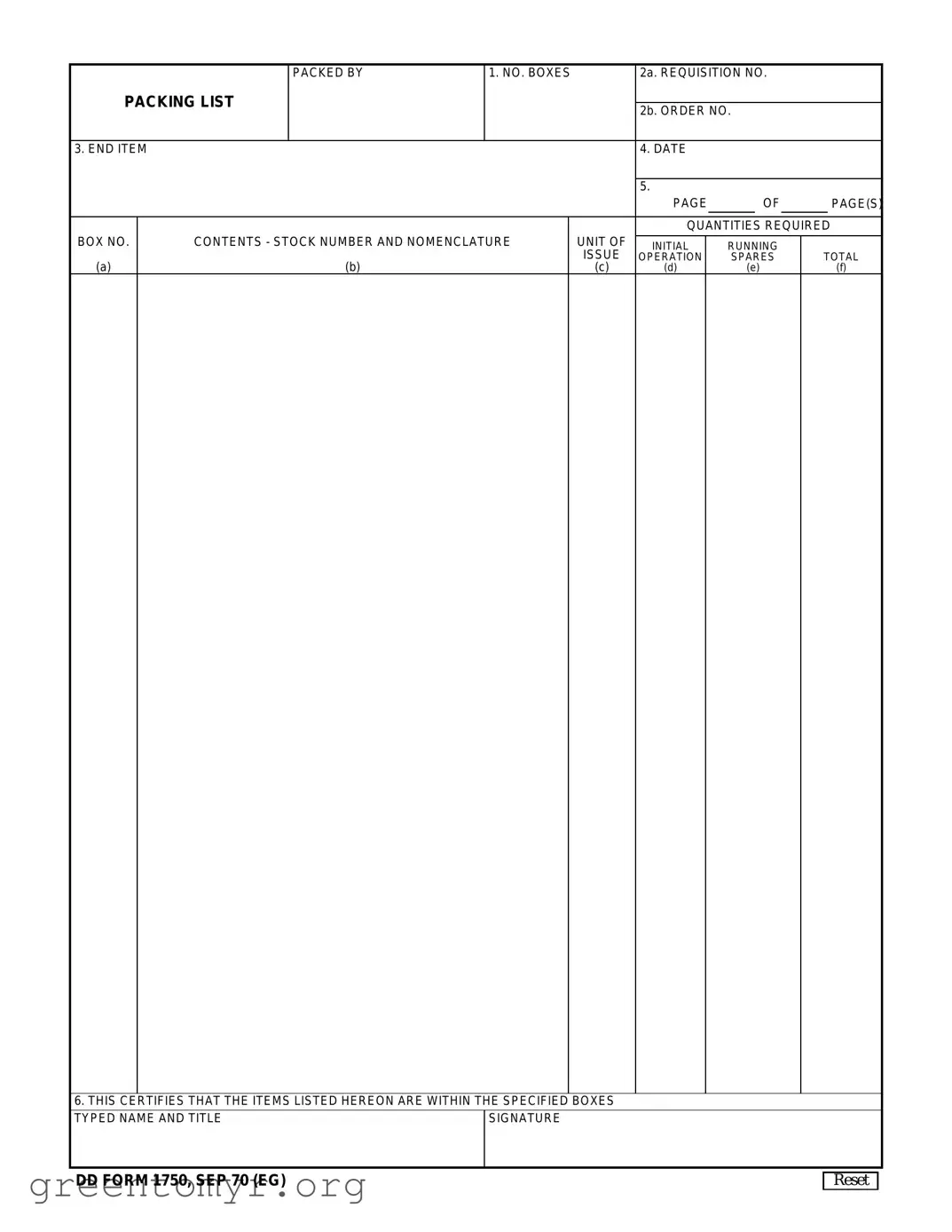
The DD Form 1750 is a vital document used in military logistics, specifically for packing lists. This form captures essential information about the items being shipped, ensuring that all necessary details are documented clearly. Each section of the form serves a specific purpose, starting with the number of boxes included in the shipment and the requisition or order numbers that help track the items. The end item description provides clarity on what is being shipped, while the date of preparation ensures that the information is current. Additionally, the form includes a detailed breakdown of the contents within each box, listing stock numbers and nomenclature for easy identification. It also distinguishes between items required for initial operation and those designated as running spares. The DD Form 1750 not only facilitates efficient inventory management but also helps maintain accountability throughout the supply chain. By adhering to the guidelines provided, personnel can ensure that all shipments are accurately documented, thus preventing potential issues during the logistics process.

|
|
PACKED BY |
1. NO. BOXES |
|
2a. REQUISITION NO. |
|
|
||
PACKING LIST |
|
|
|
|
|
|
|
|
|
|
|
|
2b. ORDER NO. |
|
|
||||
|
|
|
|
|
|
|
|||
|
|
|
|
|
|
|
|
|
|
3. END ITEM |
|
|
|
|
4. DATE |
|
|
|
|
|
|
|
|
|
|
|
|
|
|
|
|
|
|
|
5. |
|
|
|
|
|
|
|
|
|
PAGE |
|
OF |
|
PAGE(S) |
|
|
|
|
|
|
|
|
|
|
BOX NO. |
CONTENTS - STOCK NUMBER AND NOMENCLATURE |
UNIT OF |
QUANTITIES REQUIRED |
||||||
INITIAL |
RUNNING |
TOTAL |
|||||||
(a) |
|
(b) |
|
ISSUE |
OPERATION |
SPARES |
|||
|
|
(c) |
(d) |
(e) |
|
(f) |
|||
6. THIS CERTIFIES THAT THE ITEMS LISTED HEREON ARE WITHIN THE SPECIFIED BOXES
TYPED NAME AND TITLE |
SIGNATURE |
DD FORM 1750, SEP 70 (EG)
Reset

NOTES TO CONSIGNEE
The listing shown on the reverse side, together with pertinent notations relative to each item included, is furnished for your information and guidance only. In the case of lists covering equipment sets, one copy may be retained for reference and used as a supporting document to property books and the other copy retained with the equipment as a component parts listing. For the purpose of clarification, explanations of the various entries on this Packing List are furnished.
ITEM 1. The number of boxes in a set.
ITEMS 2a. & b. The requisition number appearing on the DD Form
ITEM 3. The stock number, nomenclature, type number (when available), and the directive under which the end item was assembled. Not applicable to shipments consisting only of miscellaneous repair parts and accessories for the assembly, set or unit in which case this entry will contain such a notation in lieu of the information cited above (See 5.3.1.1).
ITEM 4. Date of preparation.
ITEM 5.
Column a. This column will be used when two or more boxes are required for the equipment. It will indicate the number of the container in which the items are packed.
Column b. This space contains a listing of items contained within the box, which are identified by stock number and nomenclature. When an FSN is not
applicable, the manufacturer's code (See 5.2.2.10) and part number shall be used.
NOTE: As required, due to out of stock position within the DOD supply system, a component parts shortage which will not hinder operational functions may be waived by higher authority and will be so indicated to the right of the nomenclature. Waivers noted thereon should be requisitioned through normal supply channels.
Column c.
Column d. "Initial Operation" - Items which are required for operation of the equipment.
Column e. "Running Spares" - Those items shipped concurrently with the equipment as spare parts and accessories.
NOTE: Columns d and e will be used on an optional basis.
"Total" -
ITEM 6.
DD FORM 1750 Reverse, SEP 70
| Fact Name | Description |
|---|---|
| Purpose | The DD Form 1750 serves as a packing list for military shipments, detailing the contents of boxes, including stock numbers and nomenclature. |
| Preparation Date | The form requires a preparation date, ensuring that the information is current and relevant for tracking and logistics purposes. |
| Components Listing | It includes a comprehensive listing of items, where each item is identified by stock number, nomenclature, and other relevant details, facilitating efficient inventory management. |
| Governing Law | The DD Form 1750 is governed by Department of Defense regulations, specifically related to logistics and supply chain management within the military. |
Filling out the DD 1750 form requires careful attention to detail. Each section of the form must be completed accurately to ensure proper documentation of the items being packed. Following these steps will help you fill out the form correctly.
After completing the form, ensure that all information is accurate and legible. Retain copies as needed for your records and for any correspondence related to the shipment. Proper documentation helps facilitate smooth processing and tracking of the items involved.
The DD Form 1750 is a packing list used by the Department of Defense (DoD) to provide detailed information about items being shipped. It serves as a record of what is included in a shipment, ensuring that all parties involved have a clear understanding of the contents. This form is essential for tracking equipment and supplies, particularly in military logistics.
Several key pieces of information must be included on the DD Form 1750:
This information helps ensure that the shipment is accurate and complete.
Filling out the DD Form 1750 involves several steps:
Each entry should be made carefully to avoid confusion or errors in the shipping process.
The columns on the DD Form 1750 serve distinct purposes:
This structured format helps streamline the packing and shipping process.
The responsibility for completing the DD Form 1750 typically falls on the personnel preparing the shipment. This may include logistics specialists, supply clerks, or other military personnel involved in the packing process. It is crucial that the individual filling out the form is familiar with the items being shipped to ensure accuracy.
If there is a shortage of items, it is essential to document this on the form. If a component parts shortage exists that will not hinder operational functions, higher authority may grant a waiver. This waiver should be noted next to the relevant nomenclature. Requisitioning the missing items can then proceed through normal supply channels.
After shipment, the DD Form 1750 serves multiple purposes. One copy may be retained for reference and used as a supporting document for property books. Another copy should remain with the equipment as a component parts listing. This helps maintain an accurate inventory and ensures that all parties have access to the necessary information regarding the shipment.
The DD Form 1750 can typically be obtained from military supply offices or through official Department of Defense websites. It is important to use the most current version of the form to ensure compliance with regulations and procedures.
Filling out the DD 1750 form correctly is crucial for ensuring accurate shipping and inventory management. However, many individuals make common mistakes that can lead to confusion or delays. One frequent error is failing to complete all required fields. Each section of the form serves a specific purpose, and omitting information can result in processing issues. For instance, neglecting to include the requisition number or order number can complicate tracking and correspondence related to the shipment.
Another mistake is incorrectly listing the contents of the boxes. It’s essential to provide accurate stock numbers and nomenclature for each item. Mislabeling or providing incomplete descriptions can lead to misunderstandings about what is being shipped. This can cause delays in receiving the correct items or even lead to the wrong items being sent.
Many people also overlook the importance of signing the form. The certification at the bottom of the DD 1750 confirms that the items listed are indeed packed in the specified boxes. Failing to provide a signature can invalidate the document, leading to potential complications during the shipping process. It is important to ensure that the person filling out the form is authorized to certify the information provided.
Another common issue arises with the date of preparation. Some individuals forget to include this critical piece of information. The date helps to track when the items were packed and shipped, which is vital for inventory management. Without a date, it can be challenging to determine the timeliness of the shipment.
Using the wrong format for the stock numbers can also create confusion. It is important to follow the specified guidelines for entering stock numbers, including using the manufacturer’s code when applicable. Not adhering to these formats can lead to processing errors and may require additional follow-up.
People sometimes misinterpret the columns related to operation and running spares. Columns d and e are optional, but if they are included, they must be filled out correctly. Misunderstanding these sections can lead to either overestimating or underestimating the required spare parts, which can affect operational readiness.
Finally, failing to review the completed form before submission can lead to simple mistakes going unnoticed. A thorough review can catch errors such as typos or missing information. Taking the time to double-check the form can save significant time and effort down the line, ensuring a smoother shipping process.
The DD Form 1750 is a packing list used primarily by the Department of Defense to document the contents of a shipment. Alongside this form, several other documents are often utilized to ensure proper handling, tracking, and accountability of military supplies and equipment. Below is a list of related forms and documents that complement the DD Form 1750.
Understanding these forms and their purposes can significantly enhance the efficiency of military logistics and supply chain management. Proper documentation ensures accountability and helps prevent discrepancies throughout the procurement and shipping processes.
The DD 1750 form serves as a packing list for military shipments, detailing the contents of boxes, requisition numbers, and other essential information. Several other documents share similarities with the DD 1750 in terms of purpose and structure. Below are five such documents:
When filling out the DD 1750 form, it's essential to follow certain guidelines to ensure accuracy and compliance. Here are seven things you should and shouldn't do:
Following these steps can help prevent delays and issues with your shipment. Accuracy is key when dealing with military logistics.
The DD Form 1750 is an essential document used in military logistics, but several misconceptions surround it. Understanding these can help ensure proper use and compliance. Here are six common misconceptions:
By addressing these misconceptions, individuals involved in military logistics can better navigate the requirements of the DD Form 1750, ensuring accuracy and compliance in their operations.
When filling out the DD Form 1750, understanding its purpose and structure is crucial. This form serves as a packing list for military shipments, ensuring that all necessary items are accounted for and properly documented. Here are some key takeaways to keep in mind:
By following these guidelines, individuals can ensure that the DD Form 1750 is filled out correctly, leading to smoother logistics and better management of military supplies.