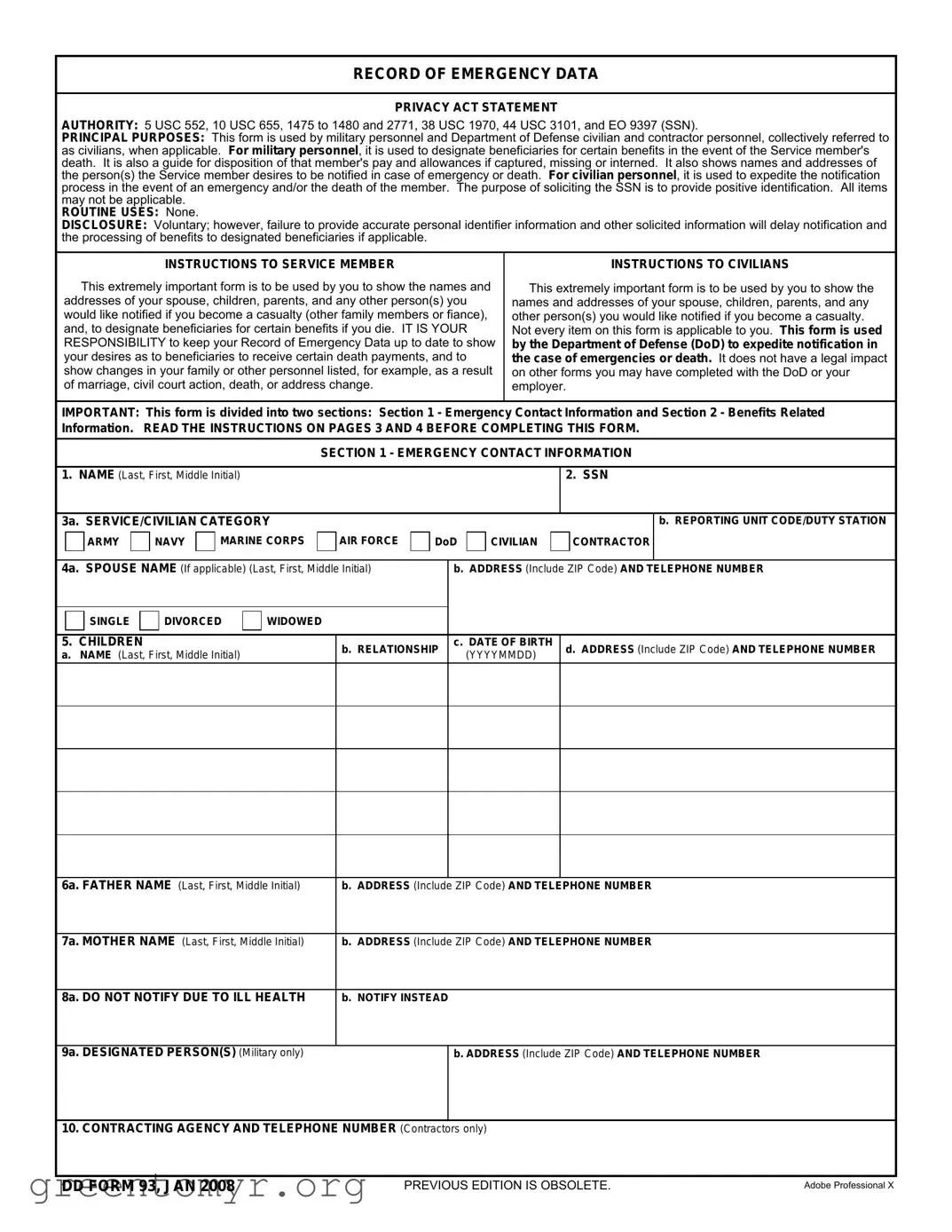
The DD 93 form, also known as the Record of Emergency Data, plays a crucial role for military personnel and their families. This document is essential for ensuring that a service member's critical information is readily available in case of an emergency. It captures vital details such as the service member's personal information, emergency contacts, and beneficiary designations. The form is not only important for the individual but also serves to protect the interests of loved ones during challenging times. Completing the DD 93 accurately is vital, as it can impact benefits and entitlements. Regular updates to this form are necessary to reflect any changes in personal circumstances, ensuring that the information remains current and relevant. Understanding the significance of the DD 93 form can help service members and their families navigate emergency situations with greater ease and confidence.

RECORD OF EMERGENCY DATA
PRIVACY ACT STATEMENT
AUTHORITY: 5 USC 552, 10 USC 655, 1475 to 1480 and 2771, 38 USC 1970, 44 USC 3101, and EO 9397 (SSN).
PRINCIPAL PURPOSES: This form is used by military personnel and Department of Defense civilian and contractor personnel, collectively referred to as civilians, when applicable. For military personnel, it is used to designate beneficiaries for certain benefits in the event of the Service member's death. It is also a guide for disposition of that member's pay and allowances if captured, missing or interned. It also shows names and addresses of the person(s) the Service member desires to be notified in case of emergency or death. For civilian personnel, it is used to expedite the notification process in the event of an emergency and/or the death of the member. The purpose of soliciting the SSN is to provide positive identification. All items may not be applicable.
ROUTINE USES: None.
DISCLOSURE: Voluntary; however, failure to provide accurate personal identifier information and other solicited information will delay notification and the processing of benefits to designated beneficiaries if applicable.
INSTRUCTIONS TO SERVICE MEMBER
This extremely important form is to be used by you to show the names and addresses of your spouse, children, parents, and any other person(s) you would like notified if you become a casualty (other family members or fiance), and, to designate beneficiaries for certain benefits if you die. IT IS YOUR RESPONSIBILITY to keep your Record of Emergency Data up to date to show your desires as to beneficiaries to receive certain death payments, and to show changes in your family or other personnel listed, for example, as a result of marriage, civil court action, death, or address change.
INSTRUCTIONS TO CIVILIANS
This extremely important form is to be used by you to show the names and addresses of your spouse, children, parents, and any other person(s) you would like notified if you become a casualty.
Not every item on this form is applicable to you. This form is used by the Department of Defense (DoD) to expedite notification in the case of emergencies or death. It does not have a legal impact on other forms you may have completed with the DoD or your employer.
IMPORTANT: This form is divided into two sections: Section 1 - Emergency Contact Information and Section 2 - Benefits Related Information. READ THE INSTRUCTIONS ON PAGES 3 AND 4 BEFORE COMPLETING THIS FORM.
|
SECTION 1 - EMERGENCY CONTACT INFORMATION |
|
|
|
|
1. NAME (Last, First, Middle Initial) |
|
2. SSN |
|
|
|
3a. SERVICE/CIVILIAN CATEGORY
ARMY |
NAVY |
MARINE CORPS |
AIR FORCE
DoD
CIVILIAN
CONTRACTOR
b. REPORTING UNIT CODE/DUTY STATION
4a. SPOUSE NAME (If applicable) (Last, First, Middle Initial) |
b. ADDRESS (Include ZIP Code) AND TELEPHONE NUMBER |
||||
|
|
|
|
|
|
SINGLE |
DIVORCED |
WIDOWED |
|
|
|
|
|
|
|
|
|
5. CHILDREN |
|
b. RELATIONSHIP |
c. DATE OF BIRTH |
d. ADDRESS (Include ZIP Code) AND TELEPHONE NUMBER |
|
a. NAME (Last, First, Middle Initial) |
(YYYYMMDD) |
||||
|
|
||||
|
|
|
|
|
|
|
|
|
|
|
|
|
|
|
|
|
|
|
|
|
|
|
|
|
|
|
|
|
|
6a. FATHER NAME (Last, First, Middle Initial) |
b. ADDRESS (Include ZIP Code) AND TELEPHONE NUMBER |
|
|
|
|
7a. MOTHER NAME (Last, First, Middle Initial) |
b. ADDRESS (Include ZIP Code) AND TELEPHONE NUMBER |
|
|
|
|
8a. DO NOT NOTIFY DUE TO ILL HEALTH |
b. NOTIFY INSTEAD |
|
|
|
|
9a. DESIGNATED PERSON(S) (Military only) |
|
b. ADDRESS (Include ZIP Code) AND TELEPHONE NUMBER |
|
|
|
10. CONTRACTING AGENCY AND TELEPHONE NUMBER (Contractors only)
DD FORM 93, JAN 2008 |
PREVIOUS EDITION IS OBSOLETE. |
Adobe Professional X |

SECTION 2 - BENEFITS RELATED INFORMATION
11a. BENEFICIARY(IES) FOR DEATH GRATUITY |
b. RELATIONSHIP |
c. ADDRESS (Include ZIP Code) AND TELEPHONE NUMBER |
d. PERCENTAGE |
(Military only) |
|
|
|
|
|
|
|
12a. BENEFICIARY(IES) FOR UNPAID PAY/ALLOWANCES |
b. ADDRESS (Include ZIP Code) AND TELEPHONE NUMBER |
c. PERCENTAGE |
|
(Military only) NAME AND RELATIONSHIP |
|
|
|
|
|
|
|
13a. PERSON AUTHORIZED TO DIRECT DISPOSITION (PADD) |
b. ADDRESS (Include ZIP Code) AND TELEPHONE NUMBER |
|
|
(Military only) NAME AND RELATIONSHIP |
|
|
|
|
|
|
|
14. CONTINUATION/REMARKS |
|
|
|
15.SIGNATURE OF SERVICE MEMBER/CIVILIAN (Include rank, rate, or grade if applicable)
16.SIGNATURE OF WITNESS (Include rank, rate, or grade as appropriate)
17.DATE SIGNED
(YYYYMMDD)
DD FORM 93 (BACK), JAN 2008

INSTRUCTIONS FOR PREPARING DD FORM 93
(See appropriate Service Directives for supplemental instructions for completion of this form at other than MEPS)
All entries explained below are for electronic or typewriter completion, except those specifically noted. If a computer or typewriter is not available, print in black or
ITEM 1. Enter full last name, first name, and middle initial.
ITEM 2. Enter social security number (SSN).
ITEM 3a. Service. Military: Mark X in appropriate block.
Civilian: Mark two blocks as appropriate. Examples: an Army civilian would mark Army and either Civilian or Contractor; a DoD civilian, without affiliation to one of the Military Services, would mark DoD and then either Civilian or Contractor as appropriate.
ITEM 3b. Reporting Unit Code/Duty Station. See Service Directives.
ITEM 4a. Spouse Name. Enter last name (if different from Item 1), first name and middle initial on the line provided. If single, divorced, or widowed, mark appropriate block.
ITEM 4b. Address and Telephone Number. Enter the "actual" address and telephone number, not the mailing address. Include civilian title or military rank and service if applicable. If one of the blocks in 4a is marked, leave blank.
ITEM
ITEM 6a. Father Name. Last name, first name and middle initial.
ITEM 6b. Address and Telephone Number of Father. If unknown or deceased, so state. Include civilian title or military rank and service if applicable. If other than natural father is listed, indicate relationship.
ITEM 7a. Mother Name. Last name, first name and middle initial.
ITEM 7b. Address and Telephone Number of Mother. If unknown or deceased, so state. Include civilian title or military rank and service if applicable. If other than natural mother is listed, indicate relationship.
ITEM 8. Persons Not to be Notified Due to Ill Health.
a.List relationship, e.g., "Mother," of person(s) listed in Items 4, 5, 6, or 7 who are not to be notified of a casualty due to ill health. If more than one child, specify, e.g., "daughter Susan." Otherwise, enter "None".
b.List relationship, e.g., "Father" or name and address of person(s) to be notified in lieu of person(s) listed in item 8a. If "None" is entered in Item 8a, leave blank.
ITEM 9a. This item will be used to record the name of the person or persons, if any, other than the member's primary next of kin or immediate family, to whom information on the whereabouts and status of the member shall be provided if the member is placed in a missing status. Reference 10 USC, Section 655. NOT APPLICABLE to civilians.
ITEM 9b. Address and telephone number of Designated Person(s). NOT APPLICABLE to civilians.
ITEM 10. Contracting Agency and Telephone Number
(Contractors only). NOT APPLICABLE to military personnel. Civilian contractors will provide the name of their contracting agency and its telephone number. Example: XYZ Electric, (703)
ITEM 11a. Beneficiary(ies) for Death Gratuity (Military only). Enter first name(s), middle initial, and last name(s) of the person(s) to receive death gratuity pay. A member may designate one or more persons to receive all or a portion of the death gratuity pay. The designation of a person to receive a portion of the amount shall indicate the percentage of the amount, to be specified only in 10 percent increments, that the person may receive. If the member does not wish to designate a beneficiary for the payment of death gratuity, enter "None," or if the full amount is not designated, the payment or balance will be paid as follows:
(1)To the surviving spouse of the person, if any;
(2)To any surviving children of the person and the descendants of any deceased children by representation;
(3)To the surviving parents or the survivor of them;
(4)To the duly appointed executor or administrator of the estate of the person;
(5)If there are none of the above, to other next of kin of the person entitled under the laws of domicile of the person at the time of the person's death.
The member should make specific designations, as it expedites payment.
DD FORM 93 (INSTRUCTIONS), JAN 2008

INSTRUCTIONS FOR PREPARING DD FORM 93
(Continued)
ITEM 11a. (Continued) Seek legal advice if naming a minor child as a beneficiary. If a member has a spouse but designates a person other than the spouse to receive all or a portion of the death gratuity pay, the Service concerned is required to provide notice of the designation to the spouse.
NOT APPLICABLE to civilians.
Item 11b. Relationship. NOT APPLICABLE to civilians.
ITEM 11c. Enter beneficiary(ies) full mailing address and telephone number to include the ZIP Code. NOT
APPLICABLE to civilians.
ITEM 11d. Show the percentage to be paid to each person. Enter 10%, 20%, 30%, up to 100% as appropriate. The sum shares must equal 100 percent. If no percent is indicated and more than one person is named, the money is paid in equal shares to the persons named. NOT APPLICABLE to
civilians.
ITEM 12a. Beneficiary(ies) for Unpaid Pay/Allowance (Military only). Enter first name(s), middle initial, last name(s) and relationship of person to receive unpaid pay and allowances at the time of death. The member may indicate anyone to receive this payment. If the member designated two or more beneficiaries, state the percentage to be paid each in item 10c. If the member does not wish to designate a beneficiary, enter "By Law." The member is urged to designate a beneficiary for unpaid pay and allowances as payment will be made to the person in order of precedence by law (10 USC 2771) in the absence of a designation. Seek legal advice if naming a minor child as beneficiary. NOT APPLICABLE to civilians.
ITEM 12b. Enter beneficiary(ies) full mailing address and telephone number to include the ZIP Code. NOT
APPLICABLE to civilians.
ITEM 12c. If the member designated two or more beneficiaries, state the percentage to be paid each in this section. The sum shares must equal 100 percent. NOT
APPLICABLE to civilians.
ITEM 13a. Enter the name and relationship of the Person Authorized to Direct Disposition (PADD) of your remains should you become a casualty. Only the following persons may be named as a PADD: surviving spouse, blood relative of legal age, or adoptive relatives of the decedent. If neither of these three can be found, a person standing in loco parentis may be named. NOT APPLICABLE to civilians.
ITEM 13b. Address and telephone number of PADD. NOT
APPLICABLE to civilians.
ITEM 14. Continuations/Remarks. Use this item for remarks or continuation of other items, if necessary. Prefix entry with the number of the item being continued; for example, 5/John J./son/ 19851220/321 Pecan Drive, Schertz TX 78151. Also use this item to list name, address, and relationship of other persons the member desires to be notified. Other dependents may also be listed. This block offers the greatest amount of flexibility for the member to record other important information not otherwise requested but considered extremely useful in the casualty notification and assistance process. Besides continuing information from other blocks on this form, the member may desire to include additional information such as: NOK language barriers, location or existence of a Will, additional private insurance information, other family member contact numbers, etc. If additional space is required, attach a supplemental sheet of standard bond paper with the information.
ITEM 15. Signature of Service Member/Civilian. Check and verify all entries and sign all copies in ink as follows: First name, middle initial, last name. Include rank, rate, or grade if applicable. May be electronically signed (see DoD Instruction 1300.18 for guidelines).
ITEM 16. Signature of Witness. Have a witness (disinterested person) sign all copies in ink as follows: First name, middle initial, last name. Include rank, rate, or grade as appropriate. A witness signature is not required for electronic versions of the DD Form 93 (see DoD Instruction 1300.18).
ITEM 17. Date the member or civilian signs the form. This item is an ink entry and must be completed on all copies.
DD FORM 93 (INSTRUCTIONS) (BACK), JAN 2008
| Fact Name | Description |
|---|---|
| Purpose | The DD Form 93 is used to record emergency contact information for military personnel. |
| Who Uses It | This form is completed by members of the United States Armed Forces. |
| Importance | It helps ensure that the military can contact designated individuals in case of emergencies. |
| Contents | The form includes sections for personal information, emergency contacts, and beneficiary designations. |
| Submission | Service members must submit the DD 93 to their personnel office. |
| Updates | It is crucial to update the form whenever there are changes in personal circumstances or contact information. |
| Governing Law | The use of this form is governed by Department of Defense regulations. |
| Retention | The form is kept in the service member's personnel file for future reference. |
| Digital Availability | The DD 93 form can be accessed online through official military websites. |
| Privacy | Information on the DD 93 is protected under privacy laws to safeguard personal data. |
Completing the DD 93 form is an important step in ensuring that your personal information is accurately recorded. This information will be used to manage your benefits and assist your family in case of emergencies. Follow these steps to fill out the form correctly.
Once you have completed the DD 93 form, review it carefully to ensure all information is accurate. This will help prevent any delays in processing your information. After confirming that everything is correct, submit the form to the appropriate military personnel office or designated authority.
The DD Form 93, also known as the Record of Emergency Data, is a crucial document used by military personnel. It collects important information about service members’ emergency contacts and beneficiaries. This form ensures that, in the event of an emergency, the military can quickly reach the appropriate individuals and provide them with necessary information.
All active duty, reserve, and National Guard members are required to complete the DD Form 93. This form is particularly important for those who are deploying or changing their duty status. It is essential for ensuring that the military has up-to-date information regarding a service member’s emergency contacts and beneficiaries.
The DD Form 93 should be updated regularly, especially when there are significant life changes. Changes such as marriage, divorce, the birth of a child, or the death of a beneficiary should prompt an update. It is advisable to review and update this form at least annually or whenever personal circumstances change.
The DD Form 93 can be obtained from various sources. Service members can access it through their unit’s administrative office or download it from the official Department of Defense website. Additionally, many military installations provide copies of this form at their personnel offices.
The DD Form 93 requires several key pieces of information, including:
This information is vital for ensuring that the right individuals are notified in emergencies and that benefits are distributed correctly.
Failure to complete the DD Form 93 can lead to complications during emergencies. If a service member does not have this form on file, the military may struggle to contact the appropriate family members or beneficiaries. This could result in delays in delivering critical information or benefits. Therefore, it is in a service member’s best interest to complete and update this form as necessary.
Yes, the DD Form 93 can be filled out electronically in many instances. Many military personnel systems allow for electronic completion and submission. However, it is important to ensure that the form is printed and signed if required by your unit’s policies. Always check with your unit’s administrative office for specific instructions regarding electronic submissions.
Filling out the DD 93 form, also known as the Record of Emergency Data, is a crucial task for service members. However, many individuals make common mistakes that can lead to complications. One frequent error is failing to update the form regularly. Life changes, such as marriage, divorce, or the birth of a child, can significantly impact the emergency contact information. If the form is not updated, the military may not be able to reach the right people in a time of need.
Another common mistake is providing incomplete information. Each section of the DD 93 form is designed to gather specific details. Omitting essential information, such as a contact's full name or relationship to the service member, can create confusion. It’s important to double-check that all fields are filled out accurately and completely to ensure that the form serves its intended purpose.
Additionally, some individuals mistakenly think that the form only needs to be filled out once. In reality, it should be reviewed and revised whenever there are significant life changes. This oversight can lead to outdated or incorrect information being on file. Service members should take the time to review their DD 93 form regularly, ensuring that all details are current and reflect their current circumstances.
Lastly, not understanding the importance of the DD 93 form can lead to mistakes. This form is more than just a bureaucratic requirement; it serves as a vital document for emergency situations. Service members should recognize its significance and treat the completion of the DD 93 form with the seriousness it deserves. By doing so, they can ensure that their loved ones are properly informed and contacted in case of an emergency.
The DD 93 form, also known as the Record of Emergency Data, is a crucial document for military personnel. It provides essential information regarding a service member's beneficiaries and emergency contacts. However, there are several other forms and documents that often accompany the DD 93, each serving a specific purpose in the context of military service and benefits. Below is a list of these important documents.
Understanding these documents and their purposes can greatly assist service members and their families in navigating the complexities of military benefits and emergency situations. Each form plays a vital role in ensuring that service members receive the support and resources they need throughout their careers and beyond.
The DD 93 form, also known as the Record of Emergency Data, is a crucial document used by military personnel to provide essential information regarding their emergency contacts and beneficiaries. Several other documents serve similar purposes, ensuring that individuals can convey important information regarding their personal and financial affairs. Below are four documents that share similarities with the DD 93 form:
When filling out the DD 93 form, it is important to follow specific guidelines to ensure accuracy and completeness. Below is a list of things to do and avoid during this process.
Things You Should Do:
Things You Shouldn't Do:
The DD 93 form, also known as the Record of Emergency Data, is an important document for military personnel. However, there are several misconceptions surrounding this form. Below are some common misunderstandings:
Understanding these misconceptions can help ensure that the DD 93 form is used correctly and effectively. Keeping this document up to date is essential for the safety and well-being of service members and their families.
The DD 93 form, also known as the Record of Emergency Data, is an important document for military personnel. Here are some key takeaways to keep in mind when filling it out and using it: