Content Navigation

When it comes to tracking the movement of goods, a Delivery Receipt form plays a crucial role in ensuring that both the sender and the recipient have a clear record of what has been delivered. This essential document typically includes vital information such as the date of delivery, the purchase order number, and a job number, which helps in organizing and referencing the transaction. It allows the recipient to confirm whether the delivery is partial or complete, thereby preventing any confusion. The form also requires a detailed description of the items delivered, including the quantity and number of pieces, ensuring that all aspects of the shipment are accounted for. Finally, the signature of the person receiving the goods is captured, providing a level of accountability and verification that is indispensable in business transactions. Understanding the importance of this form can streamline processes and safeguard against disputes, making it a key tool for effective communication between parties involved in the delivery process.
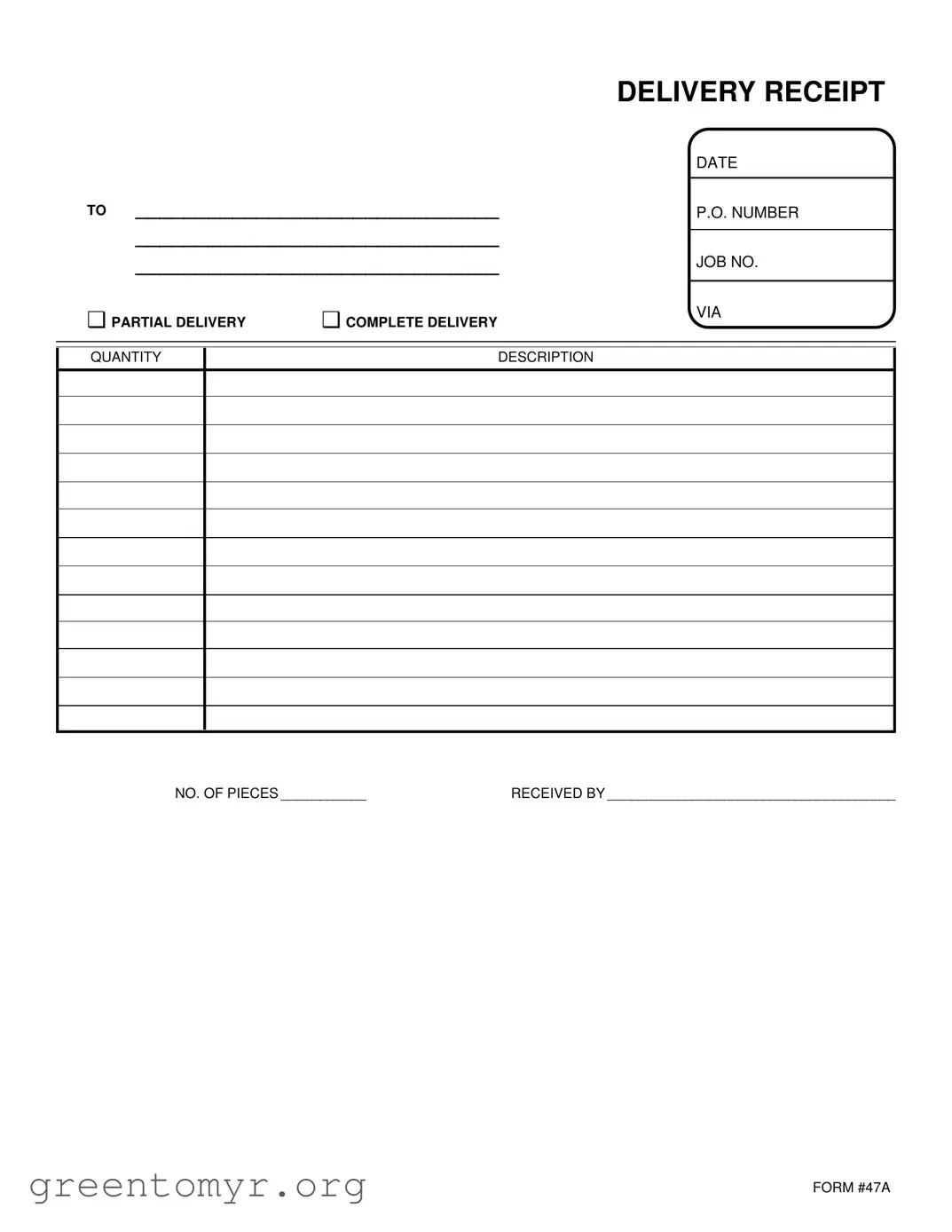
Delivery Receipt Example


DELIVERY RECEIPT


DATE

TO ______________________________


P.O. NUMBER

______________________________


______________________________


JOB NO.


PARTIAL DELIVERY

COMPLETE DELIVERY


VIA


QUANTITY

DESCRIPTION

NO. OF PIECES ___________

RECEIVED BY _____________________________________

FORM #47A

File Breakdown

Fact Name Description
Purpose The Delivery Receipt form is used to acknowledge the receipt of goods or services delivered.
Components It typically includes the date, purchase order number, job number, delivery status, quantity, and description of items.
Partial vs. Complete Delivery The form allows for indication of whether the delivery is partial or complete, which helps in inventory management.
Signature Requirement A signature from the person receiving the goods is often required to validate the receipt.
State-Specific Forms Some states may have specific requirements for delivery receipts governed by local commercial codes.
Record Keeping Businesses should retain copies of delivery receipts for accounting and auditing purposes.

Guide to Using Delivery Receipt

After completing the Delivery Receipt form, it is essential to ensure that all information is accurate and clearly written. This form will serve as a record of the delivery, and it will be crucial for tracking purposes and confirming receipt of goods.

  1. Write the date at the top of the form.
  2. Fill in the to section with the name of the recipient or company.
  3. Enter the P.O. number in the designated space.
  4. In the next line, include any relevant job number.
  5. Select either partial delivery or complete delivery by marking the appropriate box.
  6. Indicate the quantity of items delivered.
  7. Describe the items being delivered in the description section.
  8. Count the number of pieces received and fill that in.
  9. Have the recipient sign their name in the received by section.

Get Answers on Delivery Receipt

What is a Delivery Receipt form?

A Delivery Receipt form is a document that confirms the receipt of goods or services. It serves as proof that items have been delivered to the recipient, and it includes important details such as the date of delivery, purchase order number, job number, and the description of the items received. This form can be particularly useful for businesses to keep accurate records of inventory and transactions.

What information should be included on the Delivery Receipt form?

The Delivery Receipt form should include the following key information:

  • Date of delivery
  • Recipient's name and address
  • Purchase order number
  • Job number
  • Indication of whether the delivery is complete or partial
  • Quantity and description of the items delivered
  • Name of the person who received the items

Including all this information ensures clarity and helps prevent disputes regarding what was delivered.

Why is it important to use a Delivery Receipt form?

Using a Delivery Receipt form is important for several reasons:

  1. Proof of Delivery: It acts as legal evidence that goods were delivered, which can be crucial in case of disputes.
  2. Record Keeping: It helps businesses maintain accurate records of inventory and transactions.
  3. Accountability: The form identifies who received the items, promoting accountability.
  4. Clarification: It provides a clear record of what was delivered, reducing misunderstandings.

How should I fill out the Delivery Receipt form?

To fill out the Delivery Receipt form, follow these steps:

  • Start by entering the date of delivery at the top of the form.
  • Fill in the recipient's name and address, along with the purchase order number and job number.
  • Indicate whether the delivery is complete or partial by checking the appropriate box.
  • List the quantity and description of the items delivered, ensuring accuracy.
  • Finally, have the recipient sign the form to acknowledge receipt of the items.

Taking care to fill out the form correctly can prevent issues down the line.

What should I do if there are discrepancies on the Delivery Receipt form?

If you notice any discrepancies on the Delivery Receipt form, such as missing items or incorrect quantities, it’s essential to address them immediately. Here’s what you can do:

  1. Contact the supplier or delivery service right away to report the issue.
  2. Document the discrepancies by taking photos or making notes.
  3. Keep a copy of the Delivery Receipt form for your records.
  4. Request a corrected receipt if necessary.

Taking prompt action helps ensure that any issues are resolved quickly and that your records remain accurate.

Common mistakes

When filling out the Delivery Receipt form, people often overlook important details. One common mistake is forgetting to include the date. The date is crucial for tracking deliveries and ensuring that records are accurate. Without it, the receipt may lose its significance.

Another frequent error is not completing the P.O. number. The Purchase Order number helps link the delivery to a specific order. Omitting this information can lead to confusion and delays in processing.

Many individuals also neglect to fill in the job number. This number helps identify the project associated with the delivery. Without it, the delivery might not be correctly attributed to the right job, causing potential issues down the line.

People often select the wrong delivery type. The options are partial delivery or complete delivery. Choosing incorrectly can lead to misunderstandings about what was received. It is essential to mark the correct option clearly.

Another mistake is failing to accurately record the quantity of items received. This information is vital for inventory management. If the quantity is incorrect, it could result in stock shortages or excess.

Some individuals forget to describe the items received. The description section is important for identifying what was delivered. Leaving this blank can create confusion about the contents of the delivery.

Additionally, the section for number of pieces is sometimes overlooked. This detail is necessary to confirm that the correct amount of items was delivered. An inaccurate count can lead to disputes with suppliers.

Lastly, people often forget to sign the form in the received by section. A signature is essential as it confirms that the items were received by an authorized person. Without a signature, the receipt may not be considered valid.

Documents used along the form

The Delivery Receipt form is an important document used to confirm the receipt of goods. It serves as proof that items have been delivered and accepted by the recipient. However, several other forms and documents often accompany the Delivery Receipt to ensure a smooth transaction process. Below is a list of these related documents.

  • Bill of Lading: This document outlines the details of the shipment, including the type of goods, quantity, and destination. It serves as a contract between the shipper and carrier.
  • Packing List: A packing list details the contents of a shipment. It helps recipients verify that all items listed have been received.
  • Invoice: An invoice is a request for payment that includes details such as the amount owed, payment terms, and itemized list of goods or services provided.
  • Purchase Order: A purchase order is a document issued by a buyer to a seller, indicating the types and quantities of products or services they wish to purchase.
  • Return Authorization Form: This form is used when items need to be returned. It provides the necessary details to process the return efficiently.
  • Credit Memo: A credit memo is issued to reduce the amount owed by a buyer. It may occur due to returns or billing errors.
  • Shipping Manifest: A shipping manifest is a comprehensive list of all items being shipped. It is often used for tracking purposes during transit.
  • Inspection Report: An inspection report documents the condition of goods upon receipt. It helps identify any damage or discrepancies.
  • Transfer of Ownership Document: This document confirms the transfer of ownership from the seller to the buyer upon delivery of goods.

These documents play a crucial role in ensuring that transactions are clear, organized, and legally binding. They help protect both the buyer and seller by providing a detailed record of the transaction process.

Similar forms

The Delivery Receipt form serves as a crucial document in the logistics and supply chain process. It provides a record of goods received, but it shares similarities with several other important documents. Here are five documents that resemble the Delivery Receipt form:

  • Bill of Lading: This document outlines the details of the shipment and serves as a receipt for the goods. Like the Delivery Receipt, it confirms that the items have been received by the designated party.
  • Packing Slip: A packing slip accompanies a shipment and lists the items included. It is similar to the Delivery Receipt in that it provides a detailed account of what should be received, helping to verify the delivery.
  • Invoice: An invoice requests payment for goods or services rendered. While it focuses on financial transactions, it often references the delivery of items, making it relevant to the Delivery Receipt as both confirm that goods have been exchanged.
  • Purchase Order: A purchase order is a document sent from a buyer to a seller, outlining the details of the goods or services requested. It is similar to the Delivery Receipt in that both documents serve as records of transactions, though the purchase order is created before the delivery occurs.
  • Goods Received Note (GRN): This document is issued by the receiving party to confirm that goods have been received in the correct quantity and condition. Like the Delivery Receipt, it acts as proof of receipt and is often used for inventory management.

Dos and Don'ts

When filling out the Delivery Receipt form, attention to detail is essential. Here are some key points to consider:

  • Do fill in the date accurately to ensure proper record-keeping.
  • Do include the Purchase Order (P.O.) number for reference.
  • Do specify the job number if applicable to maintain clarity.
  • Do indicate whether the delivery is partial or complete.
  • Don't leave the quantity section blank; this is crucial for inventory tracking.
  • Don't forget to provide a description of the items received.
  • Don't neglect to sign and print the name of the person receiving the items.

Misconceptions

Misconceptions about the Delivery Receipt form can lead to confusion and miscommunication in various transactions. Here are four common misconceptions that need clarification:

  • The Delivery Receipt is not a legal document. Many people believe that the Delivery Receipt holds no legal weight. In reality, it serves as a formal acknowledgment of the receipt of goods, which can be important in disputes or claims.
  • It only applies to complete deliveries. Some assume that a Delivery Receipt is only necessary for complete deliveries. However, it is equally important for partial deliveries, as indicated by the option to mark whether the delivery is complete or partial.
  • Only the recipient needs to sign it. There is a misconception that only the person receiving the goods must sign the Delivery Receipt. In fact, both the sender and the recipient should retain copies, as this ensures accountability on both sides.
  • The form is optional. Many believe that using a Delivery Receipt is optional. This is misleading; while it may not be legally required in all situations, using it is highly recommended for clarity and record-keeping purposes.

Understanding these misconceptions can help individuals and businesses navigate their transactions more effectively and avoid potential issues down the line.

Key takeaways

When filling out and using the Delivery Receipt form, it is essential to keep a few key points in mind. This form serves as a crucial record of the items received and can help prevent misunderstandings between parties. Here are some important takeaways:

  • Accuracy is Key: Ensure that all information, including the date, P.O. number, and job number, is filled out correctly. Mistakes can lead to confusion and disputes.
  • Specify Delivery Type: Clearly indicate whether the delivery is partial or complete. This distinction helps both the sender and receiver understand the status of the shipment.
  • Document Quantity and Description: List the quantity and description of each item received. This detailed information provides a clear record of what was delivered.
  • Signature Requirement: The form must be signed by the person receiving the items. This signature acts as confirmation that the items were received in the stated condition.