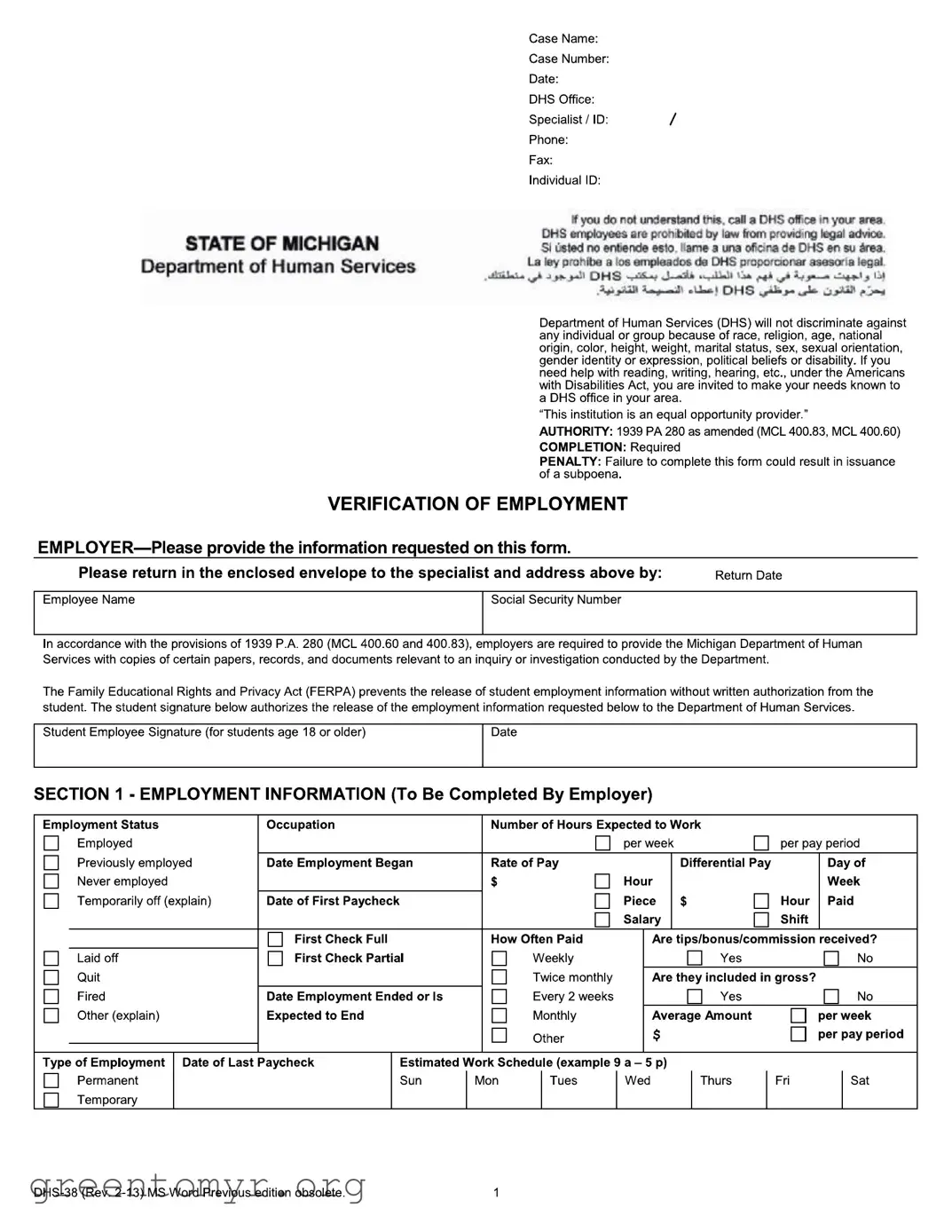
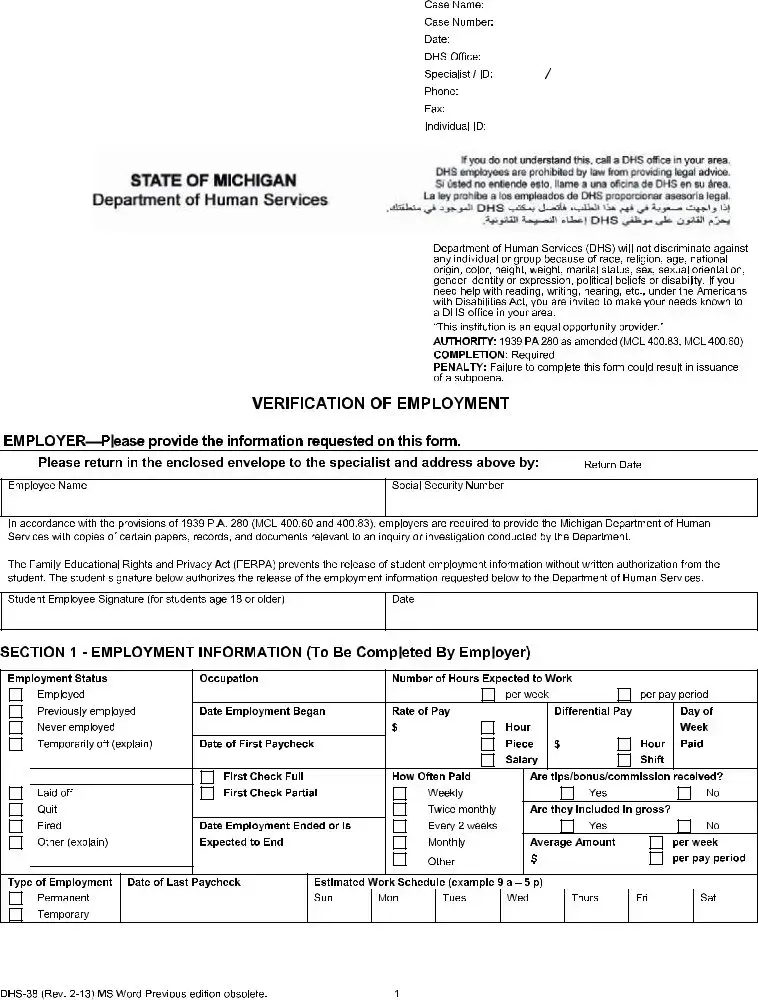
The DHS 38 form is a crucial document used by the Michigan Department of Human Services (DHS) to gather essential information regarding an individual’s employment and income status. It serves multiple purposes, including verifying employment details, assessing eligibility for assistance programs, and ensuring compliance with state regulations. The form requires employers to provide comprehensive information about their employees, such as employment status, rate of pay, and hours worked. Additionally, it requests details about health insurance and retirement plans, which are vital for understanding an employee's overall financial situation. The DHS emphasizes that completion of this form is mandatory, and failure to do so could lead to legal repercussions. Importantly, the form also includes provisions to protect the rights of individuals, ensuring that no discrimination occurs based on various personal attributes. For those who may need assistance, the DHS encourages individuals to reach out to their local office for support, reinforcing their commitment to accessibility and equal opportunity for all. This form is not just a bureaucratic requirement; it plays a significant role in the welfare system, impacting the lives of many residents in Michigan.
| Fact Name | Description |
|---|---|
| Governing Law | The DHS 38 form is governed by the 1939 Public Act 280, specifically MCL 400.60 and MCL 400.83. |
| Purpose | This form is primarily used to collect employment and income information necessary for inquiries or investigations by the Michigan Department of Human Services. |
| Completion Requirement | Completion of the DHS 38 form is mandatory. Failure to do so may lead to the issuance of a subpoena. |
| Non-Discrimination Policy | The Department of Human Services ensures that it does not discriminate against individuals based on various characteristics, including race, religion, and disability. |
| Legal Advice Prohibition | DHS employees are prohibited by law from providing legal advice to individuals filling out this form. |
| Americans with Disabilities Act | Individuals needing assistance under the Americans with Disabilities Act are encouraged to inform their local DHS office of their specific needs. |
| Employment Verification | The form requires employers to verify employment details, including job status, pay rate, and hours worked. |
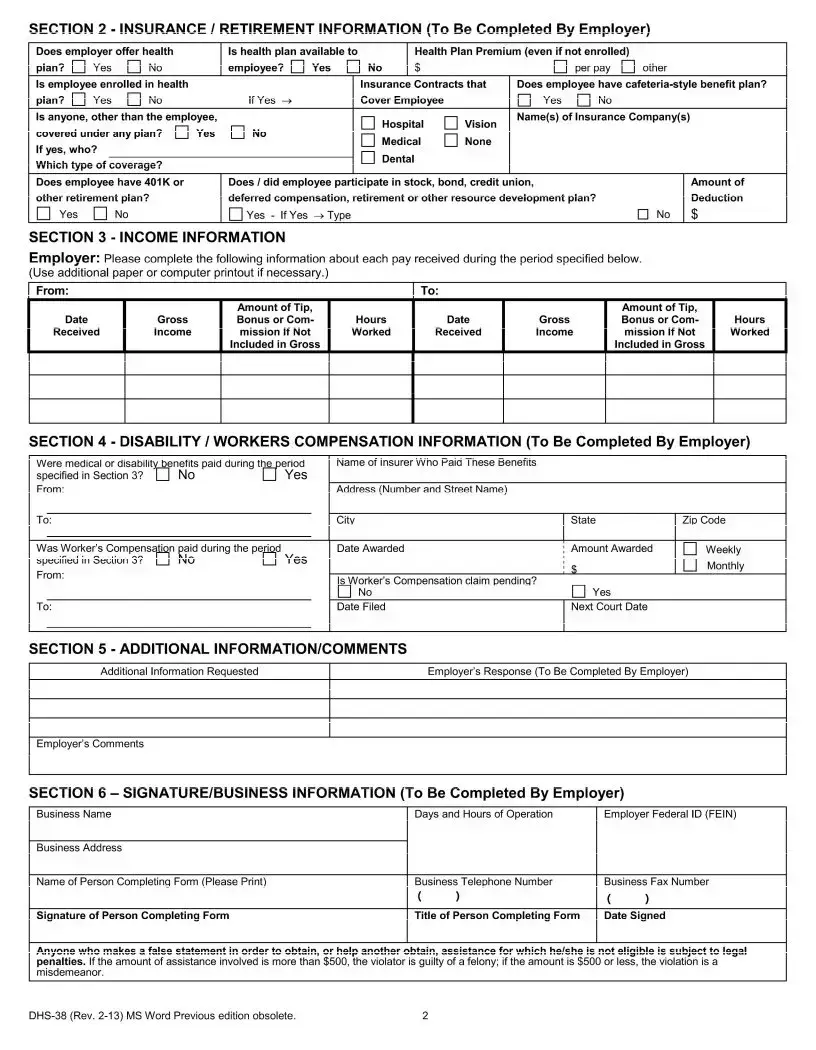
| Income Information | Section 3 of the form focuses on gathering detailed income information, including gross income and any bonuses or commissions. |
| False Statements Penalty | Submitting false information on the form can lead to legal penalties, including felony charges for amounts exceeding $500. |
Completing the DHS 38 form is an important step in providing necessary information to the Department of Human Services. Once you have filled out the form, it should be returned to the designated specialist by the specified date. This process helps ensure that the appropriate assistance can be provided based on the information submitted.
The Dhs 38 form is a document used by the Michigan Department of Human Services (DHS) to collect employment and income information from employers. This information is necessary for inquiries or investigations conducted by the DHS. The form requires details about the employee's employment status, income, insurance, and any disability or workers' compensation benefits received.
Employers are required to complete the Dhs 38 form when requested by the DHS. This includes providing information about current and former employees as part of an investigation or inquiry related to assistance programs. The employee whose information is being requested may also need to authorize the release of their employment details.
The form requires various details, including:
Failure to complete the Dhs 38 form can result in legal consequences. Specifically, it may lead to the issuance of a subpoena, requiring the employer to provide the requested information. It is important to comply with the request to avoid potential penalties.
The form will specify a return date by which it must be completed and submitted to the DHS. Employers should pay attention to this date to ensure compliance and avoid any penalties associated with late submission.
While the Dhs 38 form is typically provided in a physical format, employers may inquire with their local DHS office about the possibility of completing the form electronically. It is advisable to check with the DHS for the most current submission methods available.
If the employee does not provide authorization for the release of their employment information, the employer may not be able to complete the Dhs 38 form fully. In such cases, the employer should communicate this issue to the DHS, which may provide guidance on how to proceed.
Yes, the DHS has a non-discrimination policy in place. They will not discriminate against any individual based on race, religion, age, national origin, color, height, weight, marital status, sex, sexual orientation, gender identity or expression, political beliefs, or disability. This policy extends to the handling of information submitted on the Dhs 38 form.
Filling out the DHS 38 form can be straightforward, but mistakes can lead to delays or complications. One common error is failing to provide complete information. Each section of the form requires specific details. Missing even a single piece of information can result in processing delays.
Another frequent mistake is not signing the form. The signature is crucial as it verifies the information provided. Without a signature, the form is considered incomplete, and it cannot be processed.
People often overlook the return date. Submitting the form after the specified date can lead to penalties or the need to reapply. It's essential to pay attention to deadlines and ensure timely submission.
Many individuals also confuse their employment status. Selecting the wrong option, such as “employed” when they are not, can lead to incorrect assessments of eligibility. It’s vital to accurately reflect one’s current employment situation.
Another common error involves providing inaccurate income information. Underreporting or overreporting income can have serious consequences. Ensure that all income sources are reported accurately to avoid issues.
Some people fail to check if health insurance information is complete. This section is critical for determining eligibility for various programs. Missing details about health plans can lead to unnecessary complications.
Another mistake is neglecting to review the form before submission. Typos or incorrect information can easily slip through. A thorough review can catch these errors before they become problems.
Individuals often forget to include additional comments or information requested in the last section. This section is essential for providing context or clarifying any unusual situations. Omitting this can lead to misunderstandings.
Providing outdated or incorrect contact information is another frequent error. Ensure that all contact details are current to facilitate communication with the Department of Human Services.
Lastly, individuals sometimes fail to keep a copy of the submitted form. Retaining a copy is important for tracking purposes and for reference in case of future inquiries. Always make a copy before sending it off.
The DHS 38 form is a critical document used by the Michigan Department of Human Services (DHS) to verify employment and income information for individuals applying for assistance. When completing this form, several other documents may also be necessary to provide a comprehensive view of the applicant's situation. Below is a list of commonly used forms and documents that often accompany the DHS 38 form.
Gathering these documents alongside the DHS 38 form can streamline the application process and ensure that all necessary information is available for review. Having everything prepared can lead to quicker processing times and a smoother experience when seeking assistance from the DHS.
When filling out the DHS 38 form, it is crucial to follow specific guidelines to ensure accuracy and compliance. Here is a list of things you should and shouldn't do:
Understanding the DHS 38 form can be tricky, and several misconceptions can lead to confusion. Here are five common misunderstandings about this important document:
Clearing up these misconceptions can help individuals navigate the DHS 38 form more effectively and ensure compliance with the requirements set by the Department of Human Services.
When filling out and using the DHS-38 form, there are several important points to keep in mind. Understanding these key takeaways can help ensure the process goes smoothly and efficiently.
By keeping these takeaways in mind, you can navigate the DHS-38 form with greater confidence and ease.