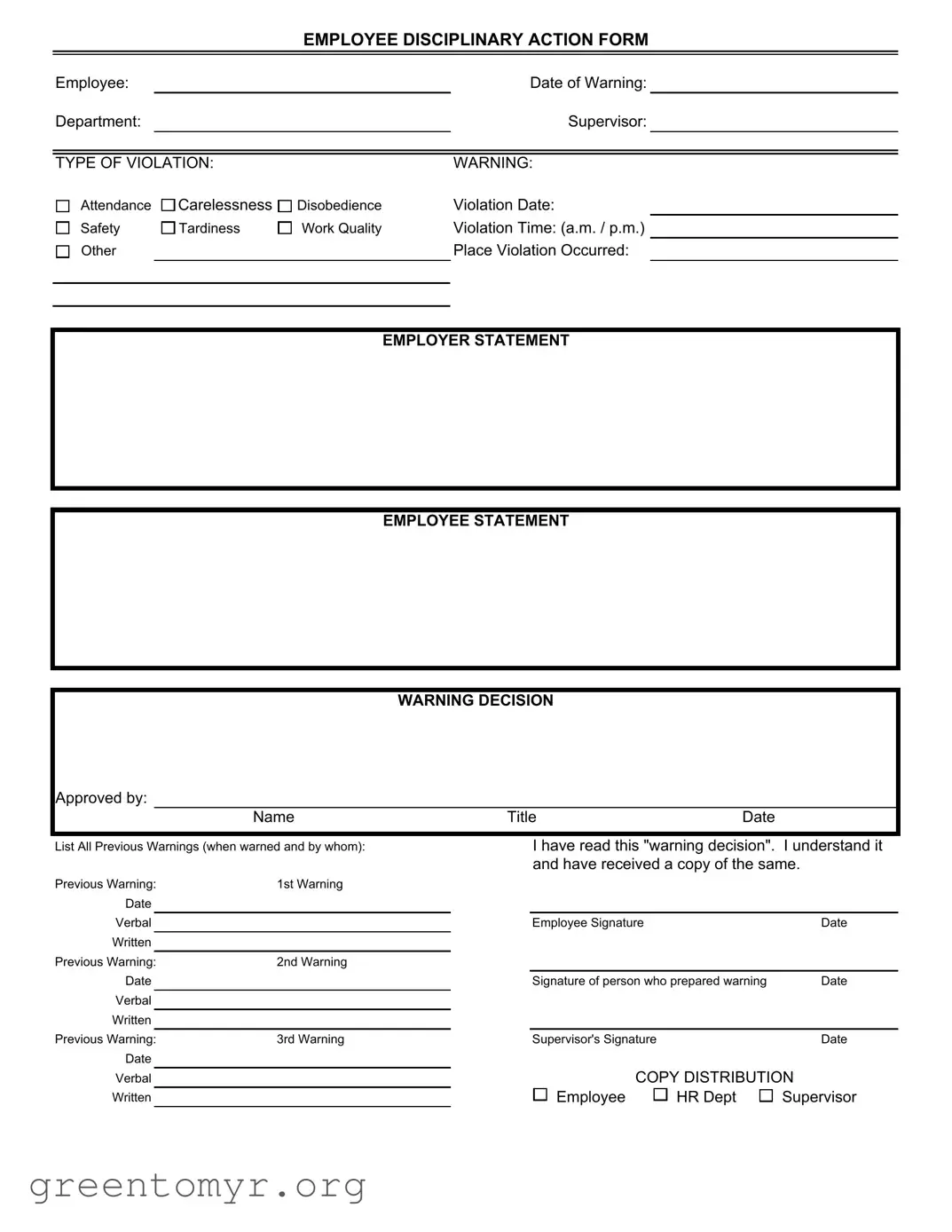
The Disciplinary Action form serves as a critical tool for maintaining workplace standards and addressing employee conduct. It documents various types of violations, including attendance issues, carelessness, safety breaches, and tardiness, ensuring that all employees are held accountable for their actions. The form captures essential details, such as the date of the warning, the department involved, and the supervisor overseeing the process. It also includes sections for both the employer and employee statements, allowing for a clear record of perspectives regarding the incident. Additionally, the form tracks previous warnings, creating a comprehensive history of an employee's conduct. This history is vital for understanding patterns and making informed decisions about future disciplinary actions. The approval section confirms that the warning has been reviewed by a designated authority, while the signature lines ensure that all parties acknowledge the warning decision. Finally, the distribution of copies to the employee, HR department, and supervisor guarantees transparency and accountability throughout the process.
EMPLOYEE DISCIPLINARY ACTION FORM
Employee: |
|
Date of Warning: |
Department:Supervisor:
TYPE OF VIOLATION:
Attendance Carelessness
Safety |
Tardiness |
Other
|
WARNING: |
Disobedience |
Violation Date: |
Work Quality |
Violation Time: (a.m. / p.m.) |
|
Place Violation Occurred: |
EMPLOYER STATEMENT
EMPLOYEE STATEMENT
WARNING DECISION
Approved by:
|
|
Name |
Title |
Date |
|
|
||
|
|
|
|
|
||||
List All Previous Warnings (when warned and by whom): |
|
I have read this "warning decision". I understand it |
||||||
|
|
|
|
and have received a copy of the same. |
||||
Previous Warning: |
1st Warning |
|
|
|
|
|
|
|
Date |
|
|
|
|
|
|
|
|
Verbal |
|
|
|
Employee Signature |
|
Date |
||
Written |
|
|
|
|
|
|
|
|
Previous Warning: |
2nd Warning |
|
|
|
|
|
|
|
Date |
|
|
|
Signature of person who prepared warning |
Date |
|||
Verbal |
|
|
|
|
|
|
|
|
Written |
|
|
|
|
|
|
|
|
Previous Warning: |
3rd Warning |
|
Supervisor's Signature |
|
Date |
|||
Date |
|
|
|
|
|
|
|
|
Verbal |
|
|
COPY DISTRIBUTION |
|||||
Written |
|
|
|
Employee |
|
HR Dept |
Supervisor |
|
|
|
|
||||||
| Fact Name | Description |
|---|---|
| Employee Information | The form requires the employee's name, the date of the warning, the department, and the supervisor's name. |
| Type of Violation | It includes options for various types of violations, such as attendance, carelessness, safety, tardiness, and others. |
| Warning Details | Specifics about the violation must be documented, including the date and time it occurred, as well as the place of the violation. |
| Employer Statement | The form provides a section for the employer to state their position regarding the disciplinary action taken. |
| Employee Statement | Employees have the opportunity to provide their own statement regarding the warning, ensuring their voice is heard. |
| Previous Warnings | There is a section to list all previous warnings, including the dates and the individuals who issued them. |
| Approval Section | The form requires approval from a designated authority, including their name, title, and date of approval. |
| Copy Distribution | Instructions for distributing copies to the employee, HR department, and supervisor are included to ensure proper record-keeping. |
Completing the Disciplinary Action form is an important step in documenting employee behavior and ensuring that all parties understand the situation. Following these steps will help ensure that the form is filled out accurately and completely.
The Disciplinary Action form serves as a formal record of employee violations and the corresponding disciplinary measures taken by the employer. It documents the type of violation, the dates of warnings, and the statements from both the employer and employee. This form helps ensure that there is a clear understanding of the issues at hand and provides a reference for future actions if necessary.
The form allows for various types of violations to be recorded. Common categories include:
Employers can select the relevant category that best describes the employee's behavior or performance issue.
Once a warning decision is made, it is documented on the form. The employee is then required to sign the form, indicating that they have read and understood the warning. A copy of the form is provided to the employee, ensuring they have a record of the disciplinary action taken against them.
The form includes a section to list all previous warnings issued to the employee. This section requires the following details:
This information helps create a comprehensive history of the employee's disciplinary record.
Once completed, the Disciplinary Action form is distributed to several parties. Copies are given to the employee, the HR department, and the supervisor. This distribution ensures that all relevant parties are informed of the disciplinary action and can reference the document as needed in future evaluations or decisions.
Filling out the Disciplinary Action form can be straightforward, but many people make common mistakes that can lead to misunderstandings or complications down the line. One frequent error is failing to provide complete information. Each section of the form is crucial. If the employee's name, date of warning, or type of violation is missing, it can create confusion and may even invalidate the warning.
Another mistake is not documenting the specifics of the violation. It's essential to include details such as the date and time of the incident, along with the place where it occurred. General statements do not provide the clarity needed for effective communication. Without these specifics, the employee may not fully understand the context of the warning.
Additionally, many individuals overlook the importance of including previous warnings. The form has a section for listing all prior warnings, which is vital for establishing a pattern of behavior. Skipping this step can lead to the perception that the current warning is unjustified. If previous warnings are not documented, it can weaken the case against the employee.
Finally, signatures are often a source of oversight. Both the employee and the supervisor must sign the form to acknowledge that they have read and understood the warning decision. Failing to obtain these signatures can result in disputes about whether the employee was aware of the warning. Ensuring that all necessary signatures are present is a simple yet critical step in the process.
The Disciplinary Action form is an essential document used by employers to formally address employee violations. However, several other forms and documents often accompany it to ensure a comprehensive approach to employee management and compliance with organizational policies. Below is a list of these related documents.
These documents collectively support a fair and transparent disciplinary process, ensuring that both the employer and employee have a clear understanding of expectations, rights, and responsibilities.
When filling out the Disciplinary Action form, it's important to approach the process with care and consideration. Here are ten things you should and shouldn't do:
By following these guidelines, you can help ensure that the disciplinary process is fair and transparent for everyone involved.
Understanding the Disciplinary Action form is essential for both employees and employers. However, several misconceptions can lead to confusion. Here are seven common misunderstandings about this important document:
By clearing up these misconceptions, both employees and employers can better navigate the disciplinary process and work towards a more productive workplace.
When filling out and using the Disciplinary Action form, it is essential to follow certain guidelines to ensure clarity and effectiveness. Here are some key takeaways:
Following these guidelines can help create a fair and organized disciplinary process, fostering a better work environment for everyone involved.