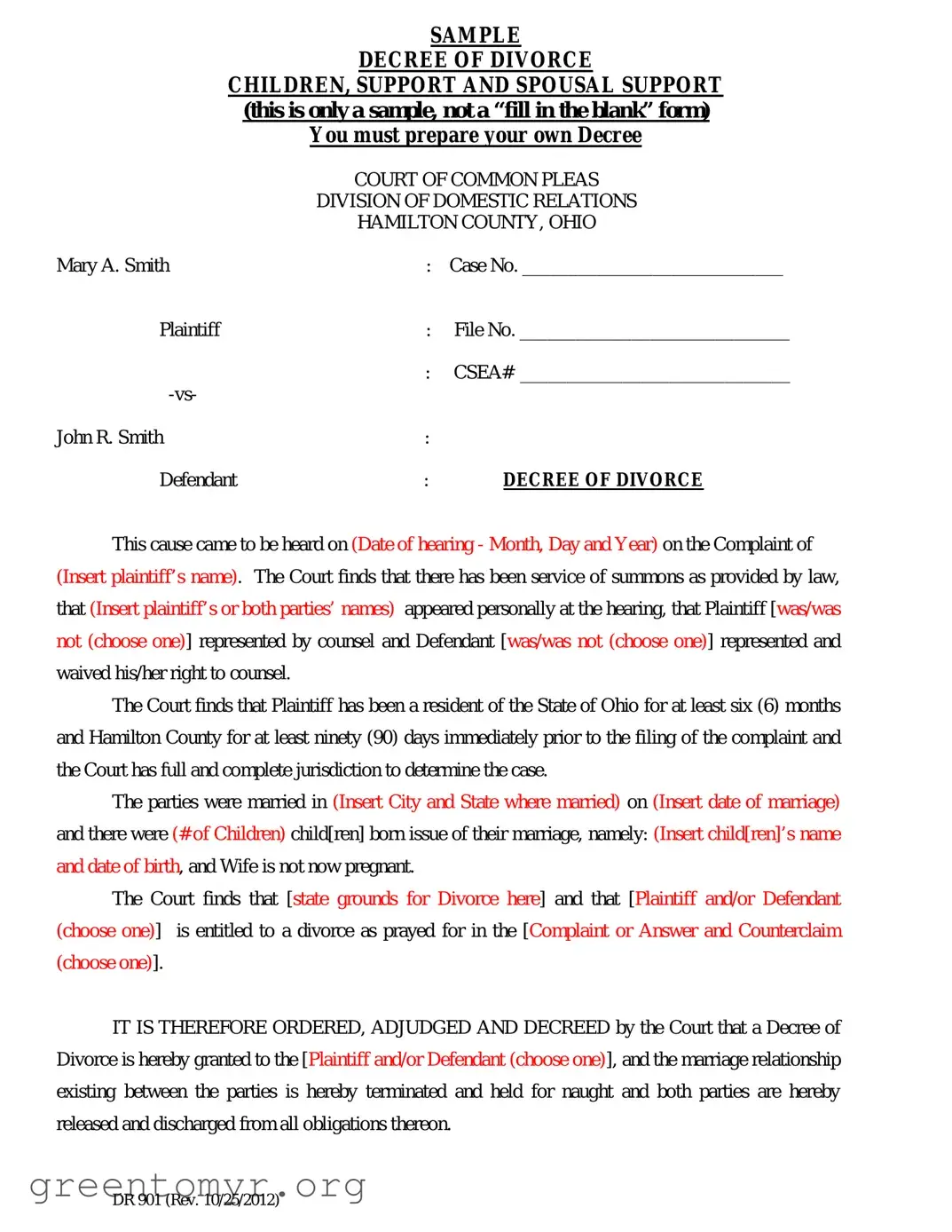
The Divorce Decree Sample form serves as a critical document in the legal dissolution of marriage, outlining essential elements that govern the terms of the divorce. This sample provides a framework for addressing issues such as child custody, child support, and spousal support. It begins with a statement of the court's jurisdiction and the details of the marriage, including the names of the parties involved and the date of marriage. The decree also specifies the grounds for divorce and confirms the parties' residency requirements. Custody arrangements for minor children are clearly stated, designating a residential parent and outlining parenting time. Furthermore, it addresses financial obligations, detailing child support amounts and spousal support provisions. This document incorporates any separation agreements and establishes the division of property, ensuring that both parties understand their rights and responsibilities. The decree concludes with instructions regarding health insurance for children and outlines the necessary forms required for compliance. By following this sample, individuals can better navigate the complexities of divorce proceedings.
SAMPLE
DECREE OF DIVORCE
CHILDREN, SUPPORT AND SPOUSAL SUPPORT (this is only a sample, not a “fill in the blank” form)
You must prepare your own Decree
COURT OF COMMON PLEAS
DIVISION OF DOMESTIC RELATIONS
HAMILTON COUNTY, OHIO
Mary A. Smith |
: |
Case No. ____________________________ |
Plaintiff |
: |
File No. _____________________________ |
: |
CSEA# _____________________________ |
|
|
|
|
John R. Smith |
: |
|
Defendant |
: |
DECREE OF DIVORCE |
This cause came to be heard on (Date of hearing - Month, Day and Year) on the Complaint of (Insert plaintiff’s name). The Court finds that there has been service of summons as provided by law, that (Insert plaintiff’s or both parties’ names) appeared personally at the hearing, that Plaintiff [was/was not (choose one)] represented by counsel and Defendant [was/was not (choose one)] represented and waived his/her right to counsel.
The Court finds that Plaintiff has been a resident of the State of Ohio for at least six (6) months and Hamilton County for at least ninety (90) days immediately prior to the filing of the complaint and the Court has full and complete jurisdiction to determine the case.
The parties were married in (Insert City and State where married) on (Insert date of marriage) and there were (# of Children) child[ren] born issue of their marriage, namely: (Insert child[ren]’s name and date of birth, and Wife is not now pregnant.
The Court finds that [state grounds for Divorce here] and that [Plaintiff and/or Defendant (choose one)] is entitled to a divorce as prayed for in the [Complaint or Answer and Counterclaim (choose one)].
IT IS THEREFORE ORDERED, ADJUDGED AND DECREED by the Court that a Decree of Divorce is hereby granted to the [Plaintiff and/or Defendant (choose one)], and the marriage relationship existing between the parties is hereby terminated and held for naught and both parties are hereby released and discharged from all obligations thereon.
DR 901 (Rev. 10/25/2012)
IT IS FURTHER ORDERED THAT THE [Separation Agreement/Agreed Entry (choose one)] which is attached hereto is hereby incorporated into the Court’s order and is a part of this Decree of Divorce as if fully rewritten. The parties acknowledge under oath that they have voluntarily entered into the [Separation Agreement/Agreed Entry (choose one)], that they have made full disclosure of all assets and liabilities, and that they understand the terms of said agreement.
IT IS FURTHER ORDERED that the (Insert name of residential parent) is the residential parent and legal custodian of the minor child[ren], (Insert names of child[ren]) and (Insert
OR
IT IS FURTHER ORDERED that the parties have entered into a Shared Parenting Plan which has been submitted to and approved by the Court. Both parents shall be designated residential parent and legal custodian, with parenting time as outlined in the Decree of Shared Parenting, filed herewith.
IT IS FURTHER ORDERED that (Insert name of parent ordered to pay child support) (Obligor)shall pay as and for the support of the minor child[ren] the sum of $(Insert Dollar Amount to pay) per month, per child, plus 2% processing charge, payable through The Office of Child Support of The Department of Jobs and Family Services for the parties' child[ren]. This order is effective (Insert date child support order begins) and is payable monthly in the total amount of $(Insert total child support obligation), including the processing charge.
This support order amount is the same as that indicated on the signed and attached child support worksheet
OR
This support order amount is different from that indicated on the attached child support worksheet and the deviation is in the child(ren)’s best interest because: (state specific reasons).
Notwithstanding Section 3109.01 of the Revised Code, the parental duty of support to children, including the duty of a parent to pay support pursuant to a child support order shall continue beyond the child's eighteenth birthday only in accordance with Section 3119.86 of the Revised Code. The duty of support shall continue during seasonal vacations. The Obligor is responsible for making payments directly to The Office of Child Support of The Department of Jobs and Family Services until such time as a deduction order takes effect. Any payment made directly to the residential parent and not through The Office of Child Support of The Department of Jobs and Family Services shall be deemed a gift and not credited to the support account.
DR 901 (Rev. 10/25/2012)
All support under this order shall be withheld or deducted from the income or assets of the obligor pursuant to a withholding or deduction notice or appropriate order issued in accordance with Chapters 3119, 3121, 3123, and 3125 of the Revised Code or a withdrawal directive issued pursuant to sections 3123.24 to 3123.38 of the Revised Code and shall be forwarded to the obligee in accordance with Chapters 3119, 3121, 3123 and 3125 of the Revised Code. A person and/or entity required to comply with withholding or deduction notices described in Section 3121.03 of the Revised Code shall determine the manner of withholding or deducting from the specific requirement included in the notices without the need for any amendment to the support order, and a person required to comply with an order described in sections 3121.03, 3121.04 to 3121.06 and 3121.12 of the Revised Code shall comply without need for any amendment to the support order. The withholding or deduction noticed and other orders issued under sections 3121.03, 3121.04 to 3121.06 and 3121.12 of the Revised Code, and the notices that require the obligor to notify the child support enforcement agency administering the support order of any change in the obligor’s employment status or of any other change in the status of the obligor’s assets, are final and enforceable by the court.
EACH PARTY TO THIS SUPPORT ORDER MUST NOTIFY THE CHILD SUPPORT ENFORCEMENT AGENCY IN WRITING OF HIS OR HER CURRENT MAILING ADDRESS, CURRENT RESIDENCE ADDRESS, CURRENT RESIDENCE TELEPHONE NUMBER, CURRENT DRIVER’S LICENSE NUMBER, AND OF ANY CHANGES IN THAT INFORMATION. EACH PARTY MUST NOTIFY THE AGENCY OF ALL CHANGES UNTIL FURTHER NOTICE FROM THE COURT OR AGENCY, WHICHEVER ISSUED THE SUPPORT ORDER. IF YOU ARE THE OBLIGOR UNDER A CHILD SUPPORT ORDER AND YOU FAIL TO MAKE THE REQUIRED NOTIFICATIONS, YOU MAY BE FINED UP TO $50 FOR A FIRST OFFENSE, $100 FOR A SECOND OFFENSE, AND $500 FOR EACH SUBSEQUENT OFFENSE. IF YOU ARE AN OBLIGOR OR OBLIGEE UNDER ANY CHILD SUPPORT ORDER ISSUED BY A COURT AND YOU WILLFULLY FAIL TO GIVE THE REQUIRED NOTICES, YOU MAY BE FOUND IN CONTEMPT OF COURT AND BE SUBJECTED TO FINES UP TO $1,000 AND IMPRISONMENT FOR NOT MORE THAN 90 DAYS.
IF YOU ARE AN OBLIGOR AND YOU FAIL TO GIVE THE REQUIRED NOTICES, YOU MAY NOT RECEIVE NOTICE OF THE FOLLOWING ENFORCEMENT ACTIONS AGAINST YOU: IMPOSITION OF LIENS AGAINST YOUR PROPERTY; LOSS OF YOUR PROFESSIONAL OR OCCUPATIONAL LICENSE, DRIVER’S LICENSE, OR RECREATIONAL LICENSE; WITHHOLDING FROM YOUR INCOME; ACCESS RESTRICTION AND DEDUCTION FROM YOUR ACCOUNTS IN FINANCIAL INSTITUTIONS; AND ANY OTHER ACTION PERMITTED BY LAW TO OBTAIN MONEY FROM YOU TO SATISFY YOUR SUPPORT OBLIGATION.
DR 901 (Rev. 10/25/2012)
IT IS FURTHER ORDERED THAT [Mother/Father (choose one)] shall maintain private health insurance for the parties’ child/children so long as [he/she (choose one) ]has accessible health insurance available for 5% or less of his/her gross annual income. A Qualified Medical Child Support Order [if no health insurance is available to either party, a Shared Liability Health Care Order] shall issue. This order shall remain in effect until the child reaches the age of eighteen (18) and no longer attends an accredited high school on a
IT IS FURTHER ORDERED that (Insert Plaintiff’s or Defendant’s name) shall pay spousal support in the amount of $(Insert Dollar Amount to pay) per month for (Insert # of months) months, effective (Insert date spousal support shall begin), payable through the The Office of Child Support of The Department of Jobs and Family Services, plus 2% processing fee. The Court [shall/shall not (choose one)] retain jurisdiction over the term or the amount of this order.
IT IS FURTHER ORDERED that [each party shall retain all property presently held in his/her name or possession, free and clear of any claim by the other and shall be solely liable for any debts presently held in his/her name and hold the other harmless on same] or [property shall be divided pursuant to the attached Separation Agreement] or [repeat the property distribution as stated in a Magistrate’s
(Insert Plaintiff’s or Defendant’s Name) shall be restored to her maiden name of (Insert name to be restored to).
[Insert name of person to be responsible to pay or ½ each] shall pay court costs.
|
_____________________________________ |
|
Judge |
_______________________________ |
_____________________________________ |
Plaintiff |
Defendant |
_______________________________ |
_____________________________________ |
Attorney |
Attorney |
DR 901 (Rev. 10/25/2012)
REQUIRED FORMS FOR DECREE: (ORIGINAL + 4 COPIES)
Divorce Decree
oSeparation Agreement or Agreed Entry (if appropriate) Child Support Worksheet (form 7.5A or 7.6)
Standard Parenting Order (if appropriate- form 2.7)
Appropriate Health Care Order (7.17 if private health insurance is available-
7.20if private health insurance is not available)
Cash Medical Order (form 7.24)
IF SHARED PARENTING: (ORIGINAL + 4 COPIES)
Divorce Decree
Separation Agreement or Agreed Entry (if appropriate)
Final Decree of Shared Parenting (form 2.3)
Approved Shared Parenting Plan
Child Support Worksheet (form 7.5A or 7.6)
Standard Parenting Order (if appropriate- form 2.7)
Appropriate Health Care Order (7.17 if private health insurance is available- 7.20 if not)
Cash Medical Order (form 7.24)
ADDITIONAL FORMS: (1 COPY)
SUPPORT ACCOUNT DATA FORM (CDR4905)
COPY OF
HEALTH CARE VERIFICATION (IF APPROPRIATE- FORM 7.21)
DR 901 (Rev. 10/25/2012)
| Fact Name | Fact Description |
|---|---|
| Purpose | The Divorce Decree Sample form serves as a template for finalizing a divorce, outlining the terms of the divorce agreement between the parties. |
| Jurisdiction | This form is specific to the Court of Common Pleas, Division of Domestic Relations in Hamilton County, Ohio. |
| Residency Requirement | The Plaintiff must have been a resident of Ohio for at least six months and of Hamilton County for at least ninety days prior to filing. |
| Children | The form allows for the inclusion of children born from the marriage, detailing custody and support arrangements. |
| Support Orders | Child support payments are specified, including amounts, payment methods, and the obligation to notify changes to the Child Support Enforcement Agency. |
| Spousal Support | Spousal support terms can be included, specifying the amount and duration of payments, if applicable. |
| Property Division | The form allows for the division of property, either retaining individual ownership or following a separation agreement. |
| Health Insurance | Provisions for maintaining health insurance for children are included, ensuring coverage until they reach eighteen or finish high school. |
| Required Forms | Several forms must accompany the Divorce Decree, including a Child Support Worksheet and a Parenting Order, depending on the circumstances. |
| Legal Authority | The decree is governed by Ohio Revised Code Sections 3109.01, 3119.86, and related chapters concerning child support and custody. |
Completing the Divorce Decree Sample form is a crucial step in finalizing a divorce. It requires careful attention to detail to ensure that all necessary information is accurately provided. Follow the steps below to fill out the form correctly.
After completing the form, make sure to gather all required supporting documents. Submit the original form and copies as needed to the court. This will help ensure that your divorce proceedings move forward smoothly.
A Divorce Decree Sample form serves as a template to illustrate what a final divorce decree might look like. It outlines the terms and conditions of a divorce, including child custody, support obligations, and property division. However, it is important to note that this is not a fill-in-the-blank form; individuals must prepare their own decree based on their specific circumstances.
A Divorce Decree is a legally binding document that officially terminates a marriage. It outlines the rights and responsibilities of both parties regarding children, finances, and property. Having a clear decree helps prevent future disputes and provides a legal framework for enforcement if either party fails to comply with the agreed terms.
A Divorce Decree typically includes the following components:
Child support is determined based on several factors, including the needs of the child, the income of both parents, and state guidelines. The decree will specify the monthly amount to be paid, any applicable processing fees, and the method of payment. It may also outline any deviations from standard guidelines and the reasons for those deviations.
If a party fails to comply with the terms of the Divorce Decree, the other party can seek enforcement through the court. This may involve filing a motion for contempt, which can lead to penalties such as fines or even imprisonment. The court has the authority to enforce support orders and other obligations to ensure compliance.
Yes, a Divorce Decree can be modified, but only under certain circumstances. Changes in financial situations, such as job loss or significant income changes, can warrant a modification of child support or spousal support. Additionally, changes in the needs of the children or living arrangements may also justify a modification of custody or parenting time agreements. A formal request must be made to the court to initiate this process.
The court plays a crucial role in reviewing and finalizing the Divorce Decree. It ensures that all legal requirements are met, including jurisdiction and proper documentation. The court also evaluates the proposed terms for fairness and legality before issuing the decree. Once the decree is signed by the judge, it becomes enforceable.
Several forms are typically required to accompany the Divorce Decree, including:
Additional forms may also be needed depending on specific circumstances, such as shared parenting arrangements.
Filling out the Divorce Decree Sample form can be a daunting task, and many individuals make common mistakes that can lead to complications down the line. One significant error is failing to provide complete and accurate information about the parties involved. It's crucial to ensure that the names of both the plaintiff and defendant are spelled correctly and that all relevant details, such as case numbers and dates, are included. Missing or incorrect information can delay the process and may require additional court appearances.
Another frequent mistake is neglecting to specify the grounds for divorce. This section is essential, as it outlines the reason for the divorce and can impact the court's decision. If this information is left blank or improperly filled out, it may lead to confusion or even rejection of the decree. Similarly, people often forget to indicate whether they or their spouse were represented by counsel during the hearing. This detail is vital, as it can affect the validity of the proceedings.
Many individuals also overlook the importance of accurately detailing child custody arrangements. It's not enough to simply state who will be the residential parent; the decree should clearly outline the parenting plan and visitation rights. Failing to do so can lead to misunderstandings and disputes later on. Additionally, it’s essential to ensure that the child support obligations are clearly defined, including the amount and payment schedule. Inaccuracies in this section can result in financial strain and further legal issues.
Another common error is not incorporating the Separation Agreement or Agreed Entry properly. This document is a crucial part of the divorce decree, and failing to attach it or reference it correctly can lead to complications. Similarly, individuals sometimes forget to include necessary supporting documents, such as the Child Support Worksheet or Health Care Orders. These forms provide essential context and details that the court needs to finalize the decree.
Furthermore, people often make the mistake of not addressing spousal support adequately. It’s important to specify the amount, duration, and effective date of any spousal support payments. Leaving this information vague can lead to disputes and confusion later. Additionally, individuals may forget to indicate whether the court will retain jurisdiction over the support order, which can impact future modifications.
Lastly, many individuals neglect to proofread their completed forms. Typos or unclear language can lead to misunderstandings or even legal challenges. Taking the time to review the document carefully can save significant time and stress. By avoiding these common pitfalls, individuals can ensure that their Divorce Decree is complete, accurate, and ready for submission to the court.
When navigating the process of divorce, several important forms and documents accompany the Divorce Decree. Each of these documents plays a crucial role in ensuring that the divorce proceedings are comprehensive and legally binding. Below is a list of these forms, along with a brief description of each.
Each of these documents plays a vital role in the divorce process, helping to clarify responsibilities and ensure that both parties adhere to the agreed-upon terms. Understanding these forms can significantly ease the transition during what is often a challenging time.
When filling out the Divorce Decree Sample form, it is essential to approach the task with care and attention to detail. Below are five important dos and don'ts to consider during this process.
By following these guidelines, individuals can navigate the completion of the Divorce Decree Sample form more effectively, helping to ensure that the process proceeds smoothly.
Understanding the Divorce Decree Sample form is essential for anyone navigating the divorce process. However, several misconceptions can lead to confusion. Below are five common misconceptions about this form:
Addressing these misconceptions can help individuals better understand the divorce process and prepare accordingly. Knowledge of the nuances involved in drafting a divorce decree is vital for ensuring that all parties' rights and responsibilities are accurately represented.
When dealing with the Divorce Decree Sample form, there are several important considerations to keep in mind. Understanding these elements can help ensure that the process runs smoothly and that all necessary information is accurately provided.
By paying attention to these key takeaways, individuals can navigate the complexities of filling out and using the Divorce Decree Sample form more effectively. Proper preparation and attention to detail are crucial in ensuring that all legal requirements are met.