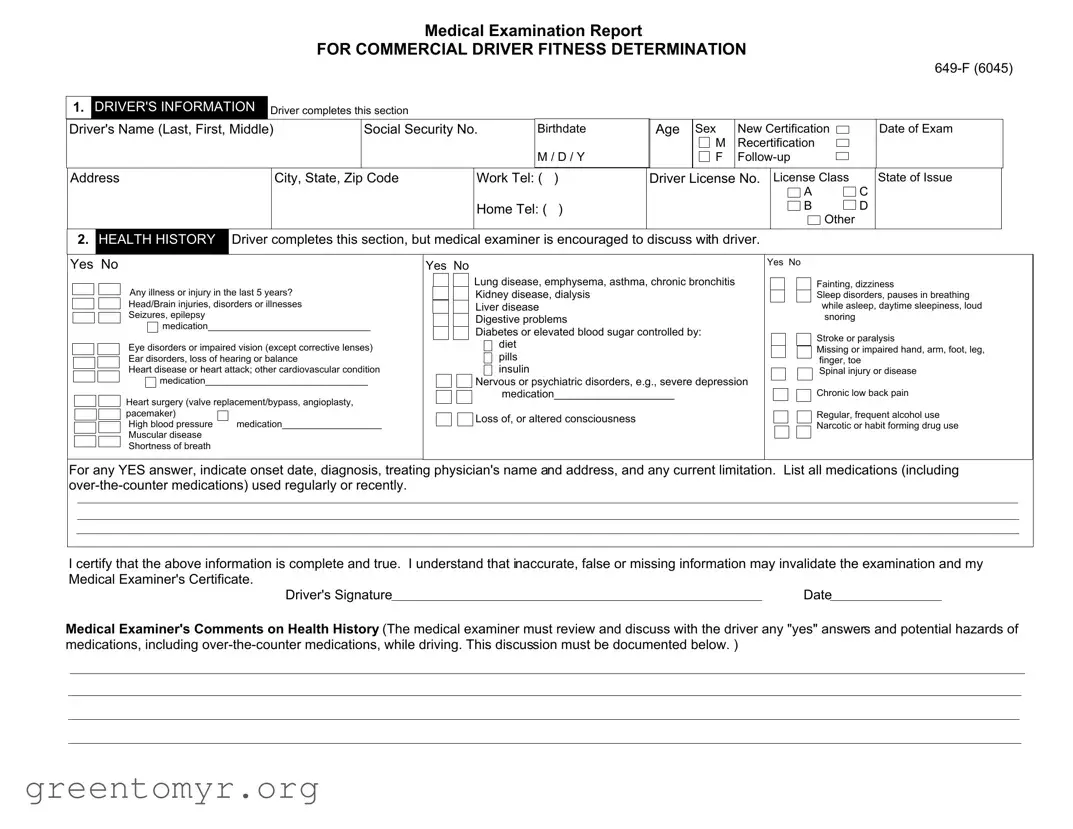
The DOT Medical form plays a crucial role in ensuring the safety and fitness of commercial drivers in the United States. This comprehensive document, officially titled the Medical Examination Report for Commercial Driver Fitness Determination, is designed to assess a driver's health and ability to operate a commercial motor vehicle safely. It begins with the driver's personal information, including their name, social security number, and driving history. Following this, the form delves into a detailed health history section where drivers disclose any medical conditions or treatments that could impact their driving capabilities. Medical examiners are encouraged to engage in discussions with the driver regarding their health status, particularly concerning any affirmative responses in the health history section. The form also includes sections for vision and hearing tests, blood pressure readings, and laboratory findings, all of which must meet specific standards to qualify for a medical examiner's certificate. Additionally, the physical examination section evaluates various body systems to identify any abnormalities that might hinder a driver's performance. Ultimately, the DOT Medical form is not just a bureaucratic requirement; it serves as a vital tool in maintaining road safety and ensuring that commercial drivers are fit for the demanding nature of their work.

Medical Examination Report
FOR COMMERCIAL DRIVER FITNESS DETERMINATION
1. |
DRIVER'S INFORMATION |
Driver completes this section |
|
|
Driver's Name (Last, First, Middle) |
Social Security No. |
Birthdate |
||
|
|
|
|
M / D / Y |
|
|
|
|
|
Age
Sex |
New Certification |
M |
Recertification |
F |
|
|
|
Date of Exam
Address |
City, State, Zip Code |
Work Tel: ( |
) |
|
|
Home Tel: ( |
) |
|
|
|
|
|
|
|
|
|
|
Driver License No. |
License Class |
|
State of Issue |
||
|
|
|
A |
C |
|
|
|
|
B |
D |
|
|
|
|
Other |
|
|
|
|
|
|
|
|
|
|
|
|
|
|
|
|
|
|
|
|
|
|
|
|
|
|
|
|
2. |
HEALTH HISTORY |
Driver completes this section, but medical examiner is encouraged to discuss with driver. |
|
|
|
|
|
||||||||||
|
|
|
|
|
|
|
|
|
|
|
|
|
|
|
|
|
|
|
Yes No |
|
Yes No |
Yes No |
|||||||||||||||
|
|
|
|
|
|
|||||||||||||
|
|
|
Any illness or injury in the last 5 years? |
|
|
|
|
|
|
|
Lung disease, emphysema, asthma, chronic bronchitis |
|
|
|
|
Fainting, dizziness |
||
|
|
|
|
|
|
|
|
|
|
|
|
|
|
|||||
|
|
|
|
|
|
|
|
|
|
Kidney disease, dialysis |
|
|
|
|
Sleep disorders, pauses in breathing |
|||
|
|
|
Head/Brain injuries, disorders or illnesses |
|
|
|
|
|
|
|
Liver disease |
|
|
|
|
while asleep, daytime sleepiness, loud |
||
|
|
|
||||||||||||||||
|
|
|
Seizures, epilepsy |
|
|
|
|
|
|
|
|
Digestive problems |
|
|
|
|
snoring |
|
|
|
|
medication_______________________________ |
|
|
|
|
|
|
|
|
|
|
|
|
|||
|
|
|
|
|
|
|
|
|
|
Diabetes or elevated blood sugar controlled by: |
|
|
|
|
Stroke or paralysis |
|||
|
|
|
|
|
|
|
|
|
|
|
|
|
|
|
|
|||
|
|
|
|
|
|
|
|
|
|
|
|
|
|
|
|
|||
|
|
|
Eye disorders or impaired vision (except corrective lenses) |
|
|
|
|
|
|
|
diet |
|
|
|
|
|||
|
|
|
|
|
|
|
|
|
|
pills |
|
|
|
|
Missing or impaired hand, arm, foot, leg, |
|||
|
|
|
Ear disorders, loss of hearing or balance |
|
|
|
|
|
|
|
|
|
|
|
finger, toe |
|||
|
|
|
|
|
|
|
|
|
|
|
|
|
|
|||||
|
|
|
Heart disease or heart attack; other cardiovascular condition |
|
|
|
|
|
|
|
insulin |
|
|
|
|
Spinal injury or disease |
||
|
|
|
||||||||||||||||
|
|
|
medication_______________________________ |
|
|
|
|
|
|
|
Nervous or psychiatric disorders, e.g., severe depression |
|
|
|
|
Chronic low back pain |
||
|
|
|
|
|
|
|
||||||||||||
|
|
|
Heart surgery (valve replacement/bypass, angioplasty, |
|
|
|
|
|
|
|
medication____________________ |
|
|
|
|
|||
|
|
|
|
|
|
|
|
|
|
|
|
|
|
|||||
|
|
|
pacemaker) |
|
|
|
|
|
|
|
|
Loss of, or altered consciousness |
|
|
|
|
Regular, frequent alcohol use |
|
|
|
|
|
|
|
|
|
|
|
|
|
|
|
|
||||
|
|
|
High blood pressure |
medication___________________ |
|
|
|
|
|
|
|
|
|
|
|
Narcotic or habit forming drug use |
||
|
|
|
|
|
|
|
|
|
|
|
|
|
|
|
|
|||
|
|
|
Muscular disease |
|
|
|
|
|
|
|
|
|
|
|
|
|
|
|
|
|
|
|
|
|
|
|
|
|
|
|
|
|
|
|
|
|
|
|
|
|
Shortness of breath |
|
|
|
|
|
|
|
|
|
|
|
|
|
|
|
|
|
|
|
|
|
|
|
|
|
|
|
|
|
|
|
|
|
|
|
|
|
|
|
|
|
|
|
|
|
|
|
|
|
|
|
|
|
For any YES answer, indicate onset date, diagnosis, treating physician's name and address, and any current limitation. List all medications (including
I certify that the above information is complete and true. I understand that inaccurate, false or missing information may invalidate the examination and my Medical Examiner's Certificate.
Driver's Signature |
|
Date |
|
|
|
|
|
Medical Examiner's Comments on Health History (The medical examiner must review and discuss with the driver any "yes" answers and potential hazards of medications, including
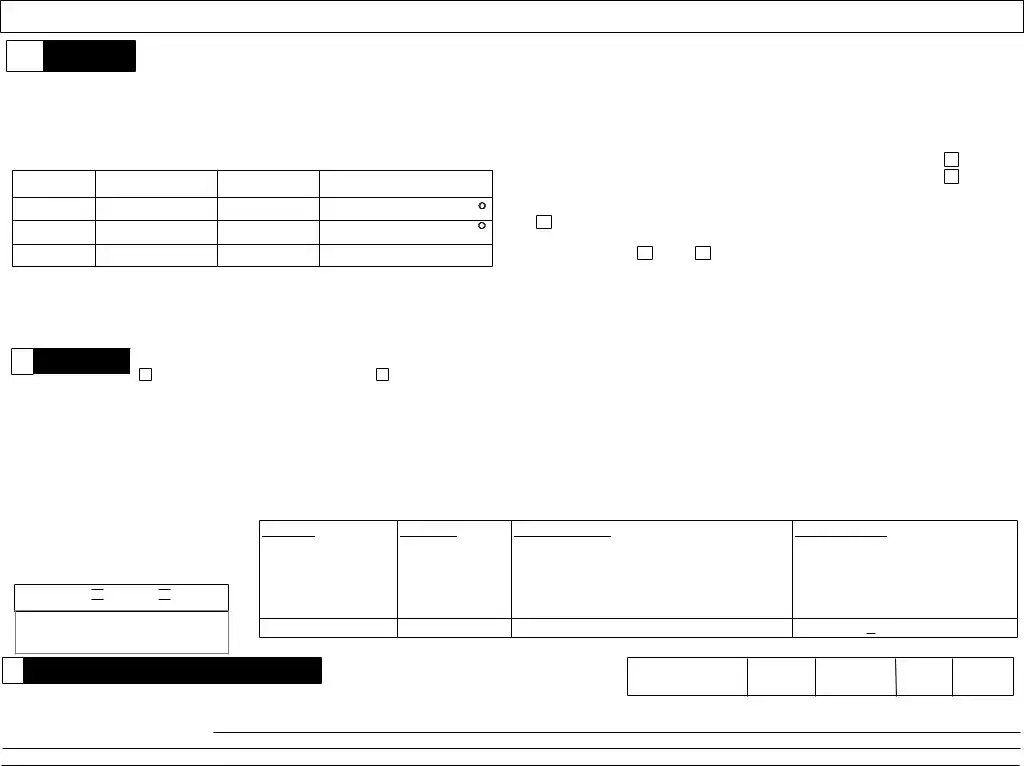
TESTING (Medical Examiner completes Section 3 through 7) NAME: LAST, |
FIRST, |
MIDDLE, |
3.
VISION
Standard: At least 20/40 acuity (Snellen) in each eye with or without correction. At least 70 degrees peripheral in horizontal meridian measured in each eye. The use of corrective lenses should be noted on the Medical Examiner's Certificate.
INSTRUCTIONS: When other than the Snellen chart is used, give test results in
Numerical readings must be provided. |
|
Applicant can recognize and distinguish among traffic control |
||||
ACUITY |
UNCORRECTED |
CORRECTED |
HORIZONTAL FIELD OF VISION |
signals and devices showing standard red, green, and amber colors ? |
||
|
|
|
||||
Right Eye |
20/ |
20/ |
Right Eye |
Applicant meets visual acuity requirement only when wearing: |
||
Left Eye |
20/ |
20/ |
Left Eye |
Corrective Lenses |
|
|
|
|
|
||||
Both Eyes |
20/ |
20/ |
|
Monocular Vision: |
Yes |
No |
|
|
|
|
|||
Yes
No
Complete next line only if vision testing is done by an opthalmologist or optometrist
|
|
|
|
|
|
|
|
|
Date of Examination Name of Ophthalmologist or Optometrist (print) Tel. No. |
|
License No./ State of Issue |
Signature |
|||||
4.HEARING Standard: a) Must first perceive forced whispered voice > 5 ft., with or without hearing aid, or b) average hearing loss in better ear < 40 dB
Check if hearing aid used for tests.
Check if hearing aid required to meet standard.
INSTRUCTIONS: To convert audiometric test results from ISO to ANSI,
Numerical readings must be recorded.
a) Record distance from individual at which |
Right ear |
Left Ear |
forced whispered voice can first be heard. |
\ Feet |
\ Feet |
|
|
|
|
Right Ear |
|
|
Left Ear |
|
|
|
|
|
|
|
|
|
b) If audiometer is used, record hearing loss in |
500 Hz |
1000 Hz |
2000 Hz |
500 Hz |
1000 Hz |
2000 Hz |
|
|
|
|
|
|
|
decibels. (acc. to ANSI |
|
|
|
|
|
|
|
Average: |
|
|
Average: |
|
|
|
|
|
|
|
|
|
5. |
BLOOD PRESSURE/ PULSE RATE |
Numerical readings must be recorded. Medical Examiner should take at least two readings to confirm BP. |
|
|
|
Blood |
Systolic |
Diastolic |
Pressure |
|
|
|
|
|
Driver qualified if <140/90.
Pulse Rate: Regular Irregular
Reading |
Category |
Expiration Date |
Recertification |
|
|
|
|
Stage 1 |
1 year |
1 year if <140/90. |
|
|
|
|
|
|
|
|
|
Stage 2 |
1 year from date of exam if <140/90 |
>180/110
Stage 3
6 months from date of exam if <140/90
6 months if < 140/90
6.LABORATORY AND OTHER TEST FINDINGS
Numerical readings must be recorded. |
SP. GR. PROTEIN BLOOD SUGAR |
|
URINE SPECIMEN |
Urinalysis is required. Protein, blood or sugar in the urine may be an indication for further testing to rule out any underlying medical problem.
Other Testing (Describe and record)
7.
PHYSICAL EXAMINATION |
|
Height: |
(in.) Weight: |
(lbs.) |
NAME: LAST, |
FIRST, |
MIDDLE, |
||
|
|||||||||
|
|
|
|
|
|
|
|
|
|
|
|
|
|
|
|
|
|
|
|
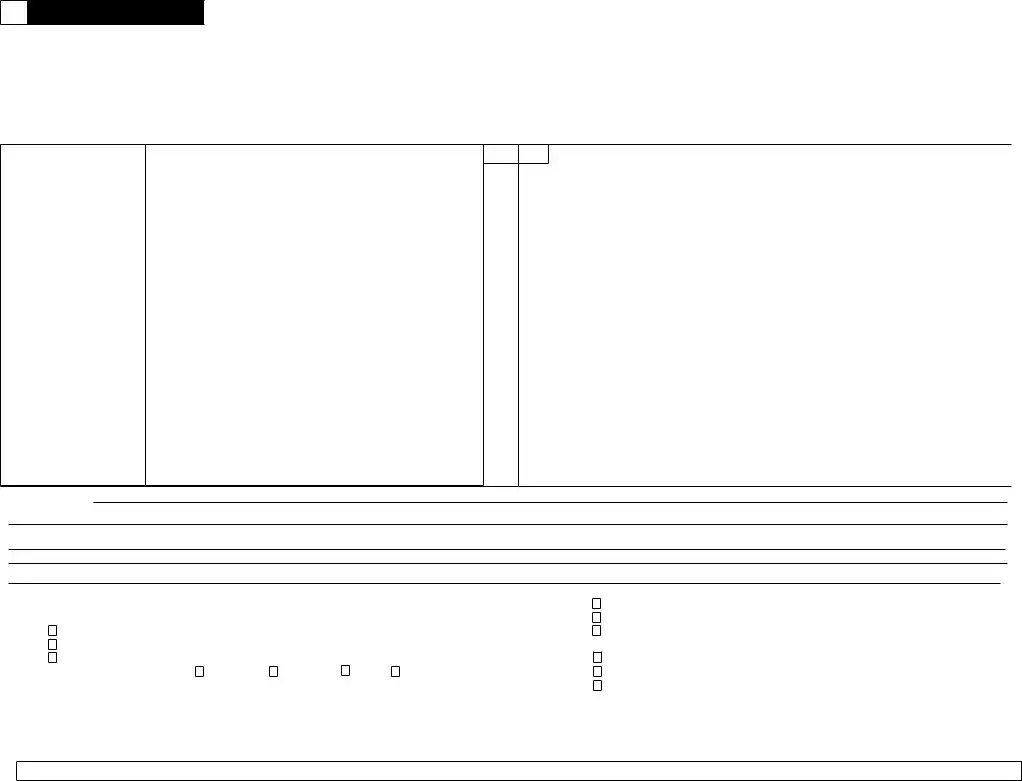
The presence of a certain condition may not necessarily disqualify a driver, particularly if the condition is controlled adequately, is not likely to worsen or is readily amenable to treatment. Even if a condition does not disqualify a driver, the medical examiner may consider deferring the driver temporarily. Also, the driver should be advised to take the necessary steps to correct the condition as soon as possible particularly if the condition, if neglected, could result in more serious illness that might affect driving.
Check YES if there are any abnormalities. Check NO if the body system is normal. Discuss any YES answers in detail in the space below, and indicate whether it would affect the driver's ability to operate a commercial motor vehicle safely. Enter applicable item number before each comment. If organic disease is present, note that it has been compensated for.
See Instructions to the Medical Examiner for guidance.
BODY SYSTEM
1.General Appearance
2.Eyes
3.Ears
4.Mouth and Throat
5.Heart
6.Lungs and chest, not including breast examination
CHECK FOR:
Marked overweight, tremor, signs of alcoholism, problem drinking, or drug abuse.
Pupillary equality, reaction to light, accommodation, ocular motility, ocular muscle imbalance, extraocular movement, nystagmus, exophthalmos. Ask about retinopathy, cataracts, aphakia, glaucoma, macular degeneration and refer to a specialist if appropriate.
Scarring of tympanic membrane, occlusion of external canal, perforated eardrums.
Irremediable deformities likely to interfere with breathing or swallowing.
Murmurs, extra sounds, enlarged heart, pacemaker, implantable defibrillator.
Abnormal chest wall expansion, abnormal respiratory rate, abnormal breath sounds including wheezes or alveolar rales, impaired respiratory function, cyanosis. Abnormal findings on physical exam may require further testing such as pulmonary tests and/ or xray of chest.
YES*
NO
|
BODY SYSTEM |
CHECK FOR: |
YES* |
NO |
|
7. Abdomen and Viscera |
Enlarged liver, enlarged spleen, masses, bruits, |
|
|
|
|
hernia, significant abdominal wall muscle |
|
|
|
|
weakness. |
|
|
|
8. Vascular System |
Abnormal pulse and amplitude, cartoid or |
|
|
|
|
|
|
|
|
|
arterial bruits, varicose veins. |
|
|
|
9. |
Hernias. |
|
|
|
10. Extremities- Limb |
Loss or impairment of leg, foot, toe, arm, hand, |
|
|
|
impaired. Driver may |
finger, Perceptible limp, deformities, atrophy, |
|
|
|
be subject to SPE |
weakness, paralysis, clubbing, edema, |
|
|
|
hypotonia. Insufficicent grasp and prehension |
|
|
|
|
certificate if otherwise |
|
|
|
|
in upper limb to maintain steering wheel grip. |
|
|
|
|
qualified. |
|
|
|
|
Insufficient mobility and strength in lower limb |
|
|
|
|
|
|
|
|
|
|
to operate pedals properly. |
|
|
|
11. Spine, other |
Previous surgery, deformities, limitation of |
|
|
|
musculoskeletal |
motion, tenderness. |
|
|
|
12. Neurological |
Impaired equilibrium, coordination or speech |
|
|
|
pattern; asymmetric deep tendon reflexes, |
|
|
|
|
|
|
|
|
|
|
sensory or positional abnormalities, abnormal |
|
|
|
|
patellar and Babinki's reflexes, ataxia. |
|
|
|
|
|
|
|
*COMMENTS:
Note certification status here. See Instructions to the Medical Examiner for guidance. |
|
|
Wearing corrective lense |
|
|
|
|
|||||||||
|
|
|
|
|
|
|
|
Wearing hearing aid |
|
|
|
|
||||
Meets standards in 49 CFR 391.41; qualifies for 2 year certificate |
|
|
Accompanied by a |
|
|
waiver/ exemption. Driver must present |
||||||||||
|
|
|
|
|||||||||||||
Does not meet standards |
|
|
|
|
|
|
|
exemption at time of certification. |
|
|
|
|
||||
Meets standards, but periodic monitoring required due to |
|
. |
|
|
Skill Performance Evaluation (SPE) Certificate |
|||||||||||
|
|
|
|
|||||||||||||
Driver qualified only for: 3 months |
6 months |
1 year |
Other |
|
|
Driving within an exempt intracity zone (See 49 CFR 391.62) |
||||||||||
|
|
|
|
|
|
|
|
Qualified by operation of 49 CFR 391.64 |
||||||||
|
|
|
|
|
|
|
Medical Examiner's signature |
|
|
|
|
|
||||
Temporarily disqualified due to (condition or medication): |
|
|
Medical Examiner's name |
|
|
|
|
|||||||||
|
|
|
|
|
|
|
Address |
|
|
|
|
|
|
|
|
|
|
|
|
|
|
|
|
|
|
|
|
|
|
|
|
|
|
Return to medical examiner's office for follow up on |
|
|
|
|
|
Telephone Number |
|
|
|
|
|
|||||
|
|
|
|
|
|
|
|
|
||||||||
If meets standards, complete a Medical Examiner's Certificate as stated in 49 CFR 391.43(h). (Driver must carry certificate when operating a commercial vehicle.)

49 CFR 391.41 Physical Qualifications for Drivers
THE DRIVER'S ROLE
Responsibilities, work schedules, physical and emotional demands, and lifestyles among commercial drivers vary by the type of driving that they do. Some of the main types of drivers include the following: turn around or short relay (drivers return to their home base each evening); long relay (drivers drive
The following factors may be involved in a driver's performance of duties: abrupt schedule changes and rotating work schedules, which may result in irregular sleep patterns and a driver beginning a trip in a fatigued condition; long hours; extended time away from family and friends, which may result in lack of social support; tight pickup and delivery schedules, with irregularity in work, rest, and eating patterns, adverse road, weather and traffic conditions, which may cause delays and lead to hurriedly loading or unloading cargo in order to compensate for the lost time; and environmental conditions such as excessive vibration, noise, and extremes in temperature. Transporting passengers or hazardous materials may add to the demands on the commercial driver.
There may be duties in addition to the driving task for which a driver is responsible and needs to be fit. Some of these responsibilities are: coupling and uncoupling trailer(s) from the tractor, loading and unloading trailer(s) (sometimes a driver may lift a heavy load or unload as much as 50,000 lbs. of freight after sitting for a long period of time without any stretching period); inspecting the operating condition of tractor and/or trailer(s) before, during and after delivery of cargo; lifting, installing, and removing heavy tire chains; and, lifting heavy tarpaulins to cover open top trailers. The above tasks demand agility, the ability to bend and stoop, the ability to maintain a crouching position to inspect the underside of the vehicle, frequent entering and exiting of the cab, and the ability to climb ladders on the tractor and/or trailer(s).
In addition, a driver must have the perceptual skills to monitor a sometimes complex driving situation, the judgment skills to make quick decisions, when necessary, and the manipulative skills to control an oversize steering wheel, shift gears using a manual transmission, and maneuver a vehicle in crowded areas.
§391.45 PHYSICAL QUALIFICATIONS FOR DRIVERS
(a)A person shall not drive a commercial motor vehicle unless he is physically qualified to do so and, except as provided in §391.67, has on his person the original, or a photographic copy, of a medical examiner's certificate that he is physically qualified to drive a commercial motor vehicle.
(b)A person is physically qualified to drive a motor vehicle if that person:
(1)Has no loss of a foot, a leg, a hand, or an arm, or has been granted a Skill Performance Evaluation (SPE) Certificate (formerly Limb Waiver Program) pursuant to §391.49.
(2)Has no impairment of: (i) A hand or finger which interferes with prehension or power grasping; or (ii) An arm, foot, or leg which interferes with the ability to perform normal tasks associated with operating a commercial motor vehicle; or any other significant limb defect or limitation which interferes with the ability to perform normal tasks associated with operating a commercial motor vehicle; or has been granted a SPE Certificate pursuant to §391.49.
(3)Has no established medical history or clinical diagnosis of diabetes mellitus currently requiring insulin for control;
(4)Has no current clinical diagnosis of myocardial infarction, angina pectoris, coronary insufficiency, thrombosis, or any other cardiovascular disease of a variety known to be accompanied by syncope, dyspnea, collapse, or congestive cardiac failure.
(5)Has no established medical history or clinical diagnosis of a respiratory dysfunction likely to interfere with his ability to control and drive a commercial motor vehicle safely.
(6)Has no current clinical diagnosis of high blood pressure likely to interfere with his ability to operate a commercial motor vehicle safely.
(7)Has no established medical history or clinical diagnosis of rheumatic, arthritic, orthopedic, muscular, neuromuscular, or vascular disease which interferes with his ability to control and operate a commercial motor vehicle safely.
(8)Has no established medical history or clinical diagnosis of epilepsy or any other condition which is likely to cause loss of consciousness or any loss of ability to control a commercial motor vehicle;
(9)Has no mental, nervous, organic, or functional disease or psychiatric disorder likely to interfere with his ability to drive a commercial motor vehicle safely;
(10)Has distant visual acuity of at least 20/40 (Snellen) in each eye without corrective lenses or visual acuity separately corrected to 20/40 (Snellen) or better with corrective lenses, distant binocular acuity of at least 20/40 (Snellen) in both eyes with or without corrective lenses, field of vision of at least 70 degrees in the horizontal meridian in each eye, and the ability to recognize the colors of traffic signals and devices showing standard red, green and amber;
(11)First perceives a forced whispered voice in the better ear not less than 5 feet with or without the use of a hearing aid, or, if tested by use of an audiometric device, does not have an average hearing loss in the better ear greater than 40 decibels at 500 Hz, 1,000 Hz and 2,000 Hz with or without a hearing device when the audiometric device is calibrated to the American National Standard (formerly ASA Standard)
(12)(i) Does not use a controlled substance identified in 21 CFR 1308.11 Schedule I, an amphetamine, a narcotic, or any other
(13)Has no current clinical diagnosis of
alcoholism.

INSTRUCTIONS TO THE MEDICAL EXAMINER
General Information
The purpose of this examination is to determine a driver's physical qualification to operate a commercial motor vehicle (CMV) in interstate
Federal Motor Carrier Safety Regulations
commerce according to the requirements in 49 CFR
In addition to reviewing the Health History section with the driver and conducting the physical examination, the medical examiner should discuss common prescriptions and
Medical conditions should be recorded even if they are not cause for denial, and they should be discussed with the driver to encourage appropriate remedial care. This advice is especially needed when a condition, if neglected, could develop into a serious illness that could affect driving.
If the medical examiner determines that the driver is fit to drive and is also able to perform
Interpretation of Medical Standards
Since the issuance of the regulations for physical qualifications of commercial drivers, the Federal Motor Carrier Safety Administration (FMCSA) has published recommendations called Advisory Criteria to help medical examiners in determining whether a driver meets the physical qualifications for commercial driving. These recommendations have been condensed to provide information to medical examiners that (1) is directly relevant to the physical examination and (2) is not already included in the medical examination form. The specific regulation is printed in italics and it's reference by section is highlighted.
Loss of Limb: §391.41(b)(1)
A person is physically qualified to drive a commercial motor vehicle if that person:
Has no loss of a foot, leg, hand or an arm, or has been granted a Skill Performance Evaluation (SPE) Certificate pursuant to Section 391.49.
Limb Impairment: §391.41(b)(2)
A person is physically qualified to drive a commercial motor vehicle if that person:
Has no impairment of: (i) A hand or finger which interferes with prehension or power grasping; or (ii) An arm, foot, or leg which interferes with the ability to perform normal tasks associated with operating a commercial motor vehicle; or (iii) Any other significant limb defect or limitation which interferes with the ability to perform normal tasks associated with operating a commercial motor vehicle; or (iv) Has been granted a Skill Performance Evaluation (SPE) Certificate pursuant to Section 391.49.
A person who suffers loss of a foot, leg, hand or arm or whose limb impairment in any way interferes with the safe performance of normal tasks associated with operating a commercial motor vehicle is subject to the Skill Performance Evaluation Certification Program pursuant to section 391.49, assuming the person is otherwise qualified.
With the advancement of technology, medical aids and equipment modifications have been developed to compensate for certain disabilities. The SPE Certification Program (formerly the Limb Waiver Program) was designed to allow persons with the loss of a foot or limb or with functional impairment to qualify under the Federal Motor Carrier Safety Regulations (FMCSRs) by use of prosthetic devices or equipment modifications which enable them to safely
operate a commercial motor vehicle. Since there are no medical aids equivalent to the original body or limb, certain risks are still present, and thus restrictions may be included on individual SPE certificates when a State Director for the FMCSA determines they are necessary to be consistent with safety and public interest.
If the driver is found otherwise medically qualified (391.41(b)(3) through (13)), the medical examiner must check on the medical certificate that the driver is qualified only if accompanied by a SPE certificate. The driver and the employing motor carrier are subject to appropriate penalty if the driver operates a motor vehicle in interstate or foreign commerce without a curent SPE certificate for his/her physical disability.
Diabetes §391.41(b)(3)
A person is physically qualified to drive a commercial motor vehicle if that person:
Has no established medical history or clinical diagnosis of diabetes mellitus currently requiring insulin for control.
Diabetes mellitus is a disease which, on occasion, can result in a loss of consciousness or disorientation in time and space. Individuals who require insulin for control have conditions which can get out of control by the use of too much or too little insulin, or food intake not consistent with the insulin dosage. Incapacitation may occur from symptoms of hyperglycemic or hypoglycemic reactions (drowsiness, semiconsciousness, diabetic coma or insulin shock).
The administration of insulin is, within itself, a complicated process requiring insulin, syringe, needle, alcohol sponge and a sterile technique. Factors related to
Hypoglycemic drugs, taken orally, are sometimes prescribed for diabetic individuals to help stimulate natural body production of insulin. If the condition can be controlled by the use of oral medication and diet, then an individual may be qualified under the present rule. CMV drivers who do not meet the Federal diabetes standard may call (202)
(See Conference Report on Diabetic Disorders and Commercial Drivers and
Cardiovascular Condition §391.41(b)(4)
A person is physically qualified to drive a commercial motor vehicle if that person:
Has no current clinical diagnosis of myocardial infarction, angina pectoris, coronary insufficiency, thrombosis or any other cardiovascular disease of a variety known to be accompanied by syncope, dyspnea, collapse or congestive cardiac failure.
The term "has no current clinical diagnosis of" is specifically designed to encompass: "a clinical diagnosis of" (1) a current cardiovascular condition, or (2) a cardiovascular condition which has not fully stabilized regardless of the time limit The term "known to BE
accompanied by" is designed to include a clinical diagnosis of a cardiovascular disease (1) which is accompanied by symptoms of syncope, dyspnea, collapse or congestive cardiac failure; and/or (2) which is likely to cause syncope, dyspnea, collapse or congestive cardiac failure.
It is the intent of the FMCSRs to render unqualified, a driver who has a current cardiovascular disease which is accompanied by and/or likely to cause symptoms of syncope, dyspnea, collapse, or congestive cardiac failure. However, the subjective decision of whether the nature and severity of an individual's condition will likely cause symptoms of cardiovascular insufficiency is on an individual basis and qualification rests with the medical examiner and the motor carrier. In those cases where there is an occurrence of cardiovascular insufficiency (myocardial infarction, thrombosis, etc.), it is suggested before a driver is certified that he or she have a normal resting and stress electrocardiogram (ECG), no residual complications and no physical limitations, and is taking no medication likely to interfere with safe driving.
Coronary artery bypass surgery and pacemaker implantation are remedial procedures and thus, not unqualifying. Implantable cardioverter defibrillators are disqualifying due to risk of syncope. Coumadin is a medical treatment which can improve the health and safety of the driver and should not, by its use, medically disqualify the commercial driver. The emphasis should be on the underlying medical condition(s) which require treatment and the general health of the driver. The FMCSA should be contacted at (202)
(See Cardiovasular Advisory Panel Guidelines for the Medical examination of Commercial Motor Vehicle Drivers at: http://www.fmcsa.dot.gov/rulesregs/medreports.htm)
Respiratory Dysfunction §391.41(b)(5)
A person is physically qualified to drive a commercial motor vehicle if that person:
Has no established medical history or clinical diagnosis of a respiratory dysfunction likely to interfere with ability to control and drive a commercial motor vehicle safely.
Since a driver must be alert at all times, any change in his or her mental state is in direct conflict with highway safety. Even the slightest impairment in respiratory function under emergency conditions (when greater oxygen supply is necessary for performance) may be detrimental to safe driving.
There are many conditions that interfere with oxygen exchange and may result in incapacitation, including emphysema, chronic asthma, carcinoma, tuberculosis, chronic bronchitis and sleep apnea. If the medical examiner detects a respiratory dysfunction, that in any way is likely to interfere with the driver's ability to safely control and drive a commercial motor vehicle, the driver must be referred to a specialist for further evaluation and therapy. Anticoagulation therapy for deep vein thrombosis and/or pulmonary thromboembolism is not unqualifying once optimum dose is achieved, provided lower extremity venous examinations remain normal and the treating physician gives a favorable recommendation.
Hypertension §391.41(b)(6)
A person is physically qualified to drive a commercial motor vehicle if that person:
Has no current clinical diagnosis of high blood pressure likely to interfere with ability to operate a commercial motor vehicle safely.
Hypertension alone is unlikely to cause sudden collapse; however, the likelihood increases when target organ damage, particularly cerebral vascular disease, is present. This regulatory criteria is based on FMCSA's Cardiovascular Advisory Guidelines for the Examination of CMV Drivers, which used the Sixth Report of the Joint National Committee on Detection, Evaluation, and Treatment of High Blood Pressure (1997).
Stage 1 hypertension corresponds to a systolic BP of
A blood pressure of
A blood pressure at or greater than 180 (systolic) and 110 (diastolic) is considered Stage 3, high risk for an acute
Annual recertification is recommended if the medical examiner does not know the severity of hypertension prior to treatment.
An elevated blood pressure finding should be confirmed by at least two subsequent measurements on different days.
Treatment includes nonpharmacologic and pharmacologic modalities as well as counseling to reduce other risk factors. Most antihypertensive medications also have side effects, the importance of which must be judged on an individual basis. Individuals must be alerted to the hazards of these medications while driving. Side effects of somnolence or syncope are particulary undesirable in commercial drivers.
Secondary hypertension is based on the above stages.
Epilepsy §391.41(b)(8)
A person is physically qualified to drive a commercial motor vehicle if that person:
Has no established medical history or clinical diagnosis of epilepsy or any other condition which is likely to cause loss of consciousness or any loss of ability to control a motor vehicle.
Epilepsy is a chronic functional disease characterized by seizures or episodes that occur without warning, resulting in loss of voluntary control which may lead to loss of consciousness and/or seizures. Therefore, the following drivers cannot be qualified: (1) a driver who has a medical history of epilepsy; (2) a driver who has a current clinical diagnosis of epilepsy; or (3) a driver who is taking antiseizure medication.
If an individual has had a sudden episode of a nonepileptic seizure or loss of consciousness of unknown cause which did not require antiseizure medication, the decision as to whether that person's condition will likely cause loss of consciousness or loss of ability to control a motor vehicle is made on an individual basis by the medical examiner in consultation with the treating physician. Before certification is considered, it is suggested that a 6 month waiting period elapse from the time of the episode. Following the waiting period, it is suggested that the individual have a complete neurological examination. If the results of the examination are negative and antiseizure medication is not required, then the driver may be qualified.
In those individual cases where a driver has a seizure or an episode of loss of consciousness that resulted from a known medical condition (e.g., drug reaction, high temperature, acute infectious disease, dehydration or acute metabolic disturbance), certification should be deferred until the driver has fully recovered from that condition and has no existing residual complications, and not taking antiseizure medication.
Drivers with a history of epilepsy/seizures off antiseizure medication and
(See Conference on Neurological Disorders and Commercial Drivers at: http://www.fmcsa.dot.gov/rulesregs/medreports.htm)
Mental Disorders §391.41(b)(9)
A person is physically qualified to drive a commercial motor vehicle if that person:
Has no mental, nervous, organic or functional disease or psychiatric disorder likely to interfere with ability to drive a motor vehicle safely.
Emotional or adjustment problems contribute directly to an individual's level of memory, reasoning, attention, and judgment. These problems often underlie physical disorders. A variety of functional disorders can cause drowsiness, dizziness, confusion, weakness or paralysis that may lead to incoordination, inattention, loss of functional control and susceptibility to accidents while driving. Physical fatigue, headache, impaired coordination, recurring physical ailments and chronic "nagging" pain may be present to such a degree that certification for commercial driving is inadvisable. Somatic and psychosomatic complaints should be thoroughly examined when determining an individual's overall fitness to drive. Disorders of a periodically incapacitating nature, even in the early stages of development, may warrant disqualification.
Many bus and truck drivers have documented that "nervous trouble" related to neurotic, personality, or emotional or adjustment problems is responsible for a significant fraction of their preventable accidents. The degree to which an individual is able to appreciate, evaluate and adequately respond to environmental strain and emotional stress is critical when assessing an individual's mental alertness and flexibility to cope with the stresses of commercial motor vehicle driving.
When examining the driver, it should be kept in mind that individuals who live under chronic emotional upsets may have deeply ingrained maladaptive or erratic behavior patterns. Excessively antagonistic, instinctive, impulsive, openly aggressive, paranoid or severely depressed behavior greatly interfere with the driver's ability to drive safely. Those individuals who are highly susceptible to frequent states of emotional instability (schizophrenia, affective psychoses, paranoia, anxiety or depressive neuroses) may warrant disqualification. Careful consideration should be given to the side effects and interactions of medications in the overall qualification determination. See Psychiatric Conference Report for specific recommendations on the use of medications and potential hazards for driving.
(See Conference on Psychiatric Disorders and Commercial Drivers at: http://www.fmcsa.dot.gov/rulesregs/medreports.htm)
Vision §391.41(b)(10)
A person is physically qualified to drive a commercial motor vehicle if that person:
Has distant visual acuity of at least 20/40 (Snellen) in each eye with or without corrective lenses or visual acuity separately corrected to 20/40 (Snellen) or better with corrective lenses, distant binocular acuity of at least 20/40 (Snellen) in both eyes with or without corrective lenses, field of vision of at least 70 degrees in the horizontal meridian in each eye, and the ability to recognize the colors of traffic signals and devices showing standard red, green, and amber.
The term "ability to recognize the colors of" is interpreted to mean if a person can recognize and distinguish among traffic control signals and devices showing standard red, green and amber, he or she meets the minimum standard, even though he or she may have some type of color perception deficiency. If certain color perception tests are administered, (such as Ishihara, Pseudoisochromatic, Yarn) and doubtful findings are discovered, a controlled test using signal red, green and amber may be employed to determine the driver's ability to recognize these colors.
Contact lenses are permissible if there is sufficient evidence to indicate that the driver has good tolerance and is well adapted to their use. Use of a contact lens in one eye for distance visual acuity and another lens in the other eye for near vision is not acceptable, nor telescopic lenses acceptable for the driving of commercial motor vehicles.
If an individual meets the criteria by the use of glasses or contact lenses, the following statement shall appear on the Medical Examiner's Certificate: "Qualified only if wearing corrective lenses."
CMV drivers who do not meet the Federal vision standard may call (202)
(See Visual Disorders and Commercial Drivers at: http://www.fmcsa.dot.gov/rulesregs/medreports.htm)
Hearing §391.41(b)(11)
A person is physically qualified to drive a commercial motor vehicle if that person:
First perceives a forced whispered voice in the better ear at not less than 5 feet with or without the use of a hearing aid, or, if tested by use of an audiometric device, does not have an average hearing loss in the better ear greater than 40 decibels at 500 Hz, 1,000 Hz, and 2,000 Hz with or without a hearing aid when the audiometric device is calibrated to American National Standard (formerly ADA Standard)
Since the prescribed standard under the FMCSRs is the American Standards Association (ANSI), it may be necessary to convert the audiometric results from the ISO standard to the ANSI standard. Instructions are included on the Medical Examination report form.
If an individual meets the criteria by using a hearing aid, the driver must wear that hearing aid and have it in operation at all times while driving. Also, the driver must be in possession of a spare power source for the hearing aid.
For the whispered voice test, the individual should be stationed at least 5 feet from the examiner with the ear being tested turned toward the examiner. The other ear is covered. Using the breath which remains after a normal expiration, the examiner whispers words or random numbers such as 66, 18,
23, etc. The examiner should not use only sibilants (s sounding materials). The opposite ear should be tested in the same manner. If the individual fails the whispered voice test, the audiometric test should be administered.
If an individual meets the criteria by the use of a hearing aid, the following statement must appear on the Medical Examiner's Certificate "Qualified only when wearing a hearing aid."
(See Hearing Disorders and Commercial Motor Vehicle Drivers at: http://www/fmcsa.dot.gov/rulesregs/medrports.htm)
Drug Use §391.41(b)(12)
A person is physically qualified to drive a commercial motor vehicle if that person:
Does not use a controlled substance identified in 21 CFR 1308.II. Schedule I, an amphetamine, a narcotic, or any other
This exception does not apply to methadone. The intent of the medical certification process is to medically evaluate a driver to ensure that the driver has no medical condition which interferes with the safe performance of driving tasks on a public road. If a driver uses a Schedule I drug or other substance, an amphetamine, a narcotic, or any other
A test for controlled substances is not required as part of this biennial certification process. The FMCSA or the driver's employer should be contacted directly for information on controlled substances and alcohol testing under Part 382 of the FMCSRs.
The term "uses" is designed to encompass instances of prohibited drug use determined by a physician through established medical means. This may or may not involve body fluid testing. If body fluid testing takes place, positive test results should be confirmed by a second test of greater specificity. The term
The driver is medically unqualified for the duration of the prohibited drug(s) use and until a second examination shows the driver is free from the prohibited drug(s) use. Recertification may involve a substance abuse evaluation, the successful completion of a drug rehabilitation program, and a negative drug test result. Additionally, given that the certification period is normally two years, the examiner has the option to certify for a period of less than 2 years if this examiner determines more frequent monitoring is required.
(See Conference on Neurological Disorders and Commercial Drivers and Conference on Psychiatric Disorders and Commercial Drivers at: http://www.fmcsa.dot.gov/rulesregs/medreports.htm)
Alcoholism §391.41(b)(13)
A person is physically qualified to drive a commercial motor vehicle if that person:
Has no current clinical diagnosis of alcoholism.
The term "current clinical diagnosis of" is specifically designed to encompass a current alcoholic illness or those instances where the individual's physical condition has not fully stabilized, regardless of the time element. If an individual shows signs of having an
| Fact Name | Description |
|---|---|
| Purpose | The DOT Medical form is used to assess the fitness of commercial drivers to operate a commercial motor vehicle safely. |
| Driver's Information | Drivers must provide personal information including name, birthdate, social security number, and contact details. |
| Health History | Drivers must disclose any illnesses or injuries from the past five years, including conditions like diabetes, heart disease, and respiratory issues. |
| Vision Standards | Drivers must have a visual acuity of at least 20/40 in each eye, with or without corrective lenses, and a horizontal field of vision of at least 70 degrees. |
| Hearing Standards | Drivers must perceive a forced whispered voice from at least 5 feet away, or have a hearing loss in the better ear of less than 40 dB. |
| Governing Law | This form is governed by the Federal Motor Carrier Safety Regulations (FMCSRs), specifically 49 CFR 391.41. |
Filling out the DOT Medical form is a crucial step for commercial drivers seeking to ensure their fitness for duty. This form collects essential health information that will be evaluated by a medical examiner. After completing the form, the driver will undergo a medical examination to assess their physical qualifications to operate a commercial motor vehicle.
The DOT Medical Form, officially known as the Medical Examination Report for Commercial Driver Fitness Determination, is a document used to assess the physical and medical qualifications of commercial drivers in the United States. This form is essential for ensuring that drivers meet the necessary health standards to operate commercial motor vehicles safely. It includes sections for the driver’s personal information, health history, and a medical examiner's evaluation of the driver’s fitness.
Any individual seeking to obtain or renew a commercial driver’s license (CDL) must complete the DOT Medical Form. This includes drivers of large trucks, buses, and other commercial vehicles. The form must be filled out by the driver and then reviewed by a certified medical examiner who will determine if the driver meets the required health standards.
The DOT Medical Form requires various pieces of information, including:
Completing this information accurately is crucial, as any inaccuracies may invalidate the examination results.
During the medical examination, a certified medical examiner will review the driver’s health history and perform a physical examination. This includes checking vision and hearing, measuring blood pressure, and assessing overall physical health. The examiner will also discuss any health concerns or medications with the driver to ensure that they do not pose a risk while driving.
Drivers are generally required to complete the DOT Medical Form every two years. However, if a driver has certain medical conditions that require closer monitoring, the medical examiner may issue a certificate valid for a shorter period, such as 3 or 6 months. This ensures that the driver’s health is regularly assessed, especially if their condition could affect their ability to drive safely.
If a driver does not meet the medical standards outlined in the DOT Medical Form, they may be disqualified from operating a commercial motor vehicle. This could result in the inability to obtain or renew a commercial driver’s license. In some cases, drivers may be eligible for a Skill Performance Evaluation (SPE) Certificate if they have certain impairments, allowing them to drive under specific conditions.
For additional information regarding the DOT Medical Form, drivers can visit the Federal Motor Carrier Safety Administration (FMCSA) website or contact their local Department of Motor Vehicles (DMV). These resources provide guidelines, updates on regulations, and further assistance regarding the medical examination process for commercial drivers.
Filling out the DOT Medical form accurately is crucial for commercial drivers seeking certification. However, many individuals make common mistakes that can lead to delays or disqualification. One frequent error is failing to provide complete personal information. Missing details such as the driver's full name, social security number, or date of birth can cause the application to be returned or rejected. It is essential to double-check that all sections are filled out completely before submission.
Another mistake often made is not disclosing relevant health history. Drivers may overlook conditions they believe are minor or unrelated to their ability to drive. However, even seemingly insignificant issues can impact driving safety. It is vital to answer all health history questions honestly, as omitting information can lead to serious consequences, including invalidation of the medical certificate.
Inaccurate medication information is also a common pitfall. Many drivers fail to list all medications they are currently taking, including over-the-counter drugs. This oversight can raise red flags for medical examiners, as certain medications may have side effects that affect driving capabilities. Always include a comprehensive list of medications and any changes in dosage or frequency.
Another frequent issue arises with the vision section. Drivers sometimes do not wear corrective lenses during the vision test, even if they typically require them. This can result in failing to meet the visual acuity standards necessary for certification. Always ensure that corrective lenses are worn during testing, and be prepared to provide documentation from an eye care professional if necessary.
Many drivers also misunderstand the hearing requirements. They may assume they meet the standards without properly testing their hearing ability. A common error is not checking if a hearing aid is required or used during testing. It is crucial to disclose any hearing aids used and ensure that the testing conditions reflect actual driving scenarios.
Additionally, drivers often neglect to document any required follow-up appointments or additional testing. If the medical examiner indicates that further evaluation is necessary, it is essential to follow through promptly. Failing to do so can lead to delays in obtaining certification.
Another mistake involves misunderstanding the blood pressure requirements. Drivers may not realize that multiple readings are necessary to confirm accurate blood pressure levels. It is advisable to have at least two readings taken during the examination to ensure that the results are reliable and meet the standards.
Lastly, many individuals overlook the importance of the driver's signature and date on the form. This step is often rushed or forgotten, which can result in the form being deemed incomplete. Always take the time to review the entire form and ensure that it is signed and dated correctly before submission. Paying attention to these details can significantly improve the chances of a smooth certification process.
The DOT Medical form is essential for commercial drivers to ensure they meet health and safety standards. Alongside this form, there are several other documents that may be required during the medical examination process. Each of these documents serves a specific purpose in assessing a driver's fitness to operate commercial vehicles.
These documents work together to provide a comprehensive overview of a driver's medical fitness, ensuring safety on the roads. Understanding each form's role helps streamline the certification process and promotes responsible driving practices.
When filling out the DOT Medical form, it's important to follow certain guidelines to ensure accuracy and completeness. Here’s a list of things you should and shouldn’t do:
By following these guidelines, you can help ensure a smooth process when applying for your Medical Examiner's Certificate.
This form is required for both new drivers and those seeking recertification. Regular check-ups ensure that all drivers maintain their fitness to operate commercial vehicles safely.
The health history section is crucial. It helps the medical examiner understand any medical conditions that may affect driving ability. Skipping this section could lead to serious safety risks.
While meeting vision standards is important, it is not the only requirement for certification. The medical examiner evaluates overall health and any other conditions that may impact driving.
Not all medical conditions disqualify a driver. If a condition is well-managed and does not impair driving ability, a driver may still qualify for certification.
The form must be completed regularly, typically every two years, or more frequently if the driver has certain medical conditions. Ongoing evaluations help ensure that drivers remain fit for duty.
Complete Driver Information: Ensure that all sections of the driver’s information are filled out accurately. This includes personal details such as name, Social Security number, and contact information.
Health History Discussion: The driver should openly discuss their health history with the medical examiner. Any "yes" answers to health questions need further clarification.
Vision and Hearing Standards: Drivers must meet specific vision and hearing standards. For instance, a visual acuity of at least 20/40 is required in each eye.
Blood Pressure Monitoring: Medical examiners should take multiple blood pressure readings to ensure accuracy. A reading of less than 140/90 is typically required for qualification.
Documentation of Medications: List all medications taken regularly, including over-the-counter drugs. Discuss any potential side effects that could affect driving.
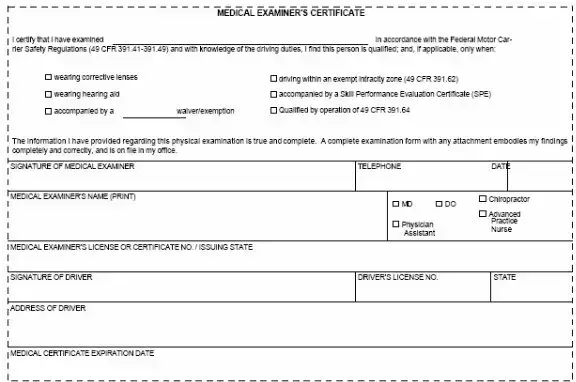
Medical Examiner's Certificate: If the driver is deemed fit, the medical examiner will issue a certificate that must be carried while driving. This certificate is generally valid for two years.