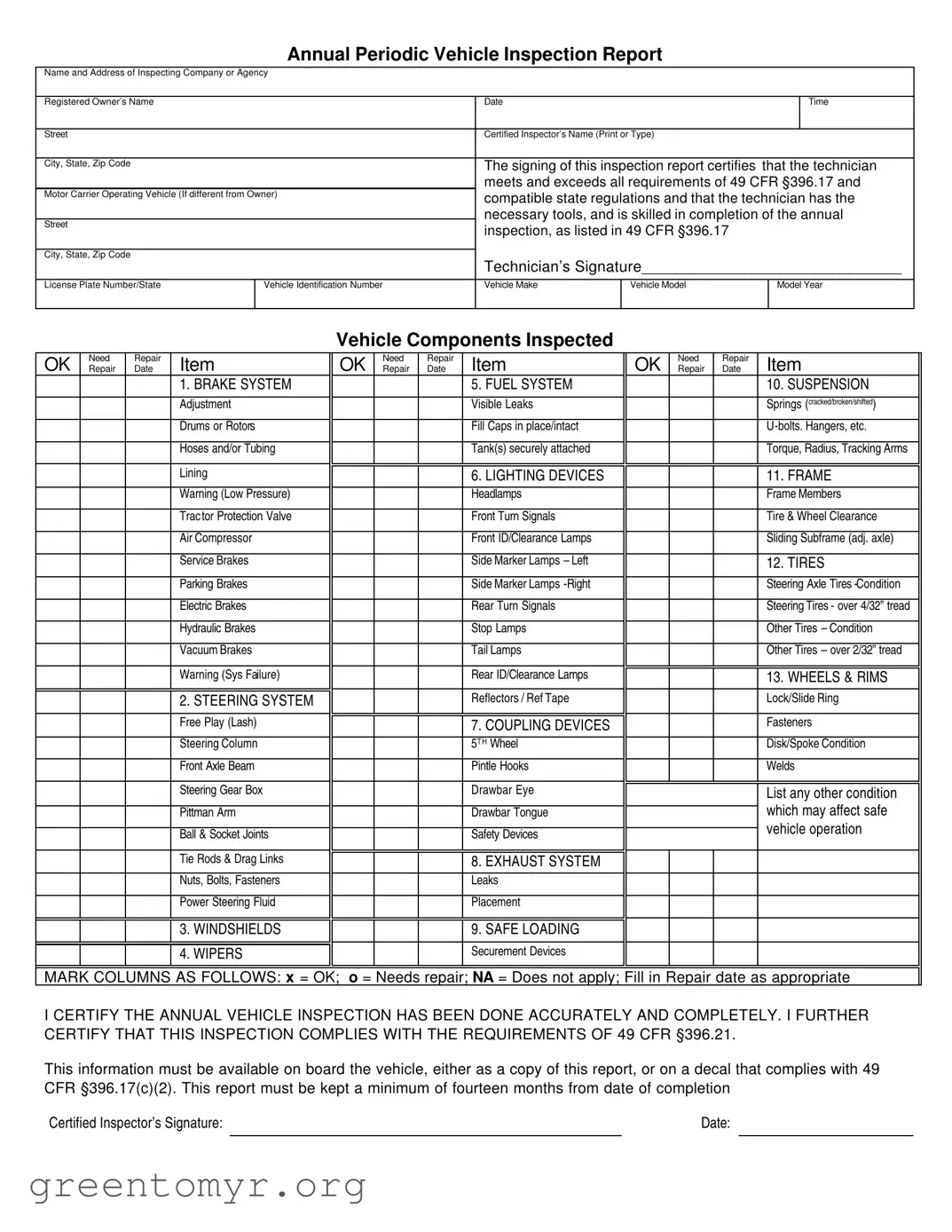
The DOT Vehicle Inspection form is a critical document designed to ensure the safety and compliance of commercial vehicles operating on U.S. roads. This form serves multiple purposes, including recording the results of an annual inspection, detailing the qualifications of the inspecting technician, and certifying that the vehicle meets federal and state regulations. Key sections of the form include the name and address of the inspecting company, the registered owner's information, and the date and time of the inspection. Additionally, it requires the certified inspector's name and signature, affirming that they possess the necessary skills and tools to conduct the inspection in accordance with 49 CFR §396.17. The form outlines various vehicle components that must be inspected, such as the brake system, steering system, and tires, allowing inspectors to mark each item as either "OK" or "Needs Repair." Furthermore, it mandates that the inspection report be kept on file for at least fourteen months and that a copy or decal of the report be available on the vehicle. This comprehensive approach not only promotes vehicle safety but also helps maintain regulatory compliance for motor carriers.

Annual Periodic Vehicle Inspection Report
Name and Address of Inspecting Company or Agency
Registered Owner’s Name |
|
Date |
|
|
Time |
|
|
|
|
|
|
Street |
|
Certified Inspector’s Name (Print or Type) |
|
|
|
|
|
|
|
|
|
City, State, Zip Code |
|
The signing of this inspection report certifies that the technician |
|||
|
|
meets and exceeds all requirements of 49 CFR §396.17 and |
|||
Motor Carrier Operating Vehicle (If different from Owner) |
compatible state regulations and that the technician has the |
||||
|
|
||||
|
|
necessary tools, and is skilled in completion of the annual |
|||
Street |
|
inspection, as listed in 49 CFR §396.17 |
|
|
|
|
|
|
|
||
|
|
|
|
|
|
City, State, Zip Code |
|
|
|
|
|
|
|
Technician’s Signature______________________________ |
|||
|
|
|
|
|
|
License Plate Number/State |
Vehicle Identification Number |
Vehicle Make |
Vehicle Model |
Model Year |
|
|
|
|
|
|
|
Vehicle Components Inspected
OK |
Need |
Repair |
Item |
OK |
Need |
Repair |
Item |
OK |
Need |
Repair |
Item |
|
Repair |
Date |
Repair |
Date |
Repair |
Date |
|
||||||
|
|
|
1. BRAKE SYSTEM |
|
|
|
5. FUEL SYSTEM |
|
|
|
10. SUSPENSION |
|
|
|
|
|
|
|
|
|
|
|
|
|
|
|
|
|
Adjustment |
|
|
|
Visible Leaks |
|
|
|
Springs (cracked/broken/shifted) |
|
|
|
|
Drums or Rotors |
|
|
|
Fill Caps in place/intact |
|
|
|
|
|
|
|
|
|
|
|
|
|
|
|
|
|
|
|
|
|
Hoses and/or Tubing |
|
|
|
Tank(s) securely attached |
|
|
|
Torque, Radius, Tracking Arms |
|
|
|
|
|
|
|
|
|
|
|
|
|
|
|
|
|
Lining |
|
|
|
|
|
|
|
|
|
|
|
|
|
|
|
6. LIGHTING DEVICES |
|
|
|
11. FRAME |
|
|
|
|
|
|
|
|
|
|
|
|
|
|
|
|
|
|
Warning (Low Pressure) |
|
|
|
Headlamps |
|
|
|
Frame Members |
|
|
|
|
|
|
|
|
|
|
|
|
|
|
|
|
|
Tractor Protection Valve |
|
|
|
Front Turn Signals |
|
|
|
Tire & Wheel Clearance |
|
|
|
|
|
|
|
|
|
|
|
|
|
|
|
|
|
Air Compressor |
|
|
|
Front ID/Clearance Lamps |
|
|
|
Sliding Subframe (adj. axle) |
|
|
|
|
|
|
|
|
|
|
|
|
|
|
|
|
|
Service Brakes |
|
|
|
Side Marker Lamps – Left |
|
|
|
12. TIRES |
|
|
|
|
|
|
|
|
|
|
|
|
|
|
|
|
|
Parking Brakes |
|
|
|
Side Marker Lamps |
|
|
|
Steering Axle Tires |
|
|
|
|
|
|
|
|
|
|
|
|
|
|
|
|
|
Electric Brakes |
|
|
|
Rear Turn Signals |
|
|
|
Steering Tires - over 4/32” tread |
|
|
|
|
|
|
|
|
|
|
|
|
|
|
|
|
|
Hydraulic Brakes |
|
|
|
Stop Lamps |
|
|
|
Other Tires – Condition |
|
|
|
|
|
|
|
|
|
|
|
|
|
|
|
|
|
Vacuum Brakes |
|
|
|
Tail Lamps |
|
|
|
Other Tires – over 2/32” tread |
|
|
|
|
|
|
|
|
|
|
|
|
|
|
|
|
|
Warning (Sys Failure) |
|
|
|
Rear ID/Clearance Lamps |
|
|
|
|
|
|
|
|
|
|
|
|
|
|
13. WHEELS & RIMS |
|
||
|
|
|
|
|
|
|
|
|
|
|
|
|
|
|
|
|
|
|
|
Reflectors / Ref Tape |
|
|
|
Lock/Slide Ring |
|
|
|
|
2. STEERING SYSTEM |
|
|
|
|
|
|
|
||
|
|
|
|
|
|
|
|
|
|
|
|
|
|
|
|
Free Play (Lash) |
|
|
|
|
|
|
|
Fasteners |
|
|
|
|
|
|
|
7. COUPLING DEVICES |
|
|
|
|
||
|
|
|
|
|
|
|
|
|
|
|
|
|
|
|
|
Steering Column |
|
|
|
5T H Wheel |
|
|
|
Disk/Spoke Condition |
|
|
|
|
|
|
|
|
|
|
|
|
|
|
|
|
|
Front Axle Beam |
|
|
|
Pintle Hooks |
|
|
|
Welds |
|
|
|
|
|
|
|
|
|
|
|
|
|
|
|
|
|
Steering Gear Box |
|
|
|
Drawbar Eye |
|
|
|
|
|
|
|
|
|
|
|
|
|
|
List any other condition |
|
||
|
|
|
|
|
|
|
|
|
|
|
which may affect safe |
|
|
|
|
Pittman Arm |
|
|
|
Drawbar Tongue |
|
|
|
||
|
|
|
|
|
|
|
|
|
|
|
vehicle operation |
|
|
|
|
Ball & Socket Joints |
|
|
|
Safety Devices |
|
|
|
||
|
|
|
|
|
|
|
|
|
|
|
||
|
|
|
|
|
|
|
|
|
|
|
|
|
|
|
|
Tie Rods & Drag Links |
|
|
|
8. EXHAUST SYSTEM |
|
|
|
|
|
|
|
|
|
|
|
|
|
|
|
|
|
|
|
|
|
Nuts, Bolts, Fasteners |
|
|
|
Leaks |
|
|
|
|
|
|
|
|
|
|
|
|
|
|
|
|
|
|
|
|
|
Power Steering Fluid |
|
|
|
Placement |
|
|
|
|
|
|
|
|
|
|
|
|
|
|
|
|
|
|
|
|
|
|
|
|
|
|
|
|
|
|
|
|
|
|
3. WINDSHIELDS |
|
|
|
9. SAFE LOADING |
|
|
|
|
|
|
|
|
|
|
|
|
|
|
|
|
|
|
|
|
|
|
|
|
|
Securement Devices |
|
|
|
|
|
|
|
|
4. WIPERS |
|
|
|
|
|
|
|
|
|
|
|
|
|
|
|
|
|
|
|
|
|
|
MARK COLUMNS AS FOLLOWS: x = OK; o = Needs repair; NA = Does not apply; Fill in Repair date as appropriate
I CERTIFY THE ANNUAL VEHICLE INSPECTION HAS BEEN DONE ACCURATELY AND COMPLETELY. I FURTHER CERTIFY THAT THIS INSPECTION COMPLIES WITH THE REQUIREMENTS OF 49 CFR §396.21.
This information must be available on board the vehicle, either as a copy of this report, or on a decal that complies with 49 CFR §396.17(c)(2). This report must be kept a minimum of fourteen months from date of completion
Certified Inspector’s Signature: |
|
Date: |
|
|
|
INSPECTOR QUALIFICATIONS
Certification — 49 CFR §396.19
Motor carriers are responsible for ensuring that individual(s) performing an annual inspection under §396.17 are qualified as follows:
•Understands the inspection criteria set forth in Part 393 and Appendix G and can identify defective components
•Is knowledgeable of and has mastered the methods, procedures, tools and equipment used when performing an inspection
•Is capable of performing an inspection by reason of experience, training, or both, and qualifies in one of the following categories (check all that apply):
I.___ Successfully completed a State or Federal training program or has certificate from a State or Canadian Province which qualifies the person to perform commercial vehicle safety inspections.
Specify: _______________________________________
II.___ Have a combination of training or experience totaling at least one year as follows (check all that apply):
a.___ Participation in a truck
Where and Date: _____________________________________________________
b.___ (years) experience as a mechanic or inspector in a motor carrier maintenance program.
Name and Date: _____________________________________________________
c.___ (years) experience as a mechanic or inspector in truck maintenance at a commercial garage, fleet leasing company, or similar facility.
Name of Facility and Dates: ____________________________________________
d.___ (years) experience as a commercial vehicle inspector for a State, Provincial, or Federal Government.
Where and Dates: ____________________________________________________
I certify the above information is true and accurate to the best of my knowledge.
Employee ______________________________________ |
________________ |
Signature of Mechanic/Inspector |
Date |
Motor Carrier/Company ____________________________________ |
________________ |
Signature of Employer/Supervisor |
Date |
Evidence of Inspector Qualification is on file at:
_______________________________
BRAKE INSPECTOR QUALIFICATIONS
Certification — 49 CPR §396.25
“Brake Inspector” means any employee of a motor carrier who is responsible for ensuring all brake inspections, maintenance, service, or repairs to any commercial motor vehicle, subject to the motor carrier’s control, meet the applicable Federal standards.
No motor carrier shall require or permit any employee who does not meet minimum brake inspector qualifications to be responsible for the inspection, maintenance, service or repairs of any brakes on its commercial motor vehicles.
Minimum Qualifications
•Understands and can perform brake service and inspection
•Is knowledgeable of and has mastered the methods, procedures, tools and equipment necessary to perform brake service and inspection
•Is capable of performing brake service or inspection by reason of experience, training, or both, and qualifies in one of the following categories (check all that apply):
I.___Has successfully completed an apprenticeship program sponsored or approved
by a State, Canadian Province, a Federal agency or labor union, or has a certificate from a State or Canadian Province which qualifies the person to perform brake service or inspections.
Specify: ________________________________________________________________
II.___ Has
a.___Participation in a brake maintenance or inspection training program sponsored by a brake or vehicle manufacturer or similar commercial training program.
Where and Date:_______________________________________________
b.___ (years) experience performing brake maintenance or inspection in a motor carrier maintenance program.
Name and Date:_______________________________________________
c.___ (years) experience performing brake maintenance or inspection at a commercial garage, fleet leasing company, or similar facility.
Name of Facility and Dates:______________________________________
I certify the above information is true and accurate to the best of my knowledge.
Employee ______________________________________ |
________________ |
Signature of Mechanic/Inspector |
Date |
Motor Carrier/Company ____________________________________ |
________________ |
Signature of Employer/Supervisor |
Date |
Evidence of Inspector Qualification is on file at:
_______________________________
| Fact Name | Description | Governing Law |
|---|---|---|
| Inspection Requirement | Annual inspections are mandatory for commercial vehicles to ensure safety and compliance. | 49 CFR §396.17 |
| Inspector Certification | Inspectors must meet specific qualifications, including training and experience in vehicle safety inspections. | 49 CFR §396.19 |
| Documentation | The inspection report must be kept on file for at least fourteen months from the completion date. | 49 CFR §396.21 |
| Brake Inspector Standards | Brake inspectors must have completed training and be knowledgeable about brake maintenance and inspection. | 49 CFR §396.25 |
Filling out the DOT Vehicle Inspection form is a straightforward process that requires attention to detail. This form captures essential information about the vehicle and the inspection conducted. After completing the form, it should be kept on board the vehicle or as a decal, ensuring compliance with federal regulations.
The DOT Vehicle Inspection form is designed to ensure that commercial vehicles meet safety standards as outlined by federal regulations. It provides a comprehensive checklist for inspectors to evaluate various vehicle components, ensuring they are in safe working condition. This helps prevent accidents and promotes road safety.
The form must be completed by a certified inspector who meets the qualifications set forth in 49 CFR §396. This individual is responsible for ensuring that the inspection is thorough and complies with all federal and state regulations. The inspector must have the necessary training and experience to identify any defects or safety issues.
The form requires several key pieces of information, including:
The inspection report must be retained for a minimum of fourteen months from the date of completion. This ensures that there is a record available for review in case of any safety audits or investigations.
If an item is marked as "Needs Repair," it indicates that the component does not meet safety standards and requires immediate attention. This could involve repairs or replacements to ensure the vehicle is safe for operation. The inspector should also provide a repair date for tracking purposes.
Yes, inspectors must meet specific qualifications as outlined in 49 CFR §396. This includes understanding inspection criteria, being knowledgeable about inspection methods and tools, and having relevant experience or training. Inspectors may also need to complete state or federal training programs to be certified.
The inspection covers a wide range of vehicle components, including:
This thorough examination helps ensure all critical parts of the vehicle are functioning properly.
If a vehicle fails the inspection, the inspector must document the specific issues identified. The owner or operator should then arrange for repairs to be made before the vehicle can be deemed safe for operation again. A follow-up inspection may be necessary to verify that all repairs have been completed satisfactorily.
Vehicle owners can prepare for the inspection by performing regular maintenance checks and addressing any known issues. It’s advisable to review the inspection criteria and ensure that all components are in good working order. Keeping records of maintenance and repairs can also be helpful during the inspection process.
If the inspection report is not available on board the vehicle, it may result in penalties for the vehicle owner or operator. Federal regulations require that either a copy of the report or a decal indicating compliance be present in the vehicle. This documentation is essential for demonstrating that the vehicle has passed the required safety inspections.
Filling out the DOT Vehicle Inspection form correctly is crucial for ensuring compliance and safety. However, many people make common mistakes that can lead to issues down the line. Here are ten mistakes to avoid.
One frequent error is failing to provide complete information. Inspectors often skip essential details like the name and address of the inspecting company or the registered owner's name. Missing this information can delay processing or raise questions about the inspection's validity.
Another mistake is not marking the inspection results properly. The form requires specific markings for each inspected item: 'OK', 'Needs Repair', or 'Does Not Apply'. Some individuals neglect to use these markings, which can lead to confusion about the vehicle's condition.
Many people also forget to sign the report. A signature from the certified inspector is vital. Without it, the inspection is incomplete and may not be accepted by regulatory authorities.
Additionally, not including repair dates for items that need attention is a common oversight. This information is important for tracking maintenance and ensuring that necessary repairs are completed in a timely manner.
Another mistake involves inaccurate vehicle identification. Errors in the Vehicle Identification Number (VIN) or license plate number can create problems during inspections or when filing paperwork with authorities.
Some inspectors mistakenly assume that prior inspections suffice for current evaluations. Each inspection must stand alone, and relying on previous reports can lead to missed issues that need immediate attention.
Another common error is not verifying the inspector’s qualifications. The form requires that the inspector meets specific criteria. Failing to check or document these qualifications can lead to liability issues.
Many people also overlook the importance of keeping a copy of the inspection report. This report must be available on board the vehicle. Not having it can result in fines or other penalties during roadside checks.
Another mistake is failing to follow up on repairs. Once repairs are noted, it’s essential to ensure they are completed and documented. Ignoring this step can lead to recurring issues and safety risks.
Finally, neglecting to review the entire form before submission can lead to overlooked mistakes. Taking a moment to double-check all entries can save time and prevent complications later.
The DOT Vehicle Inspection form is an essential document for ensuring the safety and compliance of commercial vehicles. However, several other forms and documents often accompany it to provide a comprehensive overview of vehicle condition and compliance with federal regulations. Below are four commonly used forms that work in conjunction with the DOT Vehicle Inspection form.
By utilizing these documents alongside the DOT Vehicle Inspection form, vehicle operators can maintain a clear record of compliance and safety. This proactive approach not only ensures adherence to regulations but also promotes the safety of drivers and the public alike.
The DOT Vehicle Inspection form is an essential document in the realm of vehicle safety and compliance. It shares similarities with several other important documents in the transportation and vehicle inspection field. Below is a list of eight documents that are comparable to the DOT Vehicle Inspection form, along with a brief explanation of how they relate.
Each of these documents plays a vital role in ensuring vehicle safety and compliance, reflecting the comprehensive nature of the DOT Vehicle Inspection form.
When filling out the DOT Vehicle Inspection form, it's essential to follow certain guidelines to ensure accuracy and compliance. Here are some key dos and don'ts:
Following these guidelines will help ensure that the inspection report is valid and meets regulatory requirements.
Misconceptions about the DOT Vehicle Inspection form can lead to confusion and non-compliance. Here are seven common misunderstandings:
Understanding these misconceptions can help ensure compliance and promote safety on the roads.
Understanding the DOT Vehicle Inspection form is essential for maintaining compliance and ensuring vehicle safety. Here are six key takeaways to consider:
These takeaways highlight the importance of diligence and accuracy in the vehicle inspection process, ensuring both compliance with regulations and the safety of all road users.